
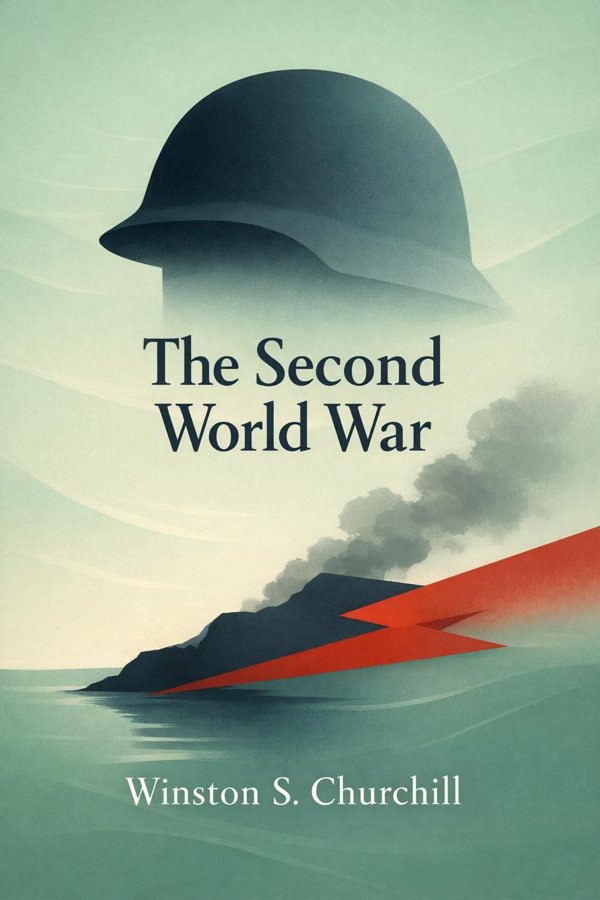
The Second World War: Summary & Key Insights
 10 min9 chaptersAudio available
Key Takeaways from The Second World War
Great wars rarely begin in a single moment; they gather force while nations look away.
A crisis becomes war when false hopes can no longer survive contact with reality.
The collapse of a great power can reorder the world in weeks.
There are moments in history when endurance becomes strategy.
No major power wins a global war alone for long.
What Is The Second World War About?
The Second World War by Winston S. Churchill is a world_history book spanning 8 pages. The Second World War is Winston S. Churchill’s sweeping account of the deadliest conflict in modern history, told by one of the few people who helped shape its outcome at the highest level. Across six volumes, Churchill traces the long road from the unstable peace after World War I to the collapse of Nazi Germany and the uneasy dawn of a new world order. This is not just a military chronicle. It is also a study of diplomacy, leadership, intelligence, alliance-building, industrial power, and moral resolve under extreme pressure. What makes the work so enduring is Churchill’s rare vantage point. As Britain’s wartime prime minister, he was present at decisive meetings, in direct communication with Roosevelt and Stalin, and immersed in the urgent calculations behind every major decision. He writes not as a distant historian but as a participant determined to explain how events unfolded and why. At the same time, the book matters because it offers lessons that reach far beyond 1945: appeasement can invite aggression, democratic societies must prepare before crises peak, and victory depends as much on endurance and coordination as on battlefield brilliance. It remains one of the most influential firsthand histories ever written.
This FizzRead summary covers all 9 key chapters of The Second World War in approximately 10 minutes, distilling the most important ideas, arguments, and takeaways from Winston S. Churchill's work. Also available as an audio summary and Key Quotes Podcast.
The Second World War
The Second World War is Winston S. Churchill’s sweeping account of the deadliest conflict in modern history, told by one of the few people who helped shape its outcome at the highest level. Across six volumes, Churchill traces the long road from the unstable peace after World War I to the collapse of Nazi Germany and the uneasy dawn of a new world order. This is not just a military chronicle. It is also a study of diplomacy, leadership, intelligence, alliance-building, industrial power, and moral resolve under extreme pressure.
What makes the work so enduring is Churchill’s rare vantage point. As Britain’s wartime prime minister, he was present at decisive meetings, in direct communication with Roosevelt and Stalin, and immersed in the urgent calculations behind every major decision. He writes not as a distant historian but as a participant determined to explain how events unfolded and why. At the same time, the book matters because it offers lessons that reach far beyond 1945: appeasement can invite aggression, democratic societies must prepare before crises peak, and victory depends as much on endurance and coordination as on battlefield brilliance. It remains one of the most influential firsthand histories ever written.
Who Should Read The Second World War?
This book is perfect for anyone interested in world_history and looking to gain actionable insights in a short read. Whether you're a student, professional, or lifelong learner, the key ideas from The Second World War by Winston S. Churchill will help you think differently.
- ✓Readers who enjoy world_history and want practical takeaways
- ✓Professionals looking to apply new ideas to their work and life
- ✓Anyone who wants the core insights of The Second World War in just 10 minutes
Want the full summary?
Get instant access to this book summary and 100K+ more with Fizz Moment.
Get Free SummaryAvailable on App Store • Free to download
Key Chapters
Great wars rarely begin in a single moment; they gather force while nations look away. Churchill’s opening argument is that the Second World War became possible not only because Hitler was aggressive, but because Europe after 1918 mistook exhaustion for peace. The Treaty of Versailles punished Germany without building a stable settlement, democratic governments were divided and hesitant, and many leaders hoped concessions would satisfy expansionist powers. Churchill presents these years as a warning about the cost of strategic self-deception.
He emphasizes that danger was visible long before 1939. Germany rearmed openly, violated treaties, remilitarized the Rhineland, absorbed Austria, and dismantled Czechoslovakia step by step. Each move tested whether the democracies would resist. Each weak response made the next act bolder. Churchill had argued for years that Britain needed military readiness, air defense, and clarity about the nature of totalitarian ambition. In his telling, the tragedy was not ignorance but refusal to act on what was already known.
The idea has enduring relevance. Organizations, governments, and even individuals often ignore accumulating risks because immediate comfort feels more attractive than early correction. Financial crises, security threats, and institutional breakdowns usually show warning signs before they erupt. The lesson is not to panic at every danger, but to distinguish temporary calm from genuine stability.
Churchill’s analysis also explains why moral language without power is ineffective. Agreements matter only if they are backed by credible resolve. A peace system survives when those defending it are organized, armed, and willing to bear costs.
Actionable takeaway: pay close attention to early warning signals. When patterns of aggression, erosion, or neglect become clear, address them before delay turns a manageable problem into a historic disaster.
A crisis becomes war when false hopes can no longer survive contact with reality. Churchill describes the German invasion of Poland in September 1939 as the moment when years of wishful thinking ended. Hitler’s claims that he sought only limited revisions were exposed as fraud. Britain and France, having guaranteed Poland, finally declared war. Yet Churchill makes clear that this decision, though necessary, came after a long period of underpreparation.
His account of the outbreak of war highlights a central paradox: countries may be morally right and strategically late at the same time. Britain had recognized the need to resist, but not early enough to enter the conflict from a position of strength. This gap between recognition and readiness shaped the painful early phase of the war. Churchill returned to government as First Lord of the Admiralty, and his writing captures both urgency and foreboding. A line had been crossed, but the consequences of prior delay remained.
Churchill also shows how modern war begins before many people grasp its scale. The invasion of Poland was not an isolated campaign; it was the opening move in a struggle over the future of Europe and the balance of world power. Once war began, previous assumptions about limited diplomacy no longer applied. Industrial capacity, alliances, logistics, intelligence, and civilian morale all became part of the battlefield.
This insight applies far beyond military history. In business, politics, and personal life, unresolved structural problems can suddenly shift from manageable tension to full crisis. When that happens, old habits of incremental response are no longer enough. One must quickly move from debate to execution.
Actionable takeaway: once a threat has clearly crossed from possibility into reality, stop negotiating with the past. Reassess conditions honestly, mobilize resources immediately, and act at the scale the new situation requires.
The collapse of a great power can reorder the world in weeks. Churchill’s account of the fall of France is one of the most sobering sections of the work because it shows how quickly a seemingly strong alliance can disintegrate under strategic surprise, operational speed, and political shock. In 1940, German forces bypassed expectations, broke through the Ardennes, and turned Allied assumptions against them. The result was not just battlefield defeat but the destruction of Europe’s balance.
Churchill explains that France did not simply lose a campaign; the Allies lost the strategic framework on which their war plans had depended. Britain had expected a prolonged continental struggle resembling the First World War, where time and resources might wear Germany down. Instead, Blitzkrieg compressed decision-making and exposed rigid planning. The evacuation at Dunkirk saved much of Britain’s army, but Churchill never romanticizes it as victory. It was deliverance from annihilation, not success in itself.
This section reveals several of Churchill’s recurring concerns: the danger of fighting the next war with the last war’s assumptions, the importance of mobility and air power, and the way political morale shapes military outcomes. Once France sought armistice, Britain faced not a difficult coalition war but a lonely fight for survival.
The broader lesson is that institutions often fail when their strategies are built for outdated conditions. Technological change, speed, and surprise can overwhelm larger but less adaptive systems. Success depends not only on strength, but on the ability to rethink plans under pressure.
Actionable takeaway: stress-test your assumptions before events do it for you. Ask what happens if the environment changes faster than expected, and build flexibility so a single shock does not destroy your entire position.
There are moments in history when endurance becomes strategy. Churchill’s narrative of Britain standing alone after the fall of France centers on a crucial proposition: survival in war depends not just on weapons, but on a nation’s willingness to refuse surrender when defeat seems plausible. In 1940, invasion appeared possible, allies had fallen or capitulated, and Germany dominated the continent. Churchill presents this phase as a test of political courage, civilian morale, and national identity.
The Battle of Britain is the clearest example. Air superiority was not a technical issue alone; it was the gatekeeper to invasion. Churchill celebrates the Royal Air Force, radar, aircraft production, and the discipline of pilots and ground crews, but he also underscores the significance of leadership language. Public speech, in his view, was not decoration. It was an instrument of resistance. Clear words helped convert fear into resolve and individual sacrifice into shared purpose.
He also shows that being alone did not mean acting blindly. Britain relied on codebreaking, naval blockade, imperial resources, and careful husbanding of limited strength. Churchill’s leadership during this period illustrates how confidence must be paired with prioritization. A leader cannot promise easy triumph; he must identify what absolutely must be held and rally effort around it.
For modern readers, this section offers a practical lesson in crisis leadership. Teams facing isolation, market pressure, political attack, or institutional upheaval need more than plans. They need meaning, discipline, and a realistic sense of what success looks like in the short term.
Actionable takeaway: in moments of isolation, define the non-negotiable objective, communicate it relentlessly, and align every available resource around preserving your ability to endure until conditions improve.
No major power wins a global war alone for long. Churchill’s story changes decisively with the formation of the Grand Alliance: Britain, the Soviet Union, and the United States, three very different powers united by the common necessity of defeating Nazi Germany. Churchill shows that alliance-building is never simple. It demands compromise, patience, trust-building, and constant management of competing priorities. Yet he also argues that without such cooperation, even heroic resistance would have been insufficient.
The German invasion of the Soviet Union in 1941 transformed the scale of the conflict. Churchill, a lifelong critic of communism, supported Soviet resistance immediately because strategic reality overrode ideology. Later that year, the Japanese attack on Pearl Harbor brought the United States fully into the war, creating the industrial and military partnership that Churchill had long hoped for. He details conferences, telegrams, and negotiations to show that victory depended as much on coordination as on combat.
One of his deepest insights is that successful alliances are built around shared objectives, not total agreement. Britain, America, and the Soviet Union disagreed about fronts, priorities, and postwar arrangements, but they aligned around the immediate task of defeating Hitler. Churchill’s account reminds readers that coalition leadership means balancing principle with pragmatism.
The application is broad. In organizations and public life, complex goals often require collaboration among parties with different cultures and incentives. Waiting for perfect harmony usually guarantees failure. Better results come from clearly defining the mission, identifying mutual interest, and managing friction without losing direction.
Actionable takeaway: when facing a challenge too large for one actor, build alliances around the clearest possible common goal. Accept differences, establish mechanisms for coordination, and keep the shared mission larger than the disputes within the coalition.
History often pivots not on one battle, but on a cluster of decisions made under extreme uncertainty. Churchill uses the phrase “the hinge of fate” to describe the period when the war’s direction began to shift. The Axis advance was halted and then reversed through a combination of military learning, industrial acceleration, intelligence gains, and strategic persistence. This was not inevitable. Churchill is keen to show how fragile turning points are while they are happening.
Several developments mattered enormously: the defense and later advance in North Africa, the Soviet stand and counteroffensive at Stalingrad, the growing strength of Allied shipping and anti-submarine warfare in the Atlantic, and the increasing effectiveness of Anglo-American cooperation. Churchill’s treatment of these events highlights cumulative advantage. Victories that appear dramatic in retrospect often result from earlier investments in production, training, logistics, technology, and command reform.
He also emphasizes the role of adaptation. Early failures forced the Allies to improve combined operations, convoy protection, air-ground coordination, and strategic planning. This is a major theme across the book: resilient powers learn while fighting. They do not merely endure setbacks; they convert them into better methods.
For modern readers, this section is a reminder that turning points are usually prepared before they are recognized. Companies regain market position, institutions recover credibility, and individuals reverse decline through disciplined adjustments that initially look small. The decisive moment is often the visible result of invisible preparation.
Actionable takeaway: when conditions begin to improve, do not mistake momentum for destiny. Study what is actually working, reinforce the systems behind it, and keep adapting until temporary gains become durable advantage.
Winning a long conflict requires turning scattered successes into converging pressure. In Churchill’s account of the later war years, “closing the ring” means tightening military, naval, and air operations around the Axis until its strategic options disappear. This phase includes the Mediterranean campaigns, the bombing offensive, intensified anti-submarine warfare, and the preparation for the liberation of Western Europe. Churchill presents victory here as a problem of orchestration.
A central insight is that scale can create confusion unless priorities are ruthlessly coordinated. By this stage, the Allies had growing resources, but resources alone do not guarantee results. They had to decide where to land, what to supply, which theaters deserved precedence, and how to synchronize political aims with military feasibility. Churchill’s narrative shows him constantly engaged in debate over timing, geography, and operational risk. Leadership at this level meant integrating information from multiple fronts into a coherent strategy.
He also stresses that pressure works best when it is multidirectional. Germany faced Soviet offensives in the east, Anglo-American force buildup in the west and south, strategic bombing from the air, and attrition at sea. Each front affected the others. The enemy’s inability to concentrate became an Allied advantage. Churchill’s larger point is that complex systems often weaken when forced to respond everywhere at once.
In practical terms, this is a lesson in execution. Whether in government, business, or institutional reform, one major initiative rarely changes everything. Transformation comes when several well-timed efforts reinforce one another and deny opponents room to recover.
Actionable takeaway: if your goal is to overcome a powerful challenge, do not rely on a single line of effort. Design coordinated pressure from multiple angles so progress in one area amplifies progress in the others.
Victory does not erase the cost of achieving it. In Churchill’s final reflections on the war’s end, triumph is inseparable from tragedy. Nazi Germany was defeated, occupied Europe was liberated, and one of history’s most destructive regimes was destroyed. Yet millions were dead, cities lay in ruins, empires were weakened, and the alliance that won the war was already straining toward Cold War rivalry. Churchill refuses to present 1945 as uncomplicated celebration.
This duality is one of the book’s most mature insights. Churchill had led Britain through existential danger, but he understood that even successful wars leave political and moral debris. The conferences that shaped the postwar settlement revealed both necessity and unease. Cooperation with Stalin had been essential in war, but it raised profound concerns for peace. The atomic bomb, emerging at the war’s close, hinted that future conflict could surpass anything yet seen. Triumph, in other words, solved one catastrophe while opening the door to new anxieties.
Churchill also treats memory itself as a responsibility. To remember only glory is to falsify the suffering; to remember only suffering is to miss the courage and organization that made liberation possible. Mature historical judgment must hold both truths together.
That lesson applies in every field. Successful campaigns, mergers, elections, reforms, or personal recoveries often contain hidden losses and unresolved consequences. Wise leaders do not become intoxicated by visible success. They ask what was spent, what remains unstable, and what responsibilities victory creates.
Actionable takeaway: after any major success, conduct a sober review. Celebrate the achievement, but also identify the costs, unresolved tensions, and future risks so today’s triumph does not become tomorrow’s complacency.
The deepest current running through The Second World War is that leadership is not simply authority; it is sustained judgment under intolerable pressure. Churchill’s work is filled with dispatches, cabinet disputes, battlefield reports, and strategic arguments because he wants readers to see how decisions are actually made: with incomplete information, competing risks, and consequences measured in lives and national survival. The book is therefore not only history, but a case study in wartime decision-making.
Churchill portrays effective leadership as a blend of realism and resolve. He had to absorb setbacks without losing nerve, inspire the public without misleading it, and work with difficult allies without surrendering national interests. He understood the importance of timing, rhetoric, symbol, and stamina. He also accepted that leadership requires choosing among imperfect options. Rarely was there a clean solution; more often there was only the least dangerous course.
A striking practical lesson is his use of communication. Churchill treated speeches, memoranda, and correspondence as operational tools. They clarified priorities, built unity, and shaped the morale needed to execute hard decisions. At the same time, he relied heavily on experts, military chiefs, intelligence, and industrial capacity. Strong leadership, in his account, is not solitary brilliance but the ability to mobilize institutions toward a common end.
For contemporary readers, this makes the book valuable beyond military history. Leaders in any arena face uncertainty, conflict, fatigue, and public scrutiny. Churchill’s example suggests that the essential task is to hold together honesty, purpose, and coordinated action.
Actionable takeaway: when leading through uncertainty, focus on three disciplines—face facts quickly, communicate priorities clearly, and make timely decisions even when perfect certainty is impossible.
All Chapters in The Second World War
About the Author
Winston Spencer Churchill (1874–1965) was a British statesman, historian, soldier, and one of the twentieth century’s most influential political leaders. He served in numerous high offices, including First Lord of the Admiralty, Chancellor of the Exchequer, and, most famously, Prime Minister during World War II. Churchill became a symbol of British defiance in 1940, using both strategy and oratory to sustain national morale during the struggle against Nazi Germany. Beyond politics, he was a prolific writer whose works ranged from journalism and biography to grand historical narratives. His literary achievement was formally recognized in 1953 when he received the Nobel Prize in Literature. Churchill’s legacy remains complex but immense: he was both a shaper of world events and one of their most vivid chroniclers.
Get This Summary in Your Preferred Format
Read or listen to the The Second World War summary by Winston S. Churchill anytime, anywhere. FizzRead offers multiple formats so you can learn on your terms — all free.
Available formats: App · Audio · PDF · EPUB — All included free with FizzRead
Download The Second World War PDF and EPUB Summary
Key Quotes from The Second World War
“Great wars rarely begin in a single moment; they gather force while nations look away.”
“A crisis becomes war when false hopes can no longer survive contact with reality.”
“The collapse of a great power can reorder the world in weeks.”
“There are moments in history when endurance becomes strategy.”
“No major power wins a global war alone for long.”
Frequently Asked Questions about The Second World War
The Second World War by Winston S. Churchill is a world_history book that explores key ideas across 9 chapters. The Second World War is Winston S. Churchill’s sweeping account of the deadliest conflict in modern history, told by one of the few people who helped shape its outcome at the highest level. Across six volumes, Churchill traces the long road from the unstable peace after World War I to the collapse of Nazi Germany and the uneasy dawn of a new world order. This is not just a military chronicle. It is also a study of diplomacy, leadership, intelligence, alliance-building, industrial power, and moral resolve under extreme pressure. What makes the work so enduring is Churchill’s rare vantage point. As Britain’s wartime prime minister, he was present at decisive meetings, in direct communication with Roosevelt and Stalin, and immersed in the urgent calculations behind every major decision. He writes not as a distant historian but as a participant determined to explain how events unfolded and why. At the same time, the book matters because it offers lessons that reach far beyond 1945: appeasement can invite aggression, democratic societies must prepare before crises peak, and victory depends as much on endurance and coordination as on battlefield brilliance. It remains one of the most influential firsthand histories ever written.
More by Winston S. Churchill
You Might Also Like
The Age of Capital
Eric Hobsbawm
10 min
The Gulag Archipelago
Aleksandr Solzhenitsyn
10 min
Jerusalem: The Biography
Simon Sebag Montefiore
10 min
The Anglo-Saxons
James Campbell
10 min
The Boer War
Thomas Pakenham
10 min
The Industrial Revolutionaries: The Making of the Modern World 1776–1914
Gavin Weightman
10 minBrowse by Category
Ready to read The Second World War?
Get the full summary and 100K+ more books with Fizz Moment.