
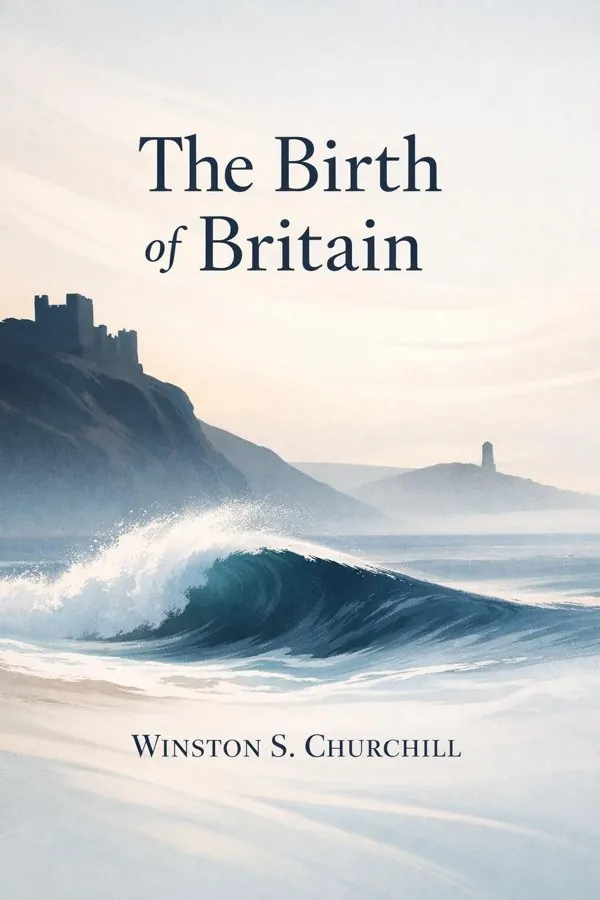
The Birth of Britain: Summary & Key Insights
 10 min13 chaptersAudio available
What Is The Birth of Britain About?
The Birth of Britain by Winston S. Churchill is a world_history book spanning 13 pages. The first volume of Winston Churchill’s monumental four-part history, 'A History of the English-Speaking Peoples,' 'The Birth of Britain' traces the story of the British Isles from prehistoric times through the end of the Middle Ages. Churchill explores the formation of the English nation, the development of its institutions, and the events that shaped the identity of the English-speaking world.
This FizzRead summary covers all 13 key chapters of The Birth of Britain in approximately 10 minutes, distilling the most important ideas, arguments, and takeaways from Winston S. Churchill's work. Also available as an audio summary and Key Quotes Podcast.
The Birth of Britain
The first volume of Winston Churchill’s monumental four-part history, 'A History of the English-Speaking Peoples,' 'The Birth of Britain' traces the story of the British Isles from prehistoric times through the end of the Middle Ages. Churchill explores the formation of the English nation, the development of its institutions, and the events that shaped the identity of the English-speaking world.
Who Should Read The Birth of Britain?
This book is perfect for anyone interested in world_history and looking to gain actionable insights in a short read. Whether you're a student, professional, or lifelong learner, the key ideas from The Birth of Britain by Winston S. Churchill will help you think differently.
- ✓Readers who enjoy world_history and want practical takeaways
- ✓Professionals looking to apply new ideas to their work and life
- ✓Anyone who wants the core insights of The Birth of Britain in just 10 minutes
Want the full summary?
Get instant access to this book summary and 100K+ more with Fizz Moment.
Get Free SummaryAvailable on App Store • Free to download
Key Chapters
In the beginning, our island was the child of geography and chance. The great ice sheets withdrew, and Britain—then still joined to the continent—was slowly carved by the seas into a separate entity. This isolation would one day shape our destiny, endowing us with an independence of spirit and a self-contained culture. The earliest inhabitants, as far as archaeological traces tell us, were hunter-gatherers and tribal farmers who wove simple societies across the green hills and river valleys. They left behind barrows, standing stones, and forts—hints of their ritual life and primitive order.
When I first pondered the origins of the British people, I perceived more than scattered tribes. There was already in those early communities the seed of endurance—the capacity to adapt to nature’s hardships, the courage to face other tribes, and the tenacity that would one day distinguish the English character. These prehistoric peoples, though nameless to us, planted the earliest roots of continuity that would anchor Britain through invasion and upheaval.
It was geography, too, that made Britain both vulnerable and invincible. Surrounded by sea, she was exposed to every power with ships and ambition; yet her insularity also allowed her to recover, to renew herself after each assault. Thus even before Romans or Saxons had dreamt of conquest, the island’s destiny was marked by a rhythm of challenge and resurgence.
The arrival of Rome was Britain’s first true encounter with civilization on a grand scale. Julius Caesar came first, not to conquer but to explore and intimidate. Nearly a century later, under Emperor Claudius, the Roman legions came to stay. With them arrived not merely soldiers but surveyors, engineers, and administrators. Roads crisscrossed the island, connecting camps that would grow into towns; stone replaced timber; law replaced tribal feuds.
To me, the Roman occupation exemplified the iron discipline of empire and the paradox of progress under subjugation. For centuries Britain was Rome’s western outpost—guarded by Hadrian’s Wall, absorbed into imperial commerce, and taught the habits of order and governance. Yet the Romans never fully blended with the native peoples. The Pax Romana imposed peace but not unity. When the legions eventually withdrew, they left behind an infrastructure of civilization but no cohesive national authority to sustain it.
Still, Rome’s legacy would prove indelible. The idea that law could be systematic and impartial, that roads could bind a realm, that cities could serve administration—all these ideas remained dormant in Britain’s memory, ready to be revived by later rulers who sought legitimacy and permanence.
+ 11 more chapters — available in the FizzRead app
All Chapters in The Birth of Britain
About the Author
Winston S. Churchill (1874–1965) was a British statesman, army officer, and writer who served as Prime Minister of the United Kingdom during World War II. He was awarded the Nobel Prize in Literature in 1953 for his mastery of historical and biographical description and for his brilliant oratory in defending exalted human values.
Get This Summary in Your Preferred Format
Read or listen to the The Birth of Britain summary by Winston S. Churchill anytime, anywhere. FizzRead offers multiple formats so you can learn on your terms — all free.
Available formats: App · Audio · PDF · EPUB — All included free with FizzRead
Download The Birth of Britain PDF and EPUB Summary
Key Quotes from The Birth of Britain
“In the beginning, our island was the child of geography and chance.”
“The arrival of Rome was Britain’s first true encounter with civilization on a grand scale.”
Frequently Asked Questions about The Birth of Britain
The Birth of Britain by Winston S. Churchill is a world_history book that explores key ideas across 13 chapters. The first volume of Winston Churchill’s monumental four-part history, 'A History of the English-Speaking Peoples,' 'The Birth of Britain' traces the story of the British Isles from prehistoric times through the end of the Middle Ages. Churchill explores the formation of the English nation, the development of its institutions, and the events that shaped the identity of the English-speaking world.
More by Winston S. Churchill
You Might Also Like
The Age of Capital
Eric Hobsbawm
10 min
The Gulag Archipelago
Aleksandr Solzhenitsyn
10 min
Jerusalem: The Biography
Simon Sebag Montefiore
10 min
The Anglo-Saxons
James Campbell
10 min
The Boer War
Thomas Pakenham
10 min
The Industrial Revolutionaries: The Making of the Modern World 1776–1914
Gavin Weightman
10 minBrowse by Category
Ready to read The Birth of Britain?
Get the full summary and 100K+ more books with Fizz Moment.