
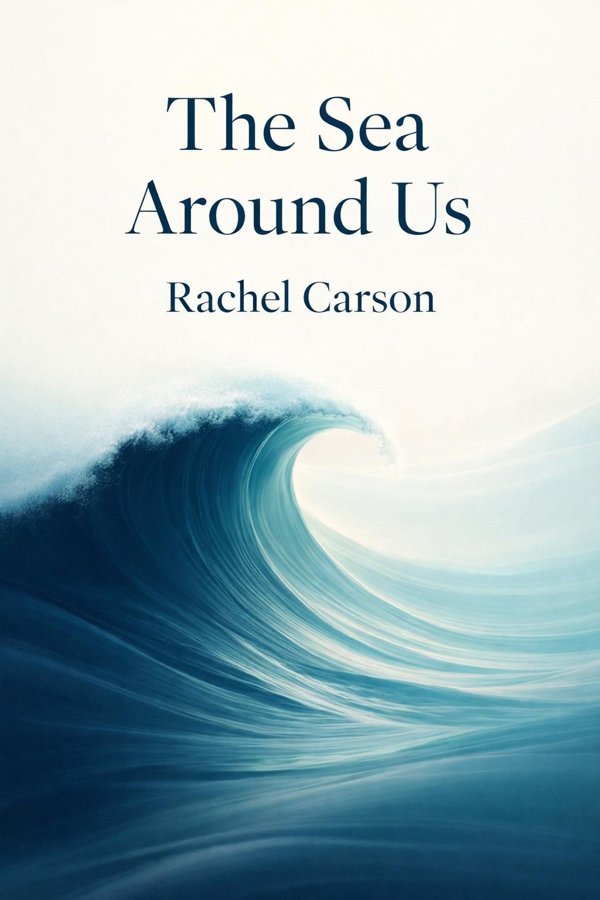
The Sea Around Us: Summary & Key Insights
 10 min10 chaptersAudio available
What Is The Sea Around Us About?
The Sea Around Us by Rachel Carson is a environment book spanning 10 pages. A landmark work of environmental literature, Rachel Carson’s 'The Sea Around Us' explores the origins, dynamics, and mysteries of the world’s oceans. Combining scientific insight with poetic prose, Carson reveals the interconnectedness of marine life and the planet’s ecological systems, inspiring generations to appreciate and protect the natural world.
This FizzRead summary covers all 10 key chapters of The Sea Around Us in approximately 10 minutes, distilling the most important ideas, arguments, and takeaways from Rachel Carson's work. Also available as an audio summary and Key Quotes Podcast.
The Sea Around Us
A landmark work of environmental literature, Rachel Carson’s 'The Sea Around Us' explores the origins, dynamics, and mysteries of the world’s oceans. Combining scientific insight with poetic prose, Carson reveals the interconnectedness of marine life and the planet’s ecological systems, inspiring generations to appreciate and protect the natural world.
Who Should Read The Sea Around Us?
This book is perfect for anyone interested in environment and looking to gain actionable insights in a short read. Whether you're a student, professional, or lifelong learner, the key ideas from The Sea Around Us by Rachel Carson will help you think differently.
- ✓Readers who enjoy environment and want practical takeaways
- ✓Professionals looking to apply new ideas to their work and life
- ✓Anyone who wants the core insights of The Sea Around Us in just 10 minutes
Want the full summary?
Get instant access to this book summary and 100K+ more with Fizz Moment.
Get Free SummaryAvailable on App Store • Free to download
Key Chapters
To tell the sea’s story, we must begin long before its waves ever broke upon rocky shores—back to a planet still forming from the dust of ancient stars. In those primeval times, the Earth was a seething sphere, molten and hostile. Gradually, cooling began; its gases condensed and rain fell in torrents that would have dwarfed any storm human eyes have witnessed. Over millennia, those rains filled depressions in the crust, and the first oceans were born.
When I studied the geological record, what struck me was the elegance of nature’s chemistry: how invisible processes of condensation and erosion combined to create the conditions for life. Hydrogen and oxygen, once free in a roiling atmosphere, forged a new partnership that would transform the planet’s destiny. The birth of the ocean marked the transition from fire to water, from chaos to the potential of creation.
These nascent seas were not yet hospitable in the way we understand today. They boiled with dissolved metals, dissolved gases, and the fragments of primitive minerals. Yet in this dynamic cauldron lay the foundations for everything living. As the Earth’s surface cooled further, complex molecules took shape, linking and recombining under conditions that promoted stability. Life began not as miracle, but as the logical outcome of the sea’s patient chemistry. In that early ocean, nourished by warmth and light, nature prepared the pattern for all future evolution.
Thus, the story of the sea’s birth is also a story of the Earth’s first harmony—how physical forces converged to craft a cradle vast enough for infinite possibility.
As the waters settled into their basins, the ancient sea became the stage upon which life’s first experimentations unfolded. Within its depths, where light scarcely penetrated, tiny creatures began their silent labor of creation. These primitive organisms were the architects of complexity; through their photosynthesis and respiration, they gradually changed the very composition of the atmosphere.
I have often imagined those early ages, when the ocean shimmered not with fish or coral, but with invisible hosts of living cells—a world of pure process, unmarked by eyes or movement as we know it. The sea then was the ultimate laboratory. Through trial and persistence, simple organisms evolved membranes, pigments, and the ability to harness energy from the sun. From this beginning came the first plankton, drifting with the currents yet shaping the destiny of the entire biosphere.
In contemplating the ancient sea, one sees time melding into transformation. Every coral skeleton and every shell bed speaks of a lineage stretching back to those first living sparks. The ocean was and remains a living archive; even its sediments tell of cycling climates, vanished species, and evolving continents. The ancient sea teaches that life’s continuity rests upon adaptation—the gentle negotiation between organism and environment that persists even now.
+ 8 more chapters — available in the FizzRead app
All Chapters in The Sea Around Us
About the Author
Rachel Carson (1907–1964) was an American marine biologist, author, and conservationist whose writings advanced the global environmental movement. Her works, including 'Silent Spring' and 'The Sea Around Us', are celebrated for their lyrical style and scientific accuracy, influencing public awareness and policy on environmental issues.
Get This Summary in Your Preferred Format
Read or listen to the The Sea Around Us summary by Rachel Carson anytime, anywhere. FizzRead offers multiple formats so you can learn on your terms — all free.
Available formats: App · Audio · PDF · EPUB — All included free with FizzRead
Download The Sea Around Us PDF and EPUB Summary
Key Quotes from The Sea Around Us
“To tell the sea’s story, we must begin long before its waves ever broke upon rocky shores—back to a planet still forming from the dust of ancient stars.”
“As the waters settled into their basins, the ancient sea became the stage upon which life’s first experimentations unfolded.”
Frequently Asked Questions about The Sea Around Us
The Sea Around Us by Rachel Carson is a environment book that explores key ideas across 10 chapters. A landmark work of environmental literature, Rachel Carson’s 'The Sea Around Us' explores the origins, dynamics, and mysteries of the world’s oceans. Combining scientific insight with poetic prose, Carson reveals the interconnectedness of marine life and the planet’s ecological systems, inspiring generations to appreciate and protect the natural world.
More by Rachel Carson
You Might Also Like
A Life on Our Planet: My Witness Statement and a Vision for the Future
David Attenborough
10 min
A Sky Full Of Birds
Matt Merritt
10 min
Carbon Zero: Imagining Cities That Can Save the Planet
Alex Steffen
10 min
Eaarth: Making a Life on a Tough New Planet
Bill McKibben
10 min
The Social Contract and Environmental Governance
Various Editors
10 min
The Wild Places
Robert Macfarlane
10 minBrowse by Category
Ready to read The Sea Around Us?
Get the full summary and 100K+ more books with Fizz Moment.