
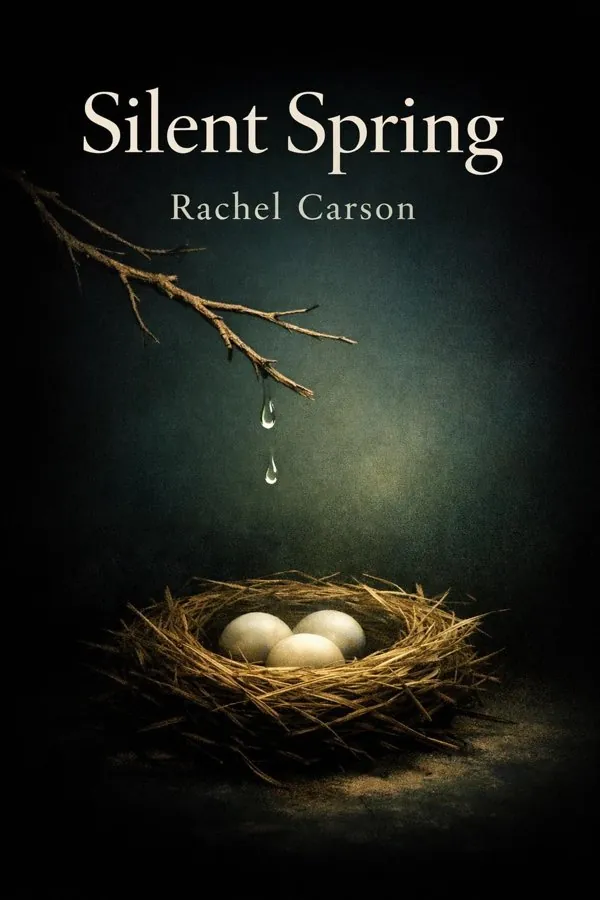
Silent Spring: Summary & Key Insights
 10 min8 chaptersAudio available
Key Takeaways from Silent Spring
The most dangerous inventions are often the ones adopted before their consequences are understood.
What society calls a miracle often becomes dangerous when it escapes scrutiny.
Pollution rarely stays where it is first released.
The most effective systems in nature are often the least visible.
When a society adopts the logic of blanket treatment, collateral damage becomes normal.
What Is Silent Spring About?
Silent Spring by Rachel Carson is a environment book spanning 13 pages. Silent Spring is one of the most influential environmental books ever written. Published in 1962 by marine biologist and science writer Rachel Carson, it exposed the hidden ecological and human costs of widespread pesticide use, especially chemicals like DDT that had been celebrated as modern miracles. Carson’s central claim was both simple and radical: when humans release powerful synthetic substances into the natural world, the consequences do not stay confined to pests or fields. They spread through soil, water, animals, and ultimately into our own bodies. What made the book so powerful was not just its science, but Carson’s ability to connect evidence with moral urgency. She showed that technological progress without humility can become a form of destruction. Drawing on scientific studies, field reports, and government records, Carson built a case that challenged industry narratives and reshaped public debate. Silent Spring matters because its warning remains current: whenever short-term convenience overrides ecological understanding, society risks poisoning the systems that sustain life. It is a foundational work for anyone seeking to understand modern environmentalism.
This FizzRead summary covers all 8 key chapters of Silent Spring in approximately 10 minutes, distilling the most important ideas, arguments, and takeaways from Rachel Carson's work. Also available as an audio summary and Key Quotes Podcast.
Silent Spring
Silent Spring is one of the most influential environmental books ever written. Published in 1962 by marine biologist and science writer Rachel Carson, it exposed the hidden ecological and human costs of widespread pesticide use, especially chemicals like DDT that had been celebrated as modern miracles. Carson’s central claim was both simple and radical: when humans release powerful synthetic substances into the natural world, the consequences do not stay confined to pests or fields. They spread through soil, water, animals, and ultimately into our own bodies. What made the book so powerful was not just its science, but Carson’s ability to connect evidence with moral urgency. She showed that technological progress without humility can become a form of destruction. Drawing on scientific studies, field reports, and government records, Carson built a case that challenged industry narratives and reshaped public debate. Silent Spring matters because its warning remains current: whenever short-term convenience overrides ecological understanding, society risks poisoning the systems that sustain life. It is a foundational work for anyone seeking to understand modern environmentalism.
Who Should Read Silent Spring?
This book is perfect for anyone interested in environment and looking to gain actionable insights in a short read. Whether you're a student, professional, or lifelong learner, the key ideas from Silent Spring by Rachel Carson will help you think differently.
- ✓Readers who enjoy environment and want practical takeaways
- ✓Professionals looking to apply new ideas to their work and life
- ✓Anyone who wants the core insights of Silent Spring in just 10 minutes
Want the full summary?
Get instant access to this book summary and 100K+ more with Fizz Moment.
Get Free SummaryAvailable on App Store • Free to download
Key Chapters
The most dangerous inventions are often the ones adopted before their consequences are understood. Carson begins from a profound ethical premise: humanity’s ability to alter nature has advanced faster than its willingness to study the effects of those changes. In the twentieth century, chemistry gave governments, farmers, and industry unprecedented power to kill insects, weeds, and fungi. But this power was treated as proof of control rather than a reason for caution. Silent Spring argues that every intervention in the natural world creates ripples, and those ripples do not stop where we want them to stop.
Carson challenges the idea that humans stand outside nature, manipulating it like an engineer adjusts machinery. Ecosystems are not simple machines. They are living networks in which soil organisms, insects, birds, fish, crops, water, and people affect one another. A chemical aimed at one target species may also weaken predators, contaminate waterways, persist in soil, or enter food chains. What appears to be efficiency in the short term can become systemic damage in the long term.
This insight applies far beyond pesticides. It speaks to modern debates about plastics, pharmaceuticals, emissions, and industrial waste. A town spraying chemicals to eliminate mosquitoes may reduce one problem while creating another if runoff enters nearby streams. A homeowner overusing lawn treatments may unknowingly expose pets, pollinators, and children.
Carson’s point is not that humans should never intervene, but that intervention requires humility, evidence, and responsibility. Before celebrating a new tool, ask what it accumulates in, what it kills indirectly, and who bears the hidden cost. Actionable takeaway: whenever a solution promises easy control over nature, pause and examine its full ecological consequences before accepting it.
Pollution rarely stays where it is first released. One of Carson’s most important contributions is her explanation of how pesticides travel through the basic life-support systems of the planet: soil and water. Chemicals sprayed on fields, forests, and suburban lawns do not simply disappear after doing their job. They seep downward, bind to particles, wash into drainage systems, and accumulate in streams, rivers, ponds, and groundwater. What appears to be local use becomes regional contamination.
Carson gives special attention to soil because healthy soil is alive. It contains fungi, bacteria, insects, worms, and countless microscopic organisms that drive decomposition, fertility, and plant growth. When toxic chemicals enter this community, they can disrupt the processes that sustain agriculture itself. In trying to protect crops, people may damage the very foundation of productive land.
Water contamination raises an equally serious threat. Runoff can carry chemicals into creeks and rivers, where fish and aquatic invertebrates absorb them. Livestock and humans may then consume contaminated water or food derived from affected ecosystems. This is not only an environmental issue but a public health issue. Carson helps readers see that there is no firm line between “nature out there” and “human life here.”
Modern examples make her point even clearer. A pesticide used on a suburban lawn can wash into storm drains and affect urban waterways. Agricultural runoff can contribute to fish kills and broader ecological decline. Even products used according to instructions can become dangerous once weather, erosion, and water movement enter the picture.
Actionable takeaway: whenever evaluating land management, think in watershed terms. Ask not only what is applied, but where it will travel after rain, irrigation, or time.
The most effective systems in nature are often the least visible. Carson repeatedly shows that ecosystems regulate themselves through complex relationships among predators, prey, plants, microbes, climate, and habitat. When humans intervene with blunt force, they often break balances they barely understand. A chemical intended to remove one insect species may also kill the organisms that naturally kept other pests under control. The result can be a rebound effect: the original problem returns, or a worse one replaces it.
This argument directly challenges the fantasy of total domination. Carson does not portray nature as fragile in the sentimental sense; she portrays it as intricately organized. That organization can absorb some disturbance, but large-scale chemical assault overwhelms the checks and balances that evolved over time. Birds help regulate insects. Soil organisms recycle nutrients. Aquatic life indicates water quality. Remove enough pieces, and the whole system starts to fail.
Carson’s famous image of a spring without birdsong captures more than emotional loss. It reflects ecological breakdown. When bird populations decline after pesticide exposure or food-chain contamination, their absence signals wider damage. The silence is evidence that life-supporting relationships have been severed.
This insight remains highly practical. Gardeners who destroy all insects often end up harming pollinators and beneficial predators. Municipal programs that rely on indiscriminate spraying may reduce visible pests temporarily while undermining long-term ecological stability. More resilient strategies work with natural balances instead of against them: planting diverse species, preserving habitat for beneficial insects, and using highly targeted controls only when necessary.
Actionable takeaway: before trying to eliminate a species, ask what role it plays in a larger system and whether a less disruptive method could restore balance more effectively.
When a society adopts the logic of blanket treatment, collateral damage becomes normal. Carson is especially critical of large-scale spraying programs conducted over forests, farmland, and communities with little regard for non-target life. Whether applied from trucks or aircraft, pesticides were often dispersed broadly, as if everything in the treated area were an acceptable sacrifice. Carson exposes the moral and scientific failure behind that approach: it assumes the right to poison entire landscapes in pursuit of limited administrative goals.
She documents how such campaigns can devastate birds, beneficial insects, fish, pets, livestock, and wild mammals. The tragedy is intensified by the fact that many of these programs were unnecessary or poorly justified. Officials often acted under pressure to appear decisive against pests, even when more restrained methods were available. The phrase “needless havoc” captures the heart of Carson’s objection: this destruction was not an unavoidable price of progress, but the result of careless choices.
The lesson extends to modern environmental management. Broad interventions may look efficient on paper, yet their hidden costs can be enormous. Spraying an entire neighborhood to control one nuisance species may expose residents and urban wildlife while only temporarily reducing the target. A more disciplined approach would assess severity, timing, species biology, and alternatives before acting.
Carson also forces readers to confront the democratic dimension of environmental decisions. Communities often had little information and little say over the chemicals applied around them. Transparency, consent, and accountability are essential whenever environmental risks are imposed on the public.
Actionable takeaway: reject one-size-fits-all pest control. Support targeted, evidence-based interventions and demand clear public disclosure whenever chemicals are released into shared environments.
A poison released into the environment does not stop at the boundary between human and nonhuman life. Carson was writing against the comforting assumption that pesticide danger was mostly about birds, fish, and forests. She insists that the same chemicals entering food chains, waterways, and household environments also pose risks to people. Exposure may come through food residues, drinking water, occupational contact, drifting spray, or accumulated contamination in the body over time.
What made Carson’s warning especially unsettling was her focus on chronic, low-level exposure. People often imagine poisoning as an immediate and dramatic event, but Carson highlights a subtler threat: repeated contact with small amounts of persistent chemicals that may build up in tissues and interact in poorly understood ways. This raises difficult questions about cancer, neurological harm, reproductive effects, and vulnerability among children, pregnant women, and workers regularly handling toxic substances.
Carson does not claim omniscience. Instead, she argues that uncertainty should lead to greater caution, not complacency. If the science is incomplete but the potential harm is serious and widespread, responsible policy should reduce exposure rather than wait for irreversible damage. That principle later became central to environmental health thinking.
Her insight remains practical today. Consumers can reduce unnecessary chemical use at home, wash produce, avoid cosmetic pesticide applications, and support stricter safety standards. Employers can improve protections for agricultural and landscaping workers. Policymakers can require stronger long-term testing and post-market monitoring.
Actionable takeaway: treat environmental health as personal health. Whenever evaluating a chemical, ask not only whether it works, but how people are exposed over time and who faces the greatest risk.
The attempt to exterminate pests through ever-stronger chemicals often fails on its own terms. Carson recognized a pattern that has since become one of the clearest arguments against indiscriminate pesticide use: evolution fights back. When a pesticide is applied repeatedly, the most vulnerable pests die first, while individuals with resistant traits survive and reproduce. Over time, the chemical loses effectiveness, and users respond by increasing dosage, frequency, or switching to new compounds. This creates an escalating cycle rather than a permanent solution.
Carson’s point is deeply strategic. Chemical warfare against living organisms encourages adaptation. The more aggressively humans rely on a single toxic method, the more strongly they select for resistant populations. What began as a quick fix becomes dependence. Farmers face higher costs, ecosystems absorb greater toxic burden, and the original pest problem may become harder to control than before.
This logic applies broadly. Antibiotic resistance in medicine follows a similar pattern: overuse undermines effectiveness. In agriculture and landscaping, integrated approaches tend to be more durable because they reduce the selective pressure imposed by constant chemical attack. Crop diversity, biological predators, timing interventions to pest life cycles, and tolerating low levels of damage can all help prevent resistance from becoming severe.
Carson therefore reframes success. The goal should not be total eradication at any cost, but intelligent management within ecological limits. A healthy system can keep pests below destructive thresholds without trying to eliminate all unwanted life.
Actionable takeaway: avoid relying on one chemical tool repeatedly. Support integrated pest management strategies that combine monitoring, prevention, biological control, and limited targeted treatment to reduce both resistance and ecological harm.
The real power of Silent Spring lies not only in its warnings, but in its alternatives. Carson rejects the false choice between chemical saturation and helplessness. She argues that there is another road: one based on ecological knowledge, selective intervention, and respect for natural processes. Instead of assuming that every unwanted species must be attacked with persistent poisons, societies can study how populations rise and fall, how predators regulate pests, how habitat shapes outbreaks, and how biological methods can achieve control with fewer side effects.
Carson highlights approaches that today would be grouped under ecological or integrated pest management. These include introducing natural enemies, sterilization techniques for certain pests, habitat modification, crop rotation, and careful monitoring before action is taken. The key principle is precision. Understand the organism, the setting, and the threshold of real harm before reaching for a toxic intervention.
This vision is practical because it aligns long-term human interests with ecological resilience. A farmer who encourages beneficial insects may reduce spray costs and protect pollination. A city that monitors pest populations before launching treatment can avoid unnecessary exposure for residents. A homeowner who tolerates minor cosmetic damage in a garden may preserve a far healthier backyard ecosystem.
Carson’s deeper message is philosophical. Progress should not be measured by how forcefully humans can dominate nature, but by how intelligently they can live within it. The mature society is not the one with the most powerful poisons, but the one with the most thoughtful restraint.
Actionable takeaway: whenever facing an environmental problem, ask for the least toxic, most targeted, ecologically informed solution first—and treat chemicals as a last resort, not a default habit.
All Chapters in Silent Spring
About the Author
Rachel Carson (1907–1964) was an American marine biologist, author, and pioneering environmental thinker. Trained in biology and deeply gifted as a writer, she became known for bringing science to a broad audience through elegant, accessible prose. Before Silent Spring, she earned widespread acclaim for books about the ocean, including The Sea Around Us, which established her as one of the leading science writers of her time. In Silent Spring, Carson combined scientific evidence with moral clarity to challenge the unchecked use of synthetic pesticides and reveal their impact on ecosystems and human health. Her work helped inspire the modern environmental movement and changed public debate about pollution, regulation, and ecological responsibility. Today, she is remembered as one of the most influential environmental voices of the twentieth century.
Get This Summary in Your Preferred Format
Read or listen to the Silent Spring summary by Rachel Carson anytime, anywhere. FizzRead offers multiple formats so you can learn on your terms — all free.
Available formats: App · Audio · PDF · EPUB — All included free with FizzRead
Download Silent Spring PDF and EPUB Summary
Key Quotes from Silent Spring
“The most dangerous inventions are often the ones adopted before their consequences are understood.”
“What society calls a miracle often becomes dangerous when it escapes scrutiny.”
“Pollution rarely stays where it is first released.”
“The most effective systems in nature are often the least visible.”
“When a society adopts the logic of blanket treatment, collateral damage becomes normal.”
Frequently Asked Questions about Silent Spring
Silent Spring by Rachel Carson is a environment book that explores key ideas across 8 chapters. Silent Spring is one of the most influential environmental books ever written. Published in 1962 by marine biologist and science writer Rachel Carson, it exposed the hidden ecological and human costs of widespread pesticide use, especially chemicals like DDT that had been celebrated as modern miracles. Carson’s central claim was both simple and radical: when humans release powerful synthetic substances into the natural world, the consequences do not stay confined to pests or fields. They spread through soil, water, animals, and ultimately into our own bodies. What made the book so powerful was not just its science, but Carson’s ability to connect evidence with moral urgency. She showed that technological progress without humility can become a form of destruction. Drawing on scientific studies, field reports, and government records, Carson built a case that challenged industry narratives and reshaped public debate. Silent Spring matters because its warning remains current: whenever short-term convenience overrides ecological understanding, society risks poisoning the systems that sustain life. It is a foundational work for anyone seeking to understand modern environmentalism.
More by Rachel Carson
You Might Also Like
A Life on Our Planet: My Witness Statement and a Vision for the Future
David Attenborough
10 min
A Sky Full Of Birds
Matt Merritt
10 min
Carbon Zero: Imagining Cities That Can Save the Planet
Alex Steffen
10 min
Eaarth: Making a Life on a Tough New Planet
Bill McKibben
10 min
The Social Contract and Environmental Governance
Various Editors
10 min
The Wild Places
Robert Macfarlane
10 minBrowse by Category
Ready to read Silent Spring?
Get the full summary and 100K+ more books with Fizz Moment.