
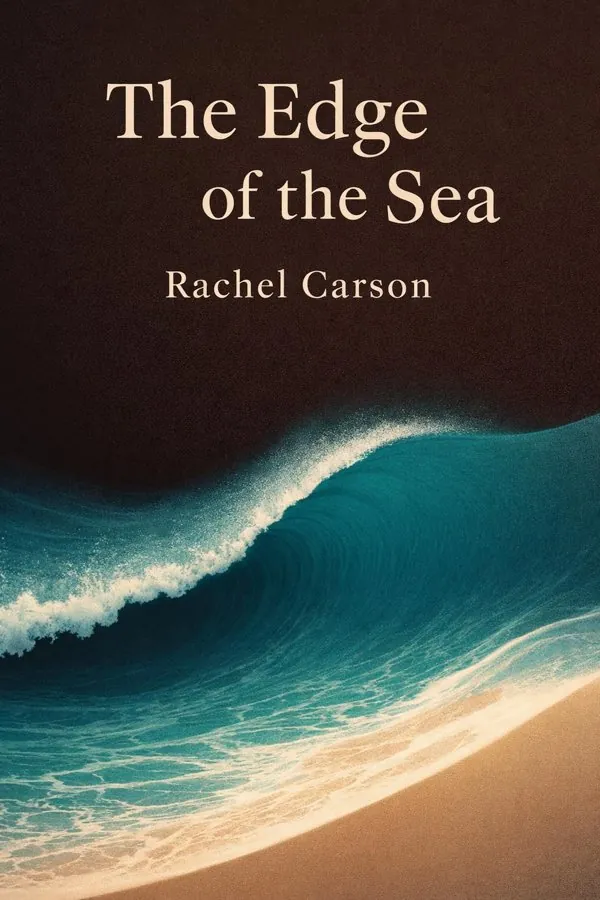
The Edge of the Sea: Summary & Key Insights
 10 min10 chaptersAudio available
What Is The Edge of the Sea About?
The Edge of the Sea by Rachel Carson is a environment book spanning 10 pages. In this classic work of natural history, Rachel Carson explores the intricate ecosystems of the Atlantic shore, from rocky coasts to sandy beaches and tidal pools. She reveals the delicate interdependence of marine life and the rhythms of the sea, blending scientific observation with poetic prose to illuminate the beauty and fragility of coastal environments.
This FizzRead summary covers all 10 key chapters of The Edge of the Sea in approximately 10 minutes, distilling the most important ideas, arguments, and takeaways from Rachel Carson's work. Also available as an audio summary and Key Quotes Podcast.
The Edge of the Sea
In this classic work of natural history, Rachel Carson explores the intricate ecosystems of the Atlantic shore, from rocky coasts to sandy beaches and tidal pools. She reveals the delicate interdependence of marine life and the rhythms of the sea, blending scientific observation with poetic prose to illuminate the beauty and fragility of coastal environments.
Who Should Read The Edge of the Sea?
This book is perfect for anyone interested in environment and looking to gain actionable insights in a short read. Whether you're a student, professional, or lifelong learner, the key ideas from The Edge of the Sea by Rachel Carson will help you think differently.
- ✓Readers who enjoy environment and want practical takeaways
- ✓Professionals looking to apply new ideas to their work and life
- ✓Anyone who wants the core insights of The Edge of the Sea in just 10 minutes
Want the full summary?
Get instant access to this book summary and 100K+ more with Fizz Moment.
Get Free SummaryAvailable on App Store • Free to download
Key Chapters
The rocky shore is where I first began to understand the tenacity of life against seemingly ruthless forces. Here, the tides carve a path that alternates between abundance and exposure. Twice each day the sea withdraws, revealing a world that must instantly adjust—from submerged calm to sunlit air and back again. It is not a gentle environment. Waves crash; salt spray scours; temperature shifts from damp chill to radiant heat. And yet, amid this harshness, life thrives in astonishing forms.
Each barnacle and periwinkle crawling upon the rocks displays an adaptation shaped by centuries of survival. I have spent long hours observing how these creatures cling with muscular precision to the surface, turning the seeming disadvantage of exposure into the very means of nourishment. The intertidal zone, where the tide alternately submerges and uncovers the rocks, becomes a laboratory of resilience. Every organism along the rocky shore is designed for flexibility: shells that seal tightly against drying air, mucous films that protect against salt, and structures that grip the stone even under relentless waves.
But the rocky coast is also a place of intimate beauty. Seaweeds drape the stones like living tapestries, their delicate fronds moving with the water’s rhythm. Beneath their shelter, small crabs scurry, and limpets cluster in the tiny niches where moisture lingers. Each depression, each fissure becomes a miniature world, suggesting that life does not seek comfort—it seeks persistence. When I watch the tide rise again, flooding these rock-bound communities, I feel a sense of continuity—a rhythm older than human memory.
Through this landscape, I want the reader to see that adversity is not the enemy of life. It is, in fact, the sculptor of its diversity. The rocky shore teaches that each act of survival is a creative response to change, that even the mightiest waves cannot erase the stubborn will of the creatures that inhabit these margins.
When the sea recedes, it leaves behind small pockets of its world: tide pools, glimmering like mirrors in the sun. These are quiet sanctuaries holding echoes of the greater ocean. To kneel beside a tide pool is to peer into a window of life suspended between two worlds—one terrestrial, one marine. Here, within a few square feet, the drama of existence unfolds.
I have always felt that the tide pool reflects the essence of continuity in miniature. Within its boundaries, starfish unfold like delicate flowers, anemones pulse in subtle rhythms, and young fish flicker through the shadows created by seaweed. Each pool is a self-contained community, maintaining its balance despite isolation. As long as the sun does not scorch or the water evaporate entirely, the creatures endure until the next tide replenishes their universe.
This microcosm demonstrates how even the smallest habitat is governed by complex interactions. Every creature here depends upon another for shelter, food, or protection. The crab’s scavenging cleans the pool, the algae oxygenate the water, and the snail quietly grazes to prevent overgrowth. What emerges from observation is a truth about mutual balance—that stability is never static, but born of constant motion.
I often think of the tide pool as a metaphor for our human insights: we, too, live within changing boundaries, seeking equilibrium in a world that shifts around us. Watching a sea anemone slowly reopen as the water cools after midday reminds me that patience and resilience are forms of adaptation. The tide pool becomes a lesson in coexistence—in the necessity of cooperation even in competition.
The beauty of these pools is not in their rarity but in their persistence. Hidden in the rocky crevices, they preserve the essence of the sea, reminding us that life finds continuity even where the conditions are temporary.
+ 8 more chapters — available in the FizzRead app
All Chapters in The Edge of the Sea
About the Author
Rachel Carson (1907–1964) was an American marine biologist, conservationist, and author whose writings advanced the global environmental movement. Her works, including 'The Sea Around Us' and 'Silent Spring', combined scientific insight with lyrical writing, inspiring public awareness of ecological issues.
Get This Summary in Your Preferred Format
Read or listen to the The Edge of the Sea summary by Rachel Carson anytime, anywhere. FizzRead offers multiple formats so you can learn on your terms — all free.
Available formats: App · Audio · PDF · EPUB — All included free with FizzRead
Download The Edge of the Sea PDF and EPUB Summary
Key Quotes from The Edge of the Sea
“The rocky shore is where I first began to understand the tenacity of life against seemingly ruthless forces.”
“When the sea recedes, it leaves behind small pockets of its world: tide pools, glimmering like mirrors in the sun.”
Frequently Asked Questions about The Edge of the Sea
The Edge of the Sea by Rachel Carson is a environment book that explores key ideas across 10 chapters. In this classic work of natural history, Rachel Carson explores the intricate ecosystems of the Atlantic shore, from rocky coasts to sandy beaches and tidal pools. She reveals the delicate interdependence of marine life and the rhythms of the sea, blending scientific observation with poetic prose to illuminate the beauty and fragility of coastal environments.
More by Rachel Carson
You Might Also Like

A Life on Our Planet: My Witness Statement and a Vision for the Future
David Attenborough
10 min
A Sky Full Of Birds
Matt Merritt
10 min
Carbon Zero: Imagining Cities That Can Save the Planet
Alex Steffen
10 min
Eaarth: Making a Life on a Tough New Planet
Bill McKibben
10 min
The Social Contract and Environmental Governance
Various Editors
10 min
The Wild Places
Robert Macfarlane
10 minBrowse by Category
Ready to read The Edge of the Sea?
Get the full summary and 100K+ more books with Fizz Moment.