
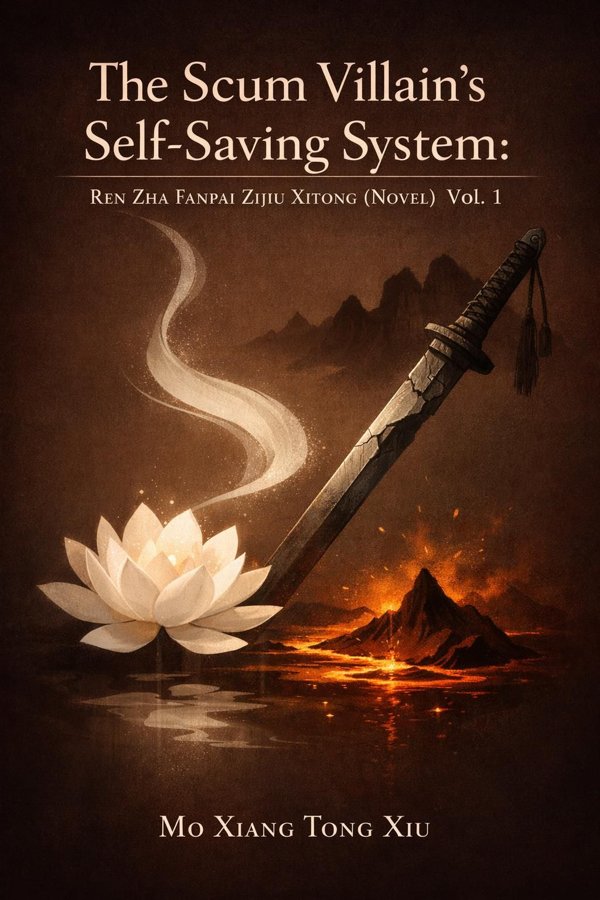
The Scum Villain’s Self-Saving System: Ren Zha Fanpai Zijiu Xitong (Novel) Vol. 1: Summary & Key Insights
 10 min8 chaptersAudio available
Key Takeaways from The Scum Villain’s Self-Saving System: Ren Zha Fanpai Zijiu Xitong (Novel) Vol. 1
Sometimes survival begins not with courage, but with the humiliating realization that the rules are already rigged.
A protagonist looks simple only from a distance.
The most radical thing a person can do inside a cruel story is to refuse its emotional logic.
Mockery is easy; affectionate critique is much harder.
People rarely meet the truth of one another directly; they meet performances, reputations, and inherited assumptions.
What Is The Scum Villain’s Self-Saving System: Ren Zha Fanpai Zijiu Xitong (Novel) Vol. 1 About?
The Scum Villain’s Self-Saving System: Ren Zha Fanpai Zijiu Xitong (Novel) Vol. 1 by Mo Xiang Tong Xiu is a scifi_fantasy book spanning 3 pages. What if the story you mocked online became the world you had to survive? That irresistible premise powers The Scum Villain’s Self-Saving System: Ren Zha Fanpai Zijiu Xitong (Novel) Vol. 1, Mo Xiang Tong Xiu’s witty, genre-savvy fantasy danmei novel. After dying suddenly, modern reader Shen Yuan awakens inside a poorly written cultivation webnovel as Shen Qingqiu, the cruel teacher fated to be destroyed by the protagonist he once abused: Luo Binghe. To avoid a gruesome ending, he must outmaneuver a merciless System, repair a broken relationship, and survive the rigid logic of a story already moving toward tragedy. What makes this novel matter is not just its humor or its inventive transmigration setup, but the way it interrogates fiction itself. Mo Xiang Tong Xiu blends satire, emotional tension, and character growth to explore whether people can escape the roles assigned to them. A foundational work in modern danmei fiction, the novel rewards readers who enjoy fantasy, meta-commentary, and slow emotional transformation. Vol. 1 is both a playful parody of cultivation tropes and a surprisingly sincere meditation on fate, compassion, and the possibility of becoming someone better than the script demands.
This FizzRead summary covers all 8 key chapters of The Scum Villain’s Self-Saving System: Ren Zha Fanpai Zijiu Xitong (Novel) Vol. 1 in approximately 10 minutes, distilling the most important ideas, arguments, and takeaways from Mo Xiang Tong Xiu's work. Also available as an audio summary and Key Quotes Podcast.
The Scum Villain’s Self-Saving System: Ren Zha Fanpai Zijiu Xitong (Novel) Vol. 1
What if the story you mocked online became the world you had to survive? That irresistible premise powers The Scum Villain’s Self-Saving System: Ren Zha Fanpai Zijiu Xitong (Novel) Vol. 1, Mo Xiang Tong Xiu’s witty, genre-savvy fantasy danmei novel. After dying suddenly, modern reader Shen Yuan awakens inside a poorly written cultivation webnovel as Shen Qingqiu, the cruel teacher fated to be destroyed by the protagonist he once abused: Luo Binghe. To avoid a gruesome ending, he must outmaneuver a merciless System, repair a broken relationship, and survive the rigid logic of a story already moving toward tragedy.
What makes this novel matter is not just its humor or its inventive transmigration setup, but the way it interrogates fiction itself. Mo Xiang Tong Xiu blends satire, emotional tension, and character growth to explore whether people can escape the roles assigned to them. A foundational work in modern danmei fiction, the novel rewards readers who enjoy fantasy, meta-commentary, and slow emotional transformation. Vol. 1 is both a playful parody of cultivation tropes and a surprisingly sincere meditation on fate, compassion, and the possibility of becoming someone better than the script demands.
Who Should Read The Scum Villain’s Self-Saving System: Ren Zha Fanpai Zijiu Xitong (Novel) Vol. 1?
This book is perfect for anyone interested in scifi_fantasy and looking to gain actionable insights in a short read. Whether you're a student, professional, or lifelong learner, the key ideas from The Scum Villain’s Self-Saving System: Ren Zha Fanpai Zijiu Xitong (Novel) Vol. 1 by Mo Xiang Tong Xiu will help you think differently.
- ✓Readers who enjoy scifi_fantasy and want practical takeaways
- ✓Professionals looking to apply new ideas to their work and life
- ✓Anyone who wants the core insights of The Scum Villain’s Self-Saving System: Ren Zha Fanpai Zijiu Xitong (Novel) Vol. 1 in just 10 minutes
Want the full summary?
Get instant access to this book summary and 100K+ more with Fizz Moment.
Get Free SummaryAvailable on App Store • Free to download
Key Chapters
Sometimes survival begins not with courage, but with the humiliating realization that the rules are already rigged. That is exactly where Shen Yuan finds himself when he dies and wakes up as Shen Qingqiu, the villain of a trashy cultivation novel he once criticized. His situation would be absurd enough on its own, but the real engine of tension is the System: a game-like force that rewards, punishes, monitors, and constrains his behavior. He cannot simply announce that he has changed, leave the sect, or rewrite events however he pleases. Every choice must be made within a framework designed to preserve the original plot.
This idea gives the novel its unique texture. The System turns ordinary moral decisions into strategic calculations. Shen Yuan is not just trying to become kinder; he is trying to appear consistent enough to avoid penalties while subtly changing outcomes. If he acts too differently, he risks punishment. If he follows the original character too closely, he moves toward death. The result is a darkly comic lesson in constrained agency: freedom often exists not in escaping systems outright, but in learning how to bend them.
In practical terms, this mirrors real life more than fantasy usually does. People often inherit roles they did not choose: family expectations, workplace hierarchies, social labels, institutional pressures. Like Shen Yuan, they must act within structures that reward performance over sincerity. His early struggle reminds us that meaningful change rarely comes through dramatic declarations. It comes through careful, repeated interventions.
Actionable takeaway: When trapped in a difficult role, stop asking how to escape instantly and start asking where the rules have small openings you can use to change your future.
A protagonist looks simple only from a distance. One of Vol. 1’s sharpest achievements is how it transforms Luo Binghe from a clichéd “chosen one” into a vulnerable, observant, deeply affected young person. In the original story, he is the handsome, talented hero who suffers terribly before rising to power. But from Shen Yuan’s new perspective, Luo Binghe is not merely a narrative device. He is a student shaped by neglect, humiliation, hope, and a desperate hunger for recognition.
This shift matters because it changes the emotional center of the novel. Shen Yuan initially sees Luo Binghe as a danger to manage. After all, this is the future hero who will one day destroy Shen Qingqiu. Yet the more he interacts with him, the harder it becomes to treat him as a plot point. Luo Binghe’s sincerity, intelligence, and sensitivity force Shen Yuan to confront a difficult truth: stories flatten people, but proximity restores their humanity. The villain’s supposed enemy is, at this stage, a boy who wants guidance and belonging.
The novel uses this relationship to critique the emotional shortcuts common in fiction and in life. It is easy to admire success after triumph, but much harder to witness the tenderness and fear that exist before greatness. Teachers, mentors, parents, and leaders can apply this lesson directly. A difficult or gifted student is not just a future outcome. They are a person being shaped now by whether they feel seen, protected, and fairly treated.
Actionable takeaway: Before defining someone by what they might become, pay close attention to what they need in the present; care offered early can alter an entire future.
The most radical thing a person can do inside a cruel story is to refuse its emotional logic. Vol. 1 repeatedly asks whether destiny is truly fixed or merely reinforced by habit, fear, and expectation. Shen Yuan enters a world with a known script: Shen Qingqiu mistreats Luo Binghe, Luo Binghe suffers, grows stronger, and eventually takes revenge. The plot seems airtight. Yet the novel slowly reveals that narratives maintain power because people keep acting as if they must.
Shen Yuan’s interference does not erase the original story, but it exposes how much of fate depends on repeated behavior. A harsh word, a withheld kindness, public humiliation, institutional neglect, and unchallenged favoritism all accumulate into catastrophe. By changing seemingly minor interactions, he begins to loosen the inevitability of tragedy. That is why the book feels emotionally resonant beneath its comedy. It suggests that redemption is not a magical reset. It is the patient interruption of patterns.
This idea has clear real-world applications. Many people live according to stories they inherited: “I am the failure in the family,” “my boss will never respect me,” “this friendship is doomed,” “I always sabotage good things.” Such narratives gain strength each time they are enacted. The novel does not deny how hard it is to break them. Instead, it insists that even limited choice matters, especially when repeated over time.
Vol. 1 also warns that changing events externally is not enough. To truly break the narrative, Shen Yuan must change how he sees others and himself. Compassion becomes not just a moral virtue, but a plot-altering force.
Actionable takeaway: Identify one destructive story you keep reenacting in your life, then interrupt it with one consistent new behavior before you wait for your feelings to catch up.
Mockery is easy; affectionate critique is much harder. One reason The Scum Villain’s Self-Saving System stands out is that it satirizes cultivation and webnovel tropes without descending into contempt. Shen Yuan begins as a frustrated reader who has strong opinions about bad plotting, overpowered protagonists, cardboard villains, and melodramatic suffering. His internal commentary is often hilarious because it says what many genre readers think but rarely see voiced so directly. Yet the novel does not simply laugh at fantasy conventions. It understands why they attract readers in the first place.
This balance creates a layered reading experience. On one level, the book is a parody of familiar patterns: absurd power scaling, dramatic sect politics, improbable beauty, misunderstood protagonists, and villainous adults who seem engineered to make future revenge satisfying. On another level, it is a sincere contribution to the same tradition. The sect world remains compelling, the stakes still matter, and the emotions become increasingly real. In effect, Mo Xiang Tong Xiu shows that critique and enjoyment do not cancel each other out. Loving a genre often means recognizing its weaknesses while still finding meaning within it.
This has broader relevance for readers, creators, and critics. Healthy criticism is not the opposite of engagement. It can deepen appreciation by exposing lazy habits and encouraging richer storytelling. In workplaces, communities, and creative teams, the same principle applies: the best feedback often comes from people who care enough to want something to improve, not from those who stand outside dismissing it.
Actionable takeaway: The next time you critique a story, a project, or a system, ask yourself whether your criticism helps reveal a better version rather than merely proving that you are smarter than it.
A teacher’s smallest choices can become a student’s deepest wound. At the heart of Vol. 1 is the master-disciple bond between Shen Qingqiu and Luo Binghe, and the novel treats that relationship as both intimate and profoundly unequal. In the original story, Shen Qingqiu’s abuse helps create the future monster who will exact revenge. In the rewritten version, Shen Yuan tries to become a better teacher, but he is constantly reminded that authority itself can nurture or deform.
This makes the novel more than a fantasy comedy. It becomes an examination of what mentorship actually means. Guidance is not just instruction in skills or doctrine. It includes fairness, recognition, protection, and emotional restraint. Luo Binghe does not simply need technical training; he needs someone in power to refrain from humiliating him and to acknowledge his worth. Shen Yuan’s developing care therefore carries real stakes. Every moment of encouragement pushes against the original pattern of damage.
The practical relevance is immediate. Teachers, managers, coaches, older siblings, and community leaders all occupy roles where casual behavior can have outsized impact. Public embarrassment, favoritism, and neglect often remain vivid in memory long after specific lessons are forgotten. Conversely, a single act of defense or confidence can become a turning point. The novel understands that people often become who authority figures repeatedly tell them they are.
At the same time, it warns that good intentions are not enough. Power requires self-awareness. Shen Yuan must notice not only what he means, but how his words land within a hierarchy already tilted in his favor.
Actionable takeaway: If someone looks up to you, treat ordinary interactions as formative moments; use your authority to create safety and dignity, not fear.
Laughter often opens the door to truths that would feel unbearable if stated plainly. One of the pleasures of Vol. 1 is Shen Yuan’s voice: sarcastic, self-aware, melodramatic, and frequently exasperated by the ridiculous situation around him. His reactions to sect politics, cultivation clichés, and the System’s arbitrary demands generate much of the book’s comedy. But the humor does more than entertain. It becomes a shield against panic, guilt, and emotional entanglement.
This is part of what gives the novel its tonal sophistication. Shen Yuan jokes because he is frightened. He overanalyzes because he is trying not to feel overwhelmed. He frames relationships in genre terms because doing so gives him distance from their emotional reality. Readers gradually sense that his wit is not simply cleverness; it is a coping mechanism. That makes the funnier scenes carry surprising tenderness. Beneath the banter is a person struggling to adapt to trauma, responsibility, and attachment.
The broader lesson is valuable. Many people use humor the same way. In friendships, workplaces, and families, jokes can deflect vulnerability while still hinting at it. Paying attention to when and why humor appears can reveal emotional undercurrents that straightforward speech would miss. For writers and communicators, this is also a reminder that comedy can deepen seriousness rather than cheapen it.
Vol. 1 succeeds because it lets absurdity coexist with sincerity. The reader laughs at Shen Yuan’s commentary while also recognizing the loneliness and pressure beneath it.
Actionable takeaway: When you notice yourself using humor constantly in stressful situations, pause and ask what feeling the joke is protecting; naming that feeling can be the first step toward handling it directly.
Redemption is often imagined as a dramatic turning point, but this novel argues that it usually starts in private, long before anyone acknowledges it. Shen Yuan inherits the body and reputation of someone who has caused real harm. Even if he personally did not commit those actions, he must live among their consequences. This creates a morally complex situation: he wants to survive, but survival requires engaging with relationships already shaped by fear, resentment, and injury.
Vol. 1 does not offer easy absolution. Shen Yuan cannot erase history with a few thoughtful gestures, and the people around him are not obligated to trust him immediately. That is what makes his efforts meaningful. Redemption here is not about receiving praise for being better than the original villain. It is about choosing, repeatedly, to do less harm and more good even when no one fully understands or rewards the effort.
This insight applies powerfully beyond fiction. Many people become aware, sometimes late, that they have hurt others, enabled bad systems, or played damaging roles. The desire for instant forgiveness can then overshadow the slower work of real change. The novel suggests a more mature path: accept the discomfort of not being seen as redeemed yet, and continue acting with care anyway.
It also complicates blame in an interesting way. Because Shen Yuan is both himself and the bearer of another man’s legacy, the book invites readers to consider how we inherit broken structures and still become responsible for what we do within them.
Actionable takeaway: If you are trying to make amends, stop measuring progress only by whether others forgive you and start measuring it by whether your daily choices consistently reduce harm.
All Chapters in The Scum Villain’s Self-Saving System: Ren Zha Fanpai Zijiu Xitong (Novel) Vol. 1
About the Author
Mo Xiang Tong Xiu is a Chinese novelist widely recognized for helping bring danmei fiction to a global readership. She is the author of three major fantasy novels: The Scum Villain’s Self-Saving System, Grandmaster of Demonic Cultivation, and Heaven Official’s Blessing. Her work is known for blending supernatural adventure, layered worldbuilding, emotional intensity, and complex relationships shaped by loyalty, trauma, humor, and redemption. Readers often praise her ability to balance sharp comedy with sincere feeling, creating stories that are both highly entertaining and emotionally resonant. Across her novels, she frequently explores identity, morality, power, and the possibility of transformation. Her books have attracted large international fan communities and have become central works in contemporary danmei literature.
Get This Summary in Your Preferred Format
Read or listen to the The Scum Villain’s Self-Saving System: Ren Zha Fanpai Zijiu Xitong (Novel) Vol. 1 summary by Mo Xiang Tong Xiu anytime, anywhere. FizzRead offers multiple formats so you can learn on your terms — all free.
Available formats: App · Audio · PDF · EPUB — All included free with FizzRead
Download The Scum Villain’s Self-Saving System: Ren Zha Fanpai Zijiu Xitong (Novel) Vol. 1 PDF and EPUB Summary
Key Quotes from The Scum Villain’s Self-Saving System: Ren Zha Fanpai Zijiu Xitong (Novel) Vol. 1
“Sometimes survival begins not with courage, but with the humiliating realization that the rules are already rigged.”
“A protagonist looks simple only from a distance.”
“The most radical thing a person can do inside a cruel story is to refuse its emotional logic.”
“Mockery is easy; affectionate critique is much harder.”
“People rarely meet the truth of one another directly; they meet performances, reputations, and inherited assumptions.”
Frequently Asked Questions about The Scum Villain’s Self-Saving System: Ren Zha Fanpai Zijiu Xitong (Novel) Vol. 1
The Scum Villain’s Self-Saving System: Ren Zha Fanpai Zijiu Xitong (Novel) Vol. 1 by Mo Xiang Tong Xiu is a scifi_fantasy book that explores key ideas across 8 chapters. What if the story you mocked online became the world you had to survive? That irresistible premise powers The Scum Villain’s Self-Saving System: Ren Zha Fanpai Zijiu Xitong (Novel) Vol. 1, Mo Xiang Tong Xiu’s witty, genre-savvy fantasy danmei novel. After dying suddenly, modern reader Shen Yuan awakens inside a poorly written cultivation webnovel as Shen Qingqiu, the cruel teacher fated to be destroyed by the protagonist he once abused: Luo Binghe. To avoid a gruesome ending, he must outmaneuver a merciless System, repair a broken relationship, and survive the rigid logic of a story already moving toward tragedy. What makes this novel matter is not just its humor or its inventive transmigration setup, but the way it interrogates fiction itself. Mo Xiang Tong Xiu blends satire, emotional tension, and character growth to explore whether people can escape the roles assigned to them. A foundational work in modern danmei fiction, the novel rewards readers who enjoy fantasy, meta-commentary, and slow emotional transformation. Vol. 1 is both a playful parody of cultivation tropes and a surprisingly sincere meditation on fate, compassion, and the possibility of becoming someone better than the script demands.
More by Mo Xiang Tong Xiu
You Might Also Like
Red Rising
Pierce Brown
10 min
Stranger in a Strange Land
Robert A. Heinlein
10 min
AI Valley
Chen Qiufan
10 min
Bloodchild
Octavia E. Butler
10 min
Do Androids Dream of Electric Sheep?
Philip K. Dick
10 min
Jujutsu Kaisen, Vol. 24
Gege Akutami
10 minBrowse by Category
Ready to read The Scum Villain’s Self-Saving System: Ren Zha Fanpai Zijiu Xitong (Novel) Vol. 1?
Get the full summary and 100K+ more books with Fizz Moment.