
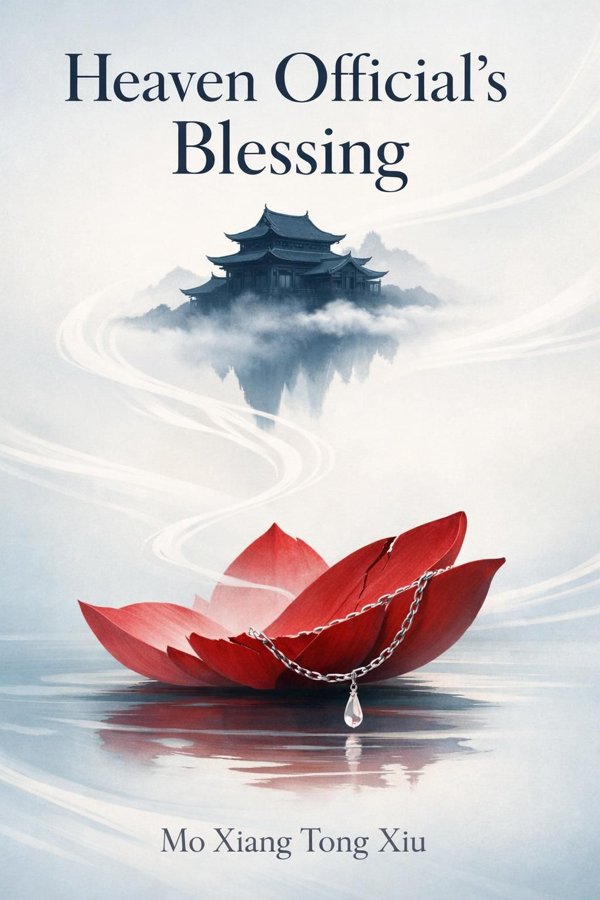
Heaven Official's Blessing: Summary & Key Insights
 10 min8 chaptersAudio available
Key Takeaways from Heaven Official's Blessing
A person’s true character is often revealed not at the height of success, but after repeated humiliation.
The people we are taught to fear are not always the ones who will harm us.
Institutions often appear most beautiful from a distance.
Some stories treat love as sudden emotion; Heaven Official's Blessing treats it as enduring recognition.
Faith becomes most meaningful when external rewards disappear.
What Is Heaven Official's Blessing About?
Heaven Official's Blessing by Mo Xiang Tong Xiu is a bestsellers book spanning 5 pages. Heaven Official's Blessing by Mo Xiang Tong Xiu is a sweeping fantasy epic that blends romance, myth, mystery, and emotional resilience into one unforgettable story. Set across heavenly courts, mortal kingdoms, and ghost-haunted realms, the novel follows Xie Lian, a once-revered crown prince who has ascended to godhood three times and fallen just as often. Mocked by the heavens and burdened by tragedy, he wanders the world with little status but enduring compassion. His path changes when he meets Hua Cheng, a feared ghost king whose devotion to Xie Lian runs deeper than legend. What begins as intrigue unfolds into a centuries-spanning story of faith, loyalty, justice, and love that survives ruin. The book matters because it refuses simple moral labels. Gods can be vain, ghosts can be tender, and true nobility lies less in status than in how one treats others when everything is lost. Mo Xiang Tong Xiu, one of the most influential voices in modern Chinese fantasy and danmei fiction, is renowned for intricate world-building, layered character arcs, and emotional storytelling. In Heaven Official's Blessing, she delivers a powerful meditation on redemption: not as perfection regained, but as kindness chosen again and again.
This FizzRead summary covers all 8 key chapters of Heaven Official's Blessing in approximately 10 minutes, distilling the most important ideas, arguments, and takeaways from Mo Xiang Tong Xiu's work. Also available as an audio summary and Key Quotes Podcast.
Heaven Official's Blessing
Heaven Official's Blessing by Mo Xiang Tong Xiu is a sweeping fantasy epic that blends romance, myth, mystery, and emotional resilience into one unforgettable story. Set across heavenly courts, mortal kingdoms, and ghost-haunted realms, the novel follows Xie Lian, a once-revered crown prince who has ascended to godhood three times and fallen just as often. Mocked by the heavens and burdened by tragedy, he wanders the world with little status but enduring compassion. His path changes when he meets Hua Cheng, a feared ghost king whose devotion to Xie Lian runs deeper than legend. What begins as intrigue unfolds into a centuries-spanning story of faith, loyalty, justice, and love that survives ruin.
The book matters because it refuses simple moral labels. Gods can be vain, ghosts can be tender, and true nobility lies less in status than in how one treats others when everything is lost. Mo Xiang Tong Xiu, one of the most influential voices in modern Chinese fantasy and danmei fiction, is renowned for intricate world-building, layered character arcs, and emotional storytelling. In Heaven Official's Blessing, she delivers a powerful meditation on redemption: not as perfection regained, but as kindness chosen again and again.
Who Should Read Heaven Official's Blessing?
This book is perfect for anyone interested in bestsellers and looking to gain actionable insights in a short read. Whether you're a student, professional, or lifelong learner, the key ideas from Heaven Official's Blessing by Mo Xiang Tong Xiu will help you think differently.
- ✓Readers who enjoy bestsellers and want practical takeaways
- ✓Professionals looking to apply new ideas to their work and life
- ✓Anyone who wants the core insights of Heaven Official's Blessing in just 10 minutes
Want the full summary?
Get instant access to this book summary and 100K+ more with Fizz Moment.
Get Free SummaryAvailable on App Store • Free to download
Key Chapters
A person’s true character is often revealed not at the height of success, but after repeated humiliation. That insight sits at the heart of Xie Lian’s journey. Once the beloved crown prince of Xianle, he was admired for his talent, grace, and sincere compassion. His first ascension to heaven seemed to confirm what everyone believed: that goodness would naturally be rewarded. But Heaven Official's Blessing quickly dismantles that comforting assumption. Xie Lian falls from divine favor, suffers disaster, and returns to heaven for a third time not as a triumphant hero, but as a ridiculed, unlucky god with no worshippers and no prestige.
What makes this arc so powerful is that his worth does not vanish with his status. He still helps strangers, still protects the vulnerable, and still tries to act with dignity even when others mock him. The novel suggests that resilience is not loud or glamorous. Sometimes it looks like continuing to sweep a shrine no one visits, take on thankless tasks, or offer kindness when bitterness would be easier.
This idea applies far beyond fantasy. Many people define themselves by promotions, recognition, or public success. But setbacks—job loss, failure, rejection, social embarrassment—often strip away borrowed identities. Xie Lian shows what remains when titles disappear: values. He keeps choosing mercy over pride, action over self-pity.
The lesson is not to romanticize suffering, but to understand that falling does not erase dignity. If anything, hardship can clarify it. Xie Lian’s third ascent matters because it is earned through endurance, not applause.
Actionable takeaway: When facing failure or loss of status, ask yourself what values you can still practice today. Let your principles, not your position, define who you are.
The people we are taught to fear are not always the ones who will harm us. Hua Cheng enters the story as Crimson Rain Sought Flower, one of the most terrifying ghost kings in existence. His name inspires anxiety across the three realms, and his power places him beyond ordinary understanding. By all appearances, he should be a threat. Yet his relationship with Xie Lian reveals one of the novel’s most compelling reversals: beneath the myth of monstrosity is profound tenderness, unwavering loyalty, and an almost sacred form of devotion.
Their meeting reshapes the emotional center of the book. Hua Cheng does not worship Xie Lian as a flawless god; he sees his scars, failures, and pain, and loves him with full knowledge of them. This matters because so much of Xie Lian’s suffering comes from being misunderstood—idealized when he was a prince, condemned when he fell, simplified by rumor at every stage. Hua Cheng offers something rare: recognition without judgment.
In everyday life, we often inherit simplified narratives about people. Someone with a harsh reputation at work may be deeply reliable. A person seen as intimidating may simply be private, wounded, or protective. The novel encourages readers to look beyond labels and ask better questions: Who benefits from this reputation? What truth lies underneath it? And who stays when appearances become inconvenient?
Hua Cheng also demonstrates that love is not passive admiration. He protects, observes, remembers, and creates space for Xie Lian’s agency. His devotion is powerful because it is active, patient, and chosen over centuries.
Actionable takeaway: Reconsider one person you have judged mainly by reputation. Try to learn who they are through direct experience, not inherited assumptions.
Institutions often appear most beautiful from a distance. In Heaven Official's Blessing, the heavenly court should represent order, virtue, and divine justice. Instead, as Xie Lian returns to heaven, readers discover a world driven by vanity, political maneuvering, status anxiety, and selective morality. Gods compete for worshippers, guard their reputations, and sometimes conceal truths that would threaten their standing. The result is one of the novel’s sharpest themes: sacred systems are not automatically ethical simply because they hold power.
This idea gives the story much of its intrigue. Mysteries across the mortal and ghost realms are connected not only to supernatural events, but also to what heaven chooses to ignore or distort. Xie Lian, because he has already been disgraced, can move more freely than others. He asks inconvenient questions. He notices hypocrisy. And he becomes dangerous precisely because he is less invested in preserving appearances.
The book’s critique feels strikingly modern. In workplaces, governments, schools, and communities, image management often outranks accountability. People may defend a respected institution even when it fails those it claims to serve. Heaven Official's Blessing reminds us that prestige is not proof of integrity. A polished hierarchy can still be built on fear, exclusion, and self-interest.
At the same time, the novel does not argue that all structure is meaningless. Instead, it asks readers to separate ideals from the flawed people who administer them. Justice remains worthwhile; the problem is when institutions use noble language to shield selfish behavior.
Actionable takeaway: The next time you trust a person or system because of rank or reputation, pause and examine behavior instead. Look for transparency, accountability, and how power is used when no one is praising it.
Some stories treat love as sudden emotion; Heaven Official's Blessing treats it as enduring recognition. The relationship between Xie Lian and Hua Cheng unfolds across years of suffering, memory, transformation, and waiting. Their bond is not built on a perfect first encounter or easy compatibility. It survives war, exile, mythmaking, silence, and loss. That long timeline allows the novel to explore redemption in a rich way: not as one dramatic act that erases the past, but as a gradual process of being seen, accepted, and chosen again.
For Xie Lian, redemption is deeply personal. He carries guilt, shame, and the weight of countless tragedies. Others reduce him to symbols—the fallen prince, the unlucky god, the cautionary tale. Hua Cheng’s love resists all those simplifications. He does not ask Xie Lian to become pure, triumphant, or emotionally unscarred before being worthy of affection. That is what makes their connection transformative. Love becomes a place where truth can exist without performance.
This idea has practical resonance. Many people believe they must become more successful, healed, attractive, or socially approved before they deserve closeness. The novel challenges that mindset. Real love does not deny flaws, but it does not use them as a reason to withdraw respect. Likewise, redemption in real life often begins when someone believes change is possible even after disgrace or failure.
The story also warns that time alone does not heal; meaningful loyalty, honesty, and courage do. Centuries matter less than what is done within them.
Actionable takeaway: Practice offering one relationship more honesty and less performance. Let care be expressed through steadiness, listening, and presence—not just dramatic declarations.
Faith becomes most meaningful when external rewards disappear. Xie Lian’s story is filled with reasons to become cynical: betrayal, ridicule, catastrophe, and divine rejection. Yet he does not wholly surrender his belief in helping others. Importantly, his faith is not naive optimism. It is a battered, tested commitment to compassion despite overwhelming evidence that the world can be cruel. That makes it more convincing, not less.
The novel distinguishes between blind faith and chosen faith. Blind faith ignores complexity and clings to appearances. Chosen faith looks directly at suffering and still decides that kindness matters. Xie Lian’s forgiveness operates in a similar way. He does not excuse all wrongdoing or erase consequences, but he repeatedly resists becoming consumed by hatred. This is one of his greatest acts of strength. To endure without hardening completely is its own kind of heroism.
In practical life, people often confuse forgiveness with surrender or forgetfulness. Heaven Official's Blessing presents a subtler version. Forgiveness may mean refusing to let injury define your entire identity. It may mean stepping away from revenge, even while maintaining boundaries. Faith may mean continuing to act according to your values when applause, certainty, and fairness are absent.
This theme is especially relevant during burnout, grief, or betrayal. Many readers will recognize the temptation to ask, “Why keep trying if the world does not reward good intentions?” The book’s answer is not simplistic. It suggests that meaning is created through action, not guaranteed by outcome.
Actionable takeaway: Identify one principle you want to keep even under stress—such as honesty, generosity, or patience—and practice it deliberately this week, especially when it feels inconvenient.
When society stops applauding you, who are you still willing to be? Heaven Official's Blessing returns to this question repeatedly. Gods depend on temples, incense, and believers for prestige and influence, making worship both spiritual and transactional. Xie Lian once had all the admiration a prince or god could want, and later almost none. That dramatic reversal forces a painful reckoning: identity built on external validation is fragile.
The novel uses divine rank as a metaphor for modern forms of recognition—job titles, public reputation, social media approval, academic achievements, or family expectations. These things can be meaningful, but they are unstable foundations for self-worth. Xie Lian’s deepest crisis is not only that he loses status; it is that he must discover whether goodness still matters without witnesses. His answer, though imperfect and hard-won, is yes.
Other characters illustrate alternative responses. Some cling desperately to position. Some manipulate perception to maintain influence. Some reshape themselves according to what others fear or desire. In contrast, Xie Lian gradually becomes more himself as he loses what once defined him. Stripped of ceremony, he learns what convictions actually belong to him.
This is a useful lens for readers navigating transition. Retirement, layoffs, divorce, migration, illness, or public failure can make people feel erased. But these moments also reveal durable identity: the habits, ethics, relationships, and forms of service that remain when labels fall away.
The book does not claim this process is easy. It is humiliating, lonely, and often unfair. Yet it can also be clarifying. A self built on character is harder to destroy than one built on applause.
Actionable takeaway: Write down three identities you rely on, then list three qualities you would still have without them. Strengthen the qualities, not just the labels.
In brutal worlds, kindness is often dismissed as softness. Heaven Official's Blessing argues the opposite: compassion can be a radical act of defiance. Xie Lian is repeatedly punished for caring too much, helping too freely, or refusing to reduce people to enemies, sinners, or collateral damage. Yet the novel never portrays this as mere passivity. His compassion is costly precisely because it resists systems that thrive on indifference and hierarchy.
This matters because many stories equate strength with dominance, emotional distance, or strategic cruelty. Xie Lian offers another model. He pays attention. He listens. He intervenes even when there is little chance of reward. He refuses to treat suffering as abstract. These choices do not always save everyone, and that failure haunts him. But the book insists that imperfect compassion is still morally significant.
Readers can apply this theme in ordinary settings. Compassion in a workplace may mean defending a colleague who is being scapegoated. In family life, it may mean noticing who is carrying invisible burdens. In public life, it may mean resisting the impulse to reduce strangers to stereotypes or statistics. Compassion is not just feeling bad for someone; it is allowing their humanity to affect your decisions.
The novel also makes clear that compassion must be paired with discernment. Helping others does not require self-erasure, and empathy does not mean accepting abuse. Xie Lian’s journey shows the tension between mercy and self-protection, making his kindness feel principled rather than naive.
Actionable takeaway: Choose one concrete act of compassion this week—check in on someone isolated, support a struggling teammate, or offer practical help where others only offer opinions.
What people refuse to confront does not disappear; it returns as mystery, conflict, and pain. Much of Heaven Official's Blessing is structured around hidden histories, unresolved trauma, and secrets that shape the present long after others would prefer to forget them. The novel’s investigations are not only about supernatural events. They are also about memory—what is remembered accurately, what is distorted by power, and what individuals do to survive unbearable experiences.
This gives the story unusual emotional depth. Characters are not simply moving forward in time; they are carrying unfinished burdens. Xie Lian’s own past remains alive in shame, rumor, and personal grief. The heavenly court’s polished surfaces conceal old failures. Hua Cheng’s devotion is rooted in events that never stopped mattering. In this way, the book suggests that healing begins not through denial, but through honest return.
The idea applies directly to real life. Families often bury conflict under silence. Organizations hide harmful decisions to preserve image. Individuals outrun pain by staying busy, detached, or ironic. But unresolved experiences tend to reemerge—through anxiety, resentment, broken trust, or repeated patterns. The past asks to be acknowledged.
Importantly, the novel does not imply that revisiting pain is easy or automatically redemptive. It can be destabilizing. But truth creates the possibility of integration. Without it, people remain trapped inside narratives created by fear, shame, or convenience.
Readers may find this theme especially resonant if they have ever felt that an old wound still shapes current behavior. The story reminds us that understanding the origin of pain is not weakness; it is often the beginning of freedom.
Actionable takeaway: Reflect on one recurring emotional pattern in your life and ask what older experience might be feeding it. Honest naming is a first step toward change.
All Chapters in Heaven Official's Blessing
About the Author
Mo Xiang Tong Xiu is a Chinese novelist widely known for her bestselling fantasy danmei fiction. She gained major recognition through serialized web novels that combine expansive mythological worlds with emotionally intense character relationships. Her best-known works include Heaven Official's Blessing, Grandmaster of Demonic Cultivation, and The Scum Villain's Self-Saving System, all of which have attracted large international readerships and multiple adaptations. Her storytelling is celebrated for its intricate plotting, slow-burn emotional development, sharp shifts between humor and heartbreak, and interest in flawed characters seeking connection, justice, or redemption. Through her novels, Mo Xiang Tong Xiu has become one of the most influential modern authors in the global rise of Chinese fantasy web literature.
Get This Summary in Your Preferred Format
Read or listen to the Heaven Official's Blessing summary by Mo Xiang Tong Xiu anytime, anywhere. FizzRead offers multiple formats so you can learn on your terms — all free.
Available formats: App · Audio · PDF · EPUB — All included free with FizzRead
Download Heaven Official's Blessing PDF and EPUB Summary
Key Quotes from Heaven Official's Blessing
“A person’s true character is often revealed not at the height of success, but after repeated humiliation.”
“The people we are taught to fear are not always the ones who will harm us.”
“Institutions often appear most beautiful from a distance.”
“Some stories treat love as sudden emotion; Heaven Official's Blessing treats it as enduring recognition.”
“Faith becomes most meaningful when external rewards disappear.”
Frequently Asked Questions about Heaven Official's Blessing
Heaven Official's Blessing by Mo Xiang Tong Xiu is a bestsellers book that explores key ideas across 8 chapters. Heaven Official's Blessing by Mo Xiang Tong Xiu is a sweeping fantasy epic that blends romance, myth, mystery, and emotional resilience into one unforgettable story. Set across heavenly courts, mortal kingdoms, and ghost-haunted realms, the novel follows Xie Lian, a once-revered crown prince who has ascended to godhood three times and fallen just as often. Mocked by the heavens and burdened by tragedy, he wanders the world with little status but enduring compassion. His path changes when he meets Hua Cheng, a feared ghost king whose devotion to Xie Lian runs deeper than legend. What begins as intrigue unfolds into a centuries-spanning story of faith, loyalty, justice, and love that survives ruin. The book matters because it refuses simple moral labels. Gods can be vain, ghosts can be tender, and true nobility lies less in status than in how one treats others when everything is lost. Mo Xiang Tong Xiu, one of the most influential voices in modern Chinese fantasy and danmei fiction, is renowned for intricate world-building, layered character arcs, and emotional storytelling. In Heaven Official's Blessing, she delivers a powerful meditation on redemption: not as perfection regained, but as kindness chosen again and again.
More by Mo Xiang Tong Xiu
You Might Also Like

The Godfather
Mario Puzo
10 min
The Handmaid's Tale
Margaret Atwood
10 min
The Hunger Games
Suzanne Collins
10 min
The Nightingale
Kristin Hannah
10 min
The Seven Husbands of Evelyn Hugo
Taylor Jenkins Reid
10 min
Backwater Justice
Fern Michaels
10 minBrowse by Category
Ready to read Heaven Official's Blessing?
Get the full summary and 100K+ more books with Fizz Moment.