
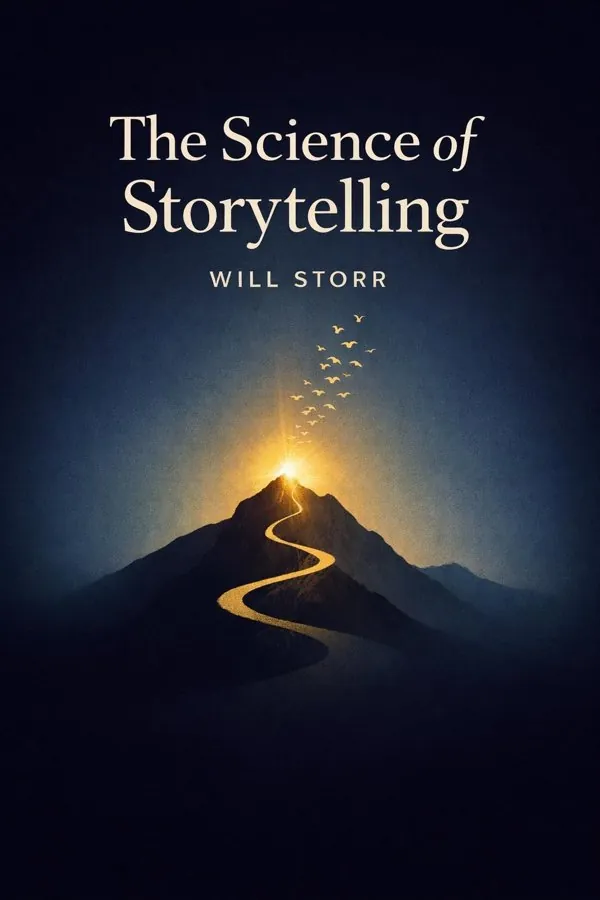
The Science of Storytelling: Why Stories Make Us Human and How to Tell Them Better: Summary & Key Insights
by Will Storr
 10 min10 chaptersAudio available
What Is The Science of Storytelling: Why Stories Make Us Human and How to Tell Them Better About?
The Science of Storytelling: Why Stories Make Us Human and How to Tell Them Better by Will Storr is a writing book spanning 10 pages. In this incisive and thought-provoking work, Will Storr explores the psychological and neuroscientific foundations of storytelling. He reveals how stories shape our identities, beliefs, and cultures, and how understanding their underlying science can help writers and creators craft more compelling narratives. Drawing on research in psychology and neuroscience, Storr explains why humans are wired for story and how narrative structures influence emotion and behavior.
This FizzRead summary covers all 10 key chapters of The Science of Storytelling: Why Stories Make Us Human and How to Tell Them Better in approximately 10 minutes, distilling the most important ideas, arguments, and takeaways from Will Storr's work. Also available as an audio summary and Key Quotes Podcast.
The Science of Storytelling: Why Stories Make Us Human and How to Tell Them Better
In this incisive and thought-provoking work, Will Storr explores the psychological and neuroscientific foundations of storytelling. He reveals how stories shape our identities, beliefs, and cultures, and how understanding their underlying science can help writers and creators craft more compelling narratives. Drawing on research in psychology and neuroscience, Storr explains why humans are wired for story and how narrative structures influence emotion and behavior.
Who Should Read The Science of Storytelling: Why Stories Make Us Human and How to Tell Them Better?
This book is perfect for anyone interested in writing and looking to gain actionable insights in a short read. Whether you're a student, professional, or lifelong learner, the key ideas from The Science of Storytelling: Why Stories Make Us Human and How to Tell Them Better by Will Storr will help you think differently.
- ✓Readers who enjoy writing and want practical takeaways
- ✓Professionals looking to apply new ideas to their work and life
- ✓Anyone who wants the core insights of The Science of Storytelling: Why Stories Make Us Human and How to Tell Them Better in just 10 minutes
Want the full summary?
Get instant access to this book summary and 100K+ more with Fizz Moment.
Get Free SummaryAvailable on App Store • Free to download
Key Chapters
Long before we had writing, we had stories. Our ancestors sat around fires, sharing accounts of danger, triumph, and love. Those early tales weren’t idle chatter—they were evolution’s means of survival. Through story, humans learned to predict others’ behavior, infer cause and effect, and navigate the complexities of social life. Storytelling was the original virtual reality, a mental simulation that prepared us for the unpredictable.
Cognitive science explains this beautifully. The brain is a storyteller by design. It takes fragments of information from the sensory world and weaves them into a cohesive narrative. When something violates our expectations, we don’t simply note the anomaly—we seek its cause. This automatic search for cause is the foundation of narrative. Stories are how our brains explain change.
Neuroscientists like Michael Gazzaniga have demonstrated that the left hemisphere acts as an “interpreter,” continuously constructing explanations for our behavior, even inventing reasons when none exist. That interpreter is the mind’s storyteller. It’s our internal novelist, writing the saga of the self. Understanding this evolutionary and biological foundation allows writers to see storytelling not as an arbitrary art but as a reflection of cognition itself.
As creators, when we honor that cognitive design—when our stories trigger the brain’s hunger for cause, consequence, and meaning—we’re not manipulating audiences; we’re speaking to the deepest part of their humanity.
If the brain evolved to tell stories, then it follows that our sense of identity must be one too. The self, I argue, is a story—a constantly edited draft that gives coherence to our experiences. Our thoughts, emotions, and memories are organized into a narrative of ‘me.’
This insight transforms how we see both people and characters. A person doesn’t have a fixed, objective self; they have an ongoing story, one shaped by memory, expectation, and selective attention. Each day, the brain updates this internal account: ‘I am this kind of person; this is what I value; this is how the world works.’
Writers who grasp this can craft far more believable characters. A character isn’t just a collection of traits—they are a consciousness maintaining a self-story, struggling to preserve it against the forces of change. The real drama begins when that story is threatened.
When a character’s self-narrative collapses, we feel it viscerally because we know that collapse. In life, those are our moments of crisis: the job loss, the betrayal, the death of a dream. Narrative mirrors this essential human tension between the story we live by and the unpredictable world that challenges it.
+ 8 more chapters — available in the FizzRead app
All Chapters in The Science of Storytelling: Why Stories Make Us Human and How to Tell Them Better
About the Author
Will Storr is an award-winning writer and journalist. His work has appeared in publications such as The Guardian and The Sunday Times. He is also the author of several acclaimed books on psychology, creativity, and human behavior, and teaches storytelling and writing workshops internationally.
Get This Summary in Your Preferred Format
Read or listen to the The Science of Storytelling: Why Stories Make Us Human and How to Tell Them Better summary by Will Storr anytime, anywhere. FizzRead offers multiple formats so you can learn on your terms — all free.
Available formats: App · Audio · PDF · EPUB — All included free with FizzRead
Download The Science of Storytelling: Why Stories Make Us Human and How to Tell Them Better PDF and EPUB Summary
Key Quotes from The Science of Storytelling: Why Stories Make Us Human and How to Tell Them Better
“Long before we had writing, we had stories.”
“If the brain evolved to tell stories, then it follows that our sense of identity must be one too.”
Frequently Asked Questions about The Science of Storytelling: Why Stories Make Us Human and How to Tell Them Better
The Science of Storytelling: Why Stories Make Us Human and How to Tell Them Better by Will Storr is a writing book that explores key ideas across 10 chapters. In this incisive and thought-provoking work, Will Storr explores the psychological and neuroscientific foundations of storytelling. He reveals how stories shape our identities, beliefs, and cultures, and how understanding their underlying science can help writers and creators craft more compelling narratives. Drawing on research in psychology and neuroscience, Storr explains why humans are wired for story and how narrative structures influence emotion and behavior.
More by Will Storr
You Might Also Like
The Art of Perspective
Christopher Castellani
10 min
Making a Point: The Persnickety Story of English Punctuation
David Crystal
10 min
The Elements Of Eloquence: How To Turn The Perfect English Phrase
Mark Forsyth
10 min
The Pocket Muse: Ideas and Inspirations for Writing
Monica Wood
10 min
A Little Book on Form: An Exploration into the Formal Imagination of Poetry
Robert Hass
10 min
Adventures In The Screen Trade: A Personal View Of Hollywood And Screenwriting
William Goldman
10 minBrowse by Category
Ready to read The Science of Storytelling: Why Stories Make Us Human and How to Tell Them Better?
Get the full summary and 100K+ more books with Fizz Moment.