
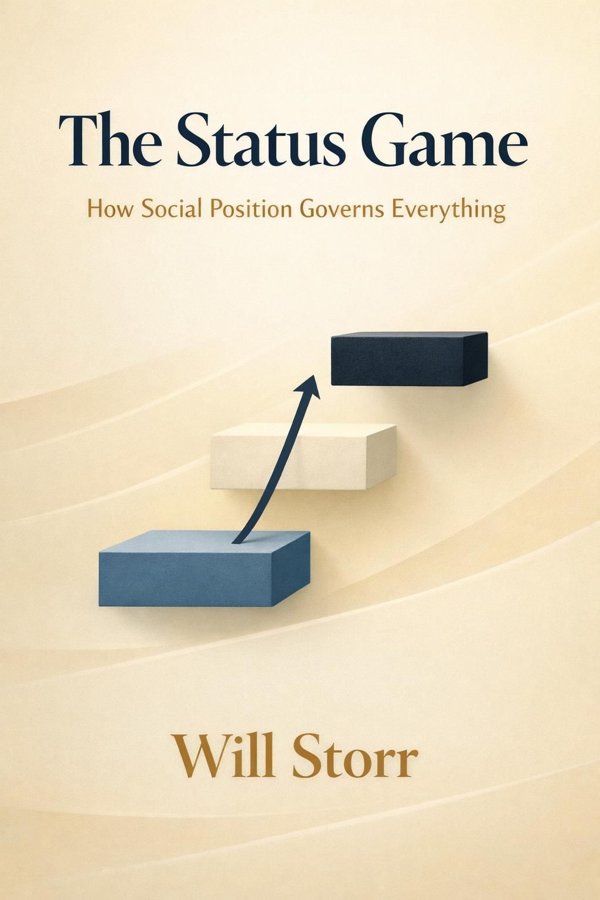
The Status Game: How Social Position Governs Everything: Summary & Key Insights
by Will Storr
 10 min9 chaptersAudio available
Key Takeaways from The Status Game: How Social Position Governs Everything
What if our hunger for recognition is not vanity, but biology?
A change in social position can alter your emotions as powerfully as hunger or pleasure.
Not all status is earned in the same way.
The modern world did not invent status competition, but it has industrialized it.
People do not just want status; they want status in a world that feels fair.
What Is The Status Game: How Social Position Governs Everything About?
The Status Game: How Social Position Governs Everything by Will Storr is a psychology book spanning 6 pages. Why do people chase promotions, obsess over likes, defend beliefs with tribal intensity, or feel crushed by exclusion? In The Status Game, journalist and author Will Storr argues that beneath these everyday behaviors lies a powerful, ancient force: the human drive for status. Far from being a shallow concern, status is a core survival mechanism that shaped our ancestors’ ability to belong, cooperate, and thrive. Today, it still influences our ambition, morality, politics, work, relationships, and mental health. Storr combines psychology, evolutionary biology, anthropology, neuroscience, and storytelling to show that human beings are constantly navigating social hierarchies, often without realizing it. He explains why status can inspire creativity, discipline, and moral action, but also fuel anxiety, conflict, cruelty, and self-deception. One of the book’s greatest strengths is that it doesn’t merely diagnose a problem; it gives readers a framework for understanding the invisible games they are already playing. With the investigative rigor of a journalist and the insight of a skilled behavioral thinker, Storr offers a compelling lens on modern life. This book matters because once you understand status, you begin to understand people—and yourself—far more clearly.
This FizzRead summary covers all 9 key chapters of The Status Game: How Social Position Governs Everything in approximately 10 minutes, distilling the most important ideas, arguments, and takeaways from Will Storr's work. Also available as an audio summary and Key Quotes Podcast.
The Status Game: How Social Position Governs Everything
Why do people chase promotions, obsess over likes, defend beliefs with tribal intensity, or feel crushed by exclusion? In The Status Game, journalist and author Will Storr argues that beneath these everyday behaviors lies a powerful, ancient force: the human drive for status. Far from being a shallow concern, status is a core survival mechanism that shaped our ancestors’ ability to belong, cooperate, and thrive. Today, it still influences our ambition, morality, politics, work, relationships, and mental health.
Storr combines psychology, evolutionary biology, anthropology, neuroscience, and storytelling to show that human beings are constantly navigating social hierarchies, often without realizing it. He explains why status can inspire creativity, discipline, and moral action, but also fuel anxiety, conflict, cruelty, and self-deception. One of the book’s greatest strengths is that it doesn’t merely diagnose a problem; it gives readers a framework for understanding the invisible games they are already playing.
With the investigative rigor of a journalist and the insight of a skilled behavioral thinker, Storr offers a compelling lens on modern life. This book matters because once you understand status, you begin to understand people—and yourself—far more clearly.
Who Should Read The Status Game: How Social Position Governs Everything?
This book is perfect for anyone interested in psychology and looking to gain actionable insights in a short read. Whether you're a student, professional, or lifelong learner, the key ideas from The Status Game: How Social Position Governs Everything by Will Storr will help you think differently.
- ✓Readers who enjoy psychology and want practical takeaways
- ✓Professionals looking to apply new ideas to their work and life
- ✓Anyone who wants the core insights of The Status Game: How Social Position Governs Everything in just 10 minutes
Want the full summary?
Get instant access to this book summary and 100K+ more with Fizz Moment.
Get Free SummaryAvailable on App Store • Free to download
Key Chapters
What if our hunger for recognition is not vanity, but biology? Storr’s central insight is that status is not a modern obsession created by capitalism, celebrity culture, or social media. It is an ancient survival system built into human nature. Our ancestors lived in small groups where survival depended on cooperation, trust, and belonging. To be valued by the tribe meant access to protection, food, allies, and mates. To lose standing, or worse, to be excluded, could be deadly.
This helps explain why status matters so intensely. Human beings evolved to monitor their social value constantly. We are highly sensitive to signals of approval, disrespect, admiration, shame, and rejection because these signals once had life-or-death consequences. That is why a criticism at work, being ignored at a party, or getting fewer responses online can feel far more painful than logic alone would justify.
Storr also shows that status was not only about dominance. Early humans needed systems of fairness, reputation, and contribution to keep cooperation stable. People who were generous, skilled, brave, or wise could gain status because they helped the group survive. In that sense, status is not always corrupting. It can reward socially useful behavior.
In modern life, the same ancient mechanism plays out in offices, families, schools, friendship circles, and digital spaces. We still seek signals that we matter. The problem is that today’s status contests are larger, faster, and more relentless than those of our ancestors.
Actionable takeaway: When you feel unusually reactive to praise, criticism, or exclusion, pause and remember that your brain may be responding to an ancient survival alarm, not an objective present-day threat.
A change in social position can alter your emotions as powerfully as hunger or pleasure. Storr explains that status is deeply embedded in the brain’s reward and threat systems. When our social standing rises, we often experience excitement, confidence, and motivation. When it falls, we may feel anxiety, anger, shame, or despair. Neuroscience suggests this is not metaphorical. Status shifts can trigger real biological responses involving dopamine, stress hormones, and pain-related neural circuits.
This is one reason social humiliation hurts so much. Rejection is not simply an unpleasant idea; the brain can process it in ways that overlap with physical pain. Likewise, public recognition, admiration, or promotion can create a genuine surge of reward. These reactions help explain why people work so hard for titles, symbols, and prestige, even when the practical benefits seem small.
Importantly, our brains are not just tracking absolute success. They are highly tuned to relative rank. A person may earn a good salary and still feel inadequate if peers are earning more. A student with strong grades may feel mediocre in an elite school. Social comparison, then, is not a bad habit layered on top of human nature. It is part of how humans assess where they stand.
This wiring has major consequences for wellbeing. If you spend your days in environments that constantly expose you to status threats—competitive workplaces, performative social media, judgment-heavy communities—your nervous system may remain in a low-grade state of vigilance.
Actionable takeaway: Reduce unnecessary status comparison by limiting exposure to environments that constantly rank, signal, and provoke insecurity, and invest more time in settings where contribution matters more than display.
Not all status is earned in the same way. One of Storr’s most useful ideas is that humans gain status through three broad games: dominance, virtue, and success. Understanding these games helps explain why people can behave so differently while all chasing the same underlying goal.
Dominance is the oldest game. It is about power, intimidation, control, and the ability to impose one’s will. We see it in bullying, authoritarian leadership, aggressive posturing, and environments where fear determines rank. Although modern societies often condemn dominance, it still appears in politics, workplaces, street culture, and personal relationships.
Virtue is status gained by appearing morally good according to a group’s values. People earn esteem by being loyal, pure, principled, caring, courageous, or ideologically correct. This game is especially powerful because it links status to identity and morality. It can inspire noble behavior, but it can also create outrage cycles, moral grandstanding, and harsh punishment for those who violate group norms.
Success is status gained through competence, achievement, skill, and accomplishment. In this game, admiration goes to those who create, solve, build, win, or perform at a high level. Artists, entrepreneurs, athletes, experts, and high achievers often compete here.
Most social worlds mix all three. A company may reward performance, but also punish dissent and celebrate certain moral codes. A family may value care, obedience, and achievement simultaneously. Problems arise when we do not recognize which game we are in.
Actionable takeaway: Before entering a stressful social environment, ask yourself: What kind of status is rewarded here—dominance, virtue, or success—and do I actually want to play that game?
The modern world did not invent status competition, but it has industrialized it. Storr argues that contemporary society exposes us to status signals at a scale our minds were never designed to handle. In ancestral groups, people compared themselves with a few dozen known individuals. Today, we compare ourselves with colleagues, celebrities, influencers, experts, activists, and strangers across the globe.
Social media is a particularly intense status arena. It quantifies attention through likes, followers, views, and shares. It rewards signaling, performance, and tribal belonging. It also keeps us locked in a loop of comparison, as we encounter curated images of beauty, achievement, wealth, and certainty. The result is not just envy, but a constant recalibration of what counts as enough.
Work has also become a more psychologically loaded status field. For many people, jobs no longer provide only income. They are expected to deliver meaning, identity, prestige, and self-worth. That makes setbacks feel existential. If your career is your status scoreboard, then a missed promotion can feel like a verdict on your value as a person.
Even politics increasingly functions as a status game. People do not merely argue policies; they battle over recognition, moral legitimacy, and group superiority. Public debates become contests over who deserves esteem and who deserves shame.
Storr’s point is not that modern life is uniquely bad, but that it intensifies ancient drives through technology, scale, and visibility. We are exposed to too many judges and too many rivals.
Actionable takeaway: Build small, grounded communities offline where your worth is measured by real contribution and mutual care rather than public performance or endless comparison.
People do not just want status; they want status in a world that feels fair. Storr highlights how human groups depend on shared rules of belonging, cooperation, and justice. In evolutionary terms, groups that maintained trust and punished cheating were more likely to survive. That means humans evolved not only to compete, but also to care deeply about fairness, reciprocity, and moral reputation.
This is why we are so alert to insults, hypocrisy, freeloading, and unequal treatment. A colleague taking credit for shared work can trigger disproportionate anger because it violates an ancient expectation of fair contribution. A leader who exempts themselves from the rules threatens the moral fabric that allows cooperation. A child quickly notices favoritism in the family because fairness and belonging are emotionally central.
At the same time, our sense of fairness is not perfectly objective. It is filtered through group loyalty and self-interest. We often notice unfairness when it hurts us or our side, while overlooking it when we benefit. This selective moral vision fuels conflict. Many status battles are framed not as ambition, but as righteous struggles for justice.
The healthiest groups are not those without hierarchy, but those in which hierarchy feels legitimate, contribution is recognized, and people trust that rules apply broadly. In workplaces, this means transparency in promotion and respect. In families, it means consistency and appreciation. In communities, it means norms that encourage both accountability and dignity.
Actionable takeaway: If you lead or participate in a group, make expectations, contributions, and recognition more explicit; perceived fairness is one of the strongest stabilizers of healthy status dynamics.
The same force that drives excellence can also drive cruelty. Storr is clear that status is not inherently noble or evil. It is a powerful human motive, and when distorted, it can produce bullying, fanaticism, humiliation, scapegoating, and even violence. Much of history’s conflict can be understood as status competition between individuals, classes, tribes, and nations.
One dark pathway is dominance unchecked by empathy or accountability. In such environments, people gain rank by intimidating others, and lower-status individuals may accept mistreatment to avoid exclusion. Another dark pathway is moralized status. When a group becomes convinced that it alone is good, pure, or righteous, attacking outsiders can feel justified, even virtuous. This is why cruelty so often arrives wearing the mask of morality.
Shame also plays a major role. People who experience chronic humiliation may become desperate to reclaim dignity. Sometimes they do so through achievement. Sometimes they do so through revenge, radicalization, or group extremism that offers a sense of significance. This helps explain why status injury can be politically explosive.
On a smaller scale, the dark side of status appears in office politics, online pile-ons, social exclusion, and family dynamics where one person must always feel superior. The danger grows when people stop seeing one another as humans and start seeing them as rank positions.
Storr’s contribution is to make these patterns legible. Once we see that status hunger can become pathological, we can better design cultures that reward competence, kindness, and fairness instead of fear and humiliation.
Actionable takeaway: Be alert to any environment where people rise by degrading others; if humiliation is the currency of status, the game will eventually damage everyone in it.
The most stable form of status is not display, but usefulness. Across the book, Storr points toward an important distinction: some status pursuits leave us brittle and dependent on external applause, while others create genuine esteem rooted in contribution. The difference often lies in whether we are trying to look valuable or to be valuable.
Performative status relies on optics. It asks how to appear impressive, righteous, elite, or desirable. This kind of status can be intoxicating, but it is fragile because it depends on constant validation. A person whose worth rests on image may become anxious, defensive, or addicted to approval.
Contribution-based status is different. It grows when people reliably add value to others through competence, generosity, creativity, leadership, teaching, caregiving, or integrity. This status is still social, but it is more grounded because it is linked to real service rather than symbolic display. The admired nurse, trusted manager, skilled craftsperson, thoughtful friend, or dependable teammate may not always be the loudest person in the room, but they often enjoy deeper respect.
This idea has practical implications for work and life. Instead of asking, “How can I win admiration?” it may be healthier to ask, “How can I become genuinely useful in a way that aligns with my values?” That shift reduces empty comparison and increases agency.
It also helps explain why some achievements feel hollow. If success is detached from meaning or contribution, it may raise rank without satisfying the deeper need to matter.
Actionable takeaway: Choose one social arena—work, family, friendship, community—and focus less on being noticed there and more on becoming unmistakably helpful, reliable, or skillful.
We cannot escape status games, but we can choose them more wisely. This is one of Storr’s most practical conclusions. Since status is a fundamental part of being human, the goal is not to become indifferent to social standing. The goal is to stop being unconsciously controlled by destructive games and to participate in healthier ones.
A better status game has clear standards, rewards real contribution, and does not require the humiliation of others. It allows dignity even in failure. It encourages growth rather than paranoia. In contrast, bad status games are arbitrary, manipulative, zero-sum, and psychologically corrosive. They keep participants insecure because insecurity makes them easier to control.
For example, a workplace where advancement depends on visible competence and teamwork is healthier than one where rank depends on flattery and internal politics. A friend group that values honesty and support is healthier than one built on subtle put-downs. An online community focused on learning is healthier than one driven by outrage and moral display.
On a personal level, playing better games means noticing where your worth feels constantly under threat. It may mean leaving a status-toxic environment, redefining success, or resisting comparison in arenas that do not reflect your values. It also means becoming less reactive to temporary status losses. Not every slight is a catastrophe. Not every audience deserves your performance.
The freedom Storr offers is not freedom from status, but freedom from status confusion. When you understand the game, you gain the power to choose your moves.
Actionable takeaway: Audit the main status games in your life and intentionally withdraw energy from one that makes you smaller, angrier, or more performative, replacing it with one that rewards growth and contribution.
All Chapters in The Status Game: How Social Position Governs Everything
About the Author
Will Storr is an award-winning British writer, journalist, and author whose work focuses on psychology, identity, culture, and human behavior. He is known for turning complex research into vivid, engaging nonfiction that feels both intellectually rigorous and highly readable. His books include Selfie, which examines the modern obsession with self-image, and The Science of Storytelling, a widely praised exploration of narrative and the mind. Storr has written for major publications such as The Guardian, The Sunday Times, and The New Yorker, and he is also a respected teacher of long-form writing and storytelling. In The Status Game, he brings together reporting, science, and sharp observation to explain one of the deepest hidden forces in social life: the universal human need for status.
Get This Summary in Your Preferred Format
Read or listen to the The Status Game: How Social Position Governs Everything summary by Will Storr anytime, anywhere. FizzRead offers multiple formats so you can learn on your terms — all free.
Available formats: App · Audio · PDF · EPUB — All included free with FizzRead
Download The Status Game: How Social Position Governs Everything PDF and EPUB Summary
Key Quotes from The Status Game: How Social Position Governs Everything
“What if our hunger for recognition is not vanity, but biology?”
“A change in social position can alter your emotions as powerfully as hunger or pleasure.”
“Not all status is earned in the same way.”
“The modern world did not invent status competition, but it has industrialized it.”
“People do not just want status; they want status in a world that feels fair.”
Frequently Asked Questions about The Status Game: How Social Position Governs Everything
The Status Game: How Social Position Governs Everything by Will Storr is a psychology book that explores key ideas across 9 chapters. Why do people chase promotions, obsess over likes, defend beliefs with tribal intensity, or feel crushed by exclusion? In The Status Game, journalist and author Will Storr argues that beneath these everyday behaviors lies a powerful, ancient force: the human drive for status. Far from being a shallow concern, status is a core survival mechanism that shaped our ancestors’ ability to belong, cooperate, and thrive. Today, it still influences our ambition, morality, politics, work, relationships, and mental health. Storr combines psychology, evolutionary biology, anthropology, neuroscience, and storytelling to show that human beings are constantly navigating social hierarchies, often without realizing it. He explains why status can inspire creativity, discipline, and moral action, but also fuel anxiety, conflict, cruelty, and self-deception. One of the book’s greatest strengths is that it doesn’t merely diagnose a problem; it gives readers a framework for understanding the invisible games they are already playing. With the investigative rigor of a journalist and the insight of a skilled behavioral thinker, Storr offers a compelling lens on modern life. This book matters because once you understand status, you begin to understand people—and yourself—far more clearly.
More by Will Storr



You Might Also Like
The Body Keeps the Score
Bessel van der Kolk
10 min
Surrounded by Idiots
Thomas Erikson
10 min
Emotional Intelligence
Daniel Goleman
10 min
Attached
Amir Levine
10 min
Why Does He Do That
Lundy Bancroft
10 min
Women Who Run with the Wolves
Clarissa Pinkola Estés
10 minBrowse by Category
Ready to read The Status Game: How Social Position Governs Everything?
Get the full summary and 100K+ more books with Fizz Moment.