
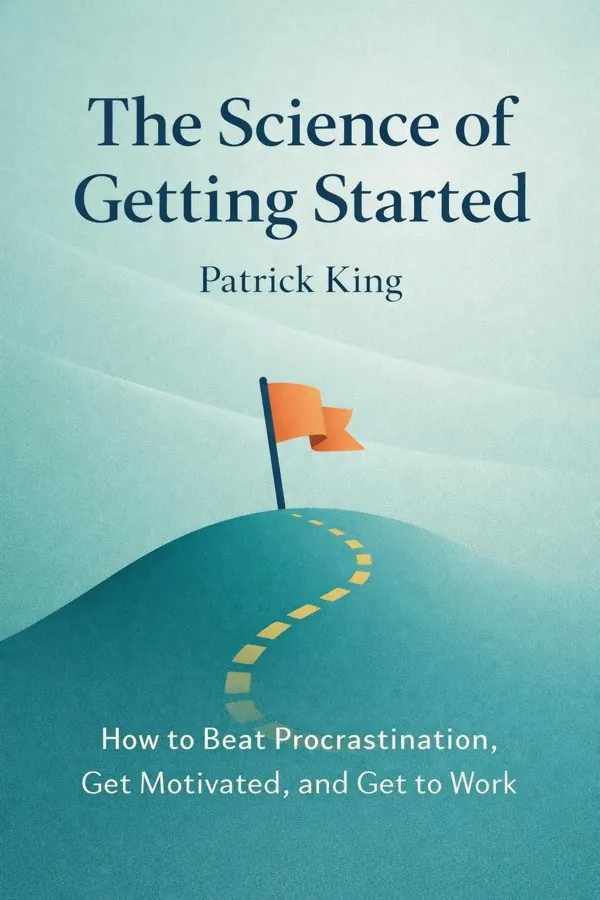
The Science of Getting Started: How to Beat Procrastination, Get Motivated, and Get to Work: Summary & Key Insights
by Patrick King
 10 min6 chaptersAudio available
What Is The Science of Getting Started: How to Beat Procrastination, Get Motivated, and Get to Work About?
The Science of Getting Started: How to Beat Procrastination, Get Motivated, and Get to Work by Patrick King is a productivity book spanning 6 pages. A practical guide that explores the psychological and behavioral science behind procrastination and motivation. Patrick King provides actionable strategies to overcome inertia, build momentum, and start tasks effectively by understanding cognitive biases and emotional triggers that prevent action.
This FizzRead summary covers all 6 key chapters of The Science of Getting Started: How to Beat Procrastination, Get Motivated, and Get to Work in approximately 10 minutes, distilling the most important ideas, arguments, and takeaways from Patrick King's work. Also available as an audio summary and Key Quotes Podcast.
The Science of Getting Started: How to Beat Procrastination, Get Motivated, and Get to Work
A practical guide that explores the psychological and behavioral science behind procrastination and motivation. Patrick King provides actionable strategies to overcome inertia, build momentum, and start tasks effectively by understanding cognitive biases and emotional triggers that prevent action.
Who Should Read The Science of Getting Started: How to Beat Procrastination, Get Motivated, and Get to Work?
This book is perfect for anyone interested in productivity and looking to gain actionable insights in a short read. Whether you're a student, professional, or lifelong learner, the key ideas from The Science of Getting Started: How to Beat Procrastination, Get Motivated, and Get to Work by Patrick King will help you think differently.
- ✓Readers who enjoy productivity and want practical takeaways
- ✓Professionals looking to apply new ideas to their work and life
- ✓Anyone who wants the core insights of The Science of Getting Started: How to Beat Procrastination, Get Motivated, and Get to Work in just 10 minutes
Want the full summary?
Get instant access to this book summary and 100K+ more with Fizz Moment.
Get Free SummaryAvailable on App Store • Free to download
Key Chapters
When I first began researching procrastination, I realized most advice oversimplifies the issue—telling people to ‘just do it’ or to grit their teeth through resistance. But procrastination is not laziness, and it’s not moral weakness—it’s a psychological strategy for emotional regulation. You delay work not because you don’t care, but because your brain is protecting you from discomfort. Tasks carry emotional weight: fear of failure, fear of judgment, anxiety about uncertainty. Procrastination is avoidance.
From a cognitive perspective, humans prefer immediate relief over long-term gain. When a task triggers stress, the limbic system overrides rational planning and pushes us toward short-term soothing—social media, tidying, daydreaming. That momentary escape reduces anxiety, but at the cost of long-term goals. The science shows that this cycle rewires motivation itself: every time you avoid discomfort, you reinforce avoidance tendencies. The cure lies not in punishment, but in understanding.
By reframing procrastination as an emotional management problem, you begin to navigate around it rather than fight through it. You acknowledge that the unpleasant feeling before starting is not a verdict—it’s a signal. The task represents uncertainty, but the feeling dissipates shortly after beginning. Studies confirm that stress declines dramatically once you’ve made progress; the first thirty seconds of action quiet the inner protest. Recognizing this mechanism changes everything: you stop waiting to feel ready, because you understand that readiness is a side effect of doing.
I emphasize that the way to beat procrastination isn’t brute force—it’s self-compassion paired with strategic action. When you treat yourself kindly, guilt and shame lose their power as motivational levers. That emotional gentleness opens mental space for curiosity—what tiny action could I take now that reduces resistance? By shifting your relationship with discomfort, you transform procrastination from an obstacle into feedback about how you perceive effort.
Emotional barriers like fear and perfectionism are deeply tied to our cultural narratives about success. Many people hesitate to start because they equate starting with risking imperfection. If I don’t begin, I can still preserve the fantasy that I would do it perfectly if I did. This is a psychological defense—a way of maintaining self-image by avoiding evidence that could contradict it.
The cognitive side adds another layer: decision fatigue and analysis paralysis. Every decision consumes mental energy, and when faced with too many options or uncertain outcomes, our brains default to inaction. The illusion of exhaustive planning feels safe—it postpones vulnerability. Yet paradoxically, overplanning is a form of resistance disguised as productivity.
Throughout this part of the book, I stress the importance of simplification. You must learn to design frictionless entry points into tasks. A complex task awakens anxiety, but a small, concrete action reduces mental load and lowers activation energy. The principle is drawn from chemistry: a reaction starts more readily when activation energy is reduced. Similarly, your brain starts working more readily when the first step feels trivial.
For example, if you need to write a report, the task ‘write report’ triggers resistance. But ‘open document and type one sentence’ bypasses perfectionism entirely. The small step is not symbolic—it’s neurological. You convert abstract fear into specific movement, and your brain follows the motion, gradually building momentum. That’s the essence of scientific habit formation—design a context in which the first action feels absurdly easy.
Fear, perfectionism, and fatigue cannot be abolished by motivation alone. They are managed through environment and framing. Once you recognize that procrastination is a technical flaw in how tasks are structured, not a personal defect, you regain agency. You begin to architect conditions that make success likely without relying on fleeting emotional highs.
+ 4 more chapters — available in the FizzRead app
All Chapters in The Science of Getting Started: How to Beat Procrastination, Get Motivated, and Get to Work
About the Author
Patrick King is a social interaction specialist and bestselling author known for his books on communication, psychology, and self-development. His work focuses on applying behavioral science to everyday challenges in productivity and relationships.
Get This Summary in Your Preferred Format
Read or listen to the The Science of Getting Started: How to Beat Procrastination, Get Motivated, and Get to Work summary by Patrick King anytime, anywhere. FizzRead offers multiple formats so you can learn on your terms — all free.
Available formats: App · Audio · PDF · EPUB — All included free with FizzRead
Download The Science of Getting Started: How to Beat Procrastination, Get Motivated, and Get to Work PDF and EPUB Summary
Key Quotes from The Science of Getting Started: How to Beat Procrastination, Get Motivated, and Get to Work
“When I first began researching procrastination, I realized most advice oversimplifies the issue—telling people to ‘just do it’ or to grit their teeth through resistance.”
“Emotional barriers like fear and perfectionism are deeply tied to our cultural narratives about success.”
Frequently Asked Questions about The Science of Getting Started: How to Beat Procrastination, Get Motivated, and Get to Work
The Science of Getting Started: How to Beat Procrastination, Get Motivated, and Get to Work by Patrick King is a productivity book that explores key ideas across 6 chapters. A practical guide that explores the psychological and behavioral science behind procrastination and motivation. Patrick King provides actionable strategies to overcome inertia, build momentum, and start tasks effectively by understanding cognitive biases and emotional triggers that prevent action.
More by Patrick King
The Art of Witty Banter: Be Clever, Quick, & Magnetic
Patrick King
10 min
Better Small Talk: Talk to Anyone, Avoid Awkwardness, Generate Deep Conversations, and Make Real Friends
Patrick King
10 min
Read People Like a Book: How to Analyze, Understand, and Predict People’s Emotions, Thoughts, Intentions, and Behaviors
Patrick King
10 minYou Might Also Like


Browse by Category
Ready to read The Science of Getting Started: How to Beat Procrastination, Get Motivated, and Get to Work?
Get the full summary and 100K+ more books with Fizz Moment.