
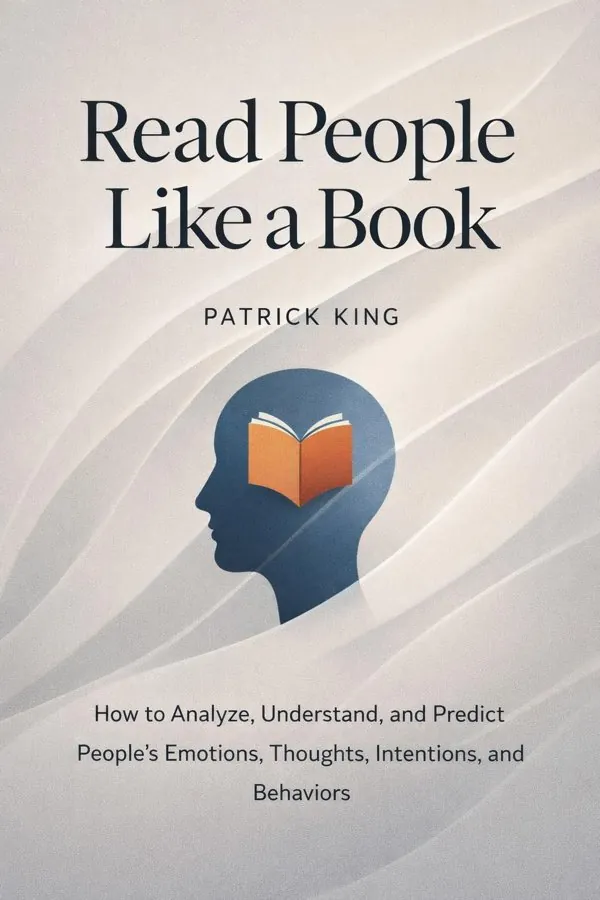
Read People Like a Book: How to Analyze, Understand, and Predict People’s Emotions, Thoughts, Intentions, and Behaviors: Summary & Key Insights
by Patrick King
 10 min9 chaptersAudio available
Key Takeaways from Read People Like a Book: How to Analyze, Understand, and Predict People’s Emotions, Thoughts, Intentions, and Behaviors
What you see in people is rarely the full story; behavior is usually the surface expression of something deeper.
The body often tells the truth before the mouth catches up.
People can manage their words, but emotions often leak out in fractions of a second.
Meaning lives not just in what people say, but in how they say it.
No behavior has a fixed meaning outside the situation surrounding it.
What Is Read People Like a Book: How to Analyze, Understand, and Predict People’s Emotions, Thoughts, Intentions, and Behaviors About?
Read People Like a Book: How to Analyze, Understand, and Predict People’s Emotions, Thoughts, Intentions, and Behaviors by Patrick King is a psychology book spanning 7 pages. Most people assume understanding others is a mysterious gift—something you either naturally have or you do not. Patrick King argues the opposite. In Read People Like a Book, he presents social insight as a learnable skill built on observation, psychology, emotional intelligence, and pattern recognition. Rather than relying on guesswork, the book teaches readers how to notice nonverbal behavior, interpret speech patterns, detect emotional shifts, and evaluate motives without jumping to simplistic conclusions. Its real value lies in showing that people constantly reveal themselves through clusters of signals, especially when words, tone, posture, and context do not align. This matters because nearly every part of life depends on accurate human understanding: relationships, work, leadership, negotiation, parenting, friendship, and self-protection. Misreading others can create conflict, missed opportunities, and unnecessary anxiety. King, known for writing practical books on communication and social dynamics, distills psychological concepts into usable tools for daily interaction. His approach is less about manipulation and more about clarity—helping readers become better listeners, sharper observers, and more empathetic communicators. The result is a practical guide to understanding what people feel, mean, hide, and need.
This FizzRead summary covers all 9 key chapters of Read People Like a Book: How to Analyze, Understand, and Predict People’s Emotions, Thoughts, Intentions, and Behaviors in approximately 10 minutes, distilling the most important ideas, arguments, and takeaways from Patrick King's work. Also available as an audio summary and Key Quotes Podcast.
Read People Like a Book: How to Analyze, Understand, and Predict People’s Emotions, Thoughts, Intentions, and Behaviors
Most people assume understanding others is a mysterious gift—something you either naturally have or you do not. Patrick King argues the opposite. In Read People Like a Book, he presents social insight as a learnable skill built on observation, psychology, emotional intelligence, and pattern recognition. Rather than relying on guesswork, the book teaches readers how to notice nonverbal behavior, interpret speech patterns, detect emotional shifts, and evaluate motives without jumping to simplistic conclusions. Its real value lies in showing that people constantly reveal themselves through clusters of signals, especially when words, tone, posture, and context do not align.
This matters because nearly every part of life depends on accurate human understanding: relationships, work, leadership, negotiation, parenting, friendship, and self-protection. Misreading others can create conflict, missed opportunities, and unnecessary anxiety. King, known for writing practical books on communication and social dynamics, distills psychological concepts into usable tools for daily interaction. His approach is less about manipulation and more about clarity—helping readers become better listeners, sharper observers, and more empathetic communicators. The result is a practical guide to understanding what people feel, mean, hide, and need.
Who Should Read Read People Like a Book: How to Analyze, Understand, and Predict People’s Emotions, Thoughts, Intentions, and Behaviors?
This book is perfect for anyone interested in psychology and looking to gain actionable insights in a short read. Whether you're a student, professional, or lifelong learner, the key ideas from Read People Like a Book: How to Analyze, Understand, and Predict People’s Emotions, Thoughts, Intentions, and Behaviors by Patrick King will help you think differently.
- ✓Readers who enjoy psychology and want practical takeaways
- ✓Professionals looking to apply new ideas to their work and life
- ✓Anyone who wants the core insights of Read People Like a Book: How to Analyze, Understand, and Predict People’s Emotions, Thoughts, Intentions, and Behaviors in just 10 minutes
Want the full summary?
Get instant access to this book summary and 100K+ more with Fizz Moment.
Get Free SummaryAvailable on App Store • Free to download
Key Chapters
What you see in people is rarely the full story; behavior is usually the surface expression of something deeper. Patrick King begins with the idea that if you want to read people accurately, you must first understand that thoughts, emotions, habits, fears, insecurities, and needs all shape outward behavior. A person who seems cold may actually be anxious. Someone who appears arrogant may be compensating for insecurity. Someone who talks too much may be seeking approval, not attention for its own sake.
This principle matters because most social mistakes come from taking behavior literally and personally. We assume another person’s tone reflects disrespect, when it may reflect stress. We interpret hesitation as dishonesty, when it may be uncertainty or fear of conflict. King encourages readers to think in terms of causes rather than labels. Instead of saying, “She is rude,” ask, “What emotional state, belief, or motive could be producing this behavior?” That shift creates more accurate analysis and better emotional control.
The book also emphasizes recurring psychological drivers: the desire for status, safety, belonging, control, validation, and comfort. These motives often explain why people interrupt, withdraw, boast, flatter, avoid eye contact, or overexplain. For example, in a workplace meeting, a colleague who keeps repeating their credentials may not be trying to dominate everyone; they may feel their authority is threatened. Recognizing this helps you respond strategically instead of reactively.
King’s larger point is that human behavior is patterned. People tend to reveal their priorities through repeated actions, not isolated moments. If you observe what consistently triggers them, calms them, energizes them, or shuts them down, you start understanding how they operate internally.
Actionable takeaway: Before judging behavior, ask yourself what need, fear, or emotional state could logically be driving it, and look for patterns across multiple interactions before forming conclusions.
The body often tells the truth before the mouth catches up. One of the book’s central ideas is that nonverbal communication forms the foundation of social reading because it is fast, instinctive, and often less controlled than speech. Posture, gestures, distance, movement, eye behavior, tension, and orientation all reveal clues about comfort, confidence, openness, resistance, and emotion.
King explains that body language should never be interpreted in isolation. Crossed arms do not automatically mean defensiveness; they may mean cold temperature, habit, or self-soothing. The goal is to identify clusters of signals. If crossed arms appear together with a tightened jaw, reduced eye contact, torso angled away, and shorter verbal responses, resistance becomes a more likely interpretation. If someone leans in, mirrors your posture, keeps their feet pointed toward you, and nods while listening, that cluster often suggests interest and engagement.
He also highlights the importance of baseline behavior. Some people naturally gesture broadly, avoid eye contact, or move restlessly. Without knowing their normal behavior, you can misread personality traits as emotional states. What matters is deviation. If a usually expressive person becomes physically restrained, something has changed. If a calm speaker begins fidgeting and touching their face during one topic, that topic likely carries emotional weight.
In practical terms, body language can help in interviews, meetings, dating, parenting, and difficult conversations. A manager may notice an employee saying, “That sounds fine,” while shrinking back and pressing their lips together. A parent may hear “Nothing’s wrong” while seeing slumped shoulders and downcast eyes. In both cases, the body invites a gentler follow-up.
Actionable takeaway: Observe nonverbal cues in clusters, compare them against the person’s usual baseline, and treat changes in body language as prompts for curiosity rather than instant judgment.
Meaning lives not just in what people say, but in how they say it. King devotes attention to vocal and verbal cues because speech carries emotion, confidence, intention, and social strategy. Tone, pace, volume, pauses, hesitations, overexplaining, clipped answers, vagueness, and repeated phrases all provide information about a person’s state of mind.
A confident statement delivered with a wavering tone can indicate self-doubt. A calm sentence spoken too quickly may reveal nervous energy. Long pauses before simple answers can suggest caution, discomfort, or active filtering. Overly formal language may signal emotional distance. Deflecting with jokes can indicate avoidance. Silence itself can be highly revealing: some silences reflect thoughtfulness, others resentment, fear, or passive resistance.
King’s approach is especially useful because it directs readers away from content alone. Many people focus on words and miss the emotional soundtrack beneath them. For example, “I’m fine” can mean acceptance, annoyance, sadness, or a request to stop asking, depending on tone and pacing. Similarly, a coworker who says, “No problem at all,” while emphasizing each word and speaking through a tight voice may be expressing the exact opposite.
He also notes that language patterns reveal thinking habits. People who speak in absolutes may be rigid or emotionally activated. People who constantly qualify statements may fear being wrong. Someone who repeatedly shifts blame in conversation may be protecting ego. In conflict, listening for these patterns helps you address the real issue rather than the literal wording.
This insight can transform daily communication. Better listening improves negotiation, leadership, intimacy, and conflict resolution because you hear what the speaker is emotionally communicating, not just what they are linguistically stating.
Actionable takeaway: In conversation, pay equal attention to tone, pace, pauses, and recurring language patterns, then ask yourself what emotional message is being carried beneath the words.
No behavior has a fixed meaning outside the situation surrounding it. One of King’s most important warnings is that accurate people-reading depends on context and congruence. A gesture, expression, or phrase can mean very different things depending on culture, environment, relationship history, timing, stress level, and the topic being discussed.
This is where many amateur observers go wrong. They learn one body language fact and apply it universally. But a person avoiding eye contact during a difficult conversation may be lying, ashamed, socially anxious, respectful, distracted, or simply tired. To interpret correctly, you have to ask: What is happening here? What just changed? What is normal for this person? What signals are matching, and what signals are conflicting?
Congruence means alignment across channels. When words, facial expression, tone, and body language all support each other, the message is easier to trust. When they conflict, that tension deserves attention. For example, if someone enthusiastically accepts an invitation but their shoulders drop, their smile is delayed, and their voice flattens, they may feel obligated rather than excited. The mismatch tells you more than the sentence itself.
King also emphasizes situational pressure. People behave differently when being evaluated, embarrassed, rushed, or socially uncertain. That does not make them fake; it makes them human. A person may appear stiff in a formal meeting and relaxed over coffee. Reading them accurately means accounting for environment, not just personality.
In everyday life, contextual thinking helps you avoid unnecessary offense and ask better follow-up questions. Instead of assuming a friend’s distractedness means disinterest, you consider that they may be overwhelmed. Instead of taking one awkward date as proof of incompatibility, you consider nerves and setting.
Actionable takeaway: Never assign meaning to a cue without checking the surrounding context, the person’s baseline, and whether their verbal and nonverbal signals are congruent.
The better you understand emotion, the less likely you are to misread people. King argues that empathy is not separate from social analysis; it is one of its most powerful tools. Without empathy, observation becomes cold pattern-matching and often leads to cynical or inaccurate conclusions. With empathy, you can imagine what the interaction feels like from the other person’s side, which sharpens interpretation.
Empathy helps because emotions create behavior. If you can recognize what shame, anxiety, pride, loneliness, defensiveness, excitement, or grief look and sound like in real situations, people become easier to understand. A defensive person may interrupt not because they disrespect you, but because they feel cornered. A withdrawn person may need safety, not pressure. A sarcastic person may be protecting vulnerability. Empathy turns symptoms back into human experiences.
King links this to emotional intelligence: awareness of your own emotions, sensitivity to others’ emotions, and the ability to regulate your response. If someone’s tense body language triggers your own insecurity, you may overreact. If you stay calm and curious, you gain better information. In this way, self-management becomes part of people-reading.
Practically, empathy improves how you respond after noticing cues. Suppose a colleague seems unusually quiet and avoids participation. A non-empathetic response might be, “Why are you being so unengaged?” An empathetic response is, “You seem quieter than usual today—is something on your mind?” The second approach invites truth.
King’s point is that accurate understanding is not about exposing others. It is about creating stronger communication and safer interactions. People reveal more when they feel understood than when they feel examined.
Actionable takeaway: Pair every observation with an empathetic question—ask what the person may be feeling, not just what their behavior seems to mean.
A single moment can mislead you, but repeated behavior tells a story. King stresses that if you want to predict people accurately, you should focus less on isolated incidents and more on patterns across time. Human beings are complex, but they are also habitual. Their beliefs, coping styles, emotional triggers, and interpersonal strategies tend to repeat.
This means prediction is less magical than it sounds. If someone regularly avoids hard conversations, becomes defensive when criticized, and delays decisions under pressure, you can reasonably expect similar behavior in future stressful situations. If a person consistently follows through, communicates clearly, and admits mistakes, that pattern predicts reliability better than any charming first impression.
King encourages readers to observe recurring themes: what topics energize someone, what threatens them, what makes them shut down, how they treat people with less power, how they handle frustration, and whether their words match their actions over time. These patterns reveal character, not just mood. For example, someone who is kind when comfortable but cruel when inconvenienced is showing you something essential about their emotional regulation.
This idea has powerful applications in dating, hiring, friendship, and leadership. Instead of asking, “How do I feel about this person right now?” ask, “What pattern am I seeing?” A persuasive speaker may still be unreliable if they repeatedly fail to follow through. A socially awkward person may still be deeply trustworthy if their actions are consistently honest and thoughtful.
Importantly, prediction should remain probabilistic, not absolute. Patterns suggest likely future behavior, but people can change—especially when motivations, environments, or consequences shift. Still, repeated actions remain one of the strongest indicators available.
Actionable takeaway: Keep a mental record of repeated behaviors, especially under stress, and base trust and expectations on long-term patterns rather than first impressions or isolated emotional moments.
The ability to understand people is powerful, and power always raises an ethical question. King closes this theme by making clear that reading people should not become a tool for exploitation, intimidation, or manipulation. The purpose of insight is better connection, wiser boundaries, clearer communication, and more compassionate judgment—not control.
This distinction matters because social knowledge can be abused. If you know someone fears rejection, you could pressure them. If you notice insecurity, you could sell more aggressively or dominate the conversation. But King encourages readers to use perception responsibly. Ethical awareness means respecting privacy, avoiding overconfidence, and remembering that no one can fully know another person from external signals alone.
He also warns against turning observation into suspicion. Not every inconsistency is deceit. Not every nervous gesture is guilt. People are messy, emotional, and influenced by countless invisible factors. Responsible interpretation means holding conclusions lightly and verifying them through conversation when possible.
An ethical reader of people uses insight to reduce harm. A leader notices burnout and offers support. A partner notices withdrawal and initiates a caring conversation. A friend senses discomfort and changes course. Even boundary-setting becomes more respectful when rooted in understanding. You can recognize manipulation without becoming manipulative yourself.
This approach also protects you from arrogance. The better you become at observation, the more tempting it is to believe you always know what others are thinking. King pushes against that certainty. Social intelligence includes humility—the willingness to say, “This is my best read, but I may be wrong.”
Actionable takeaway: Use your observations to create empathy, clarity, and healthier boundaries, and always confirm important interpretations through respectful dialogue rather than assuming your first read is the final truth.
All Chapters in Read People Like a Book: How to Analyze, Understand, and Predict People’s Emotions, Thoughts, Intentions, and Behaviors
About the Author
Patrick King is a communication writer and social interaction specialist known for practical books on psychology, emotional intelligence, conversation skills, and human behavior. His work focuses on making interpersonal insight usable in everyday life, especially for readers who want clearer communication, better relationships, and stronger social confidence. Rather than relying on heavy academic language, King is known for translating psychological concepts into straightforward tools and observations that readers can apply immediately. Across his books, he frequently explores topics such as reading body language, understanding motives, improving charisma, and handling difficult interactions. He has built a reputation as an accessible guide for people who want to become more perceptive, socially skilled, and emotionally intelligent in both personal and professional settings.
Get This Summary in Your Preferred Format
Read or listen to the Read People Like a Book: How to Analyze, Understand, and Predict People’s Emotions, Thoughts, Intentions, and Behaviors summary by Patrick King anytime, anywhere. FizzRead offers multiple formats so you can learn on your terms — all free.
Available formats: App · Audio · PDF · EPUB — All included free with FizzRead
Download Read People Like a Book: How to Analyze, Understand, and Predict People’s Emotions, Thoughts, Intentions, and Behaviors PDF and EPUB Summary
Key Quotes from Read People Like a Book: How to Analyze, Understand, and Predict People’s Emotions, Thoughts, Intentions, and Behaviors
“What you see in people is rarely the full story; behavior is usually the surface expression of something deeper.”
“The body often tells the truth before the mouth catches up.”
“People can manage their words, but emotions often leak out in fractions of a second.”
“Meaning lives not just in what people say, but in how they say it.”
“No behavior has a fixed meaning outside the situation surrounding it.”
Frequently Asked Questions about Read People Like a Book: How to Analyze, Understand, and Predict People’s Emotions, Thoughts, Intentions, and Behaviors
Read People Like a Book: How to Analyze, Understand, and Predict People’s Emotions, Thoughts, Intentions, and Behaviors by Patrick King is a psychology book that explores key ideas across 9 chapters. Most people assume understanding others is a mysterious gift—something you either naturally have or you do not. Patrick King argues the opposite. In Read People Like a Book, he presents social insight as a learnable skill built on observation, psychology, emotional intelligence, and pattern recognition. Rather than relying on guesswork, the book teaches readers how to notice nonverbal behavior, interpret speech patterns, detect emotional shifts, and evaluate motives without jumping to simplistic conclusions. Its real value lies in showing that people constantly reveal themselves through clusters of signals, especially when words, tone, posture, and context do not align. This matters because nearly every part of life depends on accurate human understanding: relationships, work, leadership, negotiation, parenting, friendship, and self-protection. Misreading others can create conflict, missed opportunities, and unnecessary anxiety. King, known for writing practical books on communication and social dynamics, distills psychological concepts into usable tools for daily interaction. His approach is less about manipulation and more about clarity—helping readers become better listeners, sharper observers, and more empathetic communicators. The result is a practical guide to understanding what people feel, mean, hide, and need.
More by Patrick King
The Science of Getting Started: How to Beat Procrastination, Get Motivated, and Get to Work
Patrick King
10 min
The Art of Witty Banter: Be Clever, Quick, & Magnetic
Patrick King
10 min
Better Small Talk: Talk to Anyone, Avoid Awkwardness, Generate Deep Conversations, and Make Real Friends
Patrick King
10 minYou Might Also Like
The Body Keeps the Score
Bessel van der Kolk
10 min
Surrounded by Idiots
Thomas Erikson
10 min
Emotional Intelligence
Daniel Goleman
10 min
Attached
Amir Levine
10 min
Why Does He Do That
Lundy Bancroft
10 min
Women Who Run with the Wolves
Clarissa Pinkola Estés
10 minBrowse by Category
Ready to read Read People Like a Book: How to Analyze, Understand, and Predict People’s Emotions, Thoughts, Intentions, and Behaviors?
Get the full summary and 100K+ more books with Fizz Moment.