
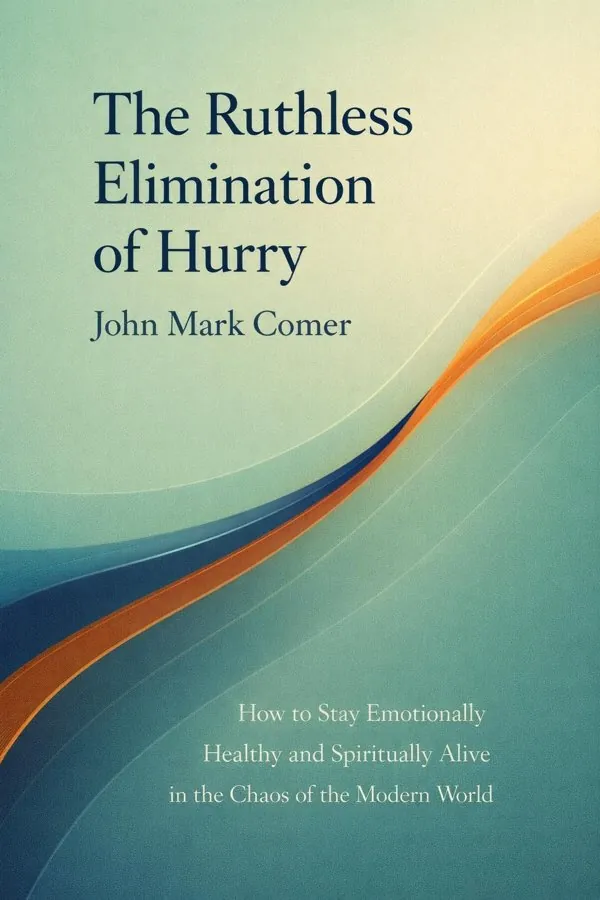
The Ruthless Elimination of Hurry: Summary & Key Insights
 10 min9 chaptersAudio available
Key Takeaways from The Ruthless Elimination of Hurry
One of the book’s most unsettling insights is that hurry often feels normal precisely because it is so destructive.
A surprising feature of the Gospels is not just what Jesus taught, but how he lived.
Many people separate faith from daily habit, but Comer insists that transformation happens through apprenticeship.
Freedom is often misunderstood as having no structure, but Comer argues that wise structure can actually create deeper freedom.
Few things are more uncomfortable for modern people than being alone in silence.
What Is The Ruthless Elimination of Hurry About?
The Ruthless Elimination of Hurry by John Mark Comer is a self-help book published in 2019 spanning 9 pages. The Ruthless Elimination of Hurry is John Mark Comer’s response to one of the defining problems of modern life: the constant feeling of being rushed, distracted, overcommitted, and emotionally exhausted. In this deeply practical and spiritually grounded book, Comer argues that hurry is more than a time-management issue. It is a way of life that damages our peace, relationships, attention, and capacity to experience God. Drawing from his own burnout, the wisdom of philosopher Dallas Willard, and the lifestyle of Jesus, Comer makes the case that slowing down is not optional for a healthy soul. He shows that the life of Jesus was marked by margin, stillness, prayer, and presence, even in the middle of enormous demands. The book blends spiritual insight with practical habits, inviting readers to resist the pressures of speed and reclaim a more rooted way of living. For anyone overwhelmed by nonstop work, technology, and noise, this book offers both diagnosis and hope: a path toward a calmer, more meaningful, and more loving life.
This FizzRead summary covers all 9 key chapters of The Ruthless Elimination of Hurry in approximately 10 minutes, distilling the most important ideas, arguments, and takeaways from John Mark Comer's work. Also available as an audio summary and Key Quotes Podcast.
The Ruthless Elimination of Hurry
The Ruthless Elimination of Hurry is John Mark Comer’s response to one of the defining problems of modern life: the constant feeling of being rushed, distracted, overcommitted, and emotionally exhausted. In this deeply practical and spiritually grounded book, Comer argues that hurry is more than a time-management issue. It is a way of life that damages our peace, relationships, attention, and capacity to experience God. Drawing from his own burnout, the wisdom of philosopher Dallas Willard, and the lifestyle of Jesus, Comer makes the case that slowing down is not optional for a healthy soul. He shows that the life of Jesus was marked by margin, stillness, prayer, and presence, even in the middle of enormous demands. The book blends spiritual insight with practical habits, inviting readers to resist the pressures of speed and reclaim a more rooted way of living. For anyone overwhelmed by nonstop work, technology, and noise, this book offers both diagnosis and hope: a path toward a calmer, more meaningful, and more loving life.
Who Should Read The Ruthless Elimination of Hurry?
This book is perfect for anyone interested in self-help and looking to gain actionable insights in a short read. Whether you're a student, professional, or lifelong learner, the key ideas from The Ruthless Elimination of Hurry by John Mark Comer will help you think differently.
- ✓Readers who enjoy self-help and want practical takeaways
- ✓Professionals looking to apply new ideas to their work and life
- ✓Anyone who wants the core insights of The Ruthless Elimination of Hurry in just 10 minutes
Want the full summary?
Get instant access to this book summary and 100K+ more with Fizz Moment.
Get Free SummaryAvailable on App Store • Free to download
Key Chapters
One of the book’s most unsettling insights is that hurry often feels normal precisely because it is so destructive. Many people think of hurry as a scheduling problem: too many meetings, too many errands, too much email. Comer argues that it goes much deeper. Hurry is a condition of the heart. It shows up as irritability, emotional numbness, distraction, superficial relationships, and an inability to be fully present. When life becomes a blur of tasks, the soul begins to shrink.
Comer builds on Dallas Willard’s famous warning that hurry is the great enemy of spiritual life in our time. The problem is not merely that hurry makes us tired. It trains us to live at a pace where love becomes difficult. Love requires attention, patience, and presence. Hurry destroys all three. A hurried person may still be productive, religious, and outwardly successful, but inwardly fragmented. That fragmentation affects prayer, friendships, marriage, parenting, and work.
The modern world rewards speed, responsiveness, and availability. Smartphones turn every pause into an opportunity to check, scroll, or react. The result is a life with no margin. Comer invites readers to notice the symptoms: snapping at loved ones, rushing through meals, treating rest as laziness, and feeling uneasy in silence. These are signs that the soul is not at peace.
A practical starting point is awareness. For one week, pay attention to when you feel rushed and how you behave in those moments. Notice what hurry does to your tone of voice, your body, your attention, and your relationships. The actionable takeaway: stop treating hurry as a badge of importance and begin treating it as a warning light for your inner life.
A surprising feature of the Gospels is not just what Jesus taught, but how he lived. He was rarely frantic. He walked from place to place. He lingered with people others ignored. He withdrew to lonely places to pray. He allowed interruptions to become ministry opportunities. In a culture that celebrates speed, Jesus embodied calm, depth, and attentiveness.
Comer emphasizes that Jesus lived under real pressure. Crowds demanded his time. People wanted healing, teaching, and answers. Yet he did not let urgency dictate his pace. He was busy at times, but never hurried in spirit. That distinction matters. Busyness may sometimes be unavoidable, but hurry is an interior condition of anxious drivenness.
Studying Jesus this way changes spiritual formation. The goal is not simply to agree with Jesus’ ideas, but to adopt his way of life. If Jesus is the model for human flourishing, then his rhythms are not incidental. Solitude, prayer, Sabbath, and presence were not extras added onto a full life. They were part of how he remained rooted in love.
This idea challenges many assumptions. We often imagine maturity as being able to carry more, move faster, and handle constant stimulation. Jesus suggests something different: strength looks like peace, clarity, and the freedom to say no. Following him means more than believing in him. It means learning his pace.
A practical application is to read one Gospel slowly and pay attention specifically to Jesus’ rhythm. Notice when he stops, withdraws, listens, or refuses demands. Ask what would change if you imitated those patterns in your own week. The actionable takeaway: begin measuring success not by how much you cram into a day, but by how closely your pace reflects the way of Jesus.
Many people separate faith from daily habit, but Comer insists that transformation happens through apprenticeship. An apprentice does not simply admire a master from a distance. An apprentice organizes life to learn the master’s way. In Christian terms, this means becoming a disciple of Jesus not only in belief, but in practice, posture, and routine.
This matters because people are always being formed by something. If we do not intentionally learn from Jesus, we will be shaped by the default forces of our age: consumerism, distraction, entertainment, ambition, and digital overload. The question is never whether we are being discipled, but by whom and into what kind of person.
Comer describes apprenticeship as involving three goals: be with Jesus, become like Jesus, and do what Jesus would do if he were you. That first goal, being with Jesus, is foundational. Without presence, spiritual activity easily becomes performance. Without intentional formation, good intentions collapse under the pressure of a rushed life.
In practical terms, apprenticeship means rethinking the structure of everyday life. A person might say they value peace, but if they begin every morning by checking notifications, racing out the door, and multitasking all day, their habits will form anxiety instead. The body learns a way of living long before the mind can explain it.
A simple application is to choose one daily routine and turn it into apprenticeship. For example, start the day with ten minutes of Scripture and quiet before touching your phone, or use your commute as a time for prayer instead of noise. The actionable takeaway: stop thinking of spiritual growth as accidental and start designing your life around becoming the kind of person Jesus would form.
Freedom is often misunderstood as having no structure, but Comer argues that wise structure can actually create deeper freedom. A rule of life is a set of intentional rhythms and practices that organize life around what matters most. It is not a legalistic checklist. It is a trellis that helps growth happen.
Without some kind of rule, modern life becomes reactive. Email, social media, work demands, family obligations, and endless options take over. People live by accident rather than conviction. A rule of life helps answer basic but powerful questions: When will I rest? When will I pray? How much technology is enough? What pace allows me to remain loving and attentive? What boundaries protect my soul?
Comer presents a rule of life as a practical tool for resisting chaos. It might include morning prayer, a weekly Sabbath, limits on screen time, shared meals, regular exercise, and times of solitude. The key is not copying someone else’s exact pattern but crafting one appropriate to your season of life. A parent of young children, a student, and a business leader may need different rhythms, but all need intentionality.
A rule of life also reduces decision fatigue. When priorities are pre-decided, it becomes easier to say no to invitations, opportunities, or habits that undermine peace. It helps translate values into repeated action.
To apply this, list the practices that help you become more patient, prayerful, and present. Then identify the habits that pull you toward stress and fragmentation. Build a simple weekly rhythm around the first list and set boundaries around the second. The actionable takeaway: create a realistic rule of life that protects your attention, honors your limits, and aligns your days with your deepest commitments.
Few things are more uncomfortable for modern people than being alone in silence. That discomfort reveals how dependent many of us have become on noise, stimulation, and constant input. Comer presents silence and solitude as essential practices for healing a hurried soul because they expose what busyness helps us avoid.
Solitude is being alone with God and yourself. Silence is quieting external noise so the heart can listen. Together, they create space for truth to surface. Hidden anxiety, grief, anger, fear, and exhaustion often rise when distractions are removed. This can feel unsettling at first, but it is also how healing begins. A life without quiet leaves little room for self-awareness or prayerful presence.
Comer does not romanticize these practices. They can be hard, especially for people conditioned by phones, podcasts, and perpetual activity. But silence trains attention. It weakens the compulsive need to react. It helps people relearn how to be instead of constantly doing. Even a few minutes of stillness can reveal how scattered the mind has become.
Practically, silence and solitude can begin very small. Sit in a chair for ten minutes without music, notifications, or tasks. Breathe slowly. Offer a short prayer. If thoughts race, do not panic; simply return your attention to God. You can also take a silent walk, leave your phone at home for a short outing, or create a technology-free corner in your home.
Over time, these practices deepen patience and emotional clarity. They also make it easier to hear what matters beneath the noise of daily life. The actionable takeaway: schedule a regular pocket of silence and solitude each day, even if brief, and protect it as a nonnegotiable space to recover attention and inner calm.
In a culture where worth is often tied to output, Sabbath sounds inefficient. That is exactly why Comer sees it as revolutionary. Sabbath is a full day each week set apart for rest, worship, delight, and freedom from normal work. It is not merely about recovery. It is a declaration that life is more than production.
Comer frames Sabbath as resistance to the lie that everything depends on us. When people never stop working, planning, fixing, and consuming, they begin to live as if they are machines rather than human beings. Sabbath interrupts that rhythm. It reminds us that we are finite, that God is in control, and that rest is an act of trust.
A healthy Sabbath is not just a day off to run errands or catch up on neglected tasks. It is qualitatively different from the rest of the week. It includes stopping paid and unpaid labor as much as possible, resting the body and mind, enjoying relationships, sharing meals, worshipping, and engaging in activities that replenish the soul. For some, that may mean a walk, a nap, reading, prayer, laughter, or time with family.
This practice can feel difficult at first because modern habits fight against it. Work follows us home through devices. Leisure often becomes passive consumption rather than true restoration. Starting small may help. Choose a consistent 24-hour period or a substantial block of time. Prepare beforehand so the day is not swallowed by chores.
Sabbath teaches that your value does not rise and fall with your efficiency. It helps retrain the nervous system away from constant striving. The actionable takeaway: designate a weekly Sabbath rhythm, prepare for it intentionally, and use it to stop working, receive rest, and remember that your life is held by more than your effort.
Clutter is not only physical. It can be mental, emotional, digital, financial, and relational. Comer argues that a hurried life is often sustained by excess: too many possessions, commitments, options, purchases, and inputs. Simplicity is the practice of reducing the unnecessary so that the essential can flourish.
The modern economy thrives on discontent. It trains people to want more, upgrade constantly, and equate abundance with accumulation. But every possession requires maintenance, every subscription demands attention, and every extra commitment takes energy. What looks like convenience can quietly become burden. Simplicity pushes back by asking: What do I really need? What supports love, peace, and presence? What is draining my life without adding meaning?
Comer connects simplicity to spiritual freedom. When people are less entangled in consumption and comparison, they are less anxious and more generous. Simplicity also creates margin. A simpler wardrobe, budget, schedule, or digital environment can reduce friction and decision fatigue. For example, limiting online shopping, decluttering one room, reducing optional commitments, or setting a cap on app usage can make life feel immediately lighter.
Importantly, simplicity is not deprivation for its own sake. It is a joyful narrowing. It is choosing depth over excess and sufficiency over endless desire. The goal is not austerity but attention.
To practice this, identify one area of overload this month: your closet, calendar, inbox, or screen habits. Remove or reduce what does not align with your values. Notice the emotional effect of having less to manage. The actionable takeaway: embrace simplicity as a deliberate way to free time, money, and mental space for relationships, prayer, and the things that truly nourish life.
Most people slow down only when they are forced to by illness, burnout, or failure. Comer suggests a better way: choose slowness before collapse makes it necessary. Slowing is not laziness or passivity. It is a spiritual discipline that retrains the body and mind to move at a human pace.
Hurry often lodges itself physically before we even notice it mentally. It shows up in fast speech, impatient driving, multitasking, shallow breathing, constant checking of the phone, and intolerance for delay. Slowing interrupts those automatic behaviors. It helps a person recover agency over their attention and reactions.
Comer offers examples that are almost deceptively simple: drive the speed limit, stand in the longest line, arrive early, eat without rushing, walk more slowly, do one task at a time, and leave the phone behind occasionally. These small acts matter because they expose the inner compulsion to optimize every moment. The goal is not to become inefficient but to become present.
This practice is especially powerful in routine moments. Instead of treating every inconvenience as an enemy, slowing allows it to become training. Waiting at a red light can become a cue to breathe. Walking from the car to the office can become a chance to notice your body and pray. A delayed response in a conversation can make room for listening instead of domination.
Over time, slowness reshapes character. It lowers reactivity and increases patience. It helps the body learn that not every moment must be conquered. The actionable takeaway: choose one ordinary activity each day, such as eating, walking, or driving, and practice doing it deliberately slowly as a way of training your soul out of hurry.
At the heart of Comer’s message is a simple but demanding truth: the opposite of hurry is not just rest, but presence. To be unhurried is to be fully available to God, to others, and to your own life. Presence is what hurry steals first. When the mind is elsewhere, relationships become transactional, prayer becomes mechanical, and even good moments pass unnoticed.
Comer shows that many people are physically present but emotionally absent. They are with their family while checking messages, in conversation while planning their next task, or at worship while mentally scanning unfinished work. This split attention weakens love because love requires actual encounter. People do not feel cared for by our efficiency. They feel cared for by our attention.
Living unhurried in a hurried world therefore requires more than isolated practices. It involves becoming the sort of person who can receive each moment rather than constantly racing ahead of it. That may mean limiting digital interruptions, creating phone-free meals, practicing single-tasking, or setting transition rituals between work and home so one sphere does not swallow the other.
Presence also changes spiritual life. Prayer becomes less about saying the right words and more about being with God. Everyday moments become meaningful when they are inhabited rather than rushed through.
A useful application is to identify one relationship that deserves your undivided attention. Create a regular space where devices are away and conversation is not squeezed between tasks. The actionable takeaway: treat attention as one of your most valuable gifts and practice giving it completely, because an unhurried life is ultimately a life able to love well.
All Chapters in The Ruthless Elimination of Hurry
About the Author
John Mark Comer is an American author, pastor, and teacher best known for his work on spiritual formation and the practice of following Jesus in contemporary culture. He previously served as the founding pastor of Bridgetown Church in Portland, Oregon, where he became known for thoughtful teaching on discipleship, identity, and the impact of modern habits on the soul. Comer’s writing blends theology, cultural analysis, and personal storytelling, often focusing on how ancient Christian practices can address modern problems such as anxiety, distraction, busyness, and burnout. His books have resonated with readers looking for a deeper, more intentional spiritual life. In The Ruthless Elimination of Hurry, he draws on both pastoral insight and personal experience to offer a compelling vision of peace, rest, and apprenticeship to Jesus.
Get This Summary in Your Preferred Format
Read or listen to the The Ruthless Elimination of Hurry summary by John Mark Comer anytime, anywhere. FizzRead offers multiple formats so you can learn on your terms — all free.
Available formats: App · Audio · PDF · EPUB — All included free with FizzRead
Download The Ruthless Elimination of Hurry PDF and EPUB Summary
Key Quotes from The Ruthless Elimination of Hurry
“One of the book’s most unsettling insights is that hurry often feels normal precisely because it is so destructive.”
“A surprising feature of the Gospels is not just what Jesus taught, but how he lived.”
“Many people separate faith from daily habit, but Comer insists that transformation happens through apprenticeship.”
“Freedom is often misunderstood as having no structure, but Comer argues that wise structure can actually create deeper freedom.”
“Few things are more uncomfortable for modern people than being alone in silence.”
Frequently Asked Questions about The Ruthless Elimination of Hurry
The Ruthless Elimination of Hurry by John Mark Comer is a self-help book that explores key ideas across 9 chapters. The Ruthless Elimination of Hurry is John Mark Comer’s response to one of the defining problems of modern life: the constant feeling of being rushed, distracted, overcommitted, and emotionally exhausted. In this deeply practical and spiritually grounded book, Comer argues that hurry is more than a time-management issue. It is a way of life that damages our peace, relationships, attention, and capacity to experience God. Drawing from his own burnout, the wisdom of philosopher Dallas Willard, and the lifestyle of Jesus, Comer makes the case that slowing down is not optional for a healthy soul. He shows that the life of Jesus was marked by margin, stillness, prayer, and presence, even in the middle of enormous demands. The book blends spiritual insight with practical habits, inviting readers to resist the pressures of speed and reclaim a more rooted way of living. For anyone overwhelmed by nonstop work, technology, and noise, this book offers both diagnosis and hope: a path toward a calmer, more meaningful, and more loving life.
More by John Mark Comer
You Might Also Like


Featured In
Browse by Category
Ready to read The Ruthless Elimination of Hurry?
Get the full summary and 100K+ more books with Fizz Moment.