
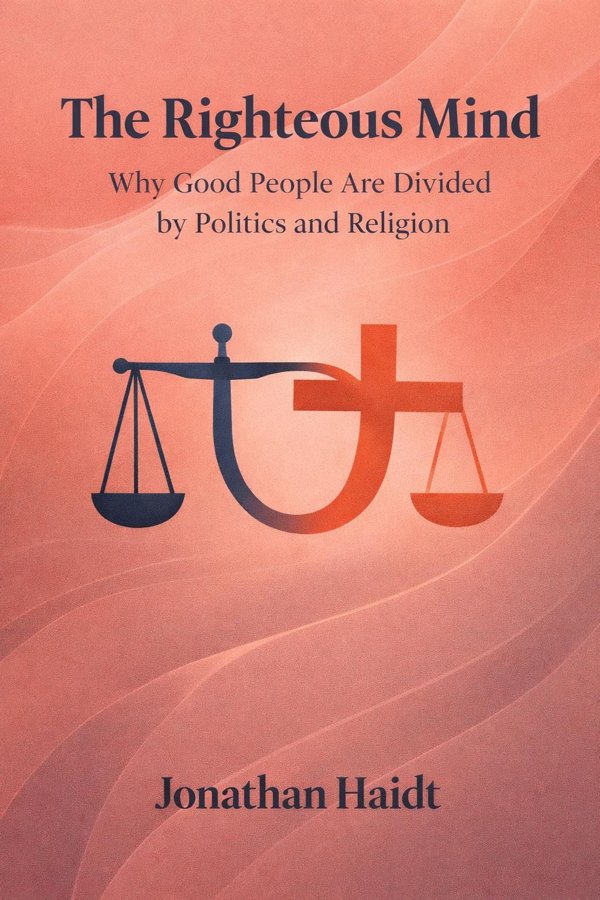
The Righteous Mind: Why Good People Are Divided by Politics and Religion: Summary & Key Insights
 10 min6 chaptersAudio available
What Is The Righteous Mind: Why Good People Are Divided by Politics and Religion About?
The Righteous Mind: Why Good People Are Divided by Politics and Religion by Jonathan Haidt is a psychology book spanning 6 pages. In this influential work, social psychologist Jonathan Haidt explores the psychological foundations of morality and how they shape political and religious divisions. Drawing on research in moral psychology, anthropology, and evolutionary theory, Haidt argues that moral reasoning is driven more by intuition than by rational thought. He introduces the concept of moral foundations—care, fairness, loyalty, authority, and sanctity—to explain why people across cultures and ideologies hold different moral priorities. The book seeks to foster understanding across ideological divides by revealing the shared moral roots of human behavior.
This FizzRead summary covers all 6 key chapters of The Righteous Mind: Why Good People Are Divided by Politics and Religion in approximately 10 minutes, distilling the most important ideas, arguments, and takeaways from Jonathan Haidt's work. Also available as an audio summary and Key Quotes Podcast.
The Righteous Mind: Why Good People Are Divided by Politics and Religion
In this influential work, social psychologist Jonathan Haidt explores the psychological foundations of morality and how they shape political and religious divisions. Drawing on research in moral psychology, anthropology, and evolutionary theory, Haidt argues that moral reasoning is driven more by intuition than by rational thought. He introduces the concept of moral foundations—care, fairness, loyalty, authority, and sanctity—to explain why people across cultures and ideologies hold different moral priorities. The book seeks to foster understanding across ideological divides by revealing the shared moral roots of human behavior.
Who Should Read The Righteous Mind: Why Good People Are Divided by Politics and Religion?
This book is perfect for anyone interested in psychology and looking to gain actionable insights in a short read. Whether you're a student, professional, or lifelong learner, the key ideas from The Righteous Mind: Why Good People Are Divided by Politics and Religion by Jonathan Haidt will help you think differently.
- ✓Readers who enjoy psychology and want practical takeaways
- ✓Professionals looking to apply new ideas to their work and life
- ✓Anyone who wants the core insights of The Righteous Mind: Why Good People Are Divided by Politics and Religion in just 10 minutes
Want the full summary?
Get instant access to this book summary and 100K+ more with Fizz Moment.
Get Free SummaryAvailable on App Store • Free to download
Key Chapters
When we imagine ourselves as moral beings, we tend to picture careful deliberation — a weighing of right and wrong, evidence and argument. But my research revealed a very different process. Moral judgments arise instantly and emotionally; reasoning arrives afterward, like a skillful attorney constructing a defense for a verdict already reached. This is the core of what I call the social intuitionist model.
In classic experiments, I presented participants with ethically puzzling scenarios — actions like consensual sibling intimacy that caused no direct harm. Many people condemned the act instinctively, yet when pressed to explain why, their reasons stumbled and faltered. Only later would they craft rationalizations to support their gut reactions. It became clear: emotion was the trigger, and reason, the post-hoc justification.
This understanding transforms how we view moral and political debates. We are not truth-seeking machines; we are storytelling creatures seeking social alignment. Moral reasoning evolved to help us persuade others and bind ourselves into cooperative groups, not to reach objective conclusions. Think of an elephant and its rider: the elephant represents powerful moral intuition, large and difficult to steer, while the rider — our reasoning mind — often just follows wherever the elephant goes, inventing stories about why it chose that path.
Recognizing this hierarchy between intuition and reason doesn’t mean abandoning rationality; it means understanding its role. If you want to change someone’s mind, appealing to logic alone won’t work. You must first engage the elephant — appeal to intuition, empathy, and shared values. Moral understanding begins, not when we argue better, but when we listen for the emotional foundations beneath another’s conviction.
Emotions are older, deeper, and faster than reasoning. To understand why moral discourse feels so personal and volatile, we must start with this truth. Moral emotions — empathy, indignation, guilt, disgust — are products of evolution, finely tuned to help our ancestors survive in cooperative groups. We are moral animals because morality kept our groups intact.
Consider disgust. Its primary purpose was once to protect us from toxins and disease, but it now operates at a symbolic level — we feel disgust at acts we deem morally polluting. Or take indignation: it is our emotional alarm system against cheating and unfairness, ensuring that cooperation is not exploited. Reason comes afterward, giving these gut feelings linguistic armor.
I like to say that reason is the dog’s tail, not the dog. The emotional dog wags the rational tail, which means our moral reasoning often reinforces our tribe’s position rather than seeks truth. This model explains why facts rarely dissolve ideological differences. When evidence threatens our group identity, our minds reflexively defend rather than revise.
Yet there’s hope. Once we become aware of the emotional dog, we can cultivate empathy for why others feel as they do. We can step out of our righteous certainty and treat disagreement not as defiance, but as data — glimpses into the emotional and cultural contexts that shape others’ moral maps. The goal is not to silence intuition, but to understand and harmonize it with others’. That, I believe, is the beginning of moral growth.
+ 4 more chapters — available in the FizzRead app
All Chapters in The Righteous Mind: Why Good People Are Divided by Politics and Religion
About the Author
Jonathan Haidt is an American social psychologist and professor of ethical leadership at New York University’s Stern School of Business. His research focuses on the psychology of morality, moral emotions, and cultural differences in moral reasoning. Haidt is also known for his work on happiness and the moral foundations theory, and he is a co-founder of the Heterodox Academy, an organization promoting viewpoint diversity in academia.
Get This Summary in Your Preferred Format
Read or listen to the The Righteous Mind: Why Good People Are Divided by Politics and Religion summary by Jonathan Haidt anytime, anywhere. FizzRead offers multiple formats so you can learn on your terms — all free.
Available formats: App · Audio · PDF · EPUB — All included free with FizzRead
Download The Righteous Mind: Why Good People Are Divided by Politics and Religion PDF and EPUB Summary
Key Quotes from The Righteous Mind: Why Good People Are Divided by Politics and Religion
“When we imagine ourselves as moral beings, we tend to picture careful deliberation — a weighing of right and wrong, evidence and argument.”
“Emotions are older, deeper, and faster than reasoning.”
Frequently Asked Questions about The Righteous Mind: Why Good People Are Divided by Politics and Religion
The Righteous Mind: Why Good People Are Divided by Politics and Religion by Jonathan Haidt is a psychology book that explores key ideas across 6 chapters. In this influential work, social psychologist Jonathan Haidt explores the psychological foundations of morality and how they shape political and religious divisions. Drawing on research in moral psychology, anthropology, and evolutionary theory, Haidt argues that moral reasoning is driven more by intuition than by rational thought. He introduces the concept of moral foundations—care, fairness, loyalty, authority, and sanctity—to explain why people across cultures and ideologies hold different moral priorities. The book seeks to foster understanding across ideological divides by revealing the shared moral roots of human behavior.
More by Jonathan Haidt
The Happiness Hypothesis: Finding Modern Truth in Ancient Wisdom
Jonathan Haidt
10 min
The Coddling of the American Mind: How Good Intentions and Bad Ideas Are Setting Up a Generation for Failure
Greg Lukianoff, Jonathan Haidt
10 min
The Anxious Generation: How the Great Rewiring of Childhood Is Causing an Epidemic of Mental Illness
Jonathan Haidt
10 minYou Might Also Like
The Body Keeps the Score
Bessel van der Kolk
10 min
Surrounded by Idiots
Thomas Erikson
10 min
Emotional Intelligence
Daniel Goleman
10 min
Attached
Amir Levine
10 min
Why Does He Do That
Lundy Bancroft
10 min
Women Who Run with the Wolves
Clarissa Pinkola Estés
10 minBrowse by Category
Ready to read The Righteous Mind: Why Good People Are Divided by Politics and Religion?
Get the full summary and 100K+ more books with Fizz Moment.