
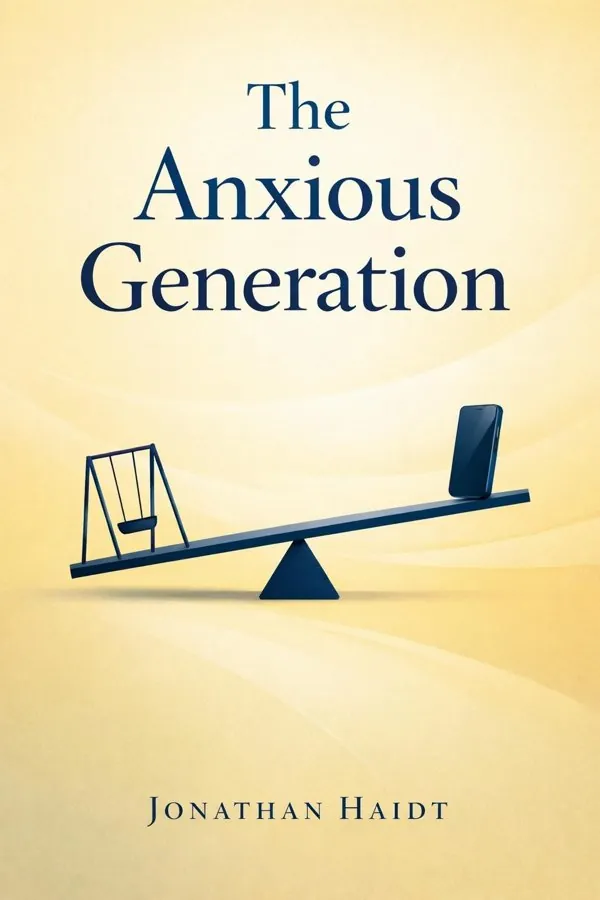
The Anxious Generation: How the Great Rewiring of Childhood Is Causing an Epidemic of Mental Illness: Summary & Key Insights
 10 min9 chaptersAudio available
What Is The Anxious Generation: How the Great Rewiring of Childhood Is Causing an Epidemic of Mental Illness About?
The Anxious Generation: How the Great Rewiring of Childhood Is Causing an Epidemic of Mental Illness by Jonathan Haidt is a psychology book spanning 9 pages. In this influential work, social psychologist Jonathan Haidt explores how the rapid shift from a play-based to a phone-based childhood has contributed to rising rates of anxiety, depression, and mental distress among young people. Drawing on psychological research, social data, and cultural analysis, Haidt argues that the 'great rewiring' of childhood—driven by smartphones and social media—has disrupted essential developmental processes. He offers evidence-based recommendations for parents, educators, and policymakers to restore balance and resilience in the next generation.
This FizzRead summary covers all 9 key chapters of The Anxious Generation: How the Great Rewiring of Childhood Is Causing an Epidemic of Mental Illness in approximately 10 minutes, distilling the most important ideas, arguments, and takeaways from Jonathan Haidt's work. Also available as an audio summary and Key Quotes Podcast.
The Anxious Generation: How the Great Rewiring of Childhood Is Causing an Epidemic of Mental Illness
In this influential work, social psychologist Jonathan Haidt explores how the rapid shift from a play-based to a phone-based childhood has contributed to rising rates of anxiety, depression, and mental distress among young people. Drawing on psychological research, social data, and cultural analysis, Haidt argues that the 'great rewiring' of childhood—driven by smartphones and social media—has disrupted essential developmental processes. He offers evidence-based recommendations for parents, educators, and policymakers to restore balance and resilience in the next generation.
Who Should Read The Anxious Generation: How the Great Rewiring of Childhood Is Causing an Epidemic of Mental Illness?
This book is perfect for anyone interested in psychology and looking to gain actionable insights in a short read. Whether you're a student, professional, or lifelong learner, the key ideas from The Anxious Generation: How the Great Rewiring of Childhood Is Causing an Epidemic of Mental Illness by Jonathan Haidt will help you think differently.
- ✓Readers who enjoy psychology and want practical takeaways
- ✓Professionals looking to apply new ideas to their work and life
- ✓Anyone who wants the core insights of The Anxious Generation: How the Great Rewiring of Childhood Is Causing an Epidemic of Mental Illness in just 10 minutes
Want the full summary?
Get instant access to this book summary and 100K+ more with Fizz Moment.
Get Free SummaryAvailable on App Store • Free to download
Key Chapters
To understand what we have lost, we must first recall what a typical childhood looked like before smartphones reshaped daily life. In the 1980s and 1990s, children were still raised in a physical world that rewarded exposure, exploration, and gradual independence. Play was unsupervised, creative, and communal. A pack of neighborhood kids could spend an entire afternoon inventing games, building makeshift forts, or wandering the woods. These unstructured experiences were not trivial—they were the crucibles in which independence, negotiation skills, and emotional regulation were forged.
Psychologists have long understood that play is the natural laboratory of the human mind. Through free play, children learn to manage fear, cooperate, and develop agency. They make mistakes, experience minor conflicts, solve them, and thereby prepare themselves for the complex social world ahead. Crucially, adults once trusted this process: parents assumed, often instinctively, that growth required a balance between freedom and care. Schools emphasized social learning as much as academic performance, and civic life relied on youth gradually encountering challenge and uncertainty.
The play-based childhood, then, was more than an innocent era of sandboxes and bicycles—it embodied a developmental principle. When we allowed children to manage small risks, we immunized them against larger ones. Navigating playground conflicts and scraped knees equipped them with the emotional antibodies that would later ward off anxiety and despair. The play-based childhood gave birth to generations who, despite imperfections, possessed strong social intuition and resilience born of real-world experience.
Around the early 2010s, a profound transformation swept across developed nations. Smartphones, first luxury objects for adults, became ubiquitous devices in the hands of children and adolescents. With them came social media platforms designed to capture attention and quantify approval—likes, follows, and shares became the currency of adolescent self-worth. Childhood, once located in backyards and schoolyards, migrated onto the digital frontier.
From the perspective of a developmental psychologist, this was an unprecedented experiment conducted on an entire generation without consent. The phone is not simply a communication tool; it is a portable social laboratory built on unpredictability and social comparison. Each notification triggers a tiny pulse of dopamine, reinforcing compulsive checking behaviors. Each scroll through curated feeds dredges up implicit judgments about one's body, popularity, and life satisfaction. Adolescents—the very stage in which self-concept is fragile—became subject to relentless surveillance by peers and algorithms alike.
The 'phone-based childhood' fundamentally rewires attention. Children learn to divide focus among multiple digital stimuli but rarely sustain deep concentration. Their capacity for boredom diminishes, as does tolerance for solitude. The consequences for sleep are severe. Bedtimes are delayed, circadian rhythms are disrupted, and the natural neurological repair mechanisms that regulate mood falter. The shift from physical to virtual social experiences undermines the embodied learning that once helped children develop empathy and social intuition. We handed them a device promising connection but delivered a mechanism of isolation.
+ 7 more chapters — available in the FizzRead app
All Chapters in The Anxious Generation: How the Great Rewiring of Childhood Is Causing an Epidemic of Mental Illness
About the Author
Jonathan Haidt is an American social psychologist and professor at New York University’s Stern School of Business. He is known for his research on moral psychology, cultural evolution, and the foundations of political ideology. Haidt is also the author of acclaimed books such as 'The Righteous Mind' and 'The Happiness Hypothesis.'
Get This Summary in Your Preferred Format
Read or listen to the The Anxious Generation: How the Great Rewiring of Childhood Is Causing an Epidemic of Mental Illness summary by Jonathan Haidt anytime, anywhere. FizzRead offers multiple formats so you can learn on your terms — all free.
Available formats: App · Audio · PDF · EPUB — All included free with FizzRead
Download The Anxious Generation: How the Great Rewiring of Childhood Is Causing an Epidemic of Mental Illness PDF and EPUB Summary
Key Quotes from The Anxious Generation: How the Great Rewiring of Childhood Is Causing an Epidemic of Mental Illness
“To understand what we have lost, we must first recall what a typical childhood looked like before smartphones reshaped daily life.”
“Around the early 2010s, a profound transformation swept across developed nations.”
Frequently Asked Questions about The Anxious Generation: How the Great Rewiring of Childhood Is Causing an Epidemic of Mental Illness
The Anxious Generation: How the Great Rewiring of Childhood Is Causing an Epidemic of Mental Illness by Jonathan Haidt is a psychology book that explores key ideas across 9 chapters. In this influential work, social psychologist Jonathan Haidt explores how the rapid shift from a play-based to a phone-based childhood has contributed to rising rates of anxiety, depression, and mental distress among young people. Drawing on psychological research, social data, and cultural analysis, Haidt argues that the 'great rewiring' of childhood—driven by smartphones and social media—has disrupted essential developmental processes. He offers evidence-based recommendations for parents, educators, and policymakers to restore balance and resilience in the next generation.
More by Jonathan Haidt

The Happiness Hypothesis: Finding Modern Truth in Ancient Wisdom
Jonathan Haidt
10 min
The Righteous Mind: Why Good People Are Divided by Politics and Religion
Jonathan Haidt
10 min
The Coddling of the American Mind: How Good Intentions and Bad Ideas Are Setting Up a Generation for Failure
Greg Lukianoff, Jonathan Haidt
10 minYou Might Also Like

The Body Keeps the Score
Bessel van der Kolk
10 min
Surrounded by Idiots
Thomas Erikson
10 min
Emotional Intelligence
Daniel Goleman
10 min
Attached
Amir Levine
10 min
Why Does He Do That
Lundy Bancroft
10 min
Women Who Run with the Wolves
Clarissa Pinkola Estés
10 minBrowse by Category
Ready to read The Anxious Generation: How the Great Rewiring of Childhood Is Causing an Epidemic of Mental Illness?
Get the full summary and 100K+ more books with Fizz Moment.