
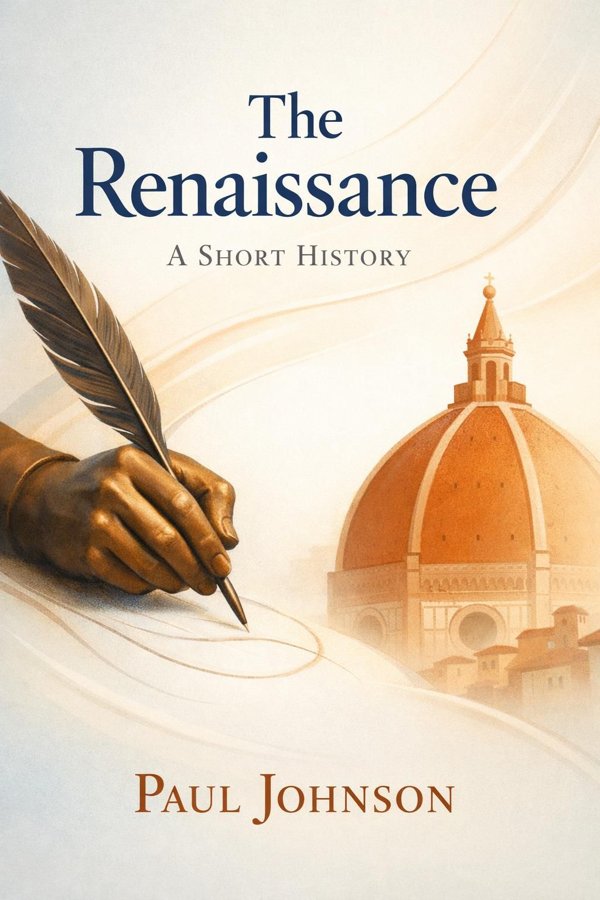
The Renaissance: A Short History: Summary & Key Insights
by Paul Johnson
 10 min9 chaptersAudio available
Key Takeaways from The Renaissance: A Short History
Great cultural revolutions rarely begin in unified, orderly nations; they often emerge from rivalry, wealth, and instability.
A civilization changes when it changes the questions it asks.
Art changes history when it teaches people to see differently.
New knowledge often begins when people trust observation more than inherited authority.
Political thought becomes more realistic when writers stop describing ideal rulers and start examining how power actually works.
What Is The Renaissance: A Short History About?
The Renaissance: A Short History by Paul Johnson is a world_history book spanning 11 pages. What happens when a civilization begins to believe again in the power of human talent, curiosity, and ambition? In The Renaissance: A Short History, Paul Johnson offers a lively and accessible account of the era that reshaped Europe between the fourteenth and seventeenth centuries. Rather than treating the Renaissance as a simple artistic movement, Johnson presents it as a broad cultural awakening that transformed painting, architecture, politics, religion, scholarship, and science. He shows how the age emerged from the competitive city-states of Italy, spread across Europe, and created new ways of thinking about individual achievement and worldly life. What makes this book matter is its clarity. Johnson distills a vast period into a sharp narrative centered on personalities, institutions, and ideas that still define modern culture. Readers encounter not only giants such as Leonardo, Michelangelo, Erasmus, and Machiavelli, but also the social and political conditions that made their work possible. As a noted historian with a gift for synthesis, Johnson brings authority and readability together. This short history is valuable because it explains why the Renaissance was not merely a rebirth of the past, but a turning point in the making of the modern world.
This FizzRead summary covers all 9 key chapters of The Renaissance: A Short History in approximately 10 minutes, distilling the most important ideas, arguments, and takeaways from Paul Johnson's work. Also available as an audio summary and Key Quotes Podcast.
The Renaissance: A Short History
What happens when a civilization begins to believe again in the power of human talent, curiosity, and ambition? In The Renaissance: A Short History, Paul Johnson offers a lively and accessible account of the era that reshaped Europe between the fourteenth and seventeenth centuries. Rather than treating the Renaissance as a simple artistic movement, Johnson presents it as a broad cultural awakening that transformed painting, architecture, politics, religion, scholarship, and science. He shows how the age emerged from the competitive city-states of Italy, spread across Europe, and created new ways of thinking about individual achievement and worldly life.
What makes this book matter is its clarity. Johnson distills a vast period into a sharp narrative centered on personalities, institutions, and ideas that still define modern culture. Readers encounter not only giants such as Leonardo, Michelangelo, Erasmus, and Machiavelli, but also the social and political conditions that made their work possible. As a noted historian with a gift for synthesis, Johnson brings authority and readability together. This short history is valuable because it explains why the Renaissance was not merely a rebirth of the past, but a turning point in the making of the modern world.
Who Should Read The Renaissance: A Short History?
This book is perfect for anyone interested in world_history and looking to gain actionable insights in a short read. Whether you're a student, professional, or lifelong learner, the key ideas from The Renaissance: A Short History by Paul Johnson will help you think differently.
- ✓Readers who enjoy world_history and want practical takeaways
- ✓Professionals looking to apply new ideas to their work and life
- ✓Anyone who wants the core insights of The Renaissance: A Short History in just 10 minutes
Want the full summary?
Get instant access to this book summary and 100K+ more with Fizz Moment.
Get Free SummaryAvailable on App Store • Free to download
Key Chapters
Great cultural revolutions rarely begin in unified, orderly nations; they often emerge from rivalry, wealth, and instability. Johnson argues that the Renaissance was born in the fragmented world of Italian city-states, where Florence, Venice, Milan, and Rome competed fiercely for prestige, trade, and influence. These urban centers were not just political entities but laboratories of ambition. Merchants funded churches, bankers financed artists, and rulers sponsored architecture and scholarship to display power and refinement.
This setting mattered because competition encouraged innovation. Florence supported painters and sculptors who could glorify the city. Venice used its maritime wealth to promote luxury, printing, and diplomacy. Rome, especially under powerful popes, became a vast stage for artistic and architectural grandeur. In this environment, talent was rewarded, and public life became linked to visible achievement.
Johnson shows that the Renaissance did not appear by accident or through abstract ideas alone. It depended on institutions, money, patronage, and urban confidence. The Medici family in Florence, for example, helped create a culture where artists and scholars could experiment. Political disorder, paradoxically, also produced creativity: city-states had to define themselves constantly through visible excellence.
A practical way to understand this today is to notice how innovation still clusters in competitive environments, whether in technology hubs, creative industries, or universities. Talent grows faster where resources, audiences, and rivalry meet.
Actionable takeaway: when studying any cultural movement, look beyond genius alone and ask what social conditions, incentives, and institutions allowed that genius to flourish.
A civilization changes when it changes the questions it asks. At the heart of the Renaissance, Johnson places humanism: the recovery of classical learning and the renewed belief that human beings possess dignity, rationality, and moral agency. Humanists such as Petrarch, Erasmus, and later a wide circle of scholars turned to Greek and Roman texts not simply to admire antiquity, but to reshape education and public life.
Humanism emphasized grammar, rhetoric, history, poetry, and moral philosophy. This curriculum aimed to form articulate, thoughtful citizens rather than merely train theologians. The movement encouraged close reading, textual criticism, and historical awareness. It taught that language matters, that eloquence is a civic tool, and that education should cultivate judgment.
Johnson makes clear that humanism was not identical with secularism. Many humanists remained deeply religious. What changed was the balance of attention. Instead of seeing earthly life only as preparation for eternity, Renaissance thinkers increasingly valued human achievement within history. Portraiture, biography, and civic writing all reflected this new interest in the individual person.
The practical relevance is striking. Modern liberal education, the study of the humanities, and the idea that reading deeply shapes character all trace part of their lineage to this period. Even today, when people debate whether education should create workers or citizens, they are revisiting a Renaissance question.
Actionable takeaway: read one foundational text slowly and critically, asking not just what it says, but how it forms your judgment, language, and sense of human possibility.
Art changes history when it teaches people to see differently. Johnson presents Renaissance art as more than decoration or religious illustration; it was a revolution in perception. Artists began to study anatomy, perspective, proportion, light, and emotion with unprecedented seriousness. The result was a new visual language that made human figures appear weighty, expressive, and alive.
This transformation can be seen in figures such as Leonardo da Vinci, Michelangelo, Raphael, and earlier pioneers like Giotto and Masaccio. Their works aimed to represent the world with greater realism while also elevating it through ideal form. Perspective gave paintings spatial depth. Anatomical study gave bodies structure and movement. Classical models offered a vocabulary of beauty and balance.
Johnson also emphasizes that Renaissance art reflected the age’s confidence in human capability. A painted face was no longer merely symbolic; it became a record of character. Public sculpture celebrated civic pride. Architecture revived classical harmony to project order and grandeur. The artist, once often treated as a craftsman, increasingly became a celebrated individual creator.
There is a practical lesson here for modern readers in any field: breakthrough work often comes from joining technical mastery with close observation. Leonardo’s notebooks show that curiosity across disciplines can strengthen creativity rather than distract from it.
Actionable takeaway: choose one masterpiece of Renaissance art and study it carefully for ten minutes, noticing perspective, gesture, emotion, and symbolism; train yourself to see how technique shapes meaning.
New knowledge often begins when people trust observation more than inherited authority. Johnson links the Renaissance to the early growth of scientific inquiry by showing how curiosity, skepticism, and disciplined investigation gained cultural legitimacy. This was not yet the fully developed Scientific Revolution, but it created the habits that made later discoveries possible.
Renaissance thinkers pursued anatomy, engineering, astronomy, cartography, and mathematics with renewed energy. Leonardo’s investigations into flight, mechanics, and the human body reveal a mind unwilling to accept appearances without analysis. Advances in navigation depended on better measurement and mapmaking. The rediscovery of ancient texts also stimulated debate by exposing Europeans to alternative intellectual frameworks.
Johnson’s broader point is that the Renaissance widened the boundaries of the knowable world. People began to believe that nature could be examined systematically and that old errors could be corrected. Printing accelerated this process by spreading diagrams, observations, and arguments more rapidly than manuscript culture had allowed.
In modern life, the same principle applies whenever evidence challenges tradition. Productive inquiry does not require contempt for the past; it requires a willingness to test assumptions. Renaissance culture did not abandon authority overnight, but it made room for disciplined doubt.
Actionable takeaway: when confronted with a claim, ask three Renaissance-style questions: What is the evidence? What can be observed directly? What might previous authorities have missed?
Political thought becomes more realistic when writers stop describing ideal rulers and start examining how power actually works. Johnson uses the Renaissance, especially through Machiavelli, to show a decisive shift in political analysis. In the turbulent world of Italian warfare, unstable alliances, and civic conflict, politics could not be understood purely in moral or theological terms. It had to be studied as action under pressure.
Machiavelli’s importance lies in his candor. He looked at states as fragile human constructions that survive through calculation, institutions, force, and adaptability. Johnson does not reduce the Renaissance to cynicism, but he shows that the era produced a harder-edged understanding of leadership. Rulers had to manage reputation, military strength, and fortune. Civic republics had to cultivate citizen virtue while defending themselves from internal corruption and external threats.
This political realism emerged from lived conditions. Florence’s internal struggles, papal ambitions, French invasions, and shifting alliances made idealism insufficient. Renaissance diplomacy became more professional, and the state itself grew more self-conscious.
The modern application is obvious. Effective leadership still requires balancing ethical aspiration with practical reality. Whether in government, business, or community organizations, leaders fail when they ignore incentives, institutions, and human weakness.
Actionable takeaway: when evaluating leadership, do not ask only whether a vision sounds noble; ask whether the system, incentives, and strategy can sustain it in the real world.
Periods of rebirth often unsettle the institutions they seem to strengthen. Johnson shows that the Renaissance deeply affected religion by intensifying both devotion and criticism. The papacy became a major patron of art and architecture, turning Rome into a center of magnificence. Yet this same worldliness exposed the Church to charges of corruption, vanity, and misplaced priorities.
Humanist scholarship played a critical role. Thinkers such as Erasmus applied philological methods to biblical and patristic texts, seeking a purer Christianity rooted in scripture and moral seriousness. This textual scrutiny encouraged reform-minded criticism. Meanwhile, the display of power by Renaissance popes highlighted a tension between spiritual mission and political ambition.
Johnson suggests that the Renaissance helped prepare the ground for the Reformation, not because it caused it directly, but because it sharpened habits of questioning, revived original sources, and made institutional contradictions more visible. Religious life became more individualized in some ways, yet also more contested.
This matters today because it shows that criticism from within a tradition can be a source of renewal, not merely rebellion. Reform often begins when people love an institution enough to measure it against its professed ideals.
Actionable takeaway: when assessing any institution, compare its founding principles with its present practices; meaningful reform starts with that honest contrast.
A society’s imagination expands when its maps do. Johnson connects the Renaissance not only to paintings and books, but to voyages, trade routes, and the widening horizons of European life. Exploration transformed how Europeans understood geography, commerce, power, and themselves. The age that rediscovered antiquity also encountered lands, peoples, and opportunities unknown to classical authorities.
Improved navigation, shipbuilding, cartography, and mathematical skill made longer voyages more feasible. Maritime powers such as Venice and later Iberian kingdoms turned movement across seas into an engine of wealth and influence. Exploration intensified curiosity about the natural world and also challenged inherited assumptions. Ancient texts remained influential, but experience increasingly corrected them.
Johnson’s treatment implies a double legacy. On one hand, expansion enriched knowledge, stimulated trade, and linked continents more directly. On the other, it opened the door to conquest, exploitation, and imperial domination. The Renaissance spirit of enterprise was therefore creative and destructive at once.
The practical application is intellectual as much as historical. Growth often requires leaving the familiar, but expansion without ethics can become predation. New horizons demand new moral seriousness.
Actionable takeaway: whenever you celebrate innovation or expansion, also ask who benefits, who bears the cost, and what responsibilities come with newly acquired power.
Cultural movements become historical turning points only when they travel. Johnson stresses that the Renaissance did not remain an Italian phenomenon. Its ideas moved northward and westward, reshaped by local conditions in France, the Low Countries, Germany, England, and Spain. As it spread, the Renaissance became less a single style and more a family of related developments.
Northern humanism, for instance, often placed greater emphasis on moral reform, biblical scholarship, and social criticism than did some of its Italian counterparts. Erasmus exemplified this variation: classical learning served Christian renewal rather than civic pageantry. In England, Renaissance influences helped energize literature, education, and statecraft. In the visual arts of the North, oil painting, domestic realism, and intricate symbolism flourished.
Johnson’s point is important: the Renaissance was never uniform. Different societies received its impulses selectively. Some adopted classical forms; others embraced philology or educational reform. Printing made this spread faster and more durable, creating a Europe-wide conversation among scholars, rulers, and artists.
This has a modern parallel in how ideas globalize today. A concept born in one place rarely arrives elsewhere unchanged. It is translated, adapted, resisted, and blended with existing traditions.
Actionable takeaway: when encountering a major idea, study not just its origin but its adaptations; the differences between versions often reveal how culture really works.
Historical eras matter most when they alter what later generations consider normal. Johnson concludes, in effect, that the Renaissance changed Europe’s assumptions about individuality, education, beauty, political life, and cultural achievement. It elevated the status of the artist and scholar, deepened respect for classical antiquity, encouraged critical reading, and made worldly accomplishment more admirable.
This legacy extended unevenly across society. Women participated in Renaissance culture as patrons, writers, and educated elites, yet their opportunities remained sharply constrained. Courts might celebrate refinement while preserving hierarchy. Urban brilliance coexisted with poverty and exclusion. Johnson’s account reminds readers that cultural flowering does not automatically produce social equality.
Even so, the long-term impact was immense. Renaissance habits of inquiry fed later scientific developments. Humanist education shaped elite formation for centuries. Artistic standards set in this period became benchmarks of excellence. Political realism influenced modern statecraft. The era’s confidence in human capacity helped prepare the ground for modernity itself.
For contemporary readers, the Renaissance offers both inspiration and caution. It demonstrates what can happen when talent, patronage, learning, and ambition converge. But it also shows that brilliance can coexist with violence, vanity, and inequality.
Actionable takeaway: inherit the Renaissance selectively—value its curiosity, craft, and belief in human possibility, while remaining alert to the exclusions and power struggles that accompanied its achievements.
All Chapters in The Renaissance: A Short History
About the Author
Paul Johnson (1928–2023) was a British historian, journalist, and public intellectual known for writing ambitious works of history for a broad readership. Educated in England, he first built his reputation in journalism before becoming one of the most widely read narrative historians in the English-speaking world. His books include Modern Times, Intellectuals, A History of the American People, and many shorter studies of major figures and eras. Johnson’s hallmark was his ability to synthesize vast subjects into clear, energetic prose shaped by strong interpretation and vivid storytelling. Though sometimes controversial for his judgments, he remained respected for his range, readability, and confidence as a historian. In The Renaissance: A Short History, he brings those strengths to one of Europe’s most formative periods.
Get This Summary in Your Preferred Format
Read or listen to the The Renaissance: A Short History summary by Paul Johnson anytime, anywhere. FizzRead offers multiple formats so you can learn on your terms — all free.
Available formats: App · Audio · PDF · EPUB — All included free with FizzRead
Download The Renaissance: A Short History PDF and EPUB Summary
Key Quotes from The Renaissance: A Short History
“Great cultural revolutions rarely begin in unified, orderly nations; they often emerge from rivalry, wealth, and instability.”
“A civilization changes when it changes the questions it asks.”
“Art changes history when it teaches people to see differently.”
“New knowledge often begins when people trust observation more than inherited authority.”
“Political thought becomes more realistic when writers stop describing ideal rulers and start examining how power actually works.”
Frequently Asked Questions about The Renaissance: A Short History
The Renaissance: A Short History by Paul Johnson is a world_history book that explores key ideas across 9 chapters. What happens when a civilization begins to believe again in the power of human talent, curiosity, and ambition? In The Renaissance: A Short History, Paul Johnson offers a lively and accessible account of the era that reshaped Europe between the fourteenth and seventeenth centuries. Rather than treating the Renaissance as a simple artistic movement, Johnson presents it as a broad cultural awakening that transformed painting, architecture, politics, religion, scholarship, and science. He shows how the age emerged from the competitive city-states of Italy, spread across Europe, and created new ways of thinking about individual achievement and worldly life. What makes this book matter is its clarity. Johnson distills a vast period into a sharp narrative centered on personalities, institutions, and ideas that still define modern culture. Readers encounter not only giants such as Leonardo, Michelangelo, Erasmus, and Machiavelli, but also the social and political conditions that made their work possible. As a noted historian with a gift for synthesis, Johnson brings authority and readability together. This short history is valuable because it explains why the Renaissance was not merely a rebirth of the past, but a turning point in the making of the modern world.
More by Paul Johnson
You Might Also Like
The Age of Capital
Eric Hobsbawm
10 min
The Gulag Archipelago
Aleksandr Solzhenitsyn
10 min
Jerusalem: The Biography
Simon Sebag Montefiore
10 min
The Anglo-Saxons
James Campbell
10 min
The Boer War
Thomas Pakenham
10 min
The Industrial Revolutionaries: The Making of the Modern World 1776–1914
Gavin Weightman
10 minBrowse by Category
Ready to read The Renaissance: A Short History?
Get the full summary and 100K+ more books with Fizz Moment.