
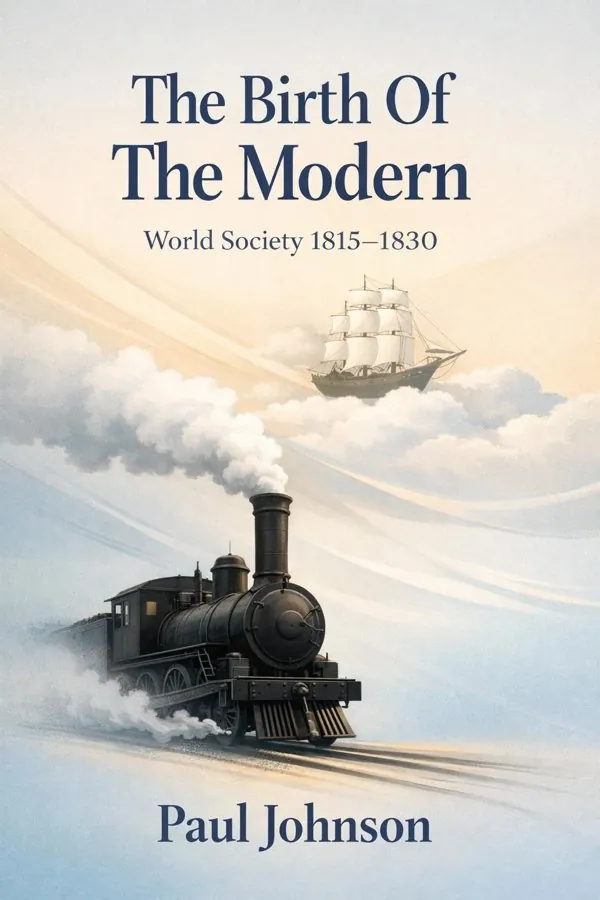
The Birth Of The Modern: World Society 1815–1830: Summary & Key Insights
by Paul Johnson
 10 min12 chaptersAudio available
What Is The Birth Of The Modern: World Society 1815–1830 About?
The Birth Of The Modern: World Society 1815–1830 by Paul Johnson is a world_history book spanning 12 pages. A sweeping historical narrative that explores the transformation of global society between 1815 and 1830, following the end of the Napoleonic Wars. Paul Johnson examines how political, cultural, technological, and social changes during this period laid the foundations for the modern world, covering figures such as Byron, Beethoven, and Bolívar, and events from the Congress of Vienna to the rise of industrialization.
This FizzRead summary covers all 12 key chapters of The Birth Of The Modern: World Society 1815–1830 in approximately 10 minutes, distilling the most important ideas, arguments, and takeaways from Paul Johnson's work. Also available as an audio summary and Key Quotes Podcast.
The Birth Of The Modern: World Society 1815–1830
A sweeping historical narrative that explores the transformation of global society between 1815 and 1830, following the end of the Napoleonic Wars. Paul Johnson examines how political, cultural, technological, and social changes during this period laid the foundations for the modern world, covering figures such as Byron, Beethoven, and Bolívar, and events from the Congress of Vienna to the rise of industrialization.
Who Should Read The Birth Of The Modern: World Society 1815–1830?
This book is perfect for anyone interested in world_history and looking to gain actionable insights in a short read. Whether you're a student, professional, or lifelong learner, the key ideas from The Birth Of The Modern: World Society 1815–1830 by Paul Johnson will help you think differently.
- ✓Readers who enjoy world_history and want practical takeaways
- ✓Professionals looking to apply new ideas to their work and life
- ✓Anyone who wants the core insights of The Birth Of The Modern: World Society 1815–1830 in just 10 minutes
Want the full summary?
Get instant access to this book summary and 100K+ more with Fizz Moment.
Get Free SummaryAvailable on App Store • Free to download
Key Chapters
In 1815, Europe stood exhausted but alive. Twenty-two years of war had overturned dynasties and consumed millions of lives. The Congress of Vienna was convened not merely to partition territory but to rebuild psychology—to restore a sense of order to a continent traumatized by revolution and conquest. My argument here is straightforward: the Congress symbolized both the desire for stability and the seeds of change. On one hand, Metternich, Castlereagh, and Talleyrand labored to redraw frontiers, balancing great powers to prevent another Napoleon; on the other, the very process of negotiation revealed a new political consciousness. Diplomacy became less about divine right and more about reasoned equilibrium—a secular system replacing metaphysical monarchy.
Yet stability came at a cost. Restoration meant reinstating reactionary regimes in France, Italy, and Germany, suppressing liberal aspirations. But underneath this apparent calm, the currents of change flowed inexorably. The people who had fought, read pamphlets, and discussed constitutions during the revolutionary years could not forget. This European settlement was therefore a paradox: it succeeded in preserving peace but inadvertently created pressure for reform. The Congress of Vienna inaugurated the European Concert—an early form of collective security—but also laid the foundation for nationalist complaint.
In writing this section, I wanted the reader to feel the tension between government and society. As monarchs rebuilt palaces, citizens rebuilt hopes. The peace of Vienna was a triumph of diplomacy but a failure of imagination. However, it gave Europe a crucial respite: fifteen years in which invention, art, and social experiment could flourish. The old order restored the shell of Europe; inside, the modern world began slowly to hatch.
Every age has its vocabulary of freedom, and the years after 1815 were incandescent with invention—not of machines, but of words and ideas. Liberalism meant constitutionalism, equality before the law, and the primacy of reason. Nationalism meant a people’s right to self-determination. Conservatism meant loyalty to inherited institutions and moral continuity. Each was born of postwar experience.
I depict the ideological conflict of those years as a vivid dialogue among unequals—aristocrats defending privilege, bourgeois thinkers demanding participation, radicals envisioning republics. The writings of Bentham, the speeches of Canning, the struggles in Spain and the Italian states—all illustrate how modern society began to think politically in terms of competing principles rather than divine commands.
What fascinates me is that these ideologies were not abstractions floating above society; they were embodied in streets and workshops, salons and pulpits. The liberal believed the machine age would bring prosperity and education. The conservative feared it would destroy tradition and faith. The nationalist felt the steamship and press were instruments to unite a people across geography. In this ideological triad—liberal, conservative, national—we see the architecture of modern politics emerge. The contest did not destroy Europe’s peace; it converted that peace into moral energy.
+ 10 more chapters — available in the FizzRead app
All Chapters in The Birth Of The Modern: World Society 1815–1830
About the Author
Paul Johnson (1928–2023) was a British historian, journalist, and author known for his wide-ranging works on history, politics, and culture. His books include 'Modern Times', 'A History of the American People', and 'Intellectuals'. He was recognized for his accessible narrative style and conservative perspective on historical interpretation.
Get This Summary in Your Preferred Format
Read or listen to the The Birth Of The Modern: World Society 1815–1830 summary by Paul Johnson anytime, anywhere. FizzRead offers multiple formats so you can learn on your terms — all free.
Available formats: App · Audio · PDF · EPUB — All included free with FizzRead
Download The Birth Of The Modern: World Society 1815–1830 PDF and EPUB Summary
Key Quotes from The Birth Of The Modern: World Society 1815–1830
“In 1815, Europe stood exhausted but alive.”
“Every age has its vocabulary of freedom, and the years after 1815 were incandescent with invention—not of machines, but of words and ideas.”
Frequently Asked Questions about The Birth Of The Modern: World Society 1815–1830
The Birth Of The Modern: World Society 1815–1830 by Paul Johnson is a world_history book that explores key ideas across 12 chapters. A sweeping historical narrative that explores the transformation of global society between 1815 and 1830, following the end of the Napoleonic Wars. Paul Johnson examines how political, cultural, technological, and social changes during this period laid the foundations for the modern world, covering figures such as Byron, Beethoven, and Bolívar, and events from the Congress of Vienna to the rise of industrialization.
More by Paul Johnson
You Might Also Like
The Age of Capital
Eric Hobsbawm
10 min
The Gulag Archipelago
Aleksandr Solzhenitsyn
10 min
Jerusalem: The Biography
Simon Sebag Montefiore
10 min
The Anglo-Saxons
James Campbell
10 min
The Boer War
Thomas Pakenham
10 min
The Industrial Revolutionaries: The Making of the Modern World 1776–1914
Gavin Weightman
10 minBrowse by Category
Ready to read The Birth Of The Modern: World Society 1815–1830?
Get the full summary and 100K+ more books with Fizz Moment.