
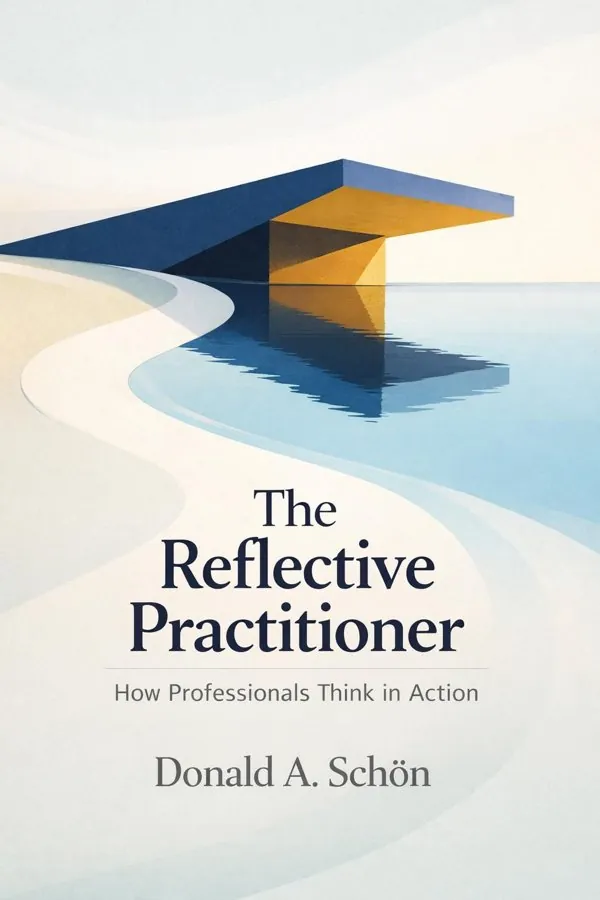
The Reflective Practitioner: How Professionals Think in Action: Summary & Key Insights
 10 min9 chaptersAudio available
Key Takeaways from The Reflective Practitioner: How Professionals Think in Action
A profession loses credibility when its experts can explain their theories but cannot reliably navigate the messiness of practice.
The most dangerous professional illusion is believing that every important problem can be solved by applying the right technique.
Much of professional competence lives in action before it ever appears in words.
Expertise is not just doing smoothly; it is noticing when smooth performance is no longer enough.
Reality does not simply wait for professionals to impose a solution; it responds, resists, and teaches.
What Is The Reflective Practitioner: How Professionals Think in Action About?
The Reflective Practitioner: How Professionals Think in Action by Donald A. Schön is a education book spanning 11 pages. Donald A. Schön’s The Reflective Practitioner is a landmark book about what professionals actually do when real-world problems refuse to fit tidy formulas. Drawing on examples from architecture, engineering, psychotherapy, management, and planning, Schön argues that expert practice is not simply the application of technical knowledge to clearly defined situations. In reality, professionals face messy, ambiguous, high-stakes challenges that demand improvisation, judgment, and ongoing reflection while acting. This insight matters because it challenges one of the most influential assumptions in modern education: that good practice flows neatly from theory to technique. Schön shows that in many fields, competence depends less on following preset rules and more on framing problems well, noticing surprises, testing interpretations, and adjusting in the moment. He calls this process reflection-in-action, and it sits at the heart of professional artistry. Schön was uniquely qualified to make this argument. As a philosopher, organizational thinker, and MIT professor, he examined how people learn in complex environments where certainty is impossible. The result is a powerful rethinking of expertise that continues to shape education, leadership, design, coaching, and professional development.
This FizzRead summary covers all 9 key chapters of The Reflective Practitioner: How Professionals Think in Action in approximately 10 minutes, distilling the most important ideas, arguments, and takeaways from Donald A. Schön's work. Also available as an audio summary and Key Quotes Podcast.
The Reflective Practitioner: How Professionals Think in Action
Donald A. Schön’s The Reflective Practitioner is a landmark book about what professionals actually do when real-world problems refuse to fit tidy formulas. Drawing on examples from architecture, engineering, psychotherapy, management, and planning, Schön argues that expert practice is not simply the application of technical knowledge to clearly defined situations. In reality, professionals face messy, ambiguous, high-stakes challenges that demand improvisation, judgment, and ongoing reflection while acting.
This insight matters because it challenges one of the most influential assumptions in modern education: that good practice flows neatly from theory to technique. Schön shows that in many fields, competence depends less on following preset rules and more on framing problems well, noticing surprises, testing interpretations, and adjusting in the moment. He calls this process reflection-in-action, and it sits at the heart of professional artistry.
Schön was uniquely qualified to make this argument. As a philosopher, organizational thinker, and MIT professor, he examined how people learn in complex environments where certainty is impossible. The result is a powerful rethinking of expertise that continues to shape education, leadership, design, coaching, and professional development.
Who Should Read The Reflective Practitioner: How Professionals Think in Action?
This book is perfect for anyone interested in education and looking to gain actionable insights in a short read. Whether you're a student, professional, or lifelong learner, the key ideas from The Reflective Practitioner: How Professionals Think in Action by Donald A. Schön will help you think differently.
- ✓Readers who enjoy education and want practical takeaways
- ✓Professionals looking to apply new ideas to their work and life
- ✓Anyone who wants the core insights of The Reflective Practitioner: How Professionals Think in Action in just 10 minutes
Want the full summary?
Get instant access to this book summary and 100K+ more with Fizz Moment.
Get Free SummaryAvailable on App Store • Free to download
Key Chapters
A profession loses credibility when its experts can explain their theories but cannot reliably navigate the messiness of practice. Schön begins with a diagnosis: many professions face a crisis of confidence because the traditional model of expertise no longer matches the realities professionals encounter. Society often expects architects, managers, teachers, doctors, and planners to solve difficult problems through specialized knowledge. Yet the most important problems in practice are rarely stable, clearly defined, or technically straightforward. They are tangled with uncertainty, conflict, uniqueness, and value judgments.
This gap matters because the public image of professionalism is still built on certainty. We imagine the professional as someone who receives a problem, applies tested knowledge, and delivers a solution. But in practice, professionals often do not begin with a clean problem at all. They must first make sense of what is happening, decide what deserves attention, and interpret conflicting signals. The issue is not that professional knowledge is useless; it is that conventional knowledge alone is insufficient.
Consider a school leader trying to improve student outcomes. Data may show declining performance, but the real issue may involve morale, curriculum alignment, family stress, or trust within the staff. No manual can fully specify the right response. The leader must probe, reframe, and learn while intervening.
Schön’s point is both diagnostic and hopeful: the problem is not that professionals are failing, but that our model of professionalism is incomplete. We need a richer account of practice that includes judgment, experimentation, and reflection under conditions of uncertainty.
Actionable takeaway: When facing a difficult professional challenge, resist the urge to define it too quickly. Spend time clarifying what kind of problem it really is before rushing to solve it.
The most dangerous professional illusion is believing that every important problem can be solved by applying the right technique. Schön calls the dominant model of expertise technical rationality: the idea that professional practice consists of instrumental problem solving based on scientific knowledge. In this view, researchers generate reliable theories, practitioners apply them, and good outcomes follow when method is used correctly.
Schön does not dismiss science or technique. Instead, he shows that technical rationality works best for problems that are already well structured. If the objective is clear, the variables are known, and the means-ends relationship can be specified, technical methods can be extremely effective. The trouble begins when professionals encounter what he elsewhere calls the “swampy lowlands” of practice: situations full of ambiguity, competing goals, moving constraints, and human complexity.
Take urban planning. A planner may possess demographic data, zoning expertise, traffic models, and environmental assessments. But a development dispute also involves political tensions, neighborhood identity, economic tradeoffs, and conflicting visions of what counts as progress. The problem cannot be reduced to technique alone because the stakeholders do not even agree on what the problem is.
The limit of technical rationality is not merely operational; it is epistemological. It assumes that knowing precedes doing in a clean sequence. Schön shows that, in complex practice, knowing often emerges through action. Professionals test moves, observe consequences, and reshape their understanding as they go.
This insight has major implications for education and leadership. Training people only to master procedures leaves them underprepared for reality. Professionals also need to learn how to cope with indeterminacy, surface assumptions, and exercise judgment when rules run out.
Actionable takeaway: Use technical expertise as a resource, not a cage. Ask yourself where the situation exceeds standard methods and requires interpretation, reframing, or experimentation.
Much of professional competence lives in action before it ever appears in words. Schön develops the idea of knowing-in-action to describe the tacit, embodied intelligence people display when performing skillfully. We often know how to do something without being able to give a full verbal account of how we do it. A seasoned teacher senses when a class is losing attention. A therapist notices a subtle shift in tone. An architect feels that a design choice is structurally sound yet aesthetically off. This is not mystical intuition; it is practiced knowing embedded in performance.
Knowing-in-action becomes visible when routines are working. We carry out complex acts fluently, making countless micro-adjustments without deliberate analysis. But this tacit competence can also become invisible to us. We may mistake habitual skill for simple rule-following, even though our performance depends on pattern recognition, sensitivity to context, and practical judgment built over time.
Schön’s point is crucial for both learners and experts. For learners, it means growth requires more than memorizing concepts. They need opportunities to practice, imitate, experiment, and receive feedback until knowledge becomes usable in real time. For experts, it means hidden assumptions may shape action without conscious awareness. When results are poor or surprises occur, professionals must bring tacit knowing into reflection.
Consider a nurse in a busy emergency department. She may quickly recognize that a patient is deteriorating before any monitor confirms it. Her awareness comes from accumulated experience, not from a step-by-step checklist alone. Yet if asked to explain every cue immediately, she may struggle.
Knowing-in-action reminds us that expertise is partly silent but not irrational. It is disciplined perception developed through repeated engagement with real situations.
Actionable takeaway: After performing a task well, pause and ask what you noticed, sensed, or adjusted instinctively. Naming tacit skill is a powerful step toward improving it.
Expertise is not just doing smoothly; it is noticing when smooth performance is no longer enough. Schön’s best-known concept, reflection-in-action, describes what professionals do when a familiar situation produces surprise, uncertainty, or resistance. Instead of blindly continuing or stepping away to analyze later, they think within the action. They attend to what the situation is “saying back,” reconsider their assumptions, try a new move, and observe the result.
This kind of reflection is fast, situated, and experimental. It does not always look like formal reasoning. A designer shifts a sketch after sensing that the form conflicts with the site. A teacher abandons a planned explanation because students look confused and tries a different example. A manager reframes a tense meeting by changing the question being discussed. In each case, the professional is not merely reacting but conducting a live inquiry.
Reflection-in-action matters because many important decisions cannot wait for postmortem analysis. Conditions evolve too quickly, and the problem itself becomes clearer only through intervention. The practitioner acts, observes, and reinterprets in a loop. This is where artistry appears: not as spontaneous brilliance detached from discipline, but as intelligent improvisation grounded in experience.
Schön also suggests that reflection-in-action can be cultivated. It grows when people work on real problems, receive coaching, and learn to notice anomalies instead of defensively ignoring them. It also requires psychological openness. If professionals must appear infallible, they will be less likely to admit surprise and revise their approach.
In modern work, this idea is vital. Whether you are facilitating a workshop, debugging software, counseling a client, or leading a classroom, plans rarely survive first contact unchanged.
Actionable takeaway: When something unexpected happens during practice, do not treat it only as an obstacle. Treat it as feedback, ask what it reveals, and make one deliberate adjustment before proceeding.
Reality does not simply wait for professionals to impose a solution; it responds, resists, and teaches. Schön captures this dynamic with the phrase reflective conversation with the situation. In skilled practice, the professional makes a move, and the situation “talks back” through consequences, constraints, surprises, and emerging patterns. Good practitioners listen to that response and continue the exchange.
This idea is especially vivid in design fields. An architect sketches a plan, then sees that circulation is awkward or light will enter poorly. The drawing reveals possibilities and problems that were not obvious in abstract thought. The situation becomes a partner in inquiry. But the same applies beyond design. A coach asks a powerful question and notices the client withdraw. A physician tests a treatment and monitors how the patient responds. A project leader changes a workflow and learns from how the team adapts.
The key insight is that professional knowledge develops in interaction, not isolation. We often imagine that thinking happens in the head and action merely executes thought. Schön reverses that sequence. Action can generate insight. Materials, people, systems, and contexts answer back, forcing us to refine our understanding.
This stance encourages humility. It reminds professionals that their first framing may be wrong and that reality is not infinitely compliant. It also encourages experimentation. Instead of waiting for certainty, the reflective practitioner makes informed moves that reveal more about the situation.
In teaching, for example, a lesson plan is only a hypothesis until students engage with it. Their questions, boredom, enthusiasm, and misunderstanding are not interruptions to the lesson; they are the lesson talking back.
Actionable takeaway: In any complex task, deliberately ask, “What is the situation telling me in response to my last move?” Then use that answer to guide your next step.
Before professionals solve problems, they quietly decide what the problem is. Schön emphasizes problem setting as one of the most important and overlooked dimensions of practice. In textbook exercises, the problem is given. In real life, it must be framed. Professionals select what to attend to, what to ignore, which values matter, and which boundaries define the task. These choices profoundly influence the solutions that become possible.
This is why expertise cannot be reduced to technique. Different professionals can face the same situation and frame it differently. A doctor may see a patient’s repeated visits as noncompliance, while another sees social isolation and treats the issue as a support problem. A school administrator may view falling performance as a curriculum issue, while a reflective leader asks whether trust, expectations, or cultural mismatch are driving the results. Problem setting determines not only action but meaning.
Schön highlights that problem framing is never neutral. It involves assumptions and values. Declaring a traffic issue to be mainly an engineering problem differs from framing it as a public health or community equity issue. Once a frame is chosen, some solutions appear rational and others invisible.
For practitioners, this means that better decisions often begin not with more effort but with better framing. The reflective practitioner revisits the original definition of the problem when solutions stall. Asking “What else might this be?” can reopen a stuck situation.
In organizations, teams frequently waste time solving the wrong problem efficiently. A decline in customer satisfaction may trigger a training program when the real issue is product complexity or unclear expectations.
Actionable takeaway: Before committing to a solution, write down at least two alternative ways of framing the problem. Compare how each frame changes the goals, stakeholders, and possible responses.
Design is not just a profession in Schön’s book; it is a model for understanding intelligent practice in many fields. He pays particular attention to architecture because design work makes reflection visible. Designers do not simply execute formulas. They work through sketches, partial solutions, constraints, and experiments. They shape the problem and the solution together. This back-and-forth process illustrates what Schön calls professional artistry.
In design, each move transforms the situation. A sketch creates new possibilities while closing others. Materials, structure, function, aesthetics, budget, and context all interact. There is rarely one correct answer, only better or worse resolutions of competing demands. This resembles the reality of leadership, teaching, therapy, and management more than the clean logic of technical problem solving.
Schön shows that design involves a particular form of intelligence: the ability to see patterns, test moves, appreciate qualities that are hard to quantify, and refine ideas in action. A skilled architect reviewing a student’s design may not merely lecture abstractly. Instead, the teacher draws over the sketch, demonstrates a possibility, and invites the student into a new way of seeing. Here, learning happens through guided participation in a reflective process.
The broader lesson is that many professions are design-like. A teacher designs learning experiences. A consultant designs interventions. A manager designs structures and conversations. In each case, the practitioner must navigate ambiguity while creating something that did not exist before.
Seeing practice as design shifts attention from rule application to iterative making. It validates experimentation, prototyping, and revision as central forms of expertise rather than signs of incomplete planning.
Actionable takeaway: Approach difficult work as a design challenge. Build small prototypes, make your thinking visible, and improve the result through iteration rather than waiting for a perfect plan.
What professionals say guides their work is often different from what actually guides their work. Schön explores a tension between espoused theories and theories-in-use. An espoused theory is the explanation people give for their behavior: the values, principles, and methods they claim to follow. A theory-in-use is the pattern embedded in what they consistently do. Reflective practice begins when we compare the two honestly.
This distinction is powerful because organizations and professionals are full of noble language. A manager may say she empowers her team, yet she interrupts constantly and rechecks every decision. A teacher may claim to value student inquiry, yet ask only questions with predetermined answers. A therapist may speak about collaboration while subtly directing every session. These gaps are not always deliberate hypocrisy. Often, people are unaware of the routines and assumptions shaping their behavior.
Schön’s framework helps explain why change is difficult. New policies, mission statements, and training programs often target espoused theories, but real improvement requires surfacing theories-in-use. That means examining behavior, consequences, and recurring patterns in concrete situations. Video review, coaching, case discussion, and reflective journaling can help make hidden practice visible.
This idea is especially relevant in education and leadership. If a school says it values reflective learning but punishes mistakes, the theory-in-use is compliance, not inquiry. If an organization claims innovation but rewards only predictability, employees learn quickly what actually matters.
The reflective practitioner does not settle for self-description. They look at evidence from action and ask, “What assumptions am I enacting?” This makes growth uncomfortable but real.
Actionable takeaway: Choose one value you say you hold professionally, then review your recent behavior for evidence. Ask whether your actions consistently support that value or quietly contradict it.
If practice is uncertain, interactive, and reflective, then professional education cannot rely on lectures and abstract knowledge alone. Schön argues that schools preparing professionals must move beyond the model in which students first master theory and only later apply it. While conceptual knowledge remains important, it becomes meaningful when learners engage with real or simulated situations that require framing, experimentation, and feedback.
He points to traditions such as the studio, practicum, and apprenticeship as environments where reflective competence can develop. In these settings, students confront concrete tasks, make visible moves, receive critique, and learn by doing under guidance. A design studio is a classic example: students produce work, instructors respond to the work in front of them, and learning emerges through cycles of action and reflection. Similar principles apply in teacher education, clinical supervision, leadership coaching, and management development.
The implication is profound. Educators must teach not only knowledge but a way of seeing and inquiring. Students should learn how to name a problem, test an intervention, read feedback, and reconsider assumptions. They must also learn to tolerate uncertainty without becoming paralyzed. This requires pedagogies that make thinking visible and treat errors as sources of learning rather than mere failures.
Modern professional training often overemphasizes standardized performance and underemphasizes judgment. Yet the most consequential work professionals do involves gray areas where no checklist fully suffices. Schön’s vision calls for educational systems that prepare people for complexity, not just compliance.
For organizations, the lesson extends beyond schools. Workplaces themselves should become learning systems where reflection is built into practice through debriefs, supervision, peer observation, and experimentation.
Actionable takeaway: If you teach or lead development, incorporate more practice-based learning: case work, live feedback, simulations, and structured reflection on real decisions.
All Chapters in The Reflective Practitioner: How Professionals Think in Action
About the Author
Donald A. Schön (1930–1997) was an American philosopher, social scientist, and influential scholar of professional learning and organizational change. He studied at Yale and Harvard and later taught at the Massachusetts Institute of Technology, where he became widely known for his work on reflective practice. Schön examined how professionals think and learn in situations of uncertainty, complexity, and conflict, challenging the assumption that expertise is simply the application of theory to practice. His ideas reshaped conversations in education, management, design, planning, and leadership development. Among his most important contributions are the concepts of knowing-in-action and reflection-in-action, which remain central to professional training today. Through books such as The Reflective Practitioner and Educating the Reflective Practitioner, Schön left a lasting legacy in how we understand practical knowledge, judgment, and learning through experience.
Get This Summary in Your Preferred Format
Read or listen to the The Reflective Practitioner: How Professionals Think in Action summary by Donald A. Schön anytime, anywhere. FizzRead offers multiple formats so you can learn on your terms — all free.
Available formats: App · Audio · PDF · EPUB — All included free with FizzRead
Download The Reflective Practitioner: How Professionals Think in Action PDF and EPUB Summary
Key Quotes from The Reflective Practitioner: How Professionals Think in Action
“A profession loses credibility when its experts can explain their theories but cannot reliably navigate the messiness of practice.”
“The most dangerous professional illusion is believing that every important problem can be solved by applying the right technique.”
“Much of professional competence lives in action before it ever appears in words.”
“Expertise is not just doing smoothly; it is noticing when smooth performance is no longer enough.”
“Reality does not simply wait for professionals to impose a solution; it responds, resists, and teaches.”
Frequently Asked Questions about The Reflective Practitioner: How Professionals Think in Action
The Reflective Practitioner: How Professionals Think in Action by Donald A. Schön is a education book that explores key ideas across 9 chapters. Donald A. Schön’s The Reflective Practitioner is a landmark book about what professionals actually do when real-world problems refuse to fit tidy formulas. Drawing on examples from architecture, engineering, psychotherapy, management, and planning, Schön argues that expert practice is not simply the application of technical knowledge to clearly defined situations. In reality, professionals face messy, ambiguous, high-stakes challenges that demand improvisation, judgment, and ongoing reflection while acting. This insight matters because it challenges one of the most influential assumptions in modern education: that good practice flows neatly from theory to technique. Schön shows that in many fields, competence depends less on following preset rules and more on framing problems well, noticing surprises, testing interpretations, and adjusting in the moment. He calls this process reflection-in-action, and it sits at the heart of professional artistry. Schön was uniquely qualified to make this argument. As a philosopher, organizational thinker, and MIT professor, he examined how people learn in complex environments where certainty is impossible. The result is a powerful rethinking of expertise that continues to shape education, leadership, design, coaching, and professional development.
You Might Also Like

Bedtime Biography: Florence Nightingale
Isabel Thomas
10 min
Introduction To Museum Studies
Howard H. Hoyt
10 min
A Mind for Numbers: How to Excel at Math and Science (Even If You Flunked Algebra)
Barbara Oakley
10 min
AI for Educators: Learning Strategies, Teacher Empowerment, and the Future of Education
Matt Miller
10 min
Animation For Beginners
Morr Meroz
10 min
Artificial Intelligence for Learning
Donald Clark
10 minBrowse by Category
Ready to read The Reflective Practitioner: How Professionals Think in Action?
Get the full summary and 100K+ more books with Fizz Moment.