
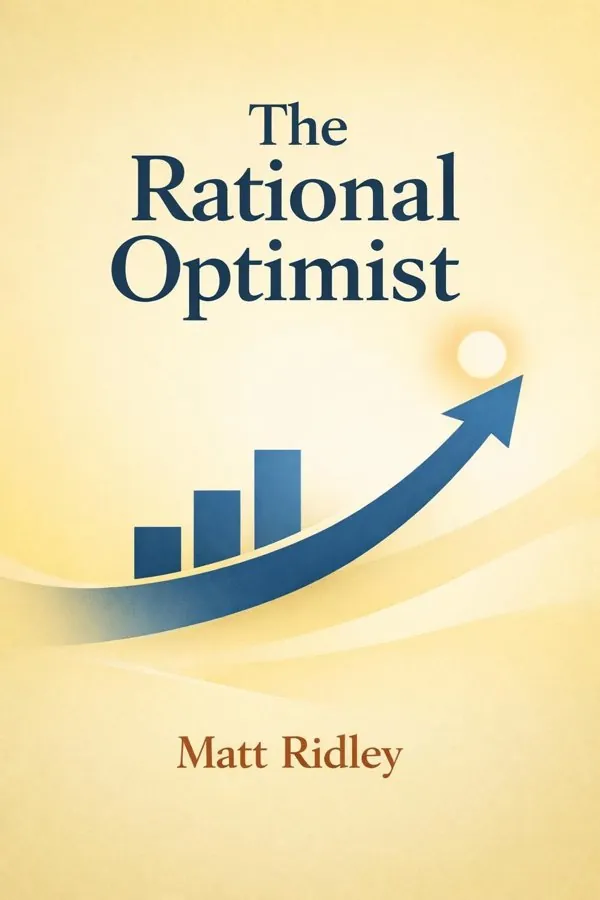
The Rational Optimist: How Prosperity Evolves: Summary & Key Insights
by Matt Ridley
 10 min6 chaptersAudio available
What Is The Rational Optimist: How Prosperity Evolves About?
The Rational Optimist: How Prosperity Evolves by Matt Ridley is a economics book spanning 6 pages. The Rational Optimist: How Prosperity Evolves is a 2010 popular science book by Matt Ridley that explores the evolution of human progress through trade, innovation, and cooperation. Ridley argues that human prosperity has consistently improved over time due to the exchange of ideas and goods, and he presents an optimistic view of the future grounded in economic and biological reasoning.
This FizzRead summary covers all 6 key chapters of The Rational Optimist: How Prosperity Evolves in approximately 10 minutes, distilling the most important ideas, arguments, and takeaways from Matt Ridley's work. Also available as an audio summary and Key Quotes Podcast.
The Rational Optimist: How Prosperity Evolves
The Rational Optimist: How Prosperity Evolves is a 2010 popular science book by Matt Ridley that explores the evolution of human progress through trade, innovation, and cooperation. Ridley argues that human prosperity has consistently improved over time due to the exchange of ideas and goods, and he presents an optimistic view of the future grounded in economic and biological reasoning.
Who Should Read The Rational Optimist: How Prosperity Evolves?
This book is perfect for anyone interested in economics and looking to gain actionable insights in a short read. Whether you're a student, professional, or lifelong learner, the key ideas from The Rational Optimist: How Prosperity Evolves by Matt Ridley will help you think differently.
- ✓Readers who enjoy economics and want practical takeaways
- ✓Professionals looking to apply new ideas to their work and life
- ✓Anyone who wants the core insights of The Rational Optimist: How Prosperity Evolves in just 10 minutes
Want the full summary?
Get instant access to this book summary and 100K+ more with Fizz Moment.
Get Free SummaryAvailable on App Store • Free to download
Key Chapters
The origin of human prosperity begins with something deceptively simple: exchange. Long before coins and markets existed, early humans bartered tools, food, and ornaments. What set us apart from other species was not our intelligence alone, but our willingness to trade beyond family and tribe. A hunter who excelled in catching game could barter with a neighbor skilled in crafting stone blades. Both became richer, not in coin, but in capability.
Through exchange, specialization became possible. Rather than each person struggling to do everything, individuals could focus on what they did best. The net effect was a collective expansion of productivity. Archaeology supports this narrative: artifacts found far from their point of origin—obsidian blades in new territories or shells from distant coasts—mark the spread of trade networks that predate written language by tens of thousands of years. These interactions demanded trust, reciprocity, and sometimes complex social norms. Exchange, in short, required moral evolution as much as material innovation.
Once humans began to depend on trade, cooperation ceased to be optional. We became biologically and socially invested in one another’s prosperity. This interdependence turned humanity into a networked species long before the internet, and that network became the engine of progress. Exchange was not just economic—it was the transmission line of ideas, skills, and imagination that would propel civilization forward.
Specialization is the catalyst of civilization. When Adam Smith famously wrote about the division of labor in pin manufacturing, he captured what our ancestors had already discovered millennia earlier: that productivity grows exponentially when tasks are divided. By focusing effort on distinct skills, people amplify the total wealth of their communities. Yet this process unfolded gradually, shaped by trial, error, and countless innovations.
In early societies, specialization allowed farmers, toolmakers, and traders to enhance efficiency beyond subsistence. A potter could refine craftsmanship rather than gather clay each day; a herder could perfect breeding techniques rather than tilling the soil. This interlocking web of professions multiplied yields and freed time for art, science, and reflection. Prosperity, in its truest sense, means not just having more, but being able to do more through others.
Specialization transformed human society into what I call a ‘collective mind.’ No single person understands how an entire economy functions; yet together we create marvels none of us could make alone—a smartphone, a jet engine, a vaccine. This interdependence, far from diminishing individuality, enlarges it. It allows any one of us to stand on the shoulders of millions. In this sense, specialization mirrors biological evolution: it is a system of cumulative improvement built on sharing and differentiation. The genius of humanity lies not in individual brilliance, but in our ability to cooperate across vast networks of specialized roles.
+ 4 more chapters — available in the FizzRead app
All Chapters in The Rational Optimist: How Prosperity Evolves
About the Author
Matt Ridley is a British author, journalist, and businessman known for his works on science, economics, and human nature. He has written several acclaimed books including The Red Queen and Genome, and his writing often explores the intersection of biology and society.
Get This Summary in Your Preferred Format
Read or listen to the The Rational Optimist: How Prosperity Evolves summary by Matt Ridley anytime, anywhere. FizzRead offers multiple formats so you can learn on your terms — all free.
Available formats: App · Audio · PDF · EPUB — All included free with FizzRead
Download The Rational Optimist: How Prosperity Evolves PDF and EPUB Summary
Key Quotes from The Rational Optimist: How Prosperity Evolves
“The origin of human prosperity begins with something deceptively simple: exchange.”
“Specialization is the catalyst of civilization.”
Frequently Asked Questions about The Rational Optimist: How Prosperity Evolves
The Rational Optimist: How Prosperity Evolves by Matt Ridley is a economics book that explores key ideas across 6 chapters. The Rational Optimist: How Prosperity Evolves is a 2010 popular science book by Matt Ridley that explores the evolution of human progress through trade, innovation, and cooperation. Ridley argues that human prosperity has consistently improved over time due to the exchange of ideas and goods, and he presents an optimistic view of the future grounded in economic and biological reasoning.
More by Matt Ridley
Genome: The Autobiography of a Species in 23 Chapters
Matt Ridley
10 min
The Red Queen: Sex and the Evolution of Human Nature
Matt Ridley
10 min
Nature Via Nurture: Genes, Experience, and What Makes Us Human
Matt Ridley
10 min
The Evolution of Everything: How New Ideas Emerge
Matt Ridley
10 minYou Might Also Like

Business Adventures
John Brooks
10 min
Nudge
Richard H. Thaler, Cass R. Sunstein
10 min
The Hitchhiker"s Guide to the Galaxy
Douglas Adams
10 minThe Muqaddimah
Ibn Khaldun
10 minThe Outsiders
William N. Thorndike
10 min
A Little History of Economics
Niall Kishtainy
10 minBrowse by Category
Ready to read The Rational Optimist: How Prosperity Evolves?
Get the full summary and 100K+ more books with Fizz Moment.