
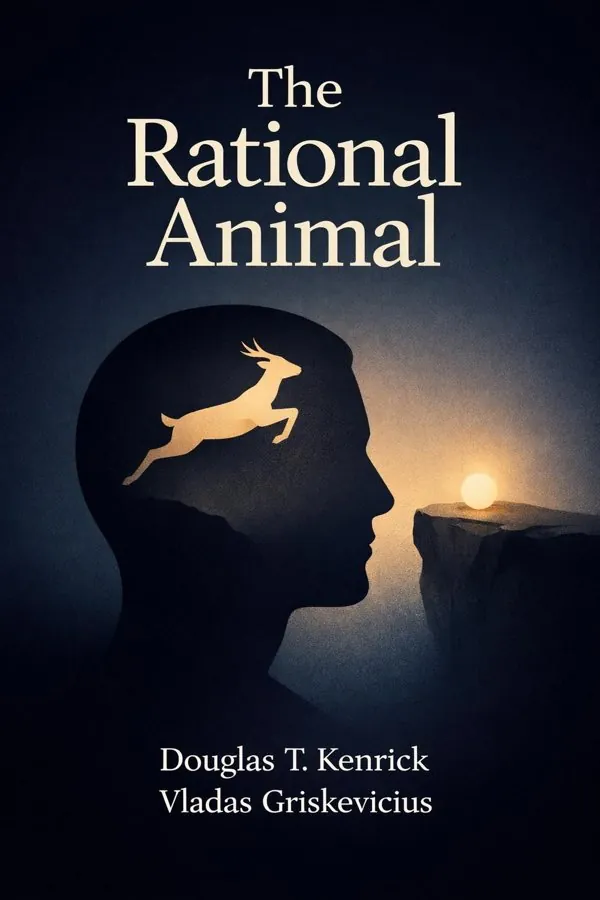
The Rational Animal: How Evolution Made Us Smarter Than We Think: Summary & Key Insights
by Douglas T. Kenrick, Vladas Griskevicius
 10 min11 chaptersAudio available
What Is The Rational Animal: How Evolution Made Us Smarter Than We Think About?
The Rational Animal: How Evolution Made Us Smarter Than We Think by Douglas T. Kenrick, Vladas Griskevicius is a cognition book spanning 11 pages. This book explores how evolutionary psychology explains human decision-making and behavior. The authors argue that our seemingly irrational choices often make sense when viewed through the lens of evolution, showing how ancient adaptive motives shape modern life in areas such as consumer behavior, relationships, and morality.
This FizzRead summary covers all 11 key chapters of The Rational Animal: How Evolution Made Us Smarter Than We Think in approximately 10 minutes, distilling the most important ideas, arguments, and takeaways from Douglas T. Kenrick, Vladas Griskevicius's work. Also available as an audio summary and Key Quotes Podcast.
The Rational Animal: How Evolution Made Us Smarter Than We Think
This book explores how evolutionary psychology explains human decision-making and behavior. The authors argue that our seemingly irrational choices often make sense when viewed through the lens of evolution, showing how ancient adaptive motives shape modern life in areas such as consumer behavior, relationships, and morality.
Who Should Read The Rational Animal: How Evolution Made Us Smarter Than We Think?
This book is perfect for anyone interested in cognition and looking to gain actionable insights in a short read. Whether you're a student, professional, or lifelong learner, the key ideas from The Rational Animal: How Evolution Made Us Smarter Than We Think by Douglas T. Kenrick, Vladas Griskevicius will help you think differently.
- ✓Readers who enjoy cognition and want practical takeaways
- ✓Professionals looking to apply new ideas to their work and life
- ✓Anyone who wants the core insights of The Rational Animal: How Evolution Made Us Smarter Than We Think in just 10 minutes
Want the full summary?
Get instant access to this book summary and 100K+ more with Fizz Moment.
Get Free SummaryAvailable on App Store • Free to download
Key Chapters
Our starting point challenges the classical notion of the rational agent. Traditional economics imagines people as calculating beings who use reason to maximize utility. But real people rarely behave that way. We fall prey to biases, ignore probabilities, and are swayed by social cues and emotions. Behavioral economists interpret these patterns as flaws in rationality. Evolutionary psychology sees something else: an outdated definition of what it means to be rational.
True rationality must be judged against the environment that shaped us. If you ask why a peacock grows an enormous tail—it’s not 'rational' for flight efficiency, but it is supremely rational for attracting mates. Likewise, our motivations evolved not to maximize money or efficiency, but to maximize inclusive fitness—the success of ourselves and our kin in passing on genes.
This perspective shifts everything. Instead of assuming a single, overarching rationality, we recognize multiple evolved logics, each tuned to specific adaptive problems: avoiding predators, gaining allies, finding partners, keeping them, raising offspring, and avoiding disease. Our mind is not a unified computer; it’s a parliament of subselves, each driven by distinct goals but cooperating for overall survival.
When economists claim that consumers are predictable in markets, they miss the point that consumers are also mates, parents, friends, competitors, and community members, all with fluctuating priorities. A man buying an expensive watch might seem irrationally wasteful—but in evolutionary terms, he’s signaling status, a cue of success and competence that can boost his attractiveness. Seen through the right lens, 'irrationality' is simply rationality serving another evolutionary goal.
The human mind was not built as a single-purpose machine. It’s more like a Swiss Army knife containing specialized tools, each evolved to solve different problems faced by our ancestors. I call these internal guides our seven subselves: self-protection, status, affiliation, mate acquisition, mate retention, kin care, and disease avoidance.
Each subself takes turns guiding our behavior depending on context. When danger looms, the self-protection subself dominates, sharpening our senses and heightening fear. When we compete for prestige, the status subself takes the lead. If we feel lonely, the affiliation subself pushes us toward connection. Each one is adaptive, yet their priorities sometimes clash. You might crave popularity (status) yet fear standing out (self-protection). Or you may desire attention from new potential partners (mate acquisition) while your relationship-oriented subself insists on loyalty (mate retention).
What makes this multi-self model profound is how it explains our inner contradictions without assuming we’re irrational. We aren’t indecisive—we’re dynamically switching among ancient motivational systems attuned to different challenges. Recognizing this dynamic helps us understand our impulses and avoid self-blame. When we see which subself is 'running the show' at a given time, we gain the power to redirect its energy more consciously.
+ 9 more chapters — available in the FizzRead app
All Chapters in The Rational Animal: How Evolution Made Us Smarter Than We Think
About the Authors
Douglas T. Kenrick is a professor of psychology at Arizona State University known for his research in evolutionary social psychology. Vladas Griskevicius is a professor of marketing and psychology at the University of Minnesota, specializing in consumer behavior and evolutionary psychology.
Get This Summary in Your Preferred Format
Read or listen to the The Rational Animal: How Evolution Made Us Smarter Than We Think summary by Douglas T. Kenrick, Vladas Griskevicius anytime, anywhere. FizzRead offers multiple formats so you can learn on your terms — all free.
Available formats: App · Audio · PDF · EPUB — All included free with FizzRead
Download The Rational Animal: How Evolution Made Us Smarter Than We Think PDF and EPUB Summary
Key Quotes from The Rational Animal: How Evolution Made Us Smarter Than We Think
“Our starting point challenges the classical notion of the rational agent.”
“The human mind was not built as a single-purpose machine.”
Frequently Asked Questions about The Rational Animal: How Evolution Made Us Smarter Than We Think
The Rational Animal: How Evolution Made Us Smarter Than We Think by Douglas T. Kenrick, Vladas Griskevicius is a cognition book that explores key ideas across 11 chapters. This book explores how evolutionary psychology explains human decision-making and behavior. The authors argue that our seemingly irrational choices often make sense when viewed through the lens of evolution, showing how ancient adaptive motives shape modern life in areas such as consumer behavior, relationships, and morality.
You Might Also Like
A Field Guide to Lies: Critical Thinking in the Information Age
Daniel J. Levitin
10 min
A Theory of Cognitive Dissonance
Leon Festinger
10 min
Black-And-White Thinking: The Burden of a Binary Brain in a Complex World
Kevin Dutton
10 min
Born Liars: Why We Can’t Live Without Deceit
Ian Leslie
10 min
Collective Illusions: Conformity, Complicity, and the Science of Why We Make Bad Decisions
Todd Rose
10 min
Concrete Mathematics: A Foundation for Computer Science
Ronald L. Graham, Donald E. Knuth, Oren Patashnik
10 minBrowse by Category
Ready to read The Rational Animal: How Evolution Made Us Smarter Than We Think?
Get the full summary and 100K+ more books with Fizz Moment.