
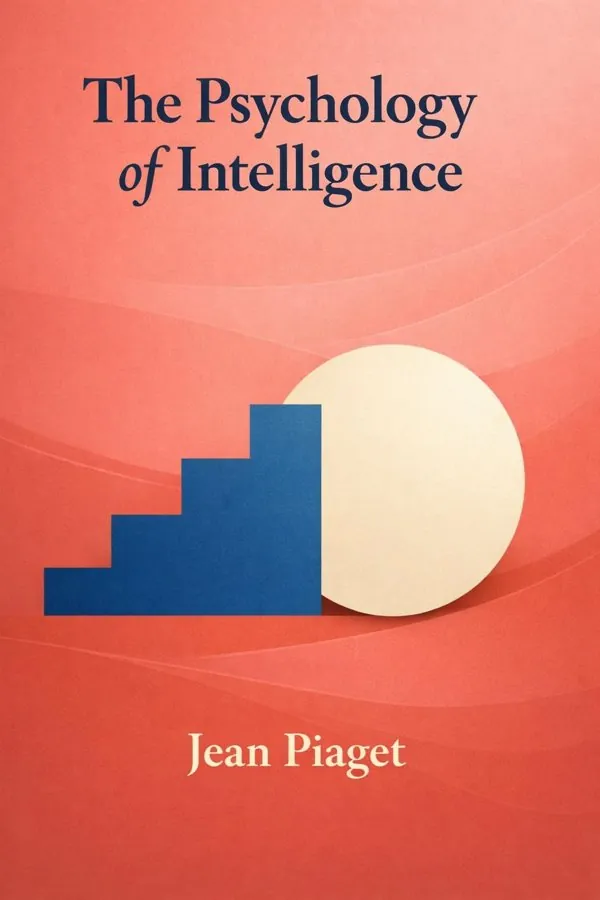
The Psychology of Intelligence: Summary & Key Insights
by Jean Piaget
 10 min9 chaptersAudio available
Key Takeaways from The Psychology of Intelligence
A powerful way to rethink intelligence is to stop seeing it as a possession and start seeing it as an adjustment.
Every new experience is first interpreted through what we already know.
Real learning begins when reality refuses to fit our expectations.
Growth often comes from imbalance.
Children do not simply know less than adults; they think differently.
What Is The Psychology of Intelligence About?
The Psychology of Intelligence by Jean Piaget is a cognition book spanning 13 pages. First published in 1947, The Psychology of Intelligence is Jean Piaget’s concise but influential account of how human thinking develops. Rather than treating intelligence as a fixed mental gift, Piaget argues that it is a living process: the mind grows by acting on the world, encountering resistance, and reorganizing itself in response. In this book, he lays out the core ideas that became central to developmental psychology, including adaptation, assimilation, accommodation, and equilibration. He also shows how children gradually construct increasingly powerful forms of reasoning, moving from action-based understanding to logic and abstract thought. The book matters because it changed the study of the mind. Piaget did not ask only what people know; he asked how knowledge becomes possible in the first place. His answer helped reshape psychology, education, and epistemology. As a Swiss psychologist and epistemologist who spent decades observing children’s reasoning in detail, Piaget wrote with unusual authority. This work remains essential for anyone who wants to understand how intelligence is built, why learning is active rather than passive, and how thought develops through a constant dialogue between the individual and the environment.
This FizzRead summary covers all 9 key chapters of The Psychology of Intelligence in approximately 10 minutes, distilling the most important ideas, arguments, and takeaways from Jean Piaget's work. Also available as an audio summary and Key Quotes Podcast.
The Psychology of Intelligence
First published in 1947, The Psychology of Intelligence is Jean Piaget’s concise but influential account of how human thinking develops. Rather than treating intelligence as a fixed mental gift, Piaget argues that it is a living process: the mind grows by acting on the world, encountering resistance, and reorganizing itself in response. In this book, he lays out the core ideas that became central to developmental psychology, including adaptation, assimilation, accommodation, and equilibration. He also shows how children gradually construct increasingly powerful forms of reasoning, moving from action-based understanding to logic and abstract thought. The book matters because it changed the study of the mind. Piaget did not ask only what people know; he asked how knowledge becomes possible in the first place. His answer helped reshape psychology, education, and epistemology. As a Swiss psychologist and epistemologist who spent decades observing children’s reasoning in detail, Piaget wrote with unusual authority. This work remains essential for anyone who wants to understand how intelligence is built, why learning is active rather than passive, and how thought develops through a constant dialogue between the individual and the environment.
Who Should Read The Psychology of Intelligence?
This book is perfect for anyone interested in cognition and looking to gain actionable insights in a short read. Whether you're a student, professional, or lifelong learner, the key ideas from The Psychology of Intelligence by Jean Piaget will help you think differently.
- ✓Readers who enjoy cognition and want practical takeaways
- ✓Professionals looking to apply new ideas to their work and life
- ✓Anyone who wants the core insights of The Psychology of Intelligence in just 10 minutes
Want the full summary?
Get instant access to this book summary and 100K+ more with Fizz Moment.
Get Free SummaryAvailable on App Store • Free to download
Key Chapters
A powerful way to rethink intelligence is to stop seeing it as a possession and start seeing it as an adjustment. Piaget’s central claim is that intelligence is a form of adaptation: the organism does not merely receive reality but actively works to achieve a workable fit with it. This idea comes from biology, yet Piaget transforms it into a psychological principle. Human thinking develops because we are constantly trying to coordinate our actions, expectations, and interpretations with the demands of the world.
For Piaget, adaptation is not passive conformity. It is an active process by which a child, and later an adult, organizes experience into increasingly stable and flexible structures. A baby reaching for a toy, a child learning that objects still exist when hidden, or a student revising a scientific idea after an experiment all display the same underlying movement: they are trying to make sense of reality while also changing themselves in response to it.
This view has practical implications. In education, it suggests that understanding cannot simply be transmitted. Learners must interact, test, fail, and revise. In parenting, it means mistakes are not signs of deficiency but evidence of active adaptation. In adult life, it reminds us that good thinking depends on responsiveness, not rigid certainty.
Piaget’s larger point is that intelligence is dynamic. It grows through contact with problems, not through avoidance of them. The more richly we engage reality, the more refined our mental structures become.
Actionable takeaway: Treat confusion as part of intelligent growth, and seek experiences that challenge your current way of understanding rather than merely confirming it.
Every new experience is first interpreted through what we already know. Piaget calls this process assimilation: the mind incorporates unfamiliar events into existing structures of understanding. We never confront reality as a blank slate. Instead, we use established patterns, habits, and concepts to give new situations meaning.
A young child who has learned to grasp toys may try to grasp any nearby object in the same way. A student who understands addition may initially approach multiplication as repeated addition. An adult entering a new workplace may interpret its culture through assumptions formed in previous jobs. In each case, the mind is not passively receiving information; it is actively filtering novelty through prior schemas.
Assimilation is essential because it creates continuity. Without it, every event would feel chaotic and disconnected. It allows learning to begin from what is already organized. But Piaget also shows its limits. If we assimilate too strongly, we distort reality rather than understand it. A child may call every four-legged animal a dog. A manager may misread a new team because old assumptions are overapplied. Assimilation gives stability, but it can also produce error when the world does not fit our expectations.
This insight matters in practical settings. Teachers should connect new material to learners’ existing frameworks, while also noticing when those frameworks are too narrow. Leaders and professionals should ask whether they are truly seeing a new situation or simply imposing an old interpretation.
Assimilation is therefore both a strength and a risk. It is the mind’s first move toward understanding, but not the final one.
Actionable takeaway: When learning something new, begin by identifying what familiar idea you are using to interpret it, then test whether that old pattern actually fits.
Real learning begins when reality refuses to fit our expectations. Piaget calls the resulting process accommodation: the modification of existing mental structures so they can better deal with what is new. If assimilation is the mind’s attempt to absorb the world, accommodation is the mind’s willingness to change itself.
This process can be seen clearly in childhood. A baby who tries to suck every object in the same way eventually adjusts when objects differ in shape and texture. A child who thinks all moving celestial bodies are the moon must revise that idea after repeated observation. In school, a student who believes heavier objects fall faster may need to reconstruct that belief when experiments show otherwise. Adults do this too. We accommodate when we revise political assumptions after evidence, rethink a relationship pattern after conflict, or adopt a new model at work because the old one no longer explains results.
Accommodation is often uncomfortable because it disrupts coherence. It forces us to admit that our previous understanding was incomplete. Yet for Piaget, this is precisely how intelligence develops. Mental growth does not happen through accumulation alone but through reorganization. We become more capable when our structures become more differentiated, flexible, and accurate.
In practice, this means good teaching should not only reinforce what students know but create moments where old frameworks break down productively. It also means mature thinking requires humility. If we never alter our schemas, we remain trapped in familiar but limited interpretations.
Accommodation is the engine of transformation. It is what allows intelligence to move beyond repetition toward genuine development.
Actionable takeaway: When you encounter strong resistance from facts or experience, ask not only “How can I explain this?” but “What in my current thinking needs to change?”
Growth often comes from imbalance. Piaget uses the concept of equilibration to explain how intelligence advances through a continuing effort to resolve tensions between assimilation and accommodation. The mind seeks coherence, but reality repeatedly introduces disruptions. Development occurs because we try to restore a more stable balance at a higher level of organization.
Imagine a child who believes that quantity changes whenever shape changes. When water is poured from a short glass into a tall one, the child may insist there is now more water. Over time, contradictory experiences accumulate. The child begins to notice that appearance alone cannot explain quantity. This disturbance creates disequilibrium. To resolve it, the child gradually constructs a more powerful concept: conservation. Equilibrium returns, but it returns in a more advanced form than before.
Piaget’s point is subtle and important. Cognitive development is not a smooth, linear accumulation of facts. It is a self-regulating process in which conflict, surprise, and contradiction stimulate restructuring. Equilibration is the principle that organizes this movement. It explains why children’s errors are so informative: they reveal the current balance point of thought and the next possible transformation.
This idea applies well beyond childhood. In professional life, a failed project can expose flaws in an old model and lead to a better strategy. In personal life, a difficult conversation may unsettle assumptions and produce deeper understanding. Productive disequilibrium is often the precondition for learning.
For educators and mentors, the lesson is clear: avoid both chaos and overprotection. Learners need enough stability to think, but enough challenge to reorganize their thinking.
Actionable takeaway: Use moments of confusion or contradiction as signals for growth, and deliberately reflect on what more coherent understanding they might be pushing you toward.
Children do not simply know less than adults; they think differently. One of Piaget’s most influential contributions is his claim that cognitive development proceeds through qualitatively distinct structures. Intelligence evolves from action-based coordination in infancy to symbolic thought, then to concrete logic, and finally to the capacity for formal, abstract reasoning.
In the sensorimotor period, knowledge is rooted in action. Infants learn through seeing, grasping, sucking, and moving, eventually discovering object permanence and basic causal patterns. In the preoperational period, children gain language and symbolic imagination, but their thought remains intuitive, centered on appearance, and often egocentric. In the concrete operational period, they become able to conserve quantity, classify systematically, and reason logically about tangible situations. In the formal operational period, they can manipulate hypotheses, consider possibilities, and think systematically about abstract relations.
Piaget does not present these stages as rigid labels for every person at every moment. Rather, they describe dominant organizations of thought. The deeper claim is that each stage creates new possibilities while setting temporary limits. A child may memorize words that sound advanced without possessing the logical structures to use them fully.
This framework transformed education by showing that instruction must match the learner’s developmental organization. It also helps adults avoid unfair expectations. We should not mistake a child’s incorrect answer for laziness when the issue may be structural readiness.
Though later researchers refined Piaget’s stage theory, the basic insight remains powerful: reasoning changes form as it develops, and understanding those forms matters.
Actionable takeaway: When explaining an idea to a child or learner, ask not just what information they lack but what kind of thinking structure they currently have available.
What we call logic does not descend fully formed into the mind; it is constructed. Piaget argues that logical structures emerge from the coordination and interiorization of actions. Before children can reason abstractly, they act on objects, compare outcomes, reverse procedures, and gradually organize these actions into stable operations. Thought grows out of doing.
This is one of the book’s deepest insights. A child learns ordering by arranging sticks from shortest to longest. The idea of reversibility develops when actions can be mentally undone: if clay is reshaped, it can be reshaped back; if numbers are added, subtraction can reverse the operation. Classification emerges when children coordinate relationships among groups and subgroups. These are not just isolated skills. They are building blocks of logic itself.
Piaget’s theory challenges the assumption that reasoning is best taught through verbal explanation alone. If logical thought depends on structures built through coordinated action, then manipulation, experimentation, and active problem-solving are indispensable. Mathematics education, for instance, becomes stronger when students discover patterns through concrete operations before moving to formal symbols. Science teaching improves when children test, observe, and compare rather than only memorize definitions.
The idea also applies to adults. We often gain deeper understanding not by hearing a principle once but by working through examples, making decisions, and noticing relationships across actions. Competence in management, design, or negotiation similarly grows from coordinated practice that becomes mentally structured.
Piaget therefore reframes reason as a developmental achievement. Logic is not merely learned language; it is organized action that has become internal thought.
Actionable takeaway: When trying to master a complex idea, move beyond passive reading and engage in hands-on exercises that let you act out the relationships you want to understand.
Experience matters, but it does not act like a stamp pressed onto a passive mind. Piaget gives an important role to both the physical and social environment, yet he insists that development depends on how the child actively organizes those influences. The world provides materials, problems, and interactions; intelligence grows by structuring them.
Physical experience supplies opportunities to explore objects, movement, space, quantity, and causality. A child learns not by being told that some objects sink and others float, but by experimenting and coordinating results. Social experience adds another layer. Through language, cooperation, disagreement, and shared rules, children encounter viewpoints beyond their own. Peer interaction can be especially important because it forces decentration: the child must recognize that others think differently and that rules are not simply imposed but can be negotiated and understood.
Still, Piaget resists both pure empiricism and pure social determinism. Neither objects nor society directly insert intelligence into the child. Development requires internal construction. Two children can receive similar instruction yet form different understandings depending on their current structures. This explains why teaching is never mere delivery.
The practical message is highly relevant today. Rich environments matter: conversation, play, experiments, stories, collaborative tasks, and open-ended questions all nourish growth. But piling up stimuli is not enough. Adults must create conditions in which learners can act, reflect, compare, and reconstruct meaning for themselves.
Piaget’s view preserves both the importance of context and the agency of the learner. Intelligence is socially and materially nourished, but never mechanically produced.
Actionable takeaway: Design learning environments with active exploration and dialogue, and judge success by the quality of understanding learners construct, not just by the amount of information presented.
One of the most striking features of development is that reasoning becomes less centered on the immediate self and more capable of coordination, perspective-taking, and reflection. Piaget describes early thought as egocentric not in a selfish sense, but in a cognitive one: the child has difficulty separating personal perspective from objective relations. Over time, reasoning becomes more decentered and more logically organized.
In the preoperational period, children often focus on one salient aspect of a situation at a time. They may judge quantity by height alone or assume others see what they see. As development proceeds, they become able to coordinate multiple dimensions, reverse transformations mentally, and understand relations among classes, causes, and viewpoints. Later still, formal reasoning allows adolescents to think about possibilities, systems, and hypothetical scenarios independent of immediate reality.
This movement from centered intuition to reflective thought has profound implications. It explains why argument, moral dialogue, and scientific thinking improve when individuals learn to step outside their first impression. It also sheds light on adult reasoning. Many intellectual failures are not due to low intelligence but to a refusal to decenter: to consider other evidence, other perspectives, or the system as a whole.
For education, Piaget’s lesson is not to shame immature reasoning but to support its transformation. Asking children to explain their answers, compare perspectives, or predict outcomes helps them become aware of their own mental operations. In adult settings, reflective practice serves a similar role.
The broader message is hopeful. Rationality is not simply inherited; it is developed through the progressive coordination of viewpoints and operations.
Actionable takeaway: Strengthen your reasoning by regularly asking, “What perspective am I leaving out, and what changes if I coordinate more than one point of view at once?”
A common educational mistake is to assume that if something can be explained, it can be understood. Piaget challenges this view by distinguishing learning from the broader development of intelligence. Learning certainly matters, but what can be learned at any moment depends on the structures already available in the learner. Development is not replaced by instruction; it conditions what instruction can achieve.
This does not mean teaching is powerless. On the contrary, well-designed learning experiences can stimulate development by creating problems that require reorganization. But memorized performance should not be confused with genuine comprehension. A child may repeat a rule about conservation or logic without truly grasping the operation behind it. Similarly, an adult may learn terminology in a field yet still reason in simplistic ways because the underlying conceptual structures remain weak.
Piaget’s position has major practical consequences. Effective teaching starts from the learner’s current mode of thought and then creates experiences that stretch it. In mathematics, this may mean using manipulatives before formal notation. In science, it may mean letting students predict and test rather than merely listen. In management training, it may mean case-based reasoning that forces participants to revise assumptions.
The idea also protects learners from unfair judgment. Failure is not always lack of effort; sometimes it reflects a mismatch between instruction and developmental readiness. The aim of education should therefore be construction, not recitation.
Piaget’s final insight is that intelligence and learning are inseparable but not identical. Learning adds content; development reorganizes the very form of thought.
Actionable takeaway: When teaching or studying, focus less on whether information was presented clearly and more on whether the learner had the opportunity to actively reconstruct the idea in a form they can truly use.
All Chapters in The Psychology of Intelligence
About the Author
Jean Piaget (1896–1980) was a Swiss psychologist, biologist, and epistemologist whose work transformed the study of how children think and learn. Initially trained in natural science, he became fascinated by the development of knowledge and spent decades observing children’s reasoning in detail. From this research, he developed a theory of cognitive development centered on the active construction of intelligence through adaptation, assimilation, accommodation, and progressive stages of thought. Piaget’s work shaped developmental psychology, educational theory, and philosophy, especially through his field of “genetic epistemology,” which examined how knowledge emerges and changes over time. Although later scholars revised some of his conclusions, his influence remains immense. He is widely regarded as one of the most important thinkers of the twentieth century in understanding the growth of human intelligence.
Get This Summary in Your Preferred Format
Read or listen to the The Psychology of Intelligence summary by Jean Piaget anytime, anywhere. FizzRead offers multiple formats so you can learn on your terms — all free.
Available formats: App · Audio · PDF · EPUB — All included free with FizzRead
Download The Psychology of Intelligence PDF and EPUB Summary
Key Quotes from The Psychology of Intelligence
“A powerful way to rethink intelligence is to stop seeing it as a possession and start seeing it as an adjustment.”
“Every new experience is first interpreted through what we already know.”
“Real learning begins when reality refuses to fit our expectations.”
“Piaget uses the concept of equilibration to explain how intelligence advances through a continuing effort to resolve tensions between assimilation and accommodation.”
“Children do not simply know less than adults; they think differently.”
Frequently Asked Questions about The Psychology of Intelligence
The Psychology of Intelligence by Jean Piaget is a cognition book that explores key ideas across 9 chapters. First published in 1947, The Psychology of Intelligence is Jean Piaget’s concise but influential account of how human thinking develops. Rather than treating intelligence as a fixed mental gift, Piaget argues that it is a living process: the mind grows by acting on the world, encountering resistance, and reorganizing itself in response. In this book, he lays out the core ideas that became central to developmental psychology, including adaptation, assimilation, accommodation, and equilibration. He also shows how children gradually construct increasingly powerful forms of reasoning, moving from action-based understanding to logic and abstract thought. The book matters because it changed the study of the mind. Piaget did not ask only what people know; he asked how knowledge becomes possible in the first place. His answer helped reshape psychology, education, and epistemology. As a Swiss psychologist and epistemologist who spent decades observing children’s reasoning in detail, Piaget wrote with unusual authority. This work remains essential for anyone who wants to understand how intelligence is built, why learning is active rather than passive, and how thought develops through a constant dialogue between the individual and the environment.
More by Jean Piaget
You Might Also Like

A Field Guide to Lies: Critical Thinking in the Information Age
Daniel J. Levitin
10 min
A Theory of Cognitive Dissonance
Leon Festinger
10 min
Black-And-White Thinking: The Burden of a Binary Brain in a Complex World
Kevin Dutton
10 min
Born Liars: Why We Can’t Live Without Deceit
Ian Leslie
10 min
Collective Illusions: Conformity, Complicity, and the Science of Why We Make Bad Decisions
Todd Rose
10 min
Concrete Mathematics: A Foundation for Computer Science
Ronald L. Graham, Donald E. Knuth, Oren Patashnik
10 minBrowse by Category
Ready to read The Psychology of Intelligence?
Get the full summary and 100K+ more books with Fizz Moment.