
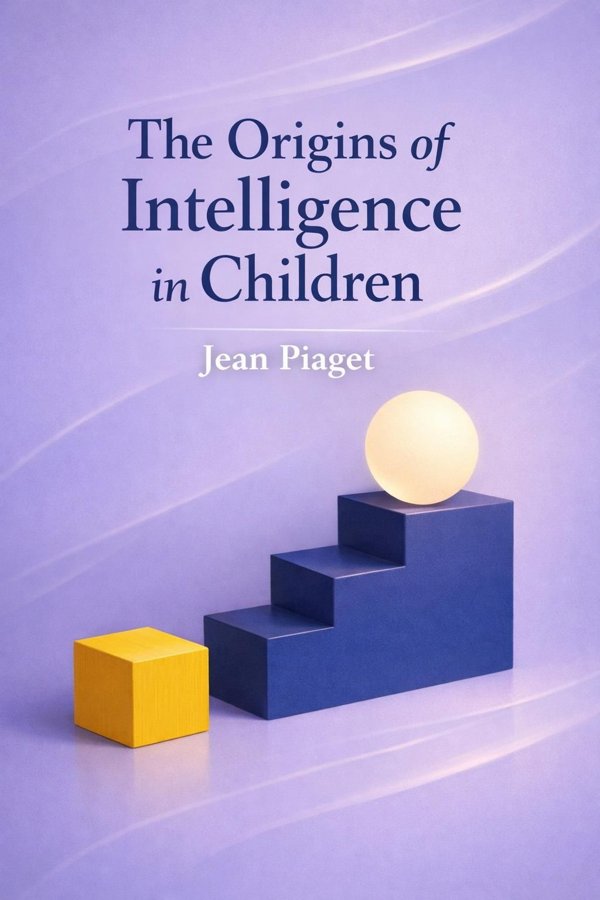
The Origins of Intelligence in Children: Summary & Key Insights
by Jean Piaget
 10 min10 chaptersAudio available
What Is The Origins of Intelligence in Children About?
The Origins of Intelligence in Children by Jean Piaget is a cognition book spanning 10 pages. In this landmark work, Jean Piaget presents his pioneering theory of cognitive development, tracing the emergence of intelligence in children from basic sensorimotor activity to complex mental structures. Based on meticulous observation, Piaget argues that knowledge is constructed progressively through the child’s interaction with the environment, laying the foundation for modern developmental psychology.
This FizzRead summary covers all 10 key chapters of The Origins of Intelligence in Children in approximately 10 minutes, distilling the most important ideas, arguments, and takeaways from Jean Piaget's work. Also available as an audio summary and Key Quotes Podcast.
The Origins of Intelligence in Children
In this landmark work, Jean Piaget presents his pioneering theory of cognitive development, tracing the emergence of intelligence in children from basic sensorimotor activity to complex mental structures. Based on meticulous observation, Piaget argues that knowledge is constructed progressively through the child’s interaction with the environment, laying the foundation for modern developmental psychology.
Who Should Read The Origins of Intelligence in Children?
This book is perfect for anyone interested in cognition and looking to gain actionable insights in a short read. Whether you're a student, professional, or lifelong learner, the key ideas from The Origins of Intelligence in Children by Jean Piaget will help you think differently.
- ✓Readers who enjoy cognition and want practical takeaways
- ✓Professionals looking to apply new ideas to their work and life
- ✓Anyone who wants the core insights of The Origins of Intelligence in Children in just 10 minutes
Want the full summary?
Get instant access to this book summary and 100K+ more with Fizz Moment.
Get Free SummaryAvailable on App Store • Free to download
Key Chapters
At the beginning of life, intelligence reveals itself in its most primitive form: the reflex. The newborn who sucks instinctively when something touches the lips is not choosing but responding, yet this reflexive act is already adaptive. It connects the organism with its environment in a meaningful way. What begins as an automatic response gradually becomes the first pattern of intelligence, the first scheme by which the infant encounters the world.
Through observation I came to see that reflexes such as sucking, grasping, or following movement with the eyes are not static. They can vary, repeat, and coordinate. When a baby sucks on different objects, or even on the tongue, the reflex becomes an exploratory act. Experience modifies the reflex. The infant learns, in the most elementary sense, that pressure changes, that some textures offer resistance, that the nipple supplies a particular satisfaction. Every variation enriches the schema, building what I call a sensorimotor system. The biological reflex is transformed into the first instrument of knowledge.
At this point, intelligence is not yet conscious; it is practical, embodied, and immediate. Yet within these simple acts lies a fundamental truth: cognition begins with adaptation. The child is not passively recording stimuli but actively reorganizing reactions based on the success or failure of action. Each successful adaptation reinforces the system, preparing the ground for more complex forms of knowledge.
As the infant repeats its reflex acts, a profound transformation occurs. The repetition itself becomes purposeful. In sucking or grasping, the child no longer acts only when stimulated but begins to seek the act, to reproduce it. This is what I call the stage of primary circular reactions — cycles of activity centered on the body that yield pleasure and feedback.
Consider the infant who inadvertently brings a hand to the mouth, experiences satisfaction, and seeks to reproduce the event. What started as accident becomes intention-like repetition, marking the first adaptation of reflex to circumstance. The act is coordinated, no longer a raw reaction but a schema that can be applied to varying conditions. The beginnings of intelligence emerge precisely through this repetition and modification.
Adaptation is always dual: it consists of *assimilation* — incorporating new experiences into existing schemes — and *accommodation* — modifying those schemes to fit new realities. Through the interplay of these two movements, the infant builds a progressively organized system of actions. Knowledge, therefore, is not a static imprint of the external world but a construction achieved by active engagement. Even at this early stage, one can see the embryo of all later reasoning — an intelligence that seeks equilibrium between what it knows and what it must adapt to.
+ 8 more chapters — available in the FizzRead app
All Chapters in The Origins of Intelligence in Children
About the Author
Jean Piaget (1896–1980) was a Swiss psychologist and epistemologist best known for his studies on child development. His research profoundly influenced psychology, education, and the philosophy of science, establishing him as one of the most important figures in developmental theory.
Get This Summary in Your Preferred Format
Read or listen to the The Origins of Intelligence in Children summary by Jean Piaget anytime, anywhere. FizzRead offers multiple formats so you can learn on your terms — all free.
Available formats: App · Audio · PDF · EPUB — All included free with FizzRead
Download The Origins of Intelligence in Children PDF and EPUB Summary
Key Quotes from The Origins of Intelligence in Children
“At the beginning of life, intelligence reveals itself in its most primitive form: the reflex.”
“As the infant repeats its reflex acts, a profound transformation occurs.”
Frequently Asked Questions about The Origins of Intelligence in Children
The Origins of Intelligence in Children by Jean Piaget is a cognition book that explores key ideas across 10 chapters. In this landmark work, Jean Piaget presents his pioneering theory of cognitive development, tracing the emergence of intelligence in children from basic sensorimotor activity to complex mental structures. Based on meticulous observation, Piaget argues that knowledge is constructed progressively through the child’s interaction with the environment, laying the foundation for modern developmental psychology.
More by Jean Piaget
You Might Also Like

A Field Guide to Lies: Critical Thinking in the Information Age
Daniel J. Levitin
10 min
A Theory of Cognitive Dissonance
Leon Festinger
10 min
Black-And-White Thinking: The Burden of a Binary Brain in a Complex World
Kevin Dutton
10 min
Born Liars: Why We Can’t Live Without Deceit
Ian Leslie
10 min
Collective Illusions: Conformity, Complicity, and the Science of Why We Make Bad Decisions
Todd Rose
10 min
Concrete Mathematics: A Foundation for Computer Science
Ronald L. Graham, Donald E. Knuth, Oren Patashnik
10 minBrowse by Category
Ready to read The Origins of Intelligence in Children?
Get the full summary and 100K+ more books with Fizz Moment.