
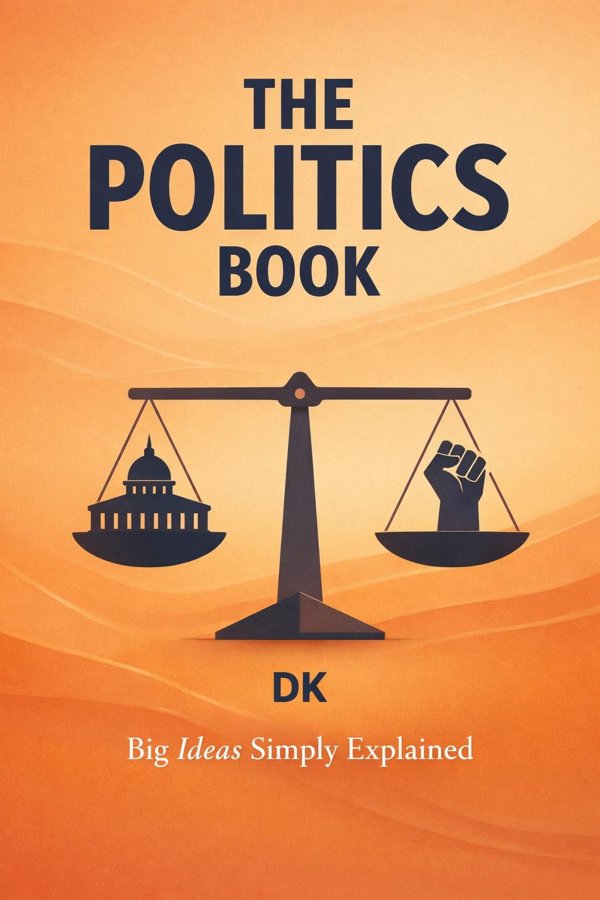
The Politics Book: Big Ideas Simply Explained: Summary & Key Insights
by DK
 10 min8 chaptersAudio available
Key Takeaways from The Politics Book: Big Ideas Simply Explained
Every political argument today still echoes questions first asked in the ancient world: Who should rule, by what right, and for whose benefit?
When political authority becomes sacred, disagreement is no longer merely civic; it can become spiritual rebellion.
Politics changes dramatically when thinkers stop asking only what rulers should be and begin asking how power actually works.
A political idea becomes truly dangerous when ordinary people believe they are entitled to rule themselves.
Economic systems are never just economic; they shape power, status, opportunity, and the meaning of freedom itself.
What Is The Politics Book: Big Ideas Simply Explained About?
The Politics Book: Big Ideas Simply Explained by DK is a politics book spanning 8 pages. The Politics Book: Big Ideas Simply Explained is a sweeping, highly accessible guide to the ideas, ideologies, conflicts, and institutions that have shaped political life from the ancient world to the present. Rather than treating politics as a narrow subject reserved for experts, the book shows that political thought touches every part of collective life: law, justice, power, freedom, rights, revolution, identity, and the responsibilities of governments and citizens. Through short explanations, visual timelines, profiles of influential thinkers, and clear summaries of major schools of thought, it helps readers understand how political systems emerge, why they change, and what values they claim to defend. The book matters because modern debates about democracy, inequality, nationalism, welfare, liberty, and global governance all have deep intellectual roots. By tracing those roots, readers gain a richer understanding of today’s headlines and public arguments. DK’s editorial authority lies in its ability to distill complex subjects into engaging, reliable reference works for general audiences. Here, that strength turns political theory into a practical map for understanding the world we live in.
This FizzRead summary covers all 8 key chapters of The Politics Book: Big Ideas Simply Explained in approximately 10 minutes, distilling the most important ideas, arguments, and takeaways from DK's work. Also available as an audio summary and Key Quotes Podcast.
The Politics Book: Big Ideas Simply Explained
The Politics Book: Big Ideas Simply Explained is a sweeping, highly accessible guide to the ideas, ideologies, conflicts, and institutions that have shaped political life from the ancient world to the present. Rather than treating politics as a narrow subject reserved for experts, the book shows that political thought touches every part of collective life: law, justice, power, freedom, rights, revolution, identity, and the responsibilities of governments and citizens. Through short explanations, visual timelines, profiles of influential thinkers, and clear summaries of major schools of thought, it helps readers understand how political systems emerge, why they change, and what values they claim to defend. The book matters because modern debates about democracy, inequality, nationalism, welfare, liberty, and global governance all have deep intellectual roots. By tracing those roots, readers gain a richer understanding of today’s headlines and public arguments. DK’s editorial authority lies in its ability to distill complex subjects into engaging, reliable reference works for general audiences. Here, that strength turns political theory into a practical map for understanding the world we live in.
Who Should Read The Politics Book: Big Ideas Simply Explained?
This book is perfect for anyone interested in politics and looking to gain actionable insights in a short read. Whether you're a student, professional, or lifelong learner, the key ideas from The Politics Book: Big Ideas Simply Explained by DK will help you think differently.
- ✓Readers who enjoy politics and want practical takeaways
- ✓Professionals looking to apply new ideas to their work and life
- ✓Anyone who wants the core insights of The Politics Book: Big Ideas Simply Explained in just 10 minutes
Want the full summary?
Get instant access to this book summary and 100K+ more with Fizz Moment.
Get Free SummaryAvailable on App Store • Free to download
Key Chapters
Every political argument today still echoes questions first asked in the ancient world: Who should rule, by what right, and for whose benefit? The book begins in antiquity because politics as a formal discipline emerged when thinkers tried to move beyond custom and ask what a good society should actually look like. In Athens, Plato argued that most people are poorly equipped to govern wisely, so the ideal state would be led by philosopher-kings trained to pursue truth rather than popularity. Aristotle took a more empirical approach, studying constitutions and concluding that political stability depends on balancing competing interests and cultivating civic virtue. In China, Confucius emphasized moral leadership, social harmony, and the duty of rulers to govern by example rather than coercion alone.
These early frameworks still appear in modern life. Plato’s suspicion of mass opinion resurfaces whenever experts are trusted more than voters on complex policy questions. Aristotle���s concern with mixed government lives on in constitutional democracies that divide power among institutions. Confucian ideals influence contemporary debates about meritocracy, public ethics, and the role of character in leadership.
What makes these ancient ideas enduring is that they treat politics as a moral enterprise, not just a technical one. They ask whether laws make citizens better, whether power corrupts, and whether justice means equality, order, or the fulfillment of human potential.
Actionable takeaway: When evaluating any political system, start with three ancient questions: Who rules, what virtues they need, and how their power is restrained.
When political authority becomes sacred, disagreement is no longer merely civic; it can become spiritual rebellion. The medieval period explored this tension intensely, as religious belief shaped the legitimacy of kings, empires, and social order. Augustine of Hippo argued that earthly politics is inevitably flawed because human beings are marked by sin. For him, no state could fully realize justice; political institutions were necessary mainly to limit disorder. This sober view made government important but morally limited. Later, Thomas Aquinas sought a more harmonious relationship between reason, natural law, and divine order. He argued that human law should reflect higher moral principles and that unjust rulers could lose their legitimacy.
The book shows how medieval political thought was not simply dogmatic theology. It was a serious effort to answer enduring questions: Is law valid because rulers command it, or because it accords with moral truth? Does political obedience have limits? Can a ruler be judged by standards higher than the state itself?
These issues remain alive today. Debates over human rights, conscientious objection, and the legitimacy of civil disobedience all draw on medieval distinctions between legal authority and moral authority. When citizens challenge unjust laws, they often rely, knowingly or not, on the idea that power must answer to principles beyond itself.
Actionable takeaway: In any political controversy, distinguish between what is legal, what is legitimate, and what is morally defensible; they are not always the same thing.
Politics changes dramatically when thinkers stop asking only what rulers should be and begin asking how power actually works. The Renaissance introduced a colder, more realistic analysis of political life. Niccolò Machiavelli famously separated political effectiveness from conventional morality, arguing that rulers must understand force, fear, strategy, and public perception if they hope to preserve the state. This was not simply an endorsement of cruelty; it was a refusal to confuse noble intentions with political success. The Enlightenment then pushed in another direction, insisting that reason, consent, and universal principles should guide government. Thomas Hobbes, John Locke, and Jean-Jacques Rousseau each used the idea of a social contract to explain political authority, yet they reached very different conclusions about human nature, liberty, and sovereignty.
Hobbes believed people need strong authority to escape chaos. Locke argued that government exists to protect life, liberty, and property, and may be resisted when it fails. Rousseau insisted that legitimate politics must reflect the general will of citizens rather than the private interests of elites. Together, these thinkers created the vocabulary of modern constitutional politics.
You can see their influence everywhere: emergency powers reflect Hobbesian concerns about order; liberal rights language comes from Locke; democratic movements often appeal to Rousseau’s idea of popular sovereignty. The enduring lesson is that stable government requires both realism about power and principles that justify it.
Actionable takeaway: Analyze leaders on two levels at once: Are they effective in managing power, and are they legitimate in the way they obtain and use it?
A political idea becomes truly dangerous when ordinary people believe they are entitled to rule themselves. The age of revolution transformed political thought from philosophy into mass action. The American and French Revolutions drew heavily on Enlightenment ideas, turning abstract claims about consent, liberty, equality, and rights into constitutional experiments and popular uprisings. The book shows that these revolutions did more than replace rulers; they redefined the source of legitimacy. Sovereignty increasingly shifted from monarchs to nations, citizens, and written constitutions.
Yet revolutionary politics also revealed a paradox. Movements launched in the name of freedom can become coercive once they claim to speak for the people as a whole. Representative government emerged partly as a solution to this problem. By creating assemblies, elections, checks and balances, and codified rights, new republics tried to channel popular power without allowing it to collapse into mob rule or authoritarian centralization.
These debates remain current. Questions about term limits, electoral reform, judicial review, and executive power all stem from the same concern: how do you make government answerable to the people without making it unstable? Even contemporary protest movements often repeat revolutionary-era arguments about legitimacy, taxation, corruption, and the meaning of citizenship.
The book’s contribution here is to show that democracy is not merely voting; it is a carefully designed set of institutions meant to balance passion and restraint. Rights matter, but so do structures.
Actionable takeaway: Judge democracies not only by whether elections happen, but by whether institutions protect rights, limit power, and allow peaceful correction of mistakes.
The nation can inspire solidarity, sacrifice, and liberation, but it can also justify exclusion, conquest, and terror. Modern politics was profoundly shaped by nationalism, the belief that political communities should align with shared identity, culture, history, or destiny. In one form, nationalism helped oppressed peoples resist imperial rule and demand self-determination. In another, it fueled militarism, racial hierarchy, and expansionist empire. The book traces how the nineteenth and twentieth centuries saw nationalism become one of the most powerful political forces in the world.
This story darkens when the state claims total authority over society. Fascism and Nazism turned mass politics, propaganda, mythic identity, and centralized power into totalitarian projects. They rejected liberal pluralism and individual rights, glorifying unity, obedience, and violence. The result was not only dictatorship but systematic dehumanization. The book places these ideologies in context, showing they were not historical accidents detached from broader political currents; they exploited modern bureaucracy, economic crisis, resentment, and the emotional pull of belonging.
These lessons remain relevant in contemporary politics. Populist rhetoric that divides society into a pure people and dangerous outsiders can slide toward authoritarian habits when institutions are weakened. Memory of empire also continues to shape international relations, migration debates, and disputes over national identity.
The key insight is that identity is politically potent because it answers deep human needs, but precisely for that reason it can be manipulated. Political maturity requires loving community without worshipping it.
Actionable takeaway: Be wary whenever leaders demand unity at the expense of dissent, minority rights, or independent institutions.
People do not experience politics only as citizens; they experience it through class, race, gender, religion, sexuality, and culture. One of the book’s strengths is showing how twentieth-century political thought expanded beyond earlier debates over monarchy, constitutions, and class alone. Liberalism, conservatism, socialism, anarchism, feminism, environmentalism, and postcolonial thought each reinterpreted what freedom and justice require. Feminist thinkers argued that political theory had long treated male experience as universal while ignoring unpaid labor, domestic power, bodily autonomy, and structural exclusion. Anti-colonial thinkers exposed how empires justified domination in the language of civilization and progress. Civil rights and identity-based movements insisted that formal equality under law often coexists with deep social and institutional discrimination.
This does not mean politics fragments into isolated grievances. Rather, it reveals that power operates in multiple dimensions. A society may hold elections and protect property rights while still marginalizing groups through policing, education, representation, language, or economic barriers. Modern ideologies ask whether neutrality is truly neutral, and whether inclusion requires more than simply removing explicit legal discrimination.
Contemporary debates over affirmative action, representation in leadership, gender policy, multiculturalism, and freedom of speech are shaped by these developments. The book helps readers see that these controversies are rooted in larger arguments about recognition, equality, and the boundaries of universal citizenship.
Politics today is partly a struggle over whose experiences count as political in the first place.
Actionable takeaway: When assessing claims about equality, look beyond formal rights and ask which groups still face patterned disadvantages in everyday life and institutions.
Politics no longer stops at the border, even though most political institutions still do. One of the book’s most contemporary themes is that global interdependence has transformed the scale of political problems. Trade, migration, financial markets, digital communication, pandemics, and climate change create consequences that individual states cannot fully manage alone. Traditional political thought often assumed a sovereign state governing a bounded population, but modern reality is far messier. Decisions made in one country can affect labor conditions, emissions, security, or information flows across the planet.
Environmental politics is especially important because it challenges older assumptions about growth, sovereignty, and human dominance over nature. Climate change forces political thinking to include long-term responsibility, intergenerational justice, and the rights of communities that contribute least to environmental harm yet suffer most from it. International organizations, treaties, transnational activism, and global civil society all emerge as attempts to govern shared problems without a single world government.
At the same time, globalization generates backlash. Citizens may feel that markets and institutions beyond national control weaken democratic accountability. This creates tension between cooperation and self-determination, efficiency and legitimacy, global responsibility and local consent.
The book makes clear that future politics will increasingly be judged by how well societies handle interconnected risks rather than isolated domestic issues. Environmental collapse, technological disruption, and global inequality are not side topics; they are central political tests.
Actionable takeaway: In public debates, ask whether proposed solutions match the scale of the problem; local tools alone cannot solve genuinely global challenges.
All Chapters in The Politics Book: Big Ideas Simply Explained
About the Author
DK is a British publishing company best known for producing visually rich, highly accessible nonfiction books across subjects such as history, science, philosophy, politics, travel, and children’s education. Founded in 1974 as Dorling Kindersley, the publisher became internationally recognized for its signature design style, which combines strong editorial research with diagrams, photographs, timelines, and clear explanatory layouts. Rather than relying on dense academic prose, DK specializes in making complex topics approachable for general readers without sacrificing reliability. Its Big Ideas Simply Explained series reflects that mission by introducing major intellectual subjects through concise summaries and engaging visuals. In The Politics Book, DK’s editorial team draws on a wide range of political scholarship to present centuries of political thought in a format that is informative, practical, and easy to navigate.
Get This Summary in Your Preferred Format
Read or listen to the The Politics Book: Big Ideas Simply Explained summary by DK anytime, anywhere. FizzRead offers multiple formats so you can learn on your terms — all free.
Available formats: App · Audio · PDF · EPUB — All included free with FizzRead
Download The Politics Book: Big Ideas Simply Explained PDF and EPUB Summary
Key Quotes from The Politics Book: Big Ideas Simply Explained
“Every political argument today still echoes questions first asked in the ancient world: Who should rule, by what right, and for whose benefit?”
“When political authority becomes sacred, disagreement is no longer merely civic; it can become spiritual rebellion.”
“Politics changes dramatically when thinkers stop asking only what rulers should be and begin asking how power actually works.”
“A political idea becomes truly dangerous when ordinary people believe they are entitled to rule themselves.”
“Economic systems are never just economic; they shape power, status, opportunity, and the meaning of freedom itself.”
Frequently Asked Questions about The Politics Book: Big Ideas Simply Explained
The Politics Book: Big Ideas Simply Explained by DK is a politics book that explores key ideas across 8 chapters. The Politics Book: Big Ideas Simply Explained is a sweeping, highly accessible guide to the ideas, ideologies, conflicts, and institutions that have shaped political life from the ancient world to the present. Rather than treating politics as a narrow subject reserved for experts, the book shows that political thought touches every part of collective life: law, justice, power, freedom, rights, revolution, identity, and the responsibilities of governments and citizens. Through short explanations, visual timelines, profiles of influential thinkers, and clear summaries of major schools of thought, it helps readers understand how political systems emerge, why they change, and what values they claim to defend. The book matters because modern debates about democracy, inequality, nationalism, welfare, liberty, and global governance all have deep intellectual roots. By tracing those roots, readers gain a richer understanding of today’s headlines and public arguments. DK’s editorial authority lies in its ability to distill complex subjects into engaging, reliable reference works for general audiences. Here, that strength turns political theory into a practical map for understanding the world we live in.
More by DK

You Might Also Like
Antifa: The Anti-Fascist Handbook
Mark Bray
10 min
Attack from Within: How Disinformation Is Sabotaging America
Barbara McQuade
10 min
Coercion, Capital, and European States, AD 990–1992
Charles Tilly
10 min
Digital Democracy: Concepts, Methodologies, Tools, and Applications
Various Authors
10 min
Fascism
Stanley G. Payne
10 min
Fire And Fury: Inside The Trump White House
Michael Wolff
10 minBrowse by Category
Ready to read The Politics Book: Big Ideas Simply Explained?
Get the full summary and 100K+ more books with Fizz Moment.