
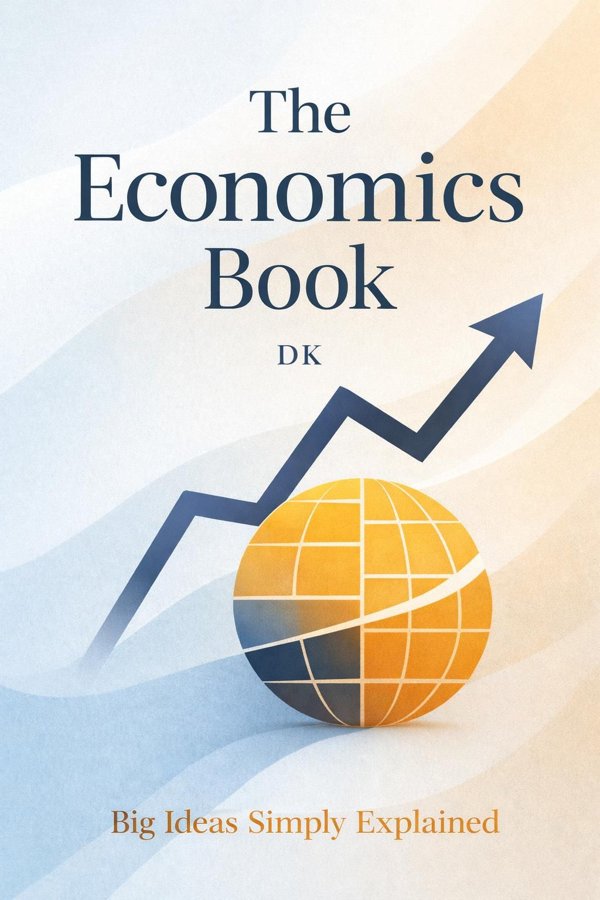
The Economics Book: Big Ideas Simply Explained: Summary & Key Insights
by DK
 10 min9 chaptersAudio available
Key Takeaways from The Economics Book: Big Ideas Simply Explained
Every economic problem starts with one uncomfortable truth: human wants are unlimited, but resources are not.
A price tag does more than tell you what something costs; it carries information about scarcity, demand, and incentives.
Prosperity often comes not from working harder, but from organizing work smarter.
Free markets can be remarkably effective, but they are not self-healing in every circumstance.
Booms and busts are not accidents at the edge of economics; they are recurring features of economic life.
What Is The Economics Book: Big Ideas Simply Explained About?
The Economics Book: Big Ideas Simply Explained by DK is a economics book. The Economics Book: Big Ideas Simply Explained is a visual, accessible tour through the history of economic thought, from ancient trade and mercantilism to behavioral economics, globalization, inequality, and financial crises. Rather than presenting economics as a dry set of formulas, the book shows how economic ideas shape everyday life: the prices we pay, the jobs we pursue, the policies governments choose, and the ways societies grow or decline. Its greatest strength is clarity. Complex theories from Adam Smith, Karl Marx, John Maynard Keynes, Milton Friedman, Friedrich Hayek, and many others are broken into digestible explanations, timelines, diagrams, and memorable examples. Published by DK, a global reference publisher known for turning difficult subjects into engaging visual guides, the book carries authority through curation rather than a single authorial voice. It draws together centuries of influential thinkers and debates into one coherent framework, helping readers see how schools of thought connect, clash, and evolve. Whether you are a student, a business professional, or simply curious about why economies behave the way they do, this book offers a practical and surprisingly readable foundation in economic thinking.
This FizzRead summary covers all 9 key chapters of The Economics Book: Big Ideas Simply Explained in approximately 10 minutes, distilling the most important ideas, arguments, and takeaways from DK's work. Also available as an audio summary and Key Quotes Podcast.
The Economics Book: Big Ideas Simply Explained
The Economics Book: Big Ideas Simply Explained is a visual, accessible tour through the history of economic thought, from ancient trade and mercantilism to behavioral economics, globalization, inequality, and financial crises. Rather than presenting economics as a dry set of formulas, the book shows how economic ideas shape everyday life: the prices we pay, the jobs we pursue, the policies governments choose, and the ways societies grow or decline. Its greatest strength is clarity. Complex theories from Adam Smith, Karl Marx, John Maynard Keynes, Milton Friedman, Friedrich Hayek, and many others are broken into digestible explanations, timelines, diagrams, and memorable examples.
Published by DK, a global reference publisher known for turning difficult subjects into engaging visual guides, the book carries authority through curation rather than a single authorial voice. It draws together centuries of influential thinkers and debates into one coherent framework, helping readers see how schools of thought connect, clash, and evolve. Whether you are a student, a business professional, or simply curious about why economies behave the way they do, this book offers a practical and surprisingly readable foundation in economic thinking.
Who Should Read The Economics Book: Big Ideas Simply Explained?
This book is perfect for anyone interested in economics and looking to gain actionable insights in a short read. Whether you're a student, professional, or lifelong learner, the key ideas from The Economics Book: Big Ideas Simply Explained by DK will help you think differently.
- ✓Readers who enjoy economics and want practical takeaways
- ✓Professionals looking to apply new ideas to their work and life
- ✓Anyone who wants the core insights of The Economics Book: Big Ideas Simply Explained in just 10 minutes
Want the full summary?
Get instant access to this book summary and 100K+ more with Fizz Moment.
Get Free SummaryAvailable on App Store • Free to download
Key Chapters
Every economic problem starts with one uncomfortable truth: human wants are unlimited, but resources are not. That simple tension, known as scarcity, is the foundation of economics. The Economics Book shows that once we understand scarcity, we can better understand why people, businesses, and governments must constantly make trade-offs. Should a family spend more on housing or save for education? Should a company invest in new technology or hire more workers? Should a government fund healthcare, defense, or infrastructure first? Economics does not eliminate hard choices; it gives us a way to think about them.
The book explains how scarcity leads to opportunity cost, the value of the next best alternative we give up when we choose something. This idea sounds abstract, but it affects daily life. If you spend Saturday working extra hours, the cost is not just fatigue; it may be missing time with family or rest. If a city uses land for luxury apartments, the cost might be fewer public parks or affordable homes. By highlighting opportunity cost, the book teaches readers to look beyond the obvious price tag and consider hidden consequences.
This principle also helps explain broader economic behavior. Limited natural resources affect energy prices. Limited labor and capital influence production decisions. Limited time shapes personal productivity. Scarcity pushes innovation too, because constraints often encourage people to use resources more efficiently or invent substitutes.
One of the most practical lessons here is that better decisions come from comparing alternatives honestly, not from wishing resources were infinite. When individuals or institutions ignore trade-offs, waste and disappointment follow. When they recognize constraints clearly, they can allocate effort and money more wisely.
Actionable takeaway: before making any important financial or strategic decision, ask yourself, "What am I giving up by choosing this?" That one question brings economic thinking into real life immediately.
A price tag does more than tell you what something costs; it carries information about scarcity, demand, and incentives. One of the book’s central insights is that markets are not merely places where buying and selling happen. They are coordination systems. Prices help millions of people, most of whom will never meet, adjust their behavior in response to changing conditions. When coffee prices rise, consumers may buy less, cafes may raise menu prices, and farmers may plant more beans. No single authority needs to command the entire process.
The Economics Book traces this insight to classical and neoclassical economics, especially the idea that supply and demand interact to create market prices. If a product is scarce and many people want it, the price tends to rise. If supply is abundant and demand weakens, the price tends to fall. These movements influence incentives. Producers respond to the possibility of profit; consumers respond to the costs they face.
The book also makes clear that incentives can produce good or bad outcomes depending on the rules around them. If employees are rewarded only for short-term sales, they may pressure customers into poor decisions. If housing regulations are too restrictive, prices may rise beyond what average households can afford. If carbon emissions are free, markets may overproduce pollution because environmental damage is not priced in.
This is why prices are powerful but not perfect. They communicate valuable information, yet they can fail when external costs, monopolies, misinformation, or unequal bargaining power distort the system. Still, understanding price signals remains essential for making sense of economic life.
Actionable takeaway: whenever prices change significantly, do not just react emotionally. Ask what underlying information the change may be revealing about scarcity, demand, competition, or incentives.
Prosperity often comes not from working harder, but from organizing work smarter. One of the most enduring ideas highlighted in The Economics Book is the division of labor: the process of breaking production into specialized tasks so that workers, firms, and even nations can become more efficient. Adam Smith famously illustrated this with a pin factory, where specialized workers collectively produced far more pins than individuals working alone. The lesson still applies across modern economies.
Specialization increases productivity in several ways. Workers improve through repetition, firms invest in tools designed for specific tasks, and time is saved because people do not constantly switch between unrelated activities. In a modern smartphone supply chain, one region may specialize in chip design, another in assembly, another in logistics, and another in software. The result is a level of output and quality that would be impossible if every producer tried to do everything.
The book also shows that division of labor extends beyond factories. In medicine, specialists improve outcomes in narrow fields. In law, expertise deepens through focus. In digital business, teams split responsibilities among engineering, design, marketing, and analytics. Even households benefit when members divide responsibilities based on skills and time constraints.
Yet specialization has trade-offs. It can make workers vulnerable if their narrow skill becomes obsolete. It can also create dependence on long supply chains, which become fragile during shocks such as pandemics or wars. The most resilient economies enjoy both specialization and adaptability.
The practical value of this idea is huge. Individuals who identify their comparative strengths can often create more value than those trying to master everything at once. Organizations that define roles clearly usually outperform those with constant overlap and confusion.
Actionable takeaway: identify the few tasks where you create the most value, focus on improving them, and delegate or streamline lower-value activities whenever possible.
Free markets can be remarkably effective, but they are not self-healing in every circumstance. A major theme in The Economics Book is that government intervention becomes important when markets fail to deliver socially desirable outcomes. This insight emerges strongly in discussions of public goods, externalities, monopoly power, inequality, and economic crises. Roads, national defense, clean air, and basic disease control are examples of areas where private incentives alone may underprovide what society needs.
The book explains that market failure occurs when individual choices do not capture full social costs or benefits. Pollution is the classic case. A factory may profit by producing goods cheaply, but if it contaminates water or air without paying for the damage, the true cost is shifted to others. Similarly, monopolies may restrict output and raise prices because competition is weak. Information asymmetry creates another problem: when sellers know far more than buyers, bad products can drive out good ones.
This is where government policy can improve outcomes through regulation, taxes, subsidies, social insurance, competition law, and public investment. Keynesian economics, in particular, emphasized the role of government in supporting demand during recessions when private spending collapses. The book does not present intervention as automatically wise; it also shows how governments can fail through bureaucracy, corruption, poor incentives, or unintended consequences.
What matters is not ideology but design. Effective policy addresses a clear problem, uses appropriate tools, and evaluates results honestly. For instance, congestion pricing can reduce traffic more efficiently than simply building more roads. Carbon taxes may work better than vague environmental pledges. Antitrust enforcement can preserve competition without micromanaging entire industries.
Actionable takeaway: when judging any public policy, ask two questions: what specific market failure is it trying to solve, and is the chosen solution likely to work better than doing nothing?
Booms and busts are not accidents at the edge of economics; they are recurring features of economic life. The Economics Book helps readers understand that economies move in cycles, with periods of expansion, optimism, rising employment, and investment often followed by contraction, fear, unemployment, and falling output. These shifts can result from changes in credit, consumer confidence, investment expectations, asset bubbles, policy mistakes, and external shocks.
The book draws on major thinkers who tried to explain instability, especially John Maynard Keynes, who argued that economies can settle into prolonged slumps when demand is too weak. In such moments, waiting for wages and prices to adjust may take too long and cause unnecessary suffering. Keynes argued that governments can step in by spending more, cutting taxes, or supporting employment until private demand recovers. Later thinkers focused more heavily on money supply, inflation expectations, and central bank credibility.
This history matters because economic crises affect ordinary life deeply. A housing bubble can look like prosperity until debt burdens become unsustainable. Easy credit may boost consumption in the short term but create financial fragility. A sudden fall in business confidence can trigger layoffs even in otherwise healthy sectors. The 2008 global financial crisis demonstrated how interconnected modern economies are and how quickly local financial problems can spread worldwide.
The book’s real value is that it teaches readers to look beneath headlines. Strong growth may conceal dangerous leverage. High market prices may reflect speculation rather than productivity. Rising unemployment may require more than individual effort; it may signal a broad collapse in demand.
Actionable takeaway: during periods of economic optimism, pay close attention to debt levels, asset bubbles, and overconfidence, because stability often looks strongest just before it is tested.
Money feels ordinary because we use it every day, yet it is one of the most powerful institutions in economic life. The Economics Book shows that money is not just coins and paper; it is a social technology that enables exchange, stores value, and provides a unit for calculation. Without it, trade would be slow and inefficient. With it, complex economies can coordinate vast networks of production and consumption.
But money’s usefulness depends on trust. If people stop believing that money will hold value, prices become unstable and economic planning becomes difficult. That is why inflation occupies such an important place in the book. Moderate inflation may be manageable, but high or unpredictable inflation damages savings, distorts contracts, confuses investment, and often hurts lower-income households most. Hyperinflation demonstrates how quickly economic order can unravel when money loses credibility.
The book also introduces the role of central banks in managing interest rates, controlling money supply, and stabilizing financial systems. Thinkers such as Milton Friedman emphasized the importance of monetary policy and warned that poor management of money can deepen recessions or fuel inflation. Modern central banks try to balance growth, employment, and price stability, though these goals can conflict.
In practical terms, interest rates influence whether households borrow, businesses invest, and currencies strengthen or weaken. If rates are low, mortgages and business loans may become cheaper, encouraging spending. If rates rise to fight inflation, borrowing slows and economic growth may cool. Understanding this relationship helps explain why central bank announcements move markets so dramatically.
Actionable takeaway: if you want to understand major changes in the economy, watch inflation, interest rates, and central bank decisions closely; they affect savings, debt, jobs, and investment more than most people realize.
Economics is not a single unquestioned doctrine; it is an ongoing argument about how the world works. One of the book’s greatest strengths is that it presents economic history as a conversation among competing schools of thought. Classical economists emphasized production, trade, and self-regulating markets. Marx criticized capitalism’s inequalities and internal contradictions. Keynes focused on demand shortfalls and instability. Hayek warned against excessive central planning. Friedman stressed money, incentives, and the risks of government overreach. Behavioral economists later challenged the assumption that people always act rationally.
This diversity matters because different theories illuminate different problems. If inflation is rising, monetarist ideas may become especially useful. If unemployment remains high during a demand slump, Keynesian analysis may be more relevant. If a policy assumes perfect rationality but real people make emotional decisions, behavioral economics may explain why it fails. The book encourages readers not to search for one permanent winner, but to understand what each framework sees clearly and what it may overlook.
This approach also protects against simplistic thinking. Policy debates often become ideological, with one side praising markets and the other praising the state. But real economies are messy. Competition can drive innovation, yet also leave some people behind. Government can provide safety nets and correct failures, yet also waste resources. A strong economic education requires intellectual flexibility.
For readers, this is liberating. You do not need to treat economics as a rigid belief system. You can learn to compare assumptions, evidence, and outcomes. That makes you a better voter, manager, investor, and citizen.
Actionable takeaway: when you hear an economic claim, ask which school of thought it reflects, what assumptions it makes, and what real-world evidence supports or challenges it.
A growing economy does not automatically mean broadly shared prosperity. The Economics Book repeatedly returns to the tension between economic growth and the distribution of its rewards. Some theories argue that market growth eventually lifts living standards widely. Others show that without strong institutions, education, taxation, labor protections, and access to opportunity, wealth can concentrate heavily while many people remain excluded from progress.
The book examines how industrialization created immense productivity gains but also harsh working conditions and sharp class divisions. Later welfare-state models tried to soften capitalism’s extremes through public services and redistribution. More recent debates have focused on global inequality, wage stagnation, superstar firms, financialization, and the gap between returns to capital and returns to labor.
This matters in everyday life because inequality influences far more than income. It affects health, education, social mobility, political trust, and long-term economic stability. If too many people lack purchasing power, demand can weaken. If housing, education, and healthcare become unaffordable, talent is wasted. If wealth buys disproportionate political influence, rules may increasingly favor incumbents over competition and fairness.
The book does not reduce the issue to envy or simple redistribution. It treats inequality as a structural economic question: how can a society encourage innovation and enterprise while maintaining legitimacy, opportunity, and cohesion? Practical solutions can include progressive taxation, targeted transfers, strong public education, competition policy, labor market reforms, and broader access to assets.
For individuals, the lesson is to judge economic success by both output and inclusion. GDP growth is important, but so is who benefits from it and who bears the costs.
Actionable takeaway: when evaluating economic policy, look beyond growth statistics alone and ask whether prosperity is becoming more productive, more resilient, and more widely shared.
People do not make decisions like flawless calculators, and economics becomes more realistic when it admits that. One of the more modern ideas in The Economics Book is behavioral economics, which questions the traditional assumption that individuals always act rationally in their own best interests. In reality, people rely on habits, emotions, mental shortcuts, social pressure, and imperfect information. We procrastinate, fear losses more than we value equivalent gains, overspend when using credit, and make inconsistent choices depending on how options are framed.
This insight has practical implications everywhere. A retirement plan with automatic enrollment usually gets higher participation than one requiring employees to opt in, even if both offer the same benefits. Consumers may buy a product because it is labeled "90% fat free" rather than "10% fat," despite the information being identical. Investors may hold losing stocks too long because admitting a loss feels painful. Governments and firms increasingly use behavioral insights to design better systems, from tax reminders to healthier cafeteria layouts.
The book’s broader point is that economic outcomes depend not only on incentives but also on psychology. A policy can look perfect on paper and still fail if it ignores how people actually behave. Likewise, businesses that understand customer bias can improve product design, though this power can also be used manipulatively.
Behavioral economics does not destroy traditional economics; it refines it. Prices, incentives, and markets still matter. But they work through human beings, and human beings are not perfectly consistent. That makes economics both more complex and more useful.
Actionable takeaway: improve your own decisions by building environments that help good behavior happen automatically, such as default savings, spending limits, and checklists that reduce emotional mistakes.
All Chapters in The Economics Book: Big Ideas Simply Explained
About the Author
DK, originally founded as Dorling Kindersley in 1974, is a globally respected publisher known for visually rich, highly accessible nonfiction. Rather than focusing on a single authorial voice, DK books are typically created by editorial teams who synthesize expert knowledge into clear, engaging formats. The company has earned a strong reputation for making complex subjects understandable through diagrams, timelines, photographs, and concise explanations. Its catalog spans science, history, business, philosophy, health, and children’s education, with many titles designed to help beginners build confidence quickly. In The Economics Book: Big Ideas Simply Explained, DK applies this signature approach to economic thought, turning dense theories and historical debates into an inviting guide for modern readers who want both clarity and substance.
Get This Summary in Your Preferred Format
Read or listen to the The Economics Book: Big Ideas Simply Explained summary by DK anytime, anywhere. FizzRead offers multiple formats so you can learn on your terms — all free.
Available formats: App · Audio · PDF · EPUB — All included free with FizzRead
Download The Economics Book: Big Ideas Simply Explained PDF and EPUB Summary
Key Quotes from The Economics Book: Big Ideas Simply Explained
“Every economic problem starts with one uncomfortable truth: human wants are unlimited, but resources are not.”
“A price tag does more than tell you what something costs; it carries information about scarcity, demand, and incentives.”
“Prosperity often comes not from working harder, but from organizing work smarter.”
“Free markets can be remarkably effective, but they are not self-healing in every circumstance.”
“Booms and busts are not accidents at the edge of economics; they are recurring features of economic life.”
Frequently Asked Questions about The Economics Book: Big Ideas Simply Explained
The Economics Book: Big Ideas Simply Explained by DK is a economics book that explores key ideas across 9 chapters. The Economics Book: Big Ideas Simply Explained is a visual, accessible tour through the history of economic thought, from ancient trade and mercantilism to behavioral economics, globalization, inequality, and financial crises. Rather than presenting economics as a dry set of formulas, the book shows how economic ideas shape everyday life: the prices we pay, the jobs we pursue, the policies governments choose, and the ways societies grow or decline. Its greatest strength is clarity. Complex theories from Adam Smith, Karl Marx, John Maynard Keynes, Milton Friedman, Friedrich Hayek, and many others are broken into digestible explanations, timelines, diagrams, and memorable examples. Published by DK, a global reference publisher known for turning difficult subjects into engaging visual guides, the book carries authority through curation rather than a single authorial voice. It draws together centuries of influential thinkers and debates into one coherent framework, helping readers see how schools of thought connect, clash, and evolve. Whether you are a student, a business professional, or simply curious about why economies behave the way they do, this book offers a practical and surprisingly readable foundation in economic thinking.
More by DK

You Might Also Like
Business Adventures
John Brooks
10 min
Nudge
Richard H. Thaler, Cass R. Sunstein
10 min
The Hitchhiker"s Guide to the Galaxy
Douglas Adams
10 minThe Muqaddimah
Ibn Khaldun
10 minThe Outsiders
William N. Thorndike
10 min
A Little History of Economics
Niall Kishtainy
10 minBrowse by Category
Ready to read The Economics Book: Big Ideas Simply Explained?
Get the full summary and 100K+ more books with Fizz Moment.