
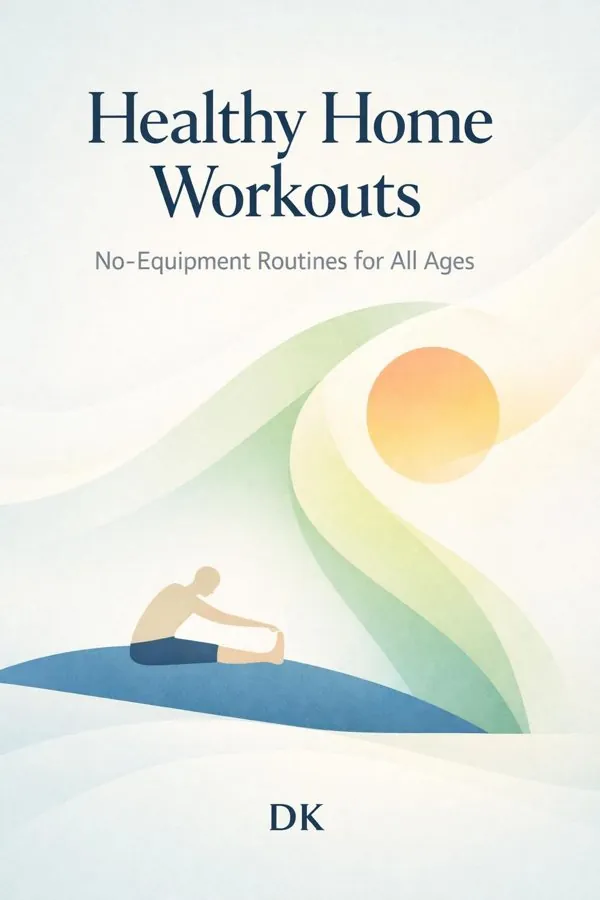
Healthy Home Workouts: No-Equipment Routines for All Ages: Summary & Key Insights
by DK
 10 min10 chaptersAudio available
Key Takeaways from Healthy Home Workouts: No-Equipment Routines for All Ages
A workout begins long before the first squat or stretch—it begins with the space you choose.
The body rarely performs well when asked to go from stillness to strain in an instant.
One of the book’s most empowering messages is that your body is not just the thing you train—it is the training tool itself.
Upper-body strength is not just about appearance; it is about capability.
Leg strength is the engine of movement, but balance is the steering.
What Is Healthy Home Workouts: No-Equipment Routines for All Ages About?
Healthy Home Workouts: No-Equipment Routines for All Ages by DK is a fitness book spanning 10 pages. What if the biggest barrier to fitness is not time, money, or access to a gym, but the belief that exercise has to be complicated? Healthy Home Workouts: No-Equipment Routines for All Ages challenges that idea by showing how effective movement can happen almost anywhere, using nothing more than your body, a bit of floor space, and a practical plan. Designed as an illustrated, accessible guide, the book offers routines for different ages, abilities, and goals, making home exercise feel achievable rather than intimidating. What makes this book especially useful is its emphasis on safety, clarity, and adaptability. Instead of pushing a one-size-fits-all program, it explains how to warm up properly, modify exercises, protect joints, improve posture, and build strength gradually. It also includes gentler routines for beginners and older adults, alongside more demanding options for those seeking a tougher challenge. DK’s long-standing reputation for visually clear, well-structured reference books gives the guide real authority: it is practical, easy to follow, and designed for everyday people. The result is a fitness resource that turns the home into a flexible, inclusive space for lifelong health.
This FizzRead summary covers all 10 key chapters of Healthy Home Workouts: No-Equipment Routines for All Ages in approximately 10 minutes, distilling the most important ideas, arguments, and takeaways from DK's work. Also available as an audio summary and Key Quotes Podcast.
Healthy Home Workouts: No-Equipment Routines for All Ages
What if the biggest barrier to fitness is not time, money, or access to a gym, but the belief that exercise has to be complicated? Healthy Home Workouts: No-Equipment Routines for All Ages challenges that idea by showing how effective movement can happen almost anywhere, using nothing more than your body, a bit of floor space, and a practical plan. Designed as an illustrated, accessible guide, the book offers routines for different ages, abilities, and goals, making home exercise feel achievable rather than intimidating.
What makes this book especially useful is its emphasis on safety, clarity, and adaptability. Instead of pushing a one-size-fits-all program, it explains how to warm up properly, modify exercises, protect joints, improve posture, and build strength gradually. It also includes gentler routines for beginners and older adults, alongside more demanding options for those seeking a tougher challenge. DK’s long-standing reputation for visually clear, well-structured reference books gives the guide real authority: it is practical, easy to follow, and designed for everyday people. The result is a fitness resource that turns the home into a flexible, inclusive space for lifelong health.
Who Should Read Healthy Home Workouts: No-Equipment Routines for All Ages?
This book is perfect for anyone interested in fitness and looking to gain actionable insights in a short read. Whether you're a student, professional, or lifelong learner, the key ideas from Healthy Home Workouts: No-Equipment Routines for All Ages by DK will help you think differently.
- ✓Readers who enjoy fitness and want practical takeaways
- ✓Professionals looking to apply new ideas to their work and life
- ✓Anyone who wants the core insights of Healthy Home Workouts: No-Equipment Routines for All Ages in just 10 minutes
Want the full summary?
Get instant access to this book summary and 100K+ more with Fizz Moment.
Get Free SummaryAvailable on App Store • Free to download
Key Chapters
A workout begins long before the first squat or stretch—it begins with the space you choose. One of the most valuable lessons in Healthy Home Workouts is that an effective exercise environment does not require expensive equipment or a dedicated gym room. What it does require is thoughtful preparation. A safe home workout space reduces distraction, lowers injury risk, and makes consistency much easier.
The book emphasizes practical factors: clear the floor of clutter, make sure the surface is stable, wear supportive footwear when needed, and ensure there is enough room to move your arms and legs without hitting furniture. Lighting and ventilation also matter more than people think. A dim, cramped room can make movement feel draining, while fresh air and a bright setting can increase alertness and motivation. Even something as simple as keeping a water bottle and towel nearby can improve the quality of a session.
This idea is especially important for households with mixed ages and abilities. A younger adult doing dynamic lunges and a senior practicing chair-supported balance work may share the same room, but each needs slightly different setup considerations. The book encourages adapting the environment to the routine rather than forcing the body to cope with poor conditions. A non-slip mat, a sturdy chair, and enough space to turn, bend, and lie down can transform an ordinary corner into a reliable fitness area.
The deeper message is that convenience fuels habit. If your space is ready, exercise becomes easier to start and harder to postpone. Actionable takeaway: choose one consistent workout spot in your home today, clear it fully, and set it up so that beginning a session takes less than two minutes.
The body rarely performs well when asked to go from stillness to strain in an instant. Healthy Home Workouts treats the warm-up not as optional filler, but as a critical transition that prepares muscles, joints, circulation, and focus for movement. This is a simple idea, yet it is one of the most overlooked habits in home fitness, where people often rush into exercise because they are short on time.
The book explains that a proper warm-up gradually raises heart rate, increases blood flow, and improves range of motion. It also sharpens coordination, which matters whether you are doing gentle mobility work or fast-paced intervals. Instead of static stretching alone, the guide favors active movements such as marching in place, shoulder rolls, arm circles, easy torso twists, and shallow squats. These exercises mirror the patterns the body will soon use in a workout, making the transition into effort smoother and safer.
The warm-up is also a diagnostic tool. It tells you how your body feels that day. Tight hips, stiff ankles, or mild fatigue can all become visible during those first few minutes, allowing you to modify the session before discomfort turns into injury. For older adults and beginners, this awareness is especially useful. For experienced exercisers, it can improve performance by helping the body move more efficiently.
A warm-up does not need to be long to be effective. Even five to ten focused minutes can significantly improve the quality of the session that follows. The key is consistency and relevance. Actionable takeaway: before every home workout, spend at least five minutes doing gentle, movement-based preparation that matches the workout you are about to perform.
One of the book’s most empowering messages is that your body is not just the thing you train—it is the training tool itself. Healthy Home Workouts shows how bodyweight exercise can build strength, mobility, balance, coordination, and cardiovascular fitness without machines or weights. This matters because many people assume real progress requires equipment, when in reality the fundamentals of fitness can be developed through well-chosen movement patterns.
The guide highlights staple exercises such as squats, lunges, push-ups, wall push-ups, step patterns, planks, glute bridges, and dynamic standing movements. These exercises recruit multiple muscle groups at once, making workouts efficient and functional. A squat trains legs and hips, but it also supports daily tasks like sitting down and standing up. Push-up variations strengthen the chest, shoulders, and arms while engaging the core. Simple combinations can produce surprisingly complete sessions.
Another strength of the book is its focus on progression. A beginner might start with a chair-assisted squat or incline push-up against a wall, while a more advanced reader may move to deeper squats, faster tempo, pulse reps, or longer work intervals. This adaptability makes bodyweight training accessible across age groups and fitness levels. It also means progress can continue without needing to buy more equipment.
Full-body training works well at home because it respects limited time. Instead of splitting workouts into overly specialized routines, the book favors movements that train the whole body in a balanced way. This helps maintain general fitness, improve posture, and support everyday energy. Actionable takeaway: build your next workout around five basic movement patterns—squat, push, hinge, core, and balance—to create a complete routine using only bodyweight.
Upper-body strength is not just about appearance; it is about capability. Healthy Home Workouts approaches arm, shoulder, chest, and upper-back training as a foundation for everyday function, helping readers carry groceries, lift objects, maintain posture, and move with more control. In a home-based program, this practical framing is important because it shifts the focus from bodybuilding ideals to useful, sustainable strength.
The book includes accessible upper-body movements such as wall push-ups, floor push-ups, triceps dips using a sturdy chair, arm raises, shoulder mobility drills, and controlled reaching patterns. These exercises do more than isolate muscles. They improve how the shoulders move, how the upper back supports the neck, and how the arms coordinate with the core. This integrated approach matters especially for people who spend hours at a desk or on devices, as poor posture often leads to tight shoulders and weak upper-back muscles.
Flexibility is woven into the same conversation. Strength without mobility can create stiffness, while mobility without strength can leave joints unsupported. The guide therefore balances effort with control, encouraging exercises that open the chest, mobilize the shoulders, and train stability. For older adults, gentle arm circles and wall presses may be enough to rebuild confidence and function. For fitter readers, higher repetitions, slower lowering phases, or circuit combinations can increase challenge.
The larger point is that upper-body training does not require dumbbells to be effective. Intelligent bodyweight variation and repetition can create real gains. Actionable takeaway: include at least two upper-body pushing or posture-focused exercises in your weekly plan, and pair them with shoulder mobility work to improve both strength and comfort.
Leg strength is the engine of movement, but balance is the steering. Healthy Home Workouts makes the case that lower-body training should go beyond building stronger thighs and glutes; it should also improve coordination, stability, and endurance for real life. This is especially relevant in a home fitness context, where workouts should support daily function rather than simply chase muscle fatigue.
The book includes lower-body staples such as squats, calf raises, lunges, side steps, glute work, and single-leg balance drills. Together, these movements target the major muscles of the hips, thighs, and lower legs while also strengthening the smaller stabilizers around the ankles and knees. This matters for everyone, but particularly for older adults, who benefit from exercises that reduce fall risk and maintain confidence in movement.
Endurance is another key element. Repeated lower-body movements increase stamina and improve circulation, which supports both fitness and general health. Simple sequences like sit-to-stands from a chair, alternating step-backs, or timed calf raises can become powerful training tools when performed consistently. The book’s no-equipment structure proves that intensity does not always come from load; it can come from repetition, tempo, and control.
There is also a strong functional connection here. Strong, stable legs help with climbing stairs, walking longer distances, getting up from the floor, and maintaining posture during daily tasks. Training the lower body well supports independence across all ages. Actionable takeaway: add one strength move, one balance move, and one endurance-based lower-body drill to each weekly routine so your legs become not only stronger, but steadier and more resilient.
The core is often misunderstood as a cosmetic target, when in fact it is the body’s central support system. Healthy Home Workouts presents core training as the key to posture, spinal support, balance, and efficient movement. This broader view is especially useful for home exercisers, who may spend much of the day sitting and then expect their bodies to suddenly move well during short workout sessions.
The guide includes classic core exercises such as planks, modified planks, abdominal bracing, leg lifts, bridges, and rotational control drills. Yet its real strength lies in showing that core work is not just about crunches. A strong core helps stabilize the trunk during squats, supports the spine during reaching and lifting, and improves alignment during walking and standing. In other words, nearly every movement becomes better when the core is trained effectively.
Postural control is a recurring theme. Weak core muscles can contribute to slouching, back discomfort, and inefficient movement patterns. By contrast, a stable midsection helps distribute force more evenly throughout the body. The book encourages steady, controlled repetitions rather than rushed effort, which is especially important for beginners and older adults. Proper breathing is also highlighted, since breath and core engagement are closely linked.
Importantly, the book respects variation in ability. A reader can begin with simple pelvic tilts or supported bridging and gradually progress to longer planks or more dynamic exercises. This makes the section practical rather than intimidating. Actionable takeaway: practice one short core routine three times a week, focusing on control, breathing, and alignment rather than speed, and use that stability to improve all your other exercises.
Fitness becomes truly valuable when it is inclusive. One of the best qualities of Healthy Home Workouts is that it does not assume all readers are equally mobile, strong, or confident. Instead, it offers gentler routines for older adults and beginners, proving that meaningful exercise can be safe, gradual, and deeply effective even at lower intensity levels.
This part of the book recognizes common barriers: fear of injury, stiffness, low confidence, limited balance, and uncertainty about technique. Rather than dismissing these concerns, it addresses them directly with slower movements, chair-supported exercises, wall-based options, and routines that emphasize mobility, coordination, and controlled strength. For example, a beginner might perform seated knee lifts, supported heel raises, or partial squats using a chair, while someone further along might turn those same patterns into standing circuits.
The book also reinforces the idea that improvement does not require exhaustion. For many people, especially older adults, success means moving more comfortably, climbing stairs with less effort, reducing stiffness, or maintaining independence. That shift in definition is powerful because it aligns exercise with quality of life. Gentle routines can improve circulation, joint mobility, posture, and confidence, all without overwhelming the body.
Equally important is the tone of progression. Readers are encouraged to build gradually, listen to their bodies, and prioritize consistency over intensity. This creates a sustainable relationship with movement rather than a short burst of motivation followed by setback. Actionable takeaway: if you are new to exercise or returning after time away, start with the easiest variation that feels safe, repeat it consistently for two weeks, and only then increase difficulty.
Intensity can be created without equipment, but it must be handled intelligently. Healthy Home Workouts introduces high-intensity interval training, or HIIT, as an option for advanced users who want to improve cardiovascular fitness, burn more energy in less time, and challenge the body with short bursts of harder effort. The book’s treatment of HIIT is useful because it frames intensity as a tool, not a requirement.
The basic format is simple: alternate periods of work with periods of rest or lighter movement. In a home setting, this could mean 30 seconds of fast squats, mountain climbers, high knees, or jumping jacks followed by 15 to 30 seconds of recovery. The appeal is efficiency. Even a short interval session can produce a demanding workout. But the book is careful to stress prerequisites: sound technique, adequate baseline fitness, and a proper warm-up.
This caution matters. Intensity magnifies both benefits and mistakes. Poor form, fatigue, or unsuitable exercise choices can quickly raise injury risk, especially in small home spaces. The guide therefore encourages readers to choose movements they can control and to scale impact where needed. For example, instead of jumping, some people may perform fast step-outs or power marches. This preserves the interval structure without unnecessary strain.
Used well, intervals can break plateaus, improve conditioning, and add variety to a weekly routine. Used poorly, they can derail consistency. The book’s balanced approach keeps the emphasis on readiness and recovery. Actionable takeaway: only add interval training after mastering basic bodyweight movements, and begin with one short session per week using low-impact options before increasing speed or duration.
Progress does not happen only during effort; it also happens during recovery. Healthy Home Workouts reminds readers that stretching, cooldowns, and rest are not secondary concerns but essential parts of a complete fitness routine. In home exercise, where people often squeeze workouts into busy days, recovery can be the first thing to disappear. The book makes clear that skipping it too often can lead to stiffness, fatigue, and reduced motivation.
A proper cooldown gradually lowers the heart rate and helps the body transition out of exertion. Gentle walking in place, slower breathing, and light mobility movements can make this shift smoother. After that, targeted stretching can help restore comfort and maintain flexibility. The book highlights areas that commonly tighten after exercise or prolonged sitting, such as calves, hamstrings, hips, chest, and shoulders.
Recovery also includes rest days and self-awareness. Soreness is not always a sign of success, and exhaustion is not proof of an effective routine. The guide encourages readers to notice how they feel, sleep, and move between workouts. If joints are irritated or energy is persistently low, the answer may be lighter activity, more mobility work, or simply an extra recovery day. This is especially important for older adults and anyone increasing activity after a sedentary period.
The bigger principle is sustainability. A routine you can recover from is a routine you can continue. And consistency always beats overexertion in the long run. Actionable takeaway: finish every session with at least five minutes of cooldown and stretching, and schedule at least one lighter or recovery-focused day each week.
The hardest part of exercise is often not the workout itself but the repetition of it over time. Healthy Home Workouts closes the gap between intention and action by treating fitness as a daily-life habit rather than an isolated event. This mindset matters because home routines succeed not through novelty, but through regularity, flexibility, and integration into real schedules.
The book encourages readers to think beyond all-or-nothing thinking. A 10-minute mobility routine, a short strength circuit, or a quick stretch break can all count. This is especially helpful for busy adults, parents, and older readers who may not have long blocks of time. By lowering the threshold for participation, the book makes movement easier to sustain. It also recognizes that motivation fluctuates, so systems matter more than mood. Keeping a routine simple, visible, and linked to daily cues—such as exercising after breakfast or before showering—can significantly improve follow-through.
Variety plays a role as well. Rotating between strength, flexibility, balance, gentle movement, and interval sessions helps prevent boredom while supporting overall fitness. The book’s age-inclusive design reinforces another powerful idea: movement can be shared. Families can adapt routines together, and individuals at different fitness levels can still participate in the same general plan.
Ultimately, the goal is not a perfect program but a durable relationship with physical activity. Fitness becomes more effective when it feels normal rather than exceptional. Actionable takeaway: choose a specific time, a short routine length, and a weekly schedule you can realistically keep, then track your sessions for the next 14 days to build momentum.
All Chapters in Healthy Home Workouts: No-Equipment Routines for All Ages
About the Author
DK, or Dorling Kindersley, is a renowned British publisher celebrated for creating visually rich, highly accessible nonfiction books. Founded in 1974, DK has built a global reputation for combining expert knowledge with clear design, photography, illustrations, and step-by-step guidance. Its publishing spans subjects such as health, fitness, cooking, science, history, travel, and children’s learning. In the wellness space, DK books are especially valued for turning practical advice into easy-to-follow visual instruction, making them useful for readers of different ages and experience levels. Although DK is not a single author, its editorial approach emphasizes clarity, reliability, and usability. That makes DK particularly well suited to topics like home fitness, where readers benefit from simple explanations, adaptable routines, and visually guided demonstrations.
Get This Summary in Your Preferred Format
Read or listen to the Healthy Home Workouts: No-Equipment Routines for All Ages summary by DK anytime, anywhere. FizzRead offers multiple formats so you can learn on your terms — all free.
Available formats: App · Audio · PDF · EPUB — All included free with FizzRead
Download Healthy Home Workouts: No-Equipment Routines for All Ages PDF and EPUB Summary
Key Quotes from Healthy Home Workouts: No-Equipment Routines for All Ages
“A workout begins long before the first squat or stretch—it begins with the space you choose.”
“The body rarely performs well when asked to go from stillness to strain in an instant.”
“One of the book’s most empowering messages is that your body is not just the thing you train—it is the training tool itself.”
“Upper-body strength is not just about appearance; it is about capability.”
“Leg strength is the engine of movement, but balance is the steering.”
Frequently Asked Questions about Healthy Home Workouts: No-Equipment Routines for All Ages
Healthy Home Workouts: No-Equipment Routines for All Ages by DK is a fitness book that explores key ideas across 10 chapters. What if the biggest barrier to fitness is not time, money, or access to a gym, but the belief that exercise has to be complicated? Healthy Home Workouts: No-Equipment Routines for All Ages challenges that idea by showing how effective movement can happen almost anywhere, using nothing more than your body, a bit of floor space, and a practical plan. Designed as an illustrated, accessible guide, the book offers routines for different ages, abilities, and goals, making home exercise feel achievable rather than intimidating. What makes this book especially useful is its emphasis on safety, clarity, and adaptability. Instead of pushing a one-size-fits-all program, it explains how to warm up properly, modify exercises, protect joints, improve posture, and build strength gradually. It also includes gentler routines for beginners and older adults, alongside more demanding options for those seeking a tougher challenge. DK’s long-standing reputation for visually clear, well-structured reference books gives the guide real authority: it is practical, easy to follow, and designed for everyday people. The result is a fitness resource that turns the home into a flexible, inclusive space for lifelong health.
More by DK



You Might Also Like
The Men's Health Handbook: Practical Fitness, Nutrition, and Wellbeing for Men
Men's Health Editors
10 min
30 Ways to Reboot Your Body: A Complete User Manual for Getting the Most Out of the Human Body
Ben Greenfield
10 min
Active Aging: Exercise Plans for Older Adults: Safe Training for Seniors and Aging Populations
Patricia A. Brill
10 min
Becoming a Supple Leopard: The Ultimate Guide to Resolving Pain, Preventing Injury, and Optimizing Athletic Performance
Kelly Starrett
10 min
Bigger Leaner Stronger: The Simple Science of Building the Ultimate Male Body
Michael Matthews
10 min
Body by Science: A Research-Based Program for Strength Training, Bodybuilding, and Complete Fitness in 12 Minutes a Week
Doug McGuff, John Little
10 minBrowse by Category
Ready to read Healthy Home Workouts: No-Equipment Routines for All Ages?
Get the full summary and 100K+ more books with Fizz Moment.