
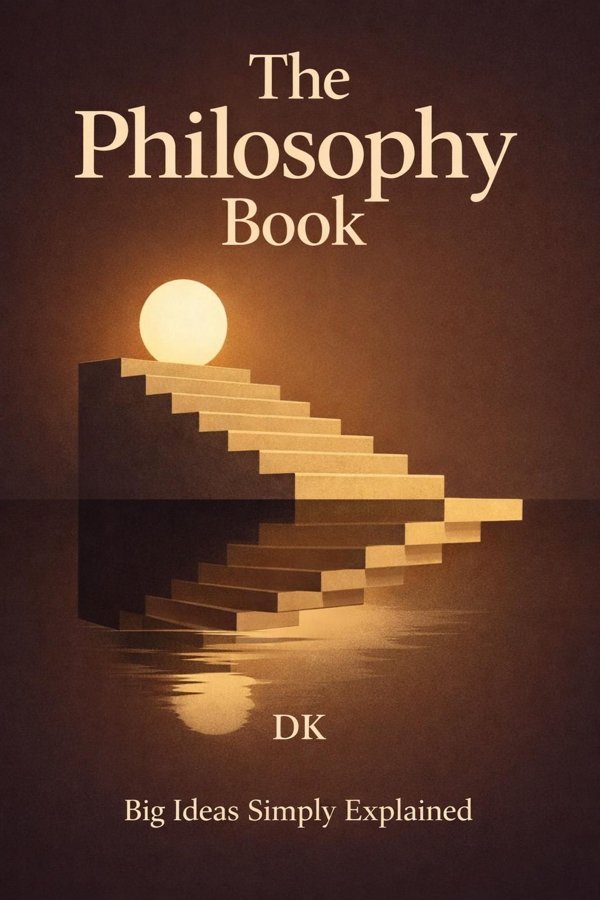
The Philosophy Book: Big Ideas Simply Explained: Summary & Key Insights
by DK
 10 min9 chaptersAudio available
Key Takeaways from The Philosophy Book: Big Ideas Simply Explained
Philosophy starts the moment someone refuses to accept easy answers.
A life can be successful and still be badly lived.
Peace of mind does not come from controlling the world; it comes from understanding what should and should not control you.
Belief becomes deeper, not weaker, when it is examined.
When old certainties collapse, the first task is to ask what can truly be known.
What Is The Philosophy Book: Big Ideas Simply Explained About?
The Philosophy Book: Big Ideas Simply Explained by DK is a western_phil book spanning 9 pages. What if the biggest questions in life could be made clear without being oversimplified? The Philosophy Book: Big Ideas Simply Explained does exactly that. Created by DK as part of its celebrated Big Ideas series, this richly illustrated guide introduces readers to more than a hundred major philosophical ideas, thinkers, and movements across history. From the pre-Socratics asking what the world is made of, to existentialists wrestling with freedom and meaning, the book shows how philosophy has shaped the way we think about reality, morality, politics, knowledge, and the self. What makes this book especially valuable is its accessibility. Philosophy can often feel intimidating, abstract, or buried in technical language. DK’s approach breaks down difficult concepts into clear explanations, visual diagrams, timelines, and memorable summaries, making complex thought easier to grasp without losing intellectual depth. The result is not just a reference book, but a map of humanity’s long conversation with itself. Backed by DK’s editorial expertise and its talent for producing authoritative visual nonfiction, this book is an ideal starting point for curious beginners, students, and lifelong learners who want to understand the foundations of Western philosophy and why those ideas still matter today.
This FizzRead summary covers all 9 key chapters of The Philosophy Book: Big Ideas Simply Explained in approximately 10 minutes, distilling the most important ideas, arguments, and takeaways from DK's work. Also available as an audio summary and Key Quotes Podcast.
The Philosophy Book: Big Ideas Simply Explained
What if the biggest questions in life could be made clear without being oversimplified? The Philosophy Book: Big Ideas Simply Explained does exactly that. Created by DK as part of its celebrated Big Ideas series, this richly illustrated guide introduces readers to more than a hundred major philosophical ideas, thinkers, and movements across history. From the pre-Socratics asking what the world is made of, to existentialists wrestling with freedom and meaning, the book shows how philosophy has shaped the way we think about reality, morality, politics, knowledge, and the self.
What makes this book especially valuable is its accessibility. Philosophy can often feel intimidating, abstract, or buried in technical language. DK’s approach breaks down difficult concepts into clear explanations, visual diagrams, timelines, and memorable summaries, making complex thought easier to grasp without losing intellectual depth. The result is not just a reference book, but a map of humanity’s long conversation with itself.
Backed by DK’s editorial expertise and its talent for producing authoritative visual nonfiction, this book is an ideal starting point for curious beginners, students, and lifelong learners who want to understand the foundations of Western philosophy and why those ideas still matter today.
Who Should Read The Philosophy Book: Big Ideas Simply Explained?
This book is perfect for anyone interested in western_phil and looking to gain actionable insights in a short read. Whether you're a student, professional, or lifelong learner, the key ideas from The Philosophy Book: Big Ideas Simply Explained by DK will help you think differently.
- ✓Readers who enjoy western_phil and want practical takeaways
- ✓Professionals looking to apply new ideas to their work and life
- ✓Anyone who wants the core insights of The Philosophy Book: Big Ideas Simply Explained in just 10 minutes
Want the full summary?
Get instant access to this book summary and 100K+ more with Fizz Moment.
Get Free SummaryAvailable on App Store • Free to download
Key Chapters
Philosophy starts the moment someone refuses to accept easy answers. The earliest Greek thinkers did something revolutionary: instead of explaining the world through myth alone, they asked whether nature had patterns, causes, and principles that human reason could discover. Thinkers such as Thales, Anaximander, and Heraclitus were not merely collecting opinions; they were inventing a new way of questioning reality.
Their central concern was the cosmos. What is the world made of? Is everything fundamentally water, fire, atoms, or something else? Heraclitus argued that change is constant, while Parmenides insisted that true being does not change at all. Democritus proposed that matter consists of indivisible atoms moving in empty space. These ideas were primitive by scientific standards, but philosophically they were transformative. They introduced rational investigation, conceptual argument, and the belief that reality is intelligible.
The practical value of this shift is still enormous. In everyday life, we often inherit assumptions from family, culture, or media without examining them. The pre-Socratic spirit teaches us to pause and ask: What is the evidence? What underlying principle explains this? If two explanations compete, which one makes more sense? This habit applies whether you are evaluating a news claim, a health trend, or a political slogan.
The book presents these pioneers as the starting point of intellectual independence. They did not yet have modern science, but they modeled a mindset that modern science depends on: curiosity disciplined by reason. Their legacy is not a set of final answers, but the courage to ask better questions.
Actionable takeaway: choose one belief you take for granted today and examine its foundations. Ask where it came from, what evidence supports it, and whether a more rational explanation exists.
A life can be successful and still be badly lived. That unsettling insight lies at the heart of classical Greek philosophy. With Socrates, philosophy turned from the structure of the cosmos to the condition of the soul. He challenged Athenians to define justice, courage, love, and virtue, not to embarrass them, but to show that most people live by words they do not truly understand.
Socrates believed that the unexamined life is not worth living. His method of dialogue exposed contradictions in confident opinions and pushed people toward humility and clarity. Plato, his student, expanded these concerns into a grand vision. He argued that the visible world is imperfect and that true knowledge concerns enduring realities such as justice, beauty, and goodness. Aristotle, Plato’s student, brought philosophy back toward observation and practical ethics. He taught that the good life is achieved not through abstract ideals alone, but through cultivating virtue, finding balance, and developing good habits.
These three thinkers still shape modern education, law, psychology, and ethics. Socrates teaches us to question our motives. Plato invites us to look beyond appearances and ask what standards should guide us. Aristotle reminds us that character is built through repeated action. If you want to become more patient, fair, or disciplined, you do not wait to feel virtuous; you practice virtue until it becomes part of you.
The book shows how classical philosophy frames one of humanity’s oldest concerns: not just how to survive, but how to live well. It makes clear that wisdom is not information alone. It is moral orientation.
Actionable takeaway: identify one virtue you admire, such as courage or honesty, and practice it deliberately in one small situation every day this week.
Peace of mind does not come from controlling the world; it comes from understanding what should and should not control you. Hellenistic and Roman philosophy emerged in an age of instability, empire, and personal uncertainty, so it naturally focused less on abstract speculation and more on how to live calmly amid chaos.
The Stoics, including Epictetus, Seneca, and Marcus Aurelius, argued that suffering often comes not from events themselves but from our judgments about them. Since we cannot control illness, reputation, weather, or politics, we should focus on what is within our power: our choices, attitudes, and responses. Epicurus offered a different but related path, teaching that happiness comes from modest pleasure, friendship, freedom from fear, and the avoidance of unnecessary desire. Skeptics, meanwhile, suggested that suspending judgment can reduce anxiety when certainty is impossible.
These schools remain deeply practical. Stoicism is useful when facing workplace setbacks, family tensions, or social media outrage. Instead of asking, “Why is this happening to me?” the Stoic asks, “What part of this is under my control?” Epicureanism offers a corrective to consumer culture by showing that endless acquisition does not equal contentment. A quiet dinner with close friends may bring more lasting happiness than status-driven ambition.
The book makes clear that these philosophies are not escape routes from life. They are disciplines for engaging reality more wisely. In an age of overstimulation, they feel strikingly modern. They show that freedom often begins when we stop demanding that the world obey our preferences.
Actionable takeaway: when something stressful happens, divide it into two lists: what you can control and what you cannot. Act firmly on the first list and release the second.
Belief becomes deeper, not weaker, when it is examined. Medieval philosophy is often misunderstood as a period of blind obedience, but the book reveals it as a rich era of debate about reason, revelation, ethics, and the nature of God. Thinkers such as Augustine, Anselm, Avicenna, Maimonides, and Thomas Aquinas wrestled with how human understanding relates to divine truth.
A central question was whether reason can support faith. Augustine emphasized inward reflection and the restless human search for God. Anselm proposed arguments for God’s existence based on the very idea of a perfect being. Aquinas synthesized Christian theology with Aristotelian philosophy, arguing that reason and faith are not enemies but complementary paths to truth. Across Christian, Islamic, and Jewish traditions, philosophers explored free will, moral law, the soul, and the structure of reality.
Why does this matter now, even for secular readers? Because the medieval period teaches us how to think seriously across different sources of authority. Many modern conflicts pit science against religion, tradition against reason, or identity against evidence. Medieval philosophy offers a more nuanced model: difficult questions deserve layered answers. It also reminds us that moral and metaphysical questions cannot always be reduced to technical problem-solving.
In practical life, this chapter encourages intellectual charity. We can disagree with someone’s worldview while still recognizing the logic, seriousness, or ethical concern within it. Whether one is religious or not, medieval philosophy sharpens reflection on purpose, moral obligation, and the limits of human certainty.
Actionable takeaway: engage with one viewpoint you disagree with by first trying to state its strongest argument fairly before offering any criticism.
When old certainties collapse, the first task is to ask what can truly be known. Renaissance and early modern philosophy arose during profound changes in science, politics, religion, and exploration. As inherited authority weakened, thinkers began rebuilding knowledge from the ground up.
René Descartes famously doubted everything he could until he reached one indubitable point: if he is thinking, he must exist. From there, he tried to reconstruct certainty. Francis Bacon championed empirical observation and experimentation, helping define the scientific mindset. Thomas Hobbes saw human beings as driven by fear and desire, leading him to justify strong political authority for the sake of peace. Spinoza reimagined God and nature as one unified reality governed by rational necessity. John Locke argued that the mind begins as a blank slate shaped by experience, laying groundwork for liberalism and modern psychology.
These debates still shape how we approach truth. Do we trust reason first, or experience? Are human beings naturally cooperative or self-interested? Should political power exist to protect us, guide us, or restrain us? In practical terms, early modern philosophy affects everything from constitutional government to classroom learning. A teacher who emphasizes experience-based discovery echoes Locke and Bacon. A person questioning how much certainty is possible in the age of misinformation is still walking in Descartes’s footsteps.
The book presents this era as a dramatic reset in human self-understanding. Knowledge became something to test, not merely inherit. Authority had to justify itself. The human mind became both suspect and powerful.
Actionable takeaway: when evaluating any claim, ask two questions: what reasons support it, and what evidence confirms it? Use both standards before accepting it as true.
To think for yourself is exhilarating, but it is also a moral responsibility. Enlightenment philosophy pushed this idea to the center of intellectual life. Thinkers such as Voltaire, Rousseau, Hume, and Kant explored reason, freedom, political legitimacy, and the foundations of ethics in a world increasingly skeptical of inherited hierarchy.
David Hume questioned whether reason alone can explain human belief and morality, stressing habit, emotion, and experience. Jean-Jacques Rousseau argued that civilization can corrupt as much as refine, and that political authority must rest on the collective will of the people. Immanuel Kant offered one of philosophy’s most influential moral frameworks: act only according to principles you could will to become universal laws. For Kant, human dignity comes from rational autonomy. People should never be treated merely as means to an end.
These ideas remain essential in modern democracy, law, and personal ethics. Human rights discourse reflects Kantian respect for persons. Public debate over government legitimacy echoes Rousseau. Hume’s insights help explain why facts alone rarely change minds if emotions and habits remain untouched.
The practical relevance is immediate. In work, relationships, and politics, we constantly face the question: am I acting on principle, convenience, or pressure? The Enlightenment insists that maturity involves more than intelligence. It requires responsibility, consistency, and the courage to justify one’s choices publicly.
The book captures this era as a turning point in modern self-rule. People were no longer merely subjects of custom or monarchy; they became moral and political agents. That shift is one of the defining inheritances of the modern West.
Actionable takeaway: before making a difficult decision, ask whether you would want everyone in a similar situation to act as you plan to act. If not, reconsider.
Philosophy becomes most urgent when the world feels unstable. The nineteenth century was marked by industrialization, revolution, secularization, and social upheaval, and its philosophers responded with bold attempts to diagnose modern life. Hegel saw history as a rational process unfolding through conflict and development. Karl Marx transformed this into a materialist critique of class power, arguing that economic structures shape consciousness and that philosophy should help change the world, not merely interpret it.
At the same time, Søren Kierkegaard focused on individual existence, faith, and the anxiety of choice. Friedrich Nietzsche launched a fierce attack on herd morality, complacency, and life-denying values. John Stuart Mill defended liberty, individuality, and the utilitarian idea that actions should aim at the greatest good for the greatest number.
Together, these thinkers ask whether modern society liberates or deforms us. Marx encourages us to examine labor, inequality, and ideology. Mill asks how far society should limit personal freedom. Kierkegaard and Nietzsche force us to confront authenticity: are we living by our own deepest commitments, or merely performing what our age expects?
These issues are intensely contemporary. Debates about capitalism, identity, burnout, conformity, and free speech all carry nineteenth-century philosophical DNA. A worker questioning corporate culture, a citizen concerned about inequality, or an individual resisting social pressure is participating in these long arguments.
The book shows this century as the age when philosophy became more historical, political, psychological, and existential. It no longer asked only what truth is, but who benefits from accepted truths, and what kind of person emerges under modern conditions.
Actionable takeaway: look at one institution in your life, such as work, school, or media, and ask whose interests it serves, what values it rewards, and whether those values align with your own.
The modern world gave humanity more knowledge than ever, yet often less certainty about meaning. Twentieth-century philosophy reflects that tension. After world wars, technological upheaval, and social dislocation, philosophers turned to language, consciousness, power, and the absurdity of existence.
Existentialists such as Jean-Paul Sartre and Albert Camus argued that human beings are radically free in a world without predetermined meaning. That freedom is both exhilarating and terrifying, because it makes us responsible for our choices. Phenomenologists like Husserl and Merleau-Ponty examined lived experience and how consciousness encounters the world. Analytic philosophers such as Bertrand Russell and Ludwig Wittgenstein focused on language, logic, and the structure of thought, arguing that many philosophical confusions arise from how we use words. Later thinkers including Foucault and Derrida questioned hidden power structures and unstable meanings embedded in institutions and texts.
This diversity can seem fragmented, but the practical questions are clear. How do I live authentically when roles and systems feel impersonal? How much of what I call truth is shaped by language or social power? Why do communication failures happen so easily even when people use the same words? In daily life, these questions matter in therapy, politics, education, relationships, and media criticism.
The book presents twentieth-century philosophy as a set of tools for navigating complexity. It does not promise a return to simple unity. Instead, it teaches readers how to think carefully amid ambiguity, competing narratives, and institutional power.
Actionable takeaway: the next time a conflict arises, examine not just what was said, but how language, assumptions, and power dynamics shaped the misunderstanding.
Philosophy is not over because the classics are finished. It continues wherever people confront new moral, political, and technological realities. Contemporary philosophy builds on earlier traditions while addressing issues the ancients could never have imagined: artificial intelligence, bioethics, environmental responsibility, identity, gender, global justice, and the ethics of digital life.
One of the book’s most useful contributions is showing that philosophy is not a museum of dead opinions. It is a living framework for thinking about real dilemmas. Questions about personhood now affect debates over abortion, animal rights, and machine consciousness. Questions about justice shape conversations about race, inequality, migration, and climate responsibility. Questions about truth and knowledge have become more urgent in the era of algorithms, propaganda, and online echo chambers.
Contemporary philosophy also reconnects specialized theory with ordinary decision-making. For example, utilitarian reasoning appears in public health policy, rights-based ethics appears in legal debates, and virtue ethics resurfaces in leadership and education. Feminist philosophy challenges assumptions hidden in traditional ideas of objectivity and power. Environmental philosophy asks whether human-centered thinking is adequate in an age of ecological crisis.
The broader lesson is that philosophical literacy makes modern life more navigable. It helps us detect assumptions, weigh principles, and understand why sincere people disagree. Rather than memorizing doctrines, readers learn to compare frameworks and ask sharper questions about consequences, fairness, dignity, and truth.
Actionable takeaway: when facing a current issue, analyze it through at least two philosophical lenses, such as consequences and rights, before deciding what you think.
All Chapters in The Philosophy Book: Big Ideas Simply Explained
About the Author
DK, originally Dorling Kindersley, is a leading British publishing company famous for creating visually rich, accessible nonfiction books for readers of all ages. Founded in 1974, DK developed a distinctive approach that combines expert research, clear writing, photography, diagrams, and elegant design to make complex subjects easier to understand. Its catalog spans history, science, travel, art, cooking, children’s learning, and reference works, with the Big Ideas Simply Explained series becoming one of its most recognizable achievements. Rather than functioning as a single authorial voice, DK works through editorial teams that collaborate with subject specialists, researchers, educators, and designers. This collaborative model allows DK to produce books that are both authoritative and highly readable, making it especially effective at introducing challenging topics like philosophy to general audiences.
Get This Summary in Your Preferred Format
Read or listen to the The Philosophy Book: Big Ideas Simply Explained summary by DK anytime, anywhere. FizzRead offers multiple formats so you can learn on your terms — all free.
Available formats: App · Audio · PDF · EPUB — All included free with FizzRead
Download The Philosophy Book: Big Ideas Simply Explained PDF and EPUB Summary
Key Quotes from The Philosophy Book: Big Ideas Simply Explained
“Philosophy starts the moment someone refuses to accept easy answers.”
“A life can be successful and still be badly lived.”
“Peace of mind does not come from controlling the world; it comes from understanding what should and should not control you.”
“Belief becomes deeper, not weaker, when it is examined.”
“When old certainties collapse, the first task is to ask what can truly be known.”
Frequently Asked Questions about The Philosophy Book: Big Ideas Simply Explained
The Philosophy Book: Big Ideas Simply Explained by DK is a western_phil book that explores key ideas across 9 chapters. What if the biggest questions in life could be made clear without being oversimplified? The Philosophy Book: Big Ideas Simply Explained does exactly that. Created by DK as part of its celebrated Big Ideas series, this richly illustrated guide introduces readers to more than a hundred major philosophical ideas, thinkers, and movements across history. From the pre-Socratics asking what the world is made of, to existentialists wrestling with freedom and meaning, the book shows how philosophy has shaped the way we think about reality, morality, politics, knowledge, and the self. What makes this book especially valuable is its accessibility. Philosophy can often feel intimidating, abstract, or buried in technical language. DK’s approach breaks down difficult concepts into clear explanations, visual diagrams, timelines, and memorable summaries, making complex thought easier to grasp without losing intellectual depth. The result is not just a reference book, but a map of humanity’s long conversation with itself. Backed by DK’s editorial expertise and its talent for producing authoritative visual nonfiction, this book is an ideal starting point for curious beginners, students, and lifelong learners who want to understand the foundations of Western philosophy and why those ideas still matter today.
More by DK

You Might Also Like
A Little History of Philosophy
Nigel Warburton
10 min
Areopagitica
John Milton
10 min
How To Think Like A Philosopher: Essential Principles For Clear Thinking
Peter Cave
10 min
Language, Truth and Logic
A. J. Ayer
10 min
The Age of Reason
Thomas Paine
10 min
The Essays
Michel De Montaigne
10 minBrowse by Category
Ready to read The Philosophy Book: Big Ideas Simply Explained?
Get the full summary and 100K+ more books with Fizz Moment.