
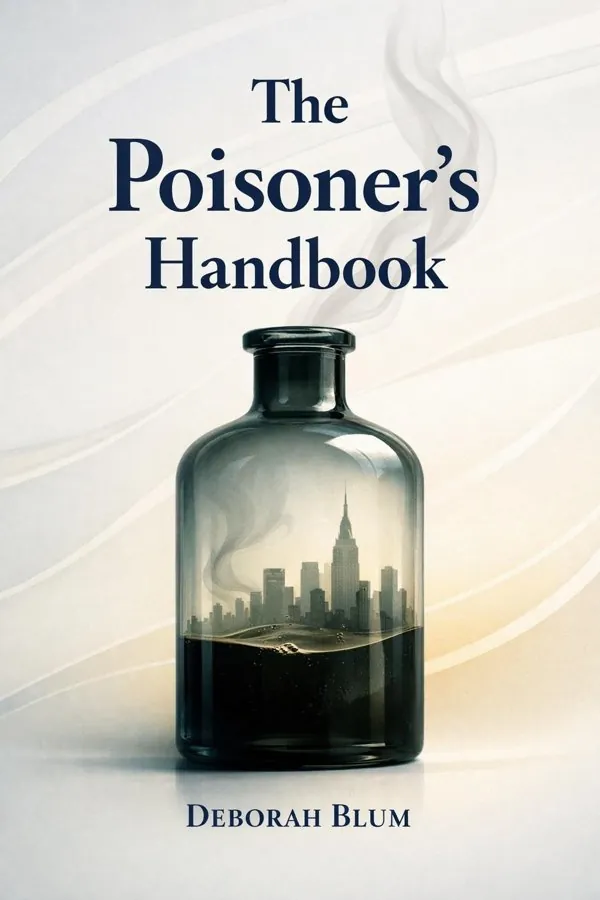
The Poisoner’s Handbook: Murder and the Birth of Forensic Medicine in Jazz Age New York: Summary & Key Insights
by Deborah Blum
 10 min7 chaptersAudio available
What Is The Poisoner’s Handbook: Murder and the Birth of Forensic Medicine in Jazz Age New York About?
The Poisoner’s Handbook: Murder and the Birth of Forensic Medicine in Jazz Age New York by Deborah Blum is a world_history book spanning 7 pages. The Poisoner’s Handbook recounts the pioneering work of New York City’s first scientifically trained medical examiner, Charles Norris, and his toxicologist, Alexander Gettler, during the early 20th century. Set in the Jazz Age, the book explores how their investigations into poison-related deaths helped establish modern forensic science and transformed criminal justice in America.
This FizzRead summary covers all 7 key chapters of The Poisoner’s Handbook: Murder and the Birth of Forensic Medicine in Jazz Age New York in approximately 10 minutes, distilling the most important ideas, arguments, and takeaways from Deborah Blum's work. Also available as an audio summary and Key Quotes Podcast.
The Poisoner’s Handbook: Murder and the Birth of Forensic Medicine in Jazz Age New York
The Poisoner’s Handbook recounts the pioneering work of New York City’s first scientifically trained medical examiner, Charles Norris, and his toxicologist, Alexander Gettler, during the early 20th century. Set in the Jazz Age, the book explores how their investigations into poison-related deaths helped establish modern forensic science and transformed criminal justice in America.
Who Should Read The Poisoner’s Handbook: Murder and the Birth of Forensic Medicine in Jazz Age New York?
This book is perfect for anyone interested in world_history and looking to gain actionable insights in a short read. Whether you're a student, professional, or lifelong learner, the key ideas from The Poisoner’s Handbook: Murder and the Birth of Forensic Medicine in Jazz Age New York by Deborah Blum will help you think differently.
- ✓Readers who enjoy world_history and want practical takeaways
- ✓Professionals looking to apply new ideas to their work and life
- ✓Anyone who wants the core insights of The Poisoner’s Handbook: Murder and the Birth of Forensic Medicine in Jazz Age New York in just 10 minutes
Want the full summary?
Get instant access to this book summary and 100K+ more with Fizz Moment.
Get Free SummaryAvailable on App Store • Free to download
Key Chapters
When Charles Norris accepted the position of New York City’s first appointed Chief Medical Examiner in 1918, he inherited not just an office, but an ethical wasteland. The coroner system was riddled with political appointments and payoffs; autopsies were rare, evidence often discarded, and justice regularly sold to the highest bidder. Norris, an independently wealthy and rigorously trained pathologist from Columbia University, was disgusted by such disorder.
What set Norris apart was his conviction that medicine must serve truth, not power. He designed the Medical Examiner’s Office as a scientific fortress, complete with a laboratory that would eventually set national standards. Even when his budget was arbitrarily cut or city officials withheld his salary—a frequent punishment for his insistence on honesty—Norris paid out of his own pocket to keep the work going. In those years, he became both scientist and crusader.
His reforms were not just administrative. They were philosophical. Norris believed that every death, no matter how seemingly insignificant, carried a story embedded in physical evidence. If one could interpret that evidence correctly—through chemistry, pathology, and observation—the truth would emerge, even against political wishes. He brought order and professionalism to what had been chaos, demanding autopsies for all suspicious deaths and bans on corrupt coroners. But his greatest act of leadership was in hiring Alexander Gettler, the quiet chemist who would turn the morgue’s laboratory into the birthplace of modern toxicology.
Gettler arrived at the Medical Examiner’s Office with a mind as precise as his beakers. A first-generation immigrant trained in chemistry, he was tireless, frugal, and astonishingly patient. While Norris battled political forces above, Gettler descended into the microscopic warfare of toxicology—where every compound could be both cure and killer, and every death demanded a new experiment.
In the early 1920s, Gettler’s lab was spare and underfunded, yet its scientific rigor rivaled anything in Europe. There, he developed methods for detecting arsenic, cyanide, mercury, and countless other poisons that previously left no trace. Each case demanded improvisation. When a suspected cyanide poisoning arrived, Gettler devised chemical extractions from tissue that could identify the faintest residues of the compound. Later, his work on carbon monoxide detection revolutionized fire and gas-leak investigations.
What distinguished Gettler was his relentless curiosity. He tested the effects of poisons on himself and his staff, experimented on sacrificed animals only when absolutely necessary, and tirelessly refined his instruments. Soon, newspaper reporters began to call him the ‘Sherlock Holmes of chemistry,’ though he always dismissed the glamour. To him, science was not heroism; it was duty. His partnership with Norris became one of mutual respect—Norris wielding administrative force and moral conviction, Gettler wielding the mathematical precision of the laboratory. Together, they made science a moral language in the courtroom, one that would challenge even entrenched political power.
+ 5 more chapters — available in the FizzRead app
All Chapters in The Poisoner’s Handbook: Murder and the Birth of Forensic Medicine in Jazz Age New York
About the Author
Deborah Blum is an American science journalist and author, known for her works that blend history, science, and narrative storytelling. She won the Pulitzer Prize for Beat Reporting in 1992 and has written several acclaimed books on the intersection of science and society.
Get This Summary in Your Preferred Format
Read or listen to the The Poisoner’s Handbook: Murder and the Birth of Forensic Medicine in Jazz Age New York summary by Deborah Blum anytime, anywhere. FizzRead offers multiple formats so you can learn on your terms — all free.
Available formats: App · Audio · PDF · EPUB — All included free with FizzRead
Download The Poisoner’s Handbook: Murder and the Birth of Forensic Medicine in Jazz Age New York PDF and EPUB Summary
Key Quotes from The Poisoner’s Handbook: Murder and the Birth of Forensic Medicine in Jazz Age New York
“When Charles Norris accepted the position of New York City’s first appointed Chief Medical Examiner in 1918, he inherited not just an office, but an ethical wasteland.”
“Gettler arrived at the Medical Examiner’s Office with a mind as precise as his beakers.”
Frequently Asked Questions about The Poisoner’s Handbook: Murder and the Birth of Forensic Medicine in Jazz Age New York
The Poisoner’s Handbook: Murder and the Birth of Forensic Medicine in Jazz Age New York by Deborah Blum is a world_history book that explores key ideas across 7 chapters. The Poisoner’s Handbook recounts the pioneering work of New York City’s first scientifically trained medical examiner, Charles Norris, and his toxicologist, Alexander Gettler, during the early 20th century. Set in the Jazz Age, the book explores how their investigations into poison-related deaths helped establish modern forensic science and transformed criminal justice in America.
More by Deborah Blum
You Might Also Like
The Age of Capital
Eric Hobsbawm
10 min
The Gulag Archipelago
Aleksandr Solzhenitsyn
10 min
Jerusalem: The Biography
Simon Sebag Montefiore
10 min
The Anglo-Saxons
James Campbell
10 min
The Boer War
Thomas Pakenham
10 min
The Industrial Revolutionaries: The Making of the Modern World 1776–1914
Gavin Weightman
10 minBrowse by Category
Ready to read The Poisoner’s Handbook: Murder and the Birth of Forensic Medicine in Jazz Age New York?
Get the full summary and 100K+ more books with Fizz Moment.