
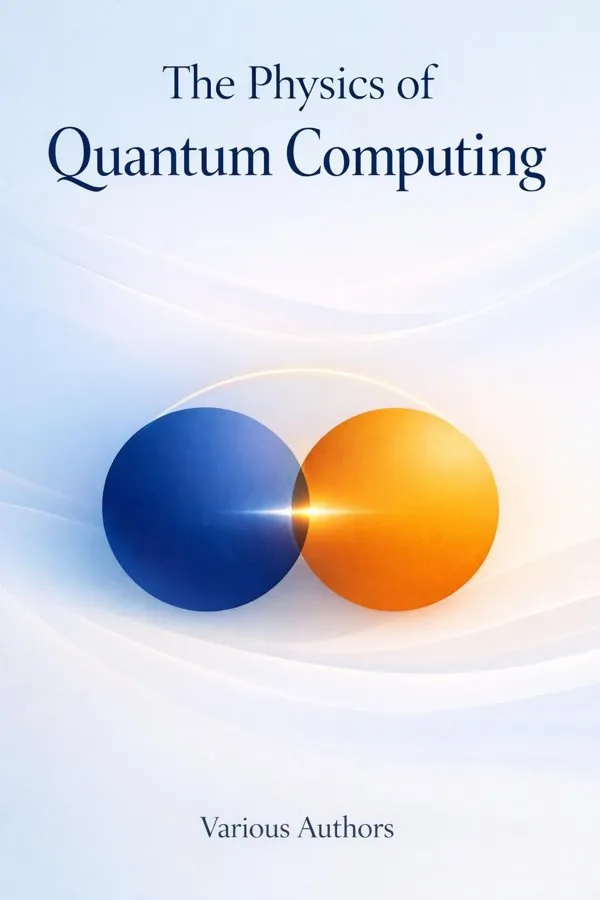
The Physics of Quantum Computing: Summary & Key Insights
 10 min9 chaptersAudio available
Key Takeaways from The Physics of Quantum Computing
The most important shift in quantum computing begins with a humbling idea: nature does not obey the information rules our everyday intuition expects.
A qubit is simple to name and difficult to fully appreciate.
If superposition challenges common sense, entanglement transforms it entirely.
Computation is not just about storing information; it is about transforming it.
The central paradox of quantum computing is that the same feature that gives it power also limits it.
What Is The Physics of Quantum Computing About?
The Physics of Quantum Computing by Various Authors is a space_physics book spanning 6 pages. Quantum computing is often presented as a technological revolution, but this book makes a deeper point: before it can be engineered, it must be understood as a physical phenomenon. The Physics of Quantum Computing introduces the scientific foundations that make quantum computation possible, moving from the strange logic of quantum mechanics to the practical realities of building machines that exploit it. Rather than treating quantum computers as abstract mathematical devices, the book grounds them in the behavior of real physical systems such as atoms, photons, superconducting circuits, and trapped ions. What makes the book especially valuable is its balance of theory and application. It explains superposition, entanglement, measurement, and quantum gates in clear terms while showing how these ideas shape algorithms, hardware design, and error correction. The result is a portrait of quantum computing not as science fiction, but as a field emerging from rigorous physics and hard engineering constraints. Written by contributing researchers and physicists working in quantum information science, the book carries the authority of specialists who understand both the elegance of the theory and the difficulty of turning it into functioning technology.
This FizzRead summary covers all 9 key chapters of The Physics of Quantum Computing in approximately 10 minutes, distilling the most important ideas, arguments, and takeaways from Various Authors's work. Also available as an audio summary and Key Quotes Podcast.
The Physics of Quantum Computing
Quantum computing is often presented as a technological revolution, but this book makes a deeper point: before it can be engineered, it must be understood as a physical phenomenon. The Physics of Quantum Computing introduces the scientific foundations that make quantum computation possible, moving from the strange logic of quantum mechanics to the practical realities of building machines that exploit it. Rather than treating quantum computers as abstract mathematical devices, the book grounds them in the behavior of real physical systems such as atoms, photons, superconducting circuits, and trapped ions.
What makes the book especially valuable is its balance of theory and application. It explains superposition, entanglement, measurement, and quantum gates in clear terms while showing how these ideas shape algorithms, hardware design, and error correction. The result is a portrait of quantum computing not as science fiction, but as a field emerging from rigorous physics and hard engineering constraints. Written by contributing researchers and physicists working in quantum information science, the book carries the authority of specialists who understand both the elegance of the theory and the difficulty of turning it into functioning technology.
Who Should Read The Physics of Quantum Computing?
This book is perfect for anyone interested in space_physics and looking to gain actionable insights in a short read. Whether you're a student, professional, or lifelong learner, the key ideas from The Physics of Quantum Computing by Various Authors will help you think differently.
- ✓Readers who enjoy space_physics and want practical takeaways
- ✓Professionals looking to apply new ideas to their work and life
- ✓Anyone who wants the core insights of The Physics of Quantum Computing in just 10 minutes
Want the full summary?
Get instant access to this book summary and 100K+ more with Fizz Moment.
Get Free SummaryAvailable on App Store • Free to download
Key Chapters
The most important shift in quantum computing begins with a humbling idea: nature does not obey the information rules our everyday intuition expects. In classical physics, objects are assumed to have definite properties whether or not we observe them. Quantum physics overturns that picture. At small scales, particles are described by wavefunctions, probabilities, and states that do not become definite until measurement. This is not just a philosophical oddity; it changes what information is and how it can be processed.
The book explains that quantum information emerges from principles such as superposition, interference, and uncertainty. A quantum system can occupy multiple possible states at once, and those possibilities evolve according to precise mathematical laws. Unlike classical uncertainty, where we simply lack knowledge of a fixed reality, quantum uncertainty is built into reality itself. This means a quantum computer does not merely store unknown values more efficiently; it manipulates probability amplitudes in ways that classical machines fundamentally cannot.
A practical example is the difference between simulating a molecule on a classical computer and representing it directly with quantum states. Classical simulation struggles because the number of possible quantum configurations grows exponentially. Quantum systems, by contrast, naturally embody that complexity. This is why quantum computing is so promising for chemistry, materials science, and optimization.
The chapter’s deeper lesson is that quantum computing is not an improved version of classical computing. It is a different model of computation rooted in different physical laws. Actionable takeaway: before trying to understand quantum algorithms or hardware, first internalize the quantum view of reality, because every later concept depends on that foundation.
A qubit is simple to name and difficult to fully appreciate. At first glance, it seems like a quantum version of a bit, but the book shows that this analogy is useful only up to a point. A classical bit must be either 0 or 1. A qubit can exist in a superposition of both, represented by a weighted combination of the two basis states. This does not mean it is partly 0 and partly 1 in a vague sense; it means its state contains amplitudes that can interfere in measurable ways.
The authors explain how qubits can be embodied in real physical systems: the polarization of a photon, the spin of an electron, the energy levels of an ion, or current states in a superconducting circuit. Each platform provides a different route to implementing the same abstract information unit. That link between mathematics and physics is central to the book’s argument. A qubit is not merely a symbol in an equation. It is a delicately controlled physical object.
One useful example is the Bloch sphere, which helps visualize a qubit as a point on a sphere rather than a switch with two positions. This representation reveals that quantum computation depends not only on whether a qubit is measured as 0 or 1, but also on its phase, a subtle property that determines interference patterns during computation.
The practical significance is enormous. Because multiple qubits can represent complex state spaces compactly, even modest quantum systems can encode structures that overwhelm classical methods. Actionable takeaway: whenever you encounter a quantum algorithm, ask how it exploits superposition and phase, because that is where the qubit’s true power lies.
If superposition challenges common sense, entanglement transforms it entirely. The book presents entanglement as one of the defining resources of quantum computing: a condition in which the states of multiple qubits become inseparable, so that describing one requires describing the whole system. This is not merely strong correlation. Two classical coins can be correlated if they always match, but each coin still has its own definite state. Entangled qubits do not fit that picture. Their joint state contains information that cannot be reduced to independent parts.
This matters because many quantum advantages arise from structured entanglement. Quantum gates do more than flip qubits; they create coordinated states that enable computation across an exponentially large space. Controlled-NOT operations, for example, can turn independent qubits into entangled pairs, forming the building blocks for teleportation, quantum error correction, and algorithmic speedups.
A practical application is quantum communication. Entanglement allows protocols such as quantum key distribution and quantum teleportation, where a quantum state can be transferred using shared entanglement and classical communication. In computing, entanglement also supports simulation of many-body physics, where particles naturally interact in collective ways that classical models struggle to capture.
The book is careful not to romanticize entanglement as magical. It is powerful because it is precise, measurable, and operationally useful. It must be generated, maintained, and manipulated under strict physical conditions. Actionable takeaway: when assessing a quantum system, do not just ask how many qubits it has; ask how well it creates and controls meaningful entanglement, because raw qubit count alone says very little.
Computation is not just about storing information; it is about transforming it. In classical machines, logic gates like AND, OR, and NOT manipulate bits through irreversible operations. In quantum computing, gates are fundamentally different. They are represented by unitary operations, meaning they preserve the total probability of the quantum state and can, in principle, be reversed. This reversibility is not a mathematical curiosity but a consequence of the underlying laws of quantum evolution.
The book explains that quantum gates act on amplitudes and phases, not just on binary values. A Hadamard gate, for instance, creates superposition. A phase gate changes the relative phase of a state. A controlled gate introduces conditional structure between qubits and can generate entanglement. By combining these operations into circuits, quantum computers choreograph interference so that useful outcomes are amplified and unhelpful ones cancel out.
A clear example is how quantum algorithms guide probability toward correct answers rather than checking every possibility one by one. This is why the language of “parallel universes” can be misleading. Quantum advantage does not come simply from trying all answers simultaneously. It comes from engineering interference patterns that bias measurement toward desired results.
This perspective also helps explain why hardware precision matters so much. A tiny gate error can distort phase relationships and ruin the interference the algorithm depends on. The physics of implementation is therefore inseparable from the logic of computation. Actionable takeaway: to understand any quantum circuit, focus less on the final measurement and more on how each gate changes phase, correlation, and interference along the way.
The central paradox of quantum computing is that the same feature that gives it power also limits it. Quantum systems can hold rich superpositions, but when measured, they yield ordinary outcomes. The book treats measurement not as a footnote at the end of computation, but as a defining physical process. A quantum state evolves smoothly according to quantum laws, yet measurement extracts only one result, apparently collapsing the state into a definite value. This creates a constant tension between preserving quantum behavior and obtaining usable information.
The authors connect this to decoherence, the process by which interaction with the environment causes a quantum system to lose its delicate coherence. Stray heat, electromagnetic noise, imperfect control pulses, or vibrations can all leak information into the environment, effectively causing unwanted measurement. Once coherence is lost, superposition and entanglement degrade, and the computation becomes classical noise.
A practical example is superconducting qubits, which must be cooled to extremely low temperatures to minimize environmental disturbance. Trapped-ion systems require exquisite isolation and laser control for similar reasons. Across platforms, the challenge is the same: quantum states must be protected long enough to perform useful operations, then measured accurately at the end.
This chapter reveals why building a quantum computer is so hard. It is not enough to create qubits; one must preserve fragile quantum information in an unruly physical world. Actionable takeaway: when thinking about quantum advantage, always pair excitement about quantum states with respect for decoherence, because stability is the hidden cost of every quantum possibility.
A remarkable truth sits at the heart of quantum engineering: useful quantum computers will not emerge from perfect hardware alone. They will require error correction. At first this seems impossible. Quantum states cannot be copied due to the no-cloning theorem, and direct measurement destroys the information one hopes to protect. The book shows how quantum error correction overcomes this by encoding one logical qubit into entangled states of many physical qubits, allowing errors to be detected indirectly without learning the encoded value itself.
The key idea is syndrome measurement. Instead of measuring the quantum information directly, one measures properties of the larger encoded system that reveal whether certain errors have occurred. Bit-flip and phase-flip errors, the two basic quantum error types, can then be identified and corrected through carefully designed codes such as the Shor code, Steane code, or surface code. This is one of the most beautiful examples of physics, mathematics, and information theory working together.
In practical terms, error correction determines whether quantum devices can scale beyond demonstrations into reliable machines. Today’s noisy intermediate-scale quantum systems can perform experiments and test algorithms, but large, fault-tolerant quantum computers will require many physical qubits for each high-quality logical qubit. That overhead is one reason progress can seem slower than headlines suggest.
The chapter’s realism is valuable. Quantum computing is not waiting for a single miracle breakthrough; it depends on steady improvements in fidelity, architecture, and error-correcting design. Actionable takeaway: judge the future of quantum computing not only by qubit counts or algorithm demos, but by advances in fault tolerance, because that is the bridge from novelty to utility.
A powerful computer is only as important as the problems it can solve better. The book therefore turns from physics to algorithms, showing how quantum mechanics becomes computational advantage only when paired with the right problem structure. Not every task benefits from quantum methods. Quantum computing matters where superposition, interference, and entanglement can be organized into a meaningful speedup or a more natural simulation of physical reality.
The authors discuss landmark algorithms such as Shor’s algorithm for factoring large integers and Grover’s algorithm for speeding up unstructured search. Shor’s result is especially consequential because it threatens widely used cryptographic systems based on the hardness of factoring. Grover’s algorithm is more modest but broadly relevant, offering quadratic improvements in certain search and optimization contexts. Beyond these famous examples, the book emphasizes quantum simulation as perhaps the most physically grounded application. Because quantum systems are hard for classical computers to model, quantum computers may become indispensable tools for chemistry, condensed matter physics, and drug discovery.
Practical applications already under exploration include designing catalysts, modeling battery materials, optimizing logistics, and developing new secure communication methods. The book also notes that many proposed use cases remain speculative, and separating genuine promise from hype is part of scientific maturity.
Its broader contribution is clarity: quantum advantage is not universal, and that is fine. The most transformative tools are often specialized before they become widespread. Actionable takeaway: when evaluating claims about quantum computing, ask two questions: what precise problem is being solved, and why does quantum physics provide an advantage there?
There is no single way to build a quantum computer, because the abstract logic of quantum computation can be embodied in many physical systems. The book surveys major hardware approaches and makes clear that each one reflects a different set of engineering compromises. Superconducting qubits are fast and compatible with microfabrication techniques, but they suffer from relatively short coherence times. Trapped ions achieve excellent coherence and high-fidelity gates, but scaling and operation speed can be challenging. Photonic systems are naturally suited to communication and low-noise transmission, yet deterministic interactions between photons are difficult to engineer.
Other approaches, such as neutral atoms, spin qubits in semiconductors, and topological proposals, offer additional possibilities. What unites them is the need to satisfy a demanding checklist: initialize qubits, control them precisely, entangle them reliably, isolate them from noise, measure them accurately, and scale the whole platform into a useful architecture. No platform excels at everything.
A practical implication is that progress in quantum computing should not be judged as a winner-takes-all race too early. Different hardware may prove optimal for different tasks, much as CPUs, GPUs, and specialized accelerators coexist in classical computing. Quantum networks may even connect different kinds of quantum devices in the future.
This chapter grounds the subject in reality. Quantum computing is not only about elegant theory but also about fabrication, cryogenics, optics, microwave engineering, control electronics, and materials science. Actionable takeaway: to understand where the field is heading, pay attention to hardware tradeoffs, because the future of quantum computing will be shaped as much by engineering constraints as by theoretical breakthroughs.
The book ends with an important corrective to both skepticism and hype: quantum computing is neither a fantasy nor an instant revolution. It is a long-term scientific and engineering project unfolding at the intersection of fundamental physics and practical design. The same laws that make quantum computers powerful also make them fragile, expensive, and difficult to scale. That tension defines the field’s present and future.
The authors argue that the next era will likely be incremental rather than explosive. Progress will come through better materials, cleaner fabrication, improved control systems, smarter error mitigation, stronger theoretical benchmarks, and applications chosen with discipline rather than marketing optimism. This perspective is refreshing because it frames quantum computing as a maturing field rather than a miracle technology waiting to appear fully formed.
The broader implications extend beyond computation. Research into quantum devices is advancing metrology, secure communication, sensing, and our understanding of many-body physics. Even partial success in quantum computing has spillover benefits across science and engineering. In that sense, the field matters whether or not it reaches every grand prediction made on its behalf.
For readers, the final lesson is intellectual as much as technological. Quantum computing teaches us that information is physical, and that the limits of computation are tied to the structure of nature itself. Actionable takeaway: approach the field with disciplined curiosity, valuing steady evidence over sensational claims, because genuine breakthroughs in quantum technology will be built on rigorous physics, not headlines.
All Chapters in The Physics of Quantum Computing
About the Author
Various Authors refers to a group of contributing researchers and physicists with expertise in quantum information science, quantum mechanics, computational physics, and related engineering fields. Their collective perspective gives the book both breadth and depth, combining foundational theory with practical insight into how quantum computers are designed and tested. Such collaborative authorship reflects the nature of the field itself, where progress depends on the work of theorists, experimental scientists, materials specialists, and computer scientists. Rather than presenting a single opinion, the book draws on a shared scientific understanding developed across laboratories and research communities. This makes it especially valuable for readers seeking a balanced, credible, and technically informed overview of the physics behind quantum computing.
Get This Summary in Your Preferred Format
Read or listen to the The Physics of Quantum Computing summary by Various Authors anytime, anywhere. FizzRead offers multiple formats so you can learn on your terms — all free.
Available formats: App · Audio · PDF · EPUB — All included free with FizzRead
Download The Physics of Quantum Computing PDF and EPUB Summary
Key Quotes from The Physics of Quantum Computing
“The most important shift in quantum computing begins with a humbling idea: nature does not obey the information rules our everyday intuition expects.”
“A qubit is simple to name and difficult to fully appreciate.”
“If superposition challenges common sense, entanglement transforms it entirely.”
“Computation is not just about storing information; it is about transforming it.”
“The central paradox of quantum computing is that the same feature that gives it power also limits it.”
Frequently Asked Questions about The Physics of Quantum Computing
The Physics of Quantum Computing by Various Authors is a space_physics book that explores key ideas across 9 chapters. Quantum computing is often presented as a technological revolution, but this book makes a deeper point: before it can be engineered, it must be understood as a physical phenomenon. The Physics of Quantum Computing introduces the scientific foundations that make quantum computation possible, moving from the strange logic of quantum mechanics to the practical realities of building machines that exploit it. Rather than treating quantum computers as abstract mathematical devices, the book grounds them in the behavior of real physical systems such as atoms, photons, superconducting circuits, and trapped ions. What makes the book especially valuable is its balance of theory and application. It explains superposition, entanglement, measurement, and quantum gates in clear terms while showing how these ideas shape algorithms, hardware design, and error correction. The result is a portrait of quantum computing not as science fiction, but as a field emerging from rigorous physics and hard engineering constraints. Written by contributing researchers and physicists working in quantum information science, the book carries the authority of specialists who understand both the elegance of the theory and the difficulty of turning it into functioning technology.
More by Various Authors



You Might Also Like
The Means Of Prediction
Mark P. Silverman
10 min
AstroTech
Various Authors
10 min
Black Holes and Time Warps: Einstein’s Outrageous Legacy
Kip S. Thorne
10 min
Dark Matter and the Dinosaurs: The Astounding Interconnectedness of the Universe
Lisa Randall
10 min
Helgoland
Carlo Rovelli
10 min
Hyperspace: A Scientific Odyssey Through Parallel Universes, Time Warps, and the 10th Dimension
Michio Kaku
10 minBrowse by Category
Ready to read The Physics of Quantum Computing?
Get the full summary and 100K+ more books with Fizz Moment.