
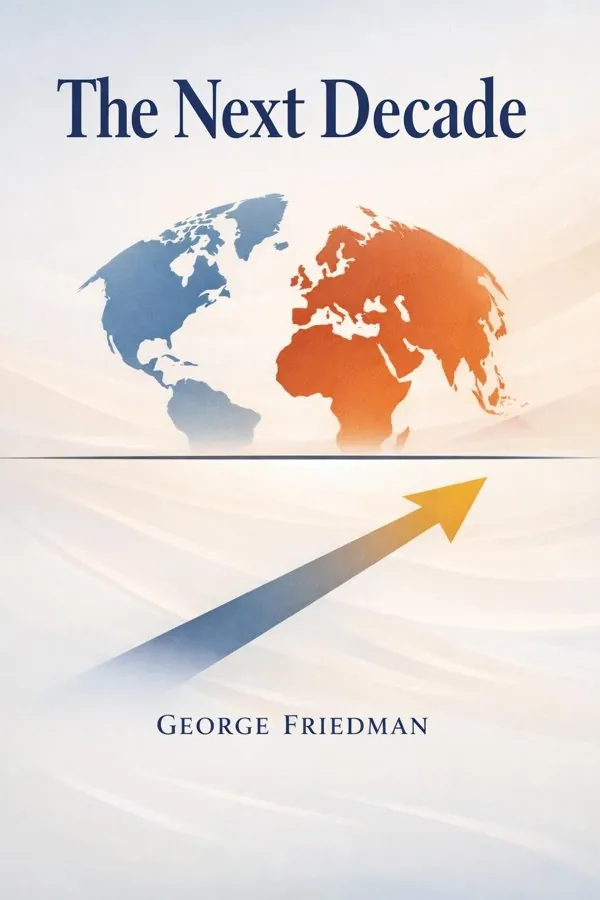
The Next Decade: Where We've Been... and Where We're Going: Summary & Key Insights
 10 min12 chaptersAudio available
What Is The Next Decade: Where We've Been... and Where We're Going About?
The Next Decade: Where We've Been... and Where We're Going by George Friedman is a future_trends book spanning 12 pages. In this geopolitical analysis, George Friedman examines the forces that will shape the world in the decade following the first decade of the 21st century. He explores the strategic imperatives of the United States, the shifting balance of power among nations, and the challenges of leadership in a rapidly changing global environment. Friedman argues that the next ten years will be defined by the U.S. managing its power responsibly while navigating crises in Europe, the Middle East, and Asia.
This FizzRead summary covers all 12 key chapters of The Next Decade: Where We've Been... and Where We're Going in approximately 10 minutes, distilling the most important ideas, arguments, and takeaways from George Friedman's work. Also available as an audio summary and Key Quotes Podcast.
The Next Decade: Where We've Been... and Where We're Going
In this geopolitical analysis, George Friedman examines the forces that will shape the world in the decade following the first decade of the 21st century. He explores the strategic imperatives of the United States, the shifting balance of power among nations, and the challenges of leadership in a rapidly changing global environment. Friedman argues that the next ten years will be defined by the U.S. managing its power responsibly while navigating crises in Europe, the Middle East, and Asia.
Who Should Read The Next Decade: Where We've Been... and Where We're Going?
This book is perfect for anyone interested in future_trends and looking to gain actionable insights in a short read. Whether you're a student, professional, or lifelong learner, the key ideas from The Next Decade: Where We've Been... and Where We're Going by George Friedman will help you think differently.
- ✓Readers who enjoy future_trends and want practical takeaways
- ✓Professionals looking to apply new ideas to their work and life
- ✓Anyone who wants the core insights of The Next Decade: Where We've Been... and Where We're Going in just 10 minutes
Want the full summary?
Get instant access to this book summary and 100K+ more with Fizz Moment.
Get Free SummaryAvailable on App Store • Free to download
Key Chapters
America’s role in the early twenty-first century cannot be measured merely by military presence or economic size. Its uniqueness lies in its geography, its wealth of natural resources, and the political system that has made it extraordinarily resilient. In *The Next Decade*, I argue that this geographic advantage gives the United States an enduring capacity to project power globally while remaining secure at home. Two oceans protect it, a network of allies supports it, and a complex internal economy fuels its reach.
Yet, with such unparalleled power comes misunderstanding. Many believe that American dominance is a recent phenomenon born of World War II or the Cold War; in reality, it is the logical outcome of its continental unity and cultural dynamism. But by 2010, America found itself facing a paradox: it had become too powerful to be ignored yet too constrained by domestic fatigue to act decisively everywhere. The central strategic task for the United States, then, was not to expand its influence but to manage its power—responsibly, efficiently, and with restraint.
That means recognizing the difference between empire and leadership. America is not an empire in the traditional sense; it does not rule by direct occupation. Its power rests upon the ability to shape outcomes—political, economic, and technological—without permanent control. This kind of influence requires continuous calibration. As new powers rise, as economies shift, America’s role must evolve from unchallenged dominance to constructive management.
Through this decade, American policy must focus less on asserting supremacy and more on maintaining stability. To achieve it, Washington must understand the deep structure of its own global position. The point is not to retreat but to accept prudence as a form of strength. The next phase of American power will depend not on conquest, but on balance and endurance.
The presidency, as I discuss in *The Next Decade*, is both an institution and a crucible. By 2010, the United States faced an uneasy dichotomy between domestic exhaustion and global expectation. Every U.S. president must embody this tension, performing a balancing act between public opinion at home and strategic necessity abroad.
A president’s moral task is to make decisions that preserve the republic, even when those decisions are unpopular. Strategic leadership often demands acting beyond sentiment. The president must recognize that America’s role is not simply moral but functional: it upholds a global system that, while imperfect, prevents widespread chaos. Managing this system means engaging in actions that may contradict national ideals yet serve national survival. The challenge lies in reconciling American virtue with geopolitical reality.
I urge presidents not to confuse rhetoric with strategy. Promising to end all wars or spread democracy universally may flatter conscience, but realism dictates otherwise. True leadership is not about moral perfection; it is about choosing the least dangerous path among imperfect options. In the decade ahead, the president must repair domestic divisions and rebuild confidence in institutions while ensuring that America’s global commitments remain intact. It is impossible to please both the isolationist instinct and the strategic necessity, and therein lies the burden of leadership.
The Oval Office, in my view, demands a new form of discipline—strategic humility anchored in an understanding of long-term national interest. Those who lead without such perspective risk undermining the very system they seek to protect. This decade will test presidents as intensely as any in modern history: the choices will be subtle, the stakes immense, and the cost of error unforgiving.
+ 10 more chapters — available in the FizzRead app
All Chapters in The Next Decade: Where We've Been... and Where We're Going
About the Author
George Friedman is a geopolitical forecaster and strategist on international affairs. He is the founder of Geopolitical Futures and previously founded Stratfor, a private intelligence and forecasting company. Friedman is known for his analyses of global political trends and his books on the future of world power dynamics.
Get This Summary in Your Preferred Format
Read or listen to the The Next Decade: Where We've Been... and Where We're Going summary by George Friedman anytime, anywhere. FizzRead offers multiple formats so you can learn on your terms — all free.
Available formats: App · Audio · PDF · EPUB — All included free with FizzRead
Download The Next Decade: Where We've Been... and Where We're Going PDF and EPUB Summary
Key Quotes from The Next Decade: Where We've Been... and Where We're Going
“America’s role in the early twenty-first century cannot be measured merely by military presence or economic size.”
“The presidency, as I discuss in *The Next Decade*, is both an institution and a crucible.”
Frequently Asked Questions about The Next Decade: Where We've Been... and Where We're Going
The Next Decade: Where We've Been... and Where We're Going by George Friedman is a future_trends book that explores key ideas across 12 chapters. In this geopolitical analysis, George Friedman examines the forces that will shape the world in the decade following the first decade of the 21st century. He explores the strategic imperatives of the United States, the shifting balance of power among nations, and the challenges of leadership in a rapidly changing global environment. Friedman argues that the next ten years will be defined by the U.S. managing its power responsibly while navigating crises in Europe, the Middle East, and Asia.
More by George Friedman
You Might Also Like
Futureproof: 9 Rules for Humans in the Age of Automation
Kevin Roose
10 min
The Third Wave
Alvin Toffler
10 min
2030: How Today's Biggest Trends Will Collide and Reshape the Future of Everything
Mauro F. Guillén
10 min
A Very Human Future: Enriching Humanity in a Digitized World
Rohit Talwar, Steve Wells, Alexandra Whittington
10 min
AI 2041: Ten Visions for Our Future
Kai-Fu Lee, Chen Qiufan
10 min
Abundance: The Future Is Better Than You Think
Peter H. Diamandis, Steven Kotler
10 minBrowse by Category
Ready to read The Next Decade: Where We've Been... and Where We're Going?
Get the full summary and 100K+ more books with Fizz Moment.