
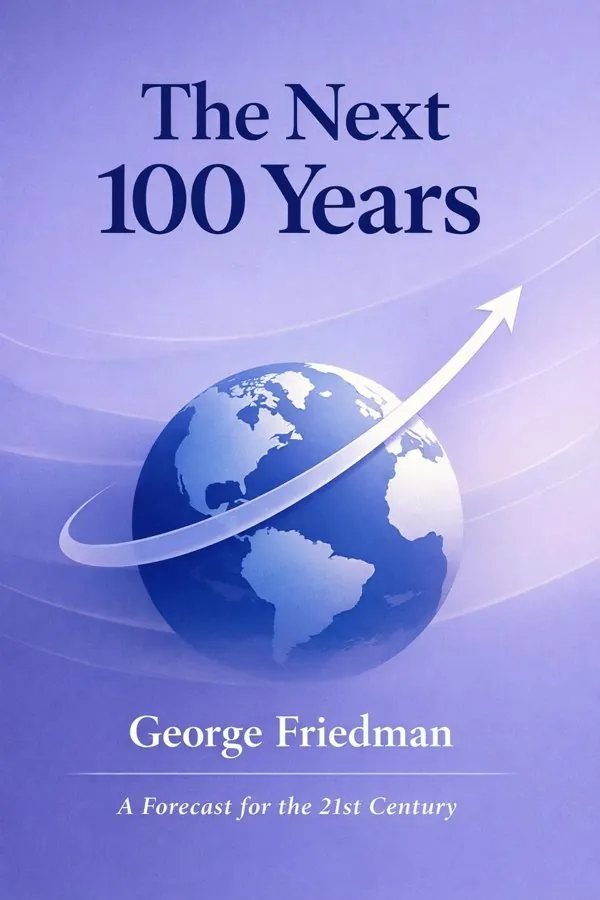
The Next 100 Years: A Forecast for the 21st Century: Summary & Key Insights
 10 min9 chaptersAudio available
What Is The Next 100 Years: A Forecast for the 21st Century About?
The Next 100 Years: A Forecast for the 21st Century by George Friedman is a future_trends book spanning 9 pages. In this geopolitical analysis, George Friedman presents a bold forecast of global events and power shifts throughout the 21st century. He explores how nations will rise and fall, predicting the United States' continued dominance, the emergence of new conflicts, and technological transformations that will reshape societies. Drawing on historical patterns and strategic insights, Friedman outlines the forces that will define the next century.
This FizzRead summary covers all 9 key chapters of The Next 100 Years: A Forecast for the 21st Century in approximately 10 minutes, distilling the most important ideas, arguments, and takeaways from George Friedman's work. Also available as an audio summary and Key Quotes Podcast.
The Next 100 Years: A Forecast for the 21st Century
In this geopolitical analysis, George Friedman presents a bold forecast of global events and power shifts throughout the 21st century. He explores how nations will rise and fall, predicting the United States' continued dominance, the emergence of new conflicts, and technological transformations that will reshape societies. Drawing on historical patterns and strategic insights, Friedman outlines the forces that will define the next century.
Who Should Read The Next 100 Years: A Forecast for the 21st Century?
This book is perfect for anyone interested in future_trends and looking to gain actionable insights in a short read. Whether you're a student, professional, or lifelong learner, the key ideas from The Next 100 Years: A Forecast for the 21st Century by George Friedman will help you think differently.
- ✓Readers who enjoy future_trends and want practical takeaways
- ✓Professionals looking to apply new ideas to their work and life
- ✓Anyone who wants the core insights of The Next 100 Years: A Forecast for the 21st Century in just 10 minutes
Want the full summary?
Get instant access to this book summary and 100K+ more with Fizz Moment.
Get Free SummaryAvailable on App Store • Free to download
Key Chapters
To understand why the United States will dominate the 21st century, we must begin with its geography. The American mainland is a fortress—flanked by oceans on two sides, with friendly neighbors to the north and south, and rich rivers binding its interior. This geography grants it agricultural abundance, internal stability, and freedom from invasion. It resembles no other major power in history. From a geopolitical standpoint, America’s challenge is never survival but management: how to deploy its vast resources without overextension.
Economic power follows from this strategic base. The United States commands immense natural resources, vast inland transport routes, and a unified market. Its strength is not accidental but systemic. It can project military force anywhere on the planet while its homeland remains insulated from serious attack. These fundamentals make it the only truly global power—a position that the 21st century will not overturn but amplify.
When I call this the American Age, I am referring to a historical cycle in which the United States, like Britain in the 19th century, defines the global framework of commerce and security. No challenger now possesses the combination of population, productivity, and geography necessary to dethrone it. Europe will continue its slow demographic decline; China’s internal stresses, aging population, and coastal vulnerability will constrain its rise. The story of the century is thus not one of American collapse, but of adaptation—a series of strategic transformations designed to maintain dominance amid change.
Over time, Americans will turn outward again, as they always do after periods of internal focus. They will invest in new technologies—automation, robotics, and space systems—that ensure global reach. Their military will evolve from controlling land to controlling information and orbit. Yet, for all these advancements, the essence of American power will remain the same: mastery of the hemisphere and command of the seas. The coming century’s drama emerges from the friction generated when this unyielding empire encounters resentful regional powers learning to assert themselves in its shadow.
The collapse of the Soviet Union marked not just the end of the Cold War but the birth of an American empire—an informal but unavoidable system in which the United States became the pivot for global stability. Unlike the old empires of conquest, America’s empire is built on coalitions, trade rules, and projection power rather than colonization. Yet the logic is imperial: others cannot ignore American interests, and American decisions reverberate across continents.
When the Cold War ended, Washington faced a paradox. Its traditional enemies were gone, but its military and economic machinery remained vast. The United States had to find new strategic imperatives—to maintain advantage without provoking global chaos. Thus began an era of intervention, alliances, and the management of instability. From the Balkan wars to the Middle East, America played the role of stabilizer and arbitrator, often clumsily, but inevitably.
This post-Cold War empire also faced the cultural challenge of perception. Americans were reluctant imperialists; they enjoyed dominance but rejected the word empire itself. Yet geopolitically, empire is the natural consequence of power without rivals. The United States became responsible for world order because no one else could bear the weight. In this phase, much of America’s trajectory involved organizing global trade, containing regional conflicts, and preserving maritime supremacy.
From this vantage point, the American empire is not an accident of ideology but the outcome of strategy. Geography forced it; economics sustained it; and technology expanded it. This empire will persist throughout the century, even as its form changes. It will evolve toward remote projection—control of space, cyber systems, and energy grids—where power resides not in occupation but in influence. The next American empire is one of information and infrastructure, its reach global yet invisible, its authority subtle but absolute.
+ 7 more chapters — available in the FizzRead app
All Chapters in The Next 100 Years: A Forecast for the 21st Century
About the Author
George Friedman is an American political scientist and strategist, founder of Stratfor and later Geopolitical Futures. He is known for his work on international affairs, intelligence, and forecasting global trends.
Get This Summary in Your Preferred Format
Read or listen to the The Next 100 Years: A Forecast for the 21st Century summary by George Friedman anytime, anywhere. FizzRead offers multiple formats so you can learn on your terms — all free.
Available formats: App · Audio · PDF · EPUB — All included free with FizzRead
Download The Next 100 Years: A Forecast for the 21st Century PDF and EPUB Summary
Key Quotes from The Next 100 Years: A Forecast for the 21st Century
“To understand why the United States will dominate the 21st century, we must begin with its geography.”
“Unlike the old empires of conquest, America’s empire is built on coalitions, trade rules, and projection power rather than colonization.”
Frequently Asked Questions about The Next 100 Years: A Forecast for the 21st Century
The Next 100 Years: A Forecast for the 21st Century by George Friedman is a future_trends book that explores key ideas across 9 chapters. In this geopolitical analysis, George Friedman presents a bold forecast of global events and power shifts throughout the 21st century. He explores how nations will rise and fall, predicting the United States' continued dominance, the emergence of new conflicts, and technological transformations that will reshape societies. Drawing on historical patterns and strategic insights, Friedman outlines the forces that will define the next century.
More by George Friedman
You Might Also Like
Futureproof: 9 Rules for Humans in the Age of Automation
Kevin Roose
10 min
The Third Wave
Alvin Toffler
10 min
2030: How Today's Biggest Trends Will Collide and Reshape the Future of Everything
Mauro F. Guillén
10 min
A Very Human Future: Enriching Humanity in a Digitized World
Rohit Talwar, Steve Wells, Alexandra Whittington
10 min
AI 2041: Ten Visions for Our Future
Kai-Fu Lee, Chen Qiufan
10 min
Abundance: The Future Is Better Than You Think
Peter H. Diamandis, Steven Kotler
10 minBrowse by Category
Ready to read The Next 100 Years: A Forecast for the 21st Century?
Get the full summary and 100K+ more books with Fizz Moment.