
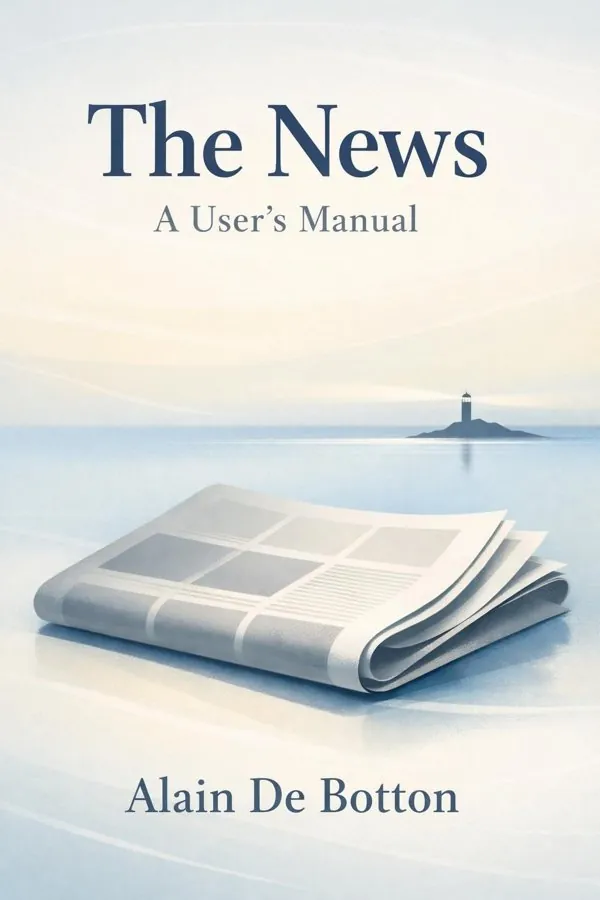
The News: A User's Manual: Summary & Key Insights
 10 min10 chaptersAudio available
What Is The News: A User's Manual About?
The News: A User's Manual by Alain De Botton is a sociology book spanning 10 pages. In this book, Alain de Botton explores how the news shapes our understanding of the world and ourselves. He examines the psychological and philosophical effects of constant exposure to news stories, analyzing how they influence our emotions, priorities, and moral outlook. Through his signature blend of wit and insight, de Botton invites readers to reconsider their relationship with the media and to approach news consumption with greater awareness and critical thought.
This FizzRead summary covers all 10 key chapters of The News: A User's Manual in approximately 10 minutes, distilling the most important ideas, arguments, and takeaways from Alain De Botton's work. Also available as an audio summary and Key Quotes Podcast.
The News: A User's Manual
In this book, Alain de Botton explores how the news shapes our understanding of the world and ourselves. He examines the psychological and philosophical effects of constant exposure to news stories, analyzing how they influence our emotions, priorities, and moral outlook. Through his signature blend of wit and insight, de Botton invites readers to reconsider their relationship with the media and to approach news consumption with greater awareness and critical thought.
Who Should Read The News: A User's Manual?
This book is perfect for anyone interested in sociology and looking to gain actionable insights in a short read. Whether you're a student, professional, or lifelong learner, the key ideas from The News: A User's Manual by Alain De Botton will help you think differently.
- ✓Readers who enjoy sociology and want practical takeaways
- ✓Professionals looking to apply new ideas to their work and life
- ✓Anyone who wants the core insights of The News: A User's Manual in just 10 minutes
Want the full summary?
Get instant access to this book summary and 100K+ more with Fizz Moment.
Get Free SummaryAvailable on App Store • Free to download
Key Chapters
Political news, at its best, should be the arena where citizens come to understand how power operates, what decisions shape our collective fate, and why certain values matter in governance. Yet more often than not, it reduces the complex vision of politics into a theater of personalities—a spectacle designed to provoke emotion rather than comprehension. In the newsrooms of modern life, the deep moral and structural questions of policy are often drowned in the noise of rivalry and scandal. Who insulted whom, whose popularity rose or fell—these replace the harder inquiries into justice and compromise.
From my perspective, politics deserves to be covered as a branch of moral philosophy. A law passed is not just an administrative act; it’s a moral statement about how we imagine human decency, fairness, and hope. But news outlets, seeking drama, treat political coverage as sport. The result is that we may know the facial expressions of leaders more intimately than their ideals. We grow cynical or fanatical, depending on which side we identify with, forgetting that governance is not war nor entertainment but a slow process of ethical negotiation.
A more meaningful political journalism would weave philosophical inquiry into its storytelling. Rather than simply showing the quarrel, it would ask what the quarrel is for: What conception of justice animates it? Whose suffering or dignity is at stake? We need a news that doesn’t just tell us what happened but helps us think about why it matters—a news that treats citizens as thinkers rather than spectators.
Whenever tragedy strikes far from our own borders, the news delivers distant suffering into our homes. We see starving children, bombed neighborhoods, and desperate refugees—images that are supposed to awaken compassion, but more often leave us fatigued or numb. There is an ethical paradox: the more frequently we encounter distress, the less likely we are to truly feel it. Our empathy, battered by repetition and scale, becomes a kind of defensive wall.
The problem lies in presentation. The modern news format isolates suffering from context; it offers pain without narrative, shock without explanation. It tells us of death tolls and crises, but rarely introduces us to the human texture of those lives before catastrophe. Faced with such abstraction, we may respond with temporary horror and then forget.
But I believe that world news could become an instrument of true compassion. Journalism should not simply inform us about tragedy—it should educate our empathy. It should remind us that those we see are not merely victims but people with histories, loves, aspirations, and humor. Only when we glimpse their full humanity do we respond with the kind of moral imagination that leads to solidarity rather than pity.
The philosopher’s task here is clear: to help the news restore depth to its portrayal of the distant other, turning compassion fatigue into empathy informed by understanding.
+ 8 more chapters — available in the FizzRead app
All Chapters in The News: A User's Manual
About the Author
Alain de Botton is a Swiss-born British author and philosopher known for his works on love, travel, architecture, and philosophy. He founded The School of Life, an organization dedicated to developing emotional intelligence through culture. His books, including 'The Consolations of Philosophy' and 'The Art of Travel', have been translated into multiple languages and are celebrated for making complex ideas accessible to a broad audience.
Get This Summary in Your Preferred Format
Read or listen to the The News: A User's Manual summary by Alain De Botton anytime, anywhere. FizzRead offers multiple formats so you can learn on your terms — all free.
Available formats: App · Audio · PDF · EPUB — All included free with FizzRead
Download The News: A User's Manual PDF and EPUB Summary
Key Quotes from The News: A User's Manual
“Political news, at its best, should be the arena where citizens come to understand how power operates, what decisions shape our collective fate, and why certain values matter in governance.”
“Whenever tragedy strikes far from our own borders, the news delivers distant suffering into our homes.”
Frequently Asked Questions about The News: A User's Manual
The News: A User's Manual by Alain De Botton is a sociology book that explores key ideas across 10 chapters. In this book, Alain de Botton explores how the news shapes our understanding of the world and ourselves. He examines the psychological and philosophical effects of constant exposure to news stories, analyzing how they influence our emotions, priorities, and moral outlook. Through his signature blend of wit and insight, de Botton invites readers to reconsider their relationship with the media and to approach news consumption with greater awareness and critical thought.
More by Alain De Botton



You Might Also Like

Between the World and Me
Ta-Nehisi Coates
10 min
Half the Sky
Nicholas D. Kristof, Sheryl WuDunn
10 min
Men Explain Things To Me
Rebecca Solnit
10 min
Rational Ritual
Michael Suk-Young Chwe
10 min
The New Jim Crow
Michelle Alexander
10 min
Beyond Culture
Edward T. Hall
10 minBrowse by Category
Ready to read The News: A User's Manual?
Get the full summary and 100K+ more books with Fizz Moment.