
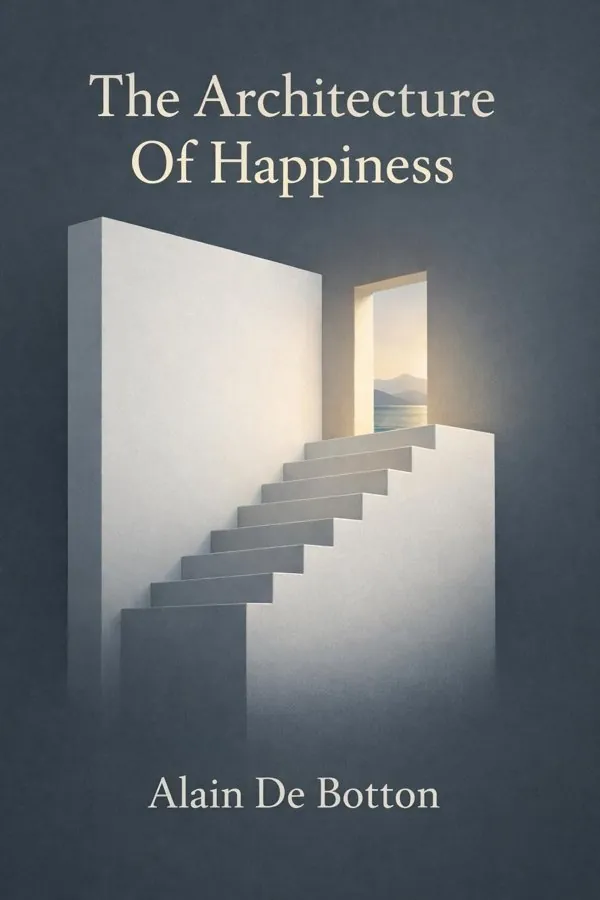
The Architecture Of Happiness: Summary & Key Insights
 10 min5 chaptersAudio available
What Is The Architecture Of Happiness About?
The Architecture Of Happiness by Alain De Botton is a design book spanning 5 pages. A philosophical exploration of how architecture influences our emotions and well-being, examining the relationship between our surroundings and our inner lives. De Botton argues that buildings and design reflect our values and aspirations, and that beauty in architecture can contribute to happiness.
This FizzRead summary covers all 5 key chapters of The Architecture Of Happiness in approximately 10 minutes, distilling the most important ideas, arguments, and takeaways from Alain De Botton's work. Also available as an audio summary and Key Quotes Podcast.
The Architecture Of Happiness
A philosophical exploration of how architecture influences our emotions and well-being, examining the relationship between our surroundings and our inner lives. De Botton argues that buildings and design reflect our values and aspirations, and that beauty in architecture can contribute to happiness.
Who Should Read The Architecture Of Happiness?
This book is perfect for anyone interested in design and looking to gain actionable insights in a short read. Whether you're a student, professional, or lifelong learner, the key ideas from The Architecture Of Happiness by Alain De Botton will help you think differently.
- ✓Readers who enjoy design and want practical takeaways
- ✓Professionals looking to apply new ideas to their work and life
- ✓Anyone who wants the core insights of The Architecture Of Happiness in just 10 minutes
Want the full summary?
Get instant access to this book summary and 100K+ more with Fizz Moment.
Get Free SummaryAvailable on App Store • Free to download
Key Chapters
Our search for beauty in architecture often begins with intuition. We stand before a building and sense, without knowing why, that it is graceful or repellent, serene or chaotic. To understand this mystery, I delve into the philosophical history of beauty: Plato’s notion of ideal forms, Aristotle’s emphasis on proportion, and Kant’s reflections on subjective taste. From these traditions, one truth emerges — beauty is not arbitrary. It expresses fundamental human needs for order, coherence, and meaning.
When we call a building beautiful, we are responding to a harmony between its parts and our own nature. A facade balanced in proportion feels reassuring because it speaks of stability and purpose. A well-lit atrium feels uplifting because it mirrors our yearning for clarity. Beauty, in architecture, becomes a promise: that the world might, for a moment, make sense.
Yet beauty is also moral. Our aesthetic preferences reveal our values. To love clean lines and light materials may signal a wish for honesty and simplicity. To favor ornament and lush texture may express a craving for richness or warmth. Thus, when we design or choose our surroundings, we are making ethical statements — about how we wish to live, and what kind of world we honor.
Beauty, therefore, is not frivolous. It nourishes the soul much as food nourishes the body. A society indifferent to beauty risks spiritual malnutrition. The steel and glass towers that dominate modern skylines may inspire awe but can also induce alienation, their smooth anonymity reflecting our collective confusion about what happiness looks like. In architecture as in life, beauty is not something we should apologize for; it is a vital part of our flourishing.
Architecture, like clothing or speech, is a form of self-expression. Civilizations and individuals alike tell their stories through buildings. The Gothic cathedral embodies medieval Europe’s yearning for transcendence; the minimalist house speaks of a modern quest for rationality and self-control. Whenever we build, we externalize our ideals — we give concrete form to abstract hopes.
Our homes, in particular, are physical manifestations of our identities. Whether we choose rustic wood or polished steel, cozy clutter or austere order, we project fragments of ourselves into the spaces we inhabit. Yet identity in architecture is never static. Just as we evolve, our surroundings must evolve with us. When they cease to align with our inner world, we feel estranged, as if we are living inside another’s skin.
But architecture also shapes identity in return. The grandeur of a city hall can foster civic pride; a gloomy corridor can dampen cooperation. Buildings teach us how to behave. A delicate arch encourages quiet reflection; an open courtyard invites conversation. Through proportion and atmosphere, architecture directs our emotional vocabulary.
This mutual shaping — between people and their built environment — is what makes architecture ethically charged. It is not enough that a building stand; it must also stand for something. In designing our surroundings, we are designing ourselves.
+ 3 more chapters — available in the FizzRead app
All Chapters in The Architecture Of Happiness
About the Author
Alain de Botton is a Swiss-born British author and philosopher known for his works on philosophy, art, and everyday life. He founded The School of Life, an organization dedicated to developing emotional intelligence through culture and philosophy.
Get This Summary in Your Preferred Format
Read or listen to the The Architecture Of Happiness summary by Alain De Botton anytime, anywhere. FizzRead offers multiple formats so you can learn on your terms — all free.
Available formats: App · Audio · PDF · EPUB — All included free with FizzRead
Download The Architecture Of Happiness PDF and EPUB Summary
Key Quotes from The Architecture Of Happiness
“Our search for beauty in architecture often begins with intuition.”
“Architecture, like clothing or speech, is a form of self-expression.”
Frequently Asked Questions about The Architecture Of Happiness
The Architecture Of Happiness by Alain De Botton is a design book that explores key ideas across 5 chapters. A philosophical exploration of how architecture influences our emotions and well-being, examining the relationship between our surroundings and our inner lives. De Botton argues that buildings and design reflect our values and aspirations, and that beauty in architecture can contribute to happiness.
More by Alain De Botton



You Might Also Like

The Design of Everyday Things
Don Norman
10 min
The Better Angels of Our Nature
Steven Pinker
10 min
A Designer's Art
Paul Rand
10 min
Architects' Sketchbooks
Various Editors
10 min
Architectural Graphic Standards
The American Institute of Architects
10 min
Design Is Storytelling
Ellen Lupton
10 minBrowse by Category
Ready to read The Architecture Of Happiness?
Get the full summary and 100K+ more books with Fizz Moment.