
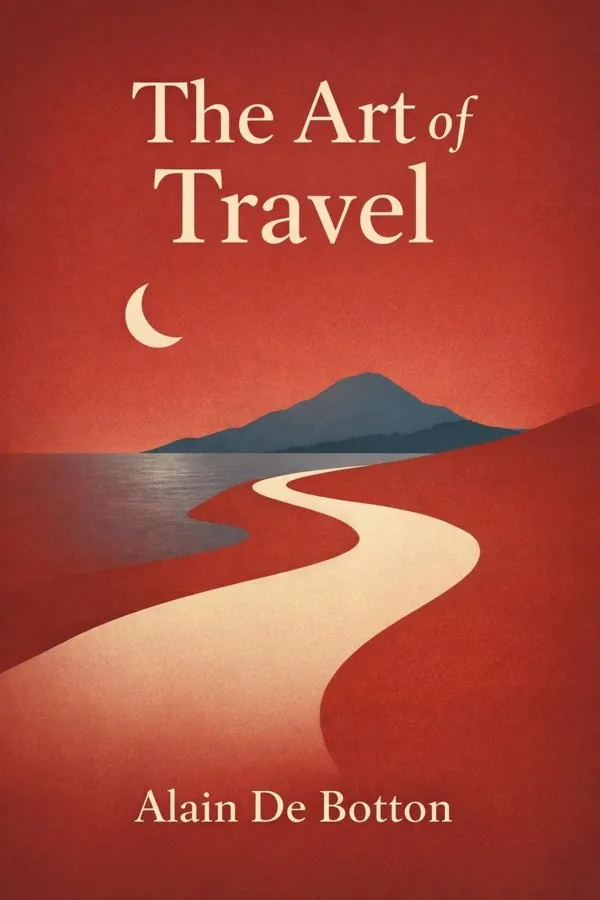
The Art of Travel: Summary & Key Insights
 10 min8 chaptersAudio available
What Is The Art of Travel About?
The Art of Travel by Alain De Botton is a travel book spanning 8 pages. The Art of Travel explores the philosophical and psychological dimensions of travel, examining why people journey, what they seek, and how they experience places. Through reflections on artists, writers, and thinkers such as Baudelaire, Van Gogh, and Wordsworth, Alain de Botton investigates the deeper meaning behind our desire to explore the world and the emotional impact of landscapes and destinations.
This FizzRead summary covers all 8 key chapters of The Art of Travel in approximately 10 minutes, distilling the most important ideas, arguments, and takeaways from Alain De Botton's work. Also available as an audio summary and Key Quotes Podcast.
The Art of Travel
The Art of Travel explores the philosophical and psychological dimensions of travel, examining why people journey, what they seek, and how they experience places. Through reflections on artists, writers, and thinkers such as Baudelaire, Van Gogh, and Wordsworth, Alain de Botton investigates the deeper meaning behind our desire to explore the world and the emotional impact of landscapes and destinations.
Who Should Read The Art of Travel?
This book is perfect for anyone interested in travel and looking to gain actionable insights in a short read. Whether you're a student, professional, or lifelong learner, the key ideas from The Art of Travel by Alain De Botton will help you think differently.
- ✓Readers who enjoy travel and want practical takeaways
- ✓Professionals looking to apply new ideas to their work and life
- ✓Anyone who wants the core insights of The Art of Travel in just 10 minutes
Want the full summary?
Get instant access to this book summary and 100K+ more with Fizz Moment.
Get Free SummaryAvailable on App Store • Free to download
Key Chapters
Departure is the moment where fantasy meets movement. As I stood in an airport or at a train station, ticket in hand, I felt the electric thrill that saturates every beginning. To depart is to enact hope — it is the visible form of our desire to change. Yet this state of anticipation is delicate, easily bruised by the mechanics of journeying, by crowds, delays, or the trivial discomforts of motion. In reflecting on these tensions, I found that the excitement of departure often lies not in what we see, but in what we project: the mind’s imaginative leap toward what it believes will be beautiful.
There is, in those earliest hours of travel, a purity of expectation that can be almost hypnotic. As the plane rises or the train accelerates, we experience a brief transcendence of routine; we sense that life, which had grown habitual, is beginning anew. Yet I also learned that this excitement tells more about our inner longing than about the destination itself. The poet’s journey and the tourist’s excursion may look similar, but philosophically they differ: one seeks self-understanding, the other distraction. I came to see departure as a mirror to human restlessness — our constant conviction that fulfillment lies elsewhere.
In departure we glimpse the art of anticipation, which suggests that travel’s true work begins long before arrival. The energy of departure reminds us that the act of motion itself can be a metaphor for transformation. But we must remain aware: the perfection we anticipate cannot be guaranteed by geography. To honor departure as art is to hold the tension between anticipation and acceptance, between movement and surrender.
Why do we go? This question echoes throughout history, and I found that our motives for travel are as varied as they are elusive. There is curiosity — the impulse to understand what lies beyond our immediate field. There is the desire for beauty — an instinct to encounter forms and colors that our daily surroundings fail to deliver. And there is escape — a longing to free ourselves from the weight of identity. I examined these motives through literature and personal experience, discovering that beneath their surface lies a philosophical hunger: the will to reconcile inner unease with outer exploration.
The philosopher and the traveler are cousins. Both move through uncertainty in search of meaning. Yet travel exposes us to paradoxes: the more we chase beauty abroad, the more we realize the limits of our perception. The beaches of Barbados, the plains of Patagonia, the temples of Kyoto — each promises renewal, yet often we find that it is not the place but our attentiveness that changes. To understand our motives is to discover that travel mirrors the psyche. When we seek escape, we are also seeking ourselves in a new light.
During my reflections, I turned to writers like Wordsworth and Ruskin, whose journeys were acts of contemplation rather than consumption. They reveal that travel is not merely about movement but perception — a disciplined openness to the world’s details. Through them I grasped that the search for beauty is not a flight from reality, but a training in seeing it rightly. True motives for travel are spiritual: they teach us patience, curiosity, and humility before the world’s vastness.
+ 6 more chapters — available in the FizzRead app
All Chapters in The Art of Travel
About the Author
Alain de Botton is a Swiss-born British writer and philosopher known for his works on love, travel, architecture, and everyday philosophy. He founded The School of Life, an organization dedicated to developing emotional intelligence through culture and philosophy.
Get This Summary in Your Preferred Format
Read or listen to the The Art of Travel summary by Alain De Botton anytime, anywhere. FizzRead offers multiple formats so you can learn on your terms — all free.
Available formats: App · Audio · PDF · EPUB — All included free with FizzRead
Download The Art of Travel PDF and EPUB Summary
Key Quotes from The Art of Travel
“Departure is the moment where fantasy meets movement.”
“This question echoes throughout history, and I found that our motives for travel are as varied as they are elusive.”
Frequently Asked Questions about The Art of Travel
The Art of Travel by Alain De Botton is a travel book that explores key ideas across 8 chapters. The Art of Travel explores the philosophical and psychological dimensions of travel, examining why people journey, what they seek, and how they experience places. Through reflections on artists, writers, and thinkers such as Baudelaire, Van Gogh, and Wordsworth, Alain de Botton investigates the deeper meaning behind our desire to explore the world and the emotional impact of landscapes and destinations.
More by Alain De Botton
You Might Also Like
The Half Known Life: In Search of Paradise
Pico Iyer
10 min
A Walk in the Woods: Rediscovering America on the Appalachian Trail
Bill Bryson
10 min
How to Travel the World on $50 a Day: Travel Cheaper, Longer, Smarter
Matt Kepnes
10 min
In Xanadu: A Quest
William Dalrymple
10 min
In a Sunburned Country
Bill Bryson
10 min
Notes From A Small Island
Bill Bryson
10 minBrowse by Category
Ready to read The Art of Travel?
Get the full summary and 100K+ more books with Fizz Moment.