
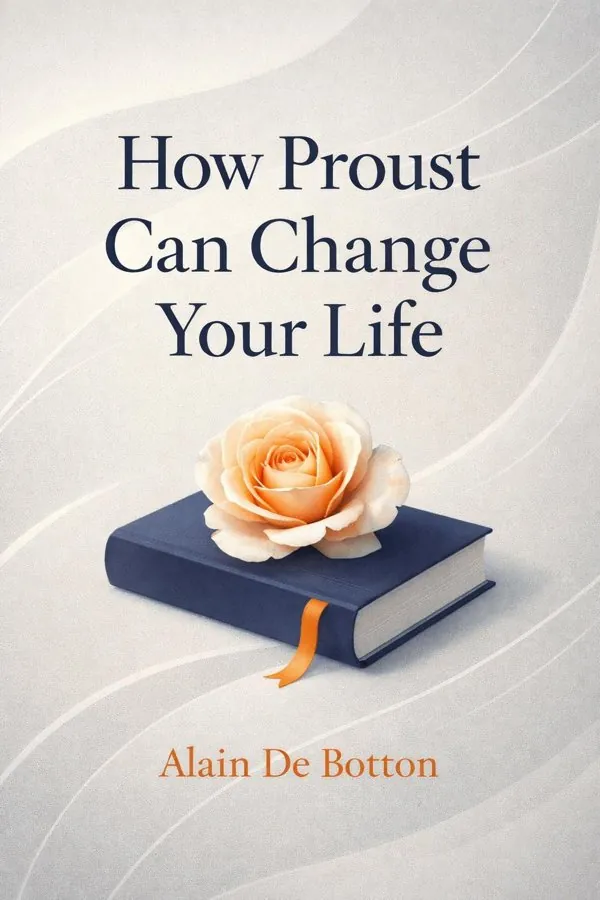
How Proust Can Change Your Life: Summary & Key Insights
 10 min9 chaptersAudio available
Key Takeaways from How Proust Can Change Your Life
We often assume that a richer life requires a change of scenery, a bigger opportunity, or a more glamorous existence.
Books can either deepen our experience or become substitutes for it.
Pain is inevitable, but wasted pain is not.
Many of our strongest feelings remain vague not because they are shallow, but because we lack the language to name them.
Friendship is often treated as effortless, but Proust understood that being a good friend requires imagination.
What Is How Proust Can Change Your Life About?
How Proust Can Change Your Life by Alain De Botton is a western_phil book spanning 8 pages. How can a sickly, reclusive novelist help us live better today? In How Proust Can Change Your Life, Alain de Botton answers this surprising question by turning Marcel Proust’s massive novel In Search of Lost Time into a practical guide to everyday existence. Rather than offering dry literary criticism, de Botton draws lessons from Proust’s life and writing on love, friendship, art, suffering, reading, and attention. His central idea is simple but powerful: many of our frustrations come not from life’s lack of richness, but from our failure to notice, interpret, and value what is already before us. The book matters because it treats literature not as an academic subject but as a tool for self-understanding. De Botton shows that Proust’s insights are not reserved for scholars; they can help anyone become more observant, more patient, and more emotionally intelligent. With wit, clarity, and philosophical sensitivity, de Botton acts as both interpreter and companion, translating Proust’s subtle ideas into practical wisdom. The result is a charming and deeply humane book about how to live more awake to beauty, memory, and the hidden meaning of ordinary life.
This FizzRead summary covers all 9 key chapters of How Proust Can Change Your Life in approximately 10 minutes, distilling the most important ideas, arguments, and takeaways from Alain De Botton's work. Also available as an audio summary and Key Quotes Podcast.
How Proust Can Change Your Life
How can a sickly, reclusive novelist help us live better today? In How Proust Can Change Your Life, Alain de Botton answers this surprising question by turning Marcel Proust’s massive novel In Search of Lost Time into a practical guide to everyday existence. Rather than offering dry literary criticism, de Botton draws lessons from Proust’s life and writing on love, friendship, art, suffering, reading, and attention. His central idea is simple but powerful: many of our frustrations come not from life’s lack of richness, but from our failure to notice, interpret, and value what is already before us.
The book matters because it treats literature not as an academic subject but as a tool for self-understanding. De Botton shows that Proust’s insights are not reserved for scholars; they can help anyone become more observant, more patient, and more emotionally intelligent. With wit, clarity, and philosophical sensitivity, de Botton acts as both interpreter and companion, translating Proust’s subtle ideas into practical wisdom. The result is a charming and deeply humane book about how to live more awake to beauty, memory, and the hidden meaning of ordinary life.
Who Should Read How Proust Can Change Your Life?
This book is perfect for anyone interested in western_phil and looking to gain actionable insights in a short read. Whether you're a student, professional, or lifelong learner, the key ideas from How Proust Can Change Your Life by Alain De Botton will help you think differently.
- ✓Readers who enjoy western_phil and want practical takeaways
- ✓Professionals looking to apply new ideas to their work and life
- ✓Anyone who wants the core insights of How Proust Can Change Your Life in just 10 minutes
Want the full summary?
Get instant access to this book summary and 100K+ more with Fizz Moment.
Get Free SummaryAvailable on App Store • Free to download
Key Chapters
We often assume that a richer life requires a change of scenery, a bigger opportunity, or a more glamorous existence. Proust challenges this assumption by suggesting that the true voyage of discovery is not about finding new landscapes, but about acquiring new eyes. In other words, life becomes meaningful not simply through novelty, but through attention. What we call boredom is often a failure of perception.
Proust’s genius lay in his ability to uncover wonder in what others dismissed as trivial: the taste of tea and cake, the changing light on a wall, the emotional undertones of a social exchange. He teaches us that the ordinary world is far more layered than we tend to notice. Much of modern life pushes us toward distraction and speed, leaving us unable to dwell on small experiences long enough for them to reveal their beauty. Proust reverses that habit. He invites us to pause, to observe, and to look again.
This is not merely an aesthetic recommendation; it is a way of resisting chronic dissatisfaction. Many people remain restless because they are waiting for life to begin somewhere else. Proust argues that life is already happening, and its value depends on our capacity to perceive it. A walk to work, a family dinner, or a rainy afternoon can become vivid if approached with enough sensitivity.
A practical way to apply this lesson is to create moments of deliberate noticing. Spend ten minutes observing a familiar room as if you had never seen it before. Write down details of a routine experience, such as your morning coffee or commute. Such exercises sharpen perception and increase gratitude.
Actionable takeaway: Choose one ordinary moment each day and study it closely, asking yourself what beauty, mood, or memory you usually miss.
Books can either deepen our experience or become substitutes for it. Proust loved reading passionately, yet he distrusted the kind of reading that turns people into collectors of other people’s thoughts. For him, the purpose of books was not to provide ready-made wisdom we mechanically absorb, but to awaken our own dormant perceptions. A great author does not think for us; a great author teaches us how to think and feel more clearly for ourselves.
This distinction matters because many readers approach books too passively. They admire eloquent sentences, underline quotations, and accumulate ideas, yet never allow those ideas to alter how they see their own lives. Proust believed reading should be an active collaboration. The best books stir memories, provoke self-examination, and illuminate experiences we had sensed but never articulated. They function less like instruction manuals and more like mirrors.
De Botton uses this insight to challenge the cultural reverence often attached to literature. Reading is not morally improving simply because it is reading. It becomes valuable when it enhances our capacity to notice reality, to understand ourselves, and to resist cliché. Someone who reads Proust but learns nothing about jealousy, habit, or memory has missed the point. The real test of reading is not whether we finish a difficult book, but whether we return to life with fresh attention.
A practical approach is to slow down and read with conversation in mind. Pause after a striking passage and ask: What in my life does this illuminate? Where have I felt something similar? Keep a reading journal focused less on summary and more on personal resonance.
Actionable takeaway: After every meaningful reading session, write one sentence beginning with, “This helps me better understand…” and complete it with a real part of your life.
Pain is inevitable, but wasted pain is not. One of Proust’s most provocative ideas is that suffering, while unwelcome, can become a source of insight. Emotional distress strips away illusions, exposes our dependencies, and forces us to confront truths we would rather avoid. Happiness can make us expansive, but suffering often makes us perceptive.
Proust knew this intimately. Illness, loneliness, social insecurity, and romantic anguish marked much of his life. Yet these miseries were not merely biographical obstacles; they became material for understanding the human condition. Suffering sharpened his observation. It taught him about attachment, vanity, hope, and self-deception. De Botton emphasizes that Proust did not romanticize pain for its own sake. Rather, he showed that when sorrow is examined rather than merely endured, it can deepen intelligence and compassion.
This lesson matters because contemporary culture often treats discomfort as something to eliminate immediately. We distract ourselves, numb ourselves, or rush to move on. But in doing so, we may lose the chance to learn from what hurts. A breakup, professional failure, or disappointment can reveal hidden expectations and misplaced ideals. It can also connect us more humbly to others, since suffering reminds us how fragile everyone is.
To suffer successfully does not mean enjoying misery or refusing help. It means asking what a painful event is showing us about our priorities, assumptions, and needs. Journaling, therapy, and thoughtful conversation can all help transform raw pain into understanding.
Actionable takeaway: The next time you face emotional pain, ask three questions: What has this exposed? What illusion has it challenged? What wisdom could I carry forward from it?
Many of our strongest feelings remain vague not because they are shallow, but because we lack the language to name them. Proust’s greatness lies partly in his ability to describe emotional subtleties that most people experience but cannot articulate. He gives precision to jealousy, longing, embarrassment, tenderness, and disappointment. In doing so, he shows that emotional clarity is one of the highest forms of self-knowledge.
De Botton highlights how often we live with murky inner states. We know we are upset, restless, or moved, yet we cannot say exactly why. This vagueness can create frustration in relationships and confusion in our own minds. When emotions remain unnamed, they are harder to communicate and harder to manage. Proust demonstrates that description is not a decorative extra; it is a way of understanding ourselves more deeply.
The practical implication is that language can refine feeling. The more carefully we describe our experience, the less likely we are to be ruled by it blindly. Instead of saying “I’m angry,” we might realize we feel slighted, excluded, or afraid of being forgotten. Instead of saying “I’m sad,” we might recognize nostalgia, humiliation, or grief for a lost possibility. Such distinctions matter because they point toward different responses.
This lesson is especially useful in friendships and romantic relationships. Many conflicts escalate because one person lacks the words to explain the true injury. Literature can help us borrow language until our own becomes more exact.
Actionable takeaway: When a strong feeling arises, resist the first generic label. Write or say three more precise descriptions of what you are experiencing, and use the most accurate one in your next conversation.
Friendship is often treated as effortless, but Proust understood that being a good friend requires imagination. To care for another person is not only to enjoy their company, but to perceive their uniqueness with tenderness and patience. Friendship thrives when we can see beyond people’s surfaces and understand the private worlds they inhabit.
Proust was acutely attentive to social nuance. He recognized how easily people misjudge one another by appearance, status, mannerisms, or passing moods. A good friend resists these superficial judgments. Instead of demanding that others always be cheerful, articulate, or convenient, friendship asks us to remain curious about what lies beneath awkwardness, vanity, or irritability. People often behave poorly not because they are malicious, but because they are tired, wounded, insecure, or misunderstood.
De Botton draws from this a more generous ideal of friendship. To be a good friend is to offer recognition. It is to notice what someone values, what embarrasses them, what comforts them, and what they cannot easily confess. This kind of friendship depends on attention rather than grand gestures. Remembering a small fear, asking a thoughtful question, or giving someone room to be imperfect can matter more than dramatic displays of loyalty.
Friendship also requires honesty. Proust did not believe affection should mean blindness. True friends help one another see more clearly, but they do so with tact and empathy. They do not merely flatter; they help interpret life.
Actionable takeaway: Strengthen one friendship this week by noticing one small but meaningful detail about the other person’s inner life, and respond to it with care—through a question, a message, or a thoughtful act.
We do not usually fail to see because the world lacks beauty; we fail because habit dulls perception. Proust believed that familiarity is one of the great enemies of appreciation. The more often we encounter something, the more invisible it can become. Rooms, faces, neighborhoods, seasons, and rituals lose vividness not because they have no value, but because we stop actively noticing them.
This is why art matters so much in Proust’s thought. Artists restore vision. A painter, novelist, or musician can reveal what was always present but overlooked. They teach us to perceive patterns of light, emotional undercurrents, or hidden significance in everyday things. De Botton shows that art’s practical function is not just pleasure or cultural prestige; it is educational. It trains attention.
To open our eyes, we must interrupt the automation of daily life. This may involve slowing down, changing perspective, or using artistic tools. Looking at a familiar street as if composing a photograph can make us see texture and atmosphere anew. Writing a detailed paragraph about a routine event can expose layers of feeling we normally pass over. Even asking simple questions—What color is the afternoon? What expression is on this person’s face?—can revive perception.
This habit of seeing better is morally important too. When we notice more, we become less careless. We appreciate people more fully and inhabit life more richly. Attention is a form of respect.
Actionable takeaway: Once a day, pause in a familiar setting and describe five details you have never consciously registered before. Treat ordinary surroundings as if you were encountering them for the first time.
Love often promises happiness but delivers anxiety, projection, and misunderstanding. Proust’s view of love is far from sentimental: he believed romantic suffering often arises because we confuse the beloved person with the fantasies we attach to them. We do not simply love another human being; we love a private interpretation shaped by longing, insecurity, and desire.
This may sound bleak, but de Botton uses it to offer a more realistic path toward love. Much of romantic misery comes from idealization. We invest another person with magical powers to complete us, redeem our loneliness, or validate our worth. Then, because no real person can sustain these projections, disappointment follows. Proust observed this with painful accuracy in jealousy and obsession. The less fully we possess someone, the more imagination can intensify our attachment.
To be happier in love, then, requires greater lucidity. We must distinguish the actual person from the story we tell ourselves about them. We also need to recognize how love is entangled with uncertainty. Some degree of insecurity is built into desire; trying to remove it entirely may only deepen fixation. Mature love depends less on possession than on understanding.
Practically, this means slowing down idealization. When infatuated, ask what evidence you really have about the other person’s character. In long-term relationships, revisit your partner as a real, changing individual rather than as the static figure you first constructed. Happiness in love grows from seeing clearly and accepting limits.
Actionable takeaway: In your current or future romantic life, list three qualities that belong to the real person and three qualities that may belong more to your fantasy. Let that distinction guide your next decision.
A surprising lesson from a book about literature is that there comes a time to stop reading. Proust believed deeply in the value of books, but he also knew that they can become a refuge from living. If reading is meant to awaken us to experience, then its purpose is defeated when it turns into endless escape. Wisdom must eventually leave the page and enter life.
De Botton presents this as one of Proust’s most practical and humane insights. Some readers seek in books a complete system, a superior world, or a permanent shelter from confusion. Yet no author can live for us. Literature can illuminate a feeling, sharpen a perception, or supply language for a dilemma, but it cannot replace our own encounters, mistakes, conversations, and risks. Books are catalysts, not substitutes.
This is especially relevant in intellectually ambitious cultures, where reading can become a form of status or avoidance. We may feel productive while consuming ideas, yet remain unchanged in conduct. Proust asks us to honor reading by completing its circuit: from text to reflection to lived experiment. If a book makes us more attentive, kinder, or braver, it has done its work. If it merely leaves us admiring the author’s intelligence, something is unfinished.
A useful practice is to pair reading with action. A chapter on friendship should lead to a message sent. A paragraph on beauty should lead to a walk taken differently. A line on memory should prompt a conversation with a parent.
Actionable takeaway: Each time you finish a meaningful section of a book, close it and perform one concrete action inspired by what you have read within the next 24 hours.
Life is not only lived forward; it is understood backward through memory. One of Proust’s deepest contributions is his account of how the past survives within us, often inaccessible to deliberate effort yet suddenly revived by a sensation, taste, smell, or sound. These involuntary memories can restore forgotten parts of ourselves and reveal that experience is richer than we consciously know.
De Botton shows that memory matters because it transforms ordinary moments into reservoirs of meaning. Proust’s famous madeleine episode is not important merely as a literary trick, but as a philosophical claim: we contain far more emotional history than we realize. Our identities are woven from layers of remembered experience, many of them dormant. A smell in a hallway or the feel of winter light can reconnect us to childhood moods, lost relationships, and earlier versions of who we were.
This insight encourages a different relationship with the past. Rather than viewing memory as a dusty archive, Proust treats it as alive and active. Remembering can deepen gratitude, sharpen self-understanding, and rescue significance from time’s apparent waste. It can also help explain the intensity of certain reactions in the present, which may be echoes of older experiences.
Practically, we can cultivate occasions for memory by paying attention to sensory details, revisiting places, preserving letters or photographs, and reflecting on the emotional atmosphere of earlier periods in life. Memory can become a source of continuity rather than mere nostalgia.
Actionable takeaway: Choose one sensory cue today—a song, a scent, a food—and use it to explore a forgotten memory. Write down what it reveals about the person you were and the person you have become.
All Chapters in How Proust Can Change Your Life
About the Author
Alain de Botton is a Swiss-born British author, essayist, and public intellectual best known for bringing philosophy and literature into everyday life. Educated at Cambridge, he built a wide readership through books that explore modern anxieties with clarity, wit, and emotional intelligence. His works include Essays in Love, The Consolations of Philosophy, Status Anxiety, The Art of Travel, and The Course of Love. Rather than writing for specialists, de Botton aims to show how ideas from great thinkers can help with ordinary problems such as relationships, work, identity, and meaning. He is also the founder of The School of Life, an organization devoted to emotional education. His writing is distinctive for its accessible style, humane tone, and ability to connect culture, psychology, and practical wisdom.
Get This Summary in Your Preferred Format
Read or listen to the How Proust Can Change Your Life summary by Alain De Botton anytime, anywhere. FizzRead offers multiple formats so you can learn on your terms — all free.
Available formats: App · Audio · PDF · EPUB — All included free with FizzRead
Download How Proust Can Change Your Life PDF and EPUB Summary
Key Quotes from How Proust Can Change Your Life
“We often assume that a richer life requires a change of scenery, a bigger opportunity, or a more glamorous existence.”
“Books can either deepen our experience or become substitutes for it.”
“Pain is inevitable, but wasted pain is not.”
“Many of our strongest feelings remain vague not because they are shallow, but because we lack the language to name them.”
“Friendship is often treated as effortless, but Proust understood that being a good friend requires imagination.”
Frequently Asked Questions about How Proust Can Change Your Life
How Proust Can Change Your Life by Alain De Botton is a western_phil book that explores key ideas across 9 chapters. How can a sickly, reclusive novelist help us live better today? In How Proust Can Change Your Life, Alain de Botton answers this surprising question by turning Marcel Proust’s massive novel In Search of Lost Time into a practical guide to everyday existence. Rather than offering dry literary criticism, de Botton draws lessons from Proust’s life and writing on love, friendship, art, suffering, reading, and attention. His central idea is simple but powerful: many of our frustrations come not from life’s lack of richness, but from our failure to notice, interpret, and value what is already before us. The book matters because it treats literature not as an academic subject but as a tool for self-understanding. De Botton shows that Proust’s insights are not reserved for scholars; they can help anyone become more observant, more patient, and more emotionally intelligent. With wit, clarity, and philosophical sensitivity, de Botton acts as both interpreter and companion, translating Proust’s subtle ideas into practical wisdom. The result is a charming and deeply humane book about how to live more awake to beauty, memory, and the hidden meaning of ordinary life.
More by Alain De Botton
You Might Also Like
A Little History of Philosophy
Nigel Warburton
10 min
Areopagitica
John Milton
10 min
How To Think Like A Philosopher: Essential Principles For Clear Thinking
Peter Cave
10 min
Language, Truth and Logic
A. J. Ayer
10 min
The Age of Reason
Thomas Paine
10 min
The Essays
Michel De Montaigne
10 minBrowse by Category
Ready to read How Proust Can Change Your Life?
Get the full summary and 100K+ more books with Fizz Moment.