
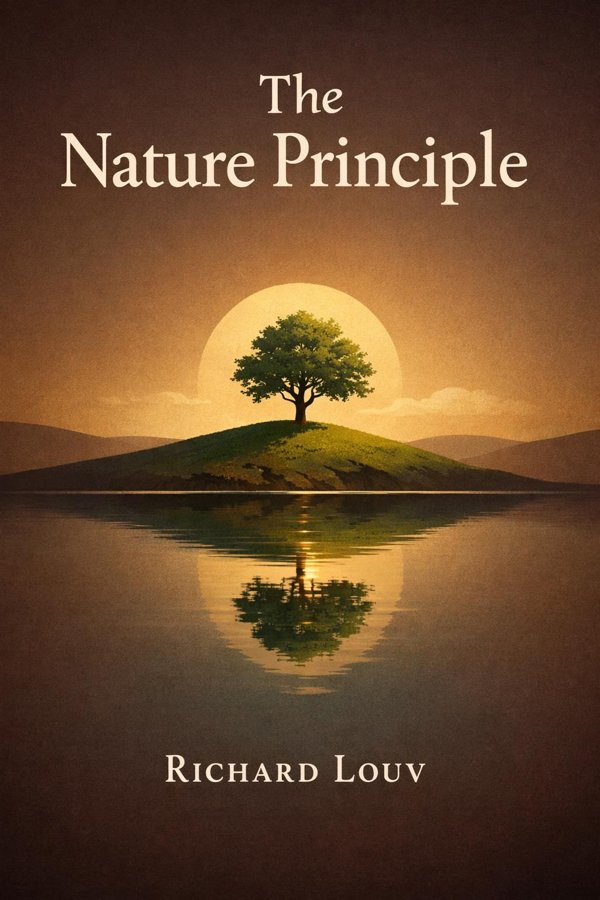
The Nature Principle: Human Restoration and the End of Nature-Deficit Disorder: Summary & Key Insights
by Richard Louv
 10 min10 chaptersAudio available
What Is The Nature Principle: Human Restoration and the End of Nature-Deficit Disorder About?
The Nature Principle: Human Restoration and the End of Nature-Deficit Disorder by Richard Louv is a environment book spanning 10 pages. In this book, Richard Louv explores how reconnecting with the natural world can restore our physical and mental health, enhance creativity, and strengthen communities. Building on his earlier work about nature-deficit disorder, Louv presents research and personal stories that demonstrate the profound benefits of nature immersion in an increasingly digital age.
This FizzRead summary covers all 10 key chapters of The Nature Principle: Human Restoration and the End of Nature-Deficit Disorder in approximately 10 minutes, distilling the most important ideas, arguments, and takeaways from Richard Louv's work. Also available as an audio summary and Key Quotes Podcast.
The Nature Principle: Human Restoration and the End of Nature-Deficit Disorder
In this book, Richard Louv explores how reconnecting with the natural world can restore our physical and mental health, enhance creativity, and strengthen communities. Building on his earlier work about nature-deficit disorder, Louv presents research and personal stories that demonstrate the profound benefits of nature immersion in an increasingly digital age.
Who Should Read The Nature Principle: Human Restoration and the End of Nature-Deficit Disorder?
This book is perfect for anyone interested in environment and looking to gain actionable insights in a short read. Whether you're a student, professional, or lifelong learner, the key ideas from The Nature Principle: Human Restoration and the End of Nature-Deficit Disorder by Richard Louv will help you think differently.
- ✓Readers who enjoy environment and want practical takeaways
- ✓Professionals looking to apply new ideas to their work and life
- ✓Anyone who wants the core insights of The Nature Principle: Human Restoration and the End of Nature-Deficit Disorder in just 10 minutes
Want the full summary?
Get instant access to this book summary and 100K+ more with Fizz Moment.
Get Free SummaryAvailable on App Store • Free to download
Key Chapters
In these pages, I describe a remarkable shift taking place around the world—a movement that transcends political divisions, spanning scientists, teachers, parents, and ordinary citizens. I call it the 'new nature movement.' It’s not about rejecting urban life or technology; it’s about integrating the two with a renewed reverence for the natural world. This movement arises from the collective realization that environmentalism must evolve from fear and guilt toward joy and restoration.
The old environmental narrative too often revolved around crisis—melting glaciers, vanishing species, shrinking forests. While these threats remain urgent, the new nature movement focuses on what can be built, not only what’s being destroyed. It recognizes that every rooftop garden, every restored wetland, every child’s muddy hands matter. In this movement, nature is not a distant sanctuary; it’s part of the living fabric of our communities.
I’ve spoken with architects designing nature-friendly skyscrapers, with psychologists who prescribe outdoor time as therapy, with parents who form neighborhood 'green play groups.' Their common conviction is that the human-nature bond can—and must—be rekindled. Research confirms the emotional and cognitive benefits of exposure to natural environments; individuals report increased empathy, cooperation, and happiness. Communities find renewed vitality when nature is woven into everyday life.
This movement doesn’t demand perfection; it invites participation. You might plant native flowers in a balcony box or unite neighbors to protect a local trail. The ripple spreads. As humanity faces climate change and biodiversity loss, the new nature movement offers a more hopeful narrative: that reconnection with nature not only sustains the planet but restores the human heart.
A recurring question people ask me is whether technology and nature are enemies. In truth, they’re partners—if we choose to make them so. The hybrid mind is what emerges when we learn to hold both worlds lightly: the quick responsiveness of digital intelligence, and the deep patience of natural awareness.
Children raised entirely in digital ecosystems gain rapid analytical skills but often lose sensory and spatial capacities. They know pixels better than pine needles. Yet, when those same children spend time hiking, gardening, or observing wildlife, they develop a broader intelligence—a synthesis of technological and ecological thinking. Neuroscience even shows that nature sharpens attention, increases creativity, and strengthens memory. The hybrid mind thrives on this duality.
In my conversations with educators, I’ve seen classrooms blending computer science with outdoor exploration—projects where students code weather-monitoring systems for parks, or use digital photography to document urban ecosystems. Such integration doesn’t dilute the magic of nature; it amplifies it. Technology, when used consciously, can become a lens through which we rediscover the living world.
For adults too, the hybrid mind means remembering that unplugging isn’t rejection—it’s renewal. Stepping outdoors after a day staring at screens isn’t escaping productivity; it’s restoring it. When you walk under trees after sunset, sensing the subtle rhythm of wind, your digital anxiety settles into biological calm. In those moments, you’re reclaiming an ancient balance—calibrating your nervous system to rhythms older than civilization itself.
The hybrid mind represents evolution, not regression. It’s what allows us to navigate modern life while remaining rooted in the eternal wisdom of nature.
+ 8 more chapters — available in the FizzRead app
All Chapters in The Nature Principle: Human Restoration and the End of Nature-Deficit Disorder
About the Author
Richard Louv is an American journalist and author best known for his work on the connection between children and nature. He coined the term 'nature-deficit disorder' and founded the Children & Nature Network, advocating for stronger human-nature relationships.
Get This Summary in Your Preferred Format
Read or listen to the The Nature Principle: Human Restoration and the End of Nature-Deficit Disorder summary by Richard Louv anytime, anywhere. FizzRead offers multiple formats so you can learn on your terms — all free.
Available formats: App · Audio · PDF · EPUB — All included free with FizzRead
Download The Nature Principle: Human Restoration and the End of Nature-Deficit Disorder PDF and EPUB Summary
Key Quotes from The Nature Principle: Human Restoration and the End of Nature-Deficit Disorder
“In these pages, I describe a remarkable shift taking place around the world—a movement that transcends political divisions, spanning scientists, teachers, parents, and ordinary citizens.”
“A recurring question people ask me is whether technology and nature are enemies.”
Frequently Asked Questions about The Nature Principle: Human Restoration and the End of Nature-Deficit Disorder
The Nature Principle: Human Restoration and the End of Nature-Deficit Disorder by Richard Louv is a environment book that explores key ideas across 10 chapters. In this book, Richard Louv explores how reconnecting with the natural world can restore our physical and mental health, enhance creativity, and strengthen communities. Building on his earlier work about nature-deficit disorder, Louv presents research and personal stories that demonstrate the profound benefits of nature immersion in an increasingly digital age.
More by Richard Louv
You Might Also Like
A Life on Our Planet: My Witness Statement and a Vision for the Future
David Attenborough
10 min
A Sky Full Of Birds
Matt Merritt
10 min
Carbon Zero: Imagining Cities That Can Save the Planet
Alex Steffen
10 min
Eaarth: Making a Life on a Tough New Planet
Bill McKibben
10 min
The Social Contract and Environmental Governance
Various Editors
10 min
The Wild Places
Robert Macfarlane
10 minBrowse by Category
Ready to read The Nature Principle: Human Restoration and the End of Nature-Deficit Disorder?
Get the full summary and 100K+ more books with Fizz Moment.