
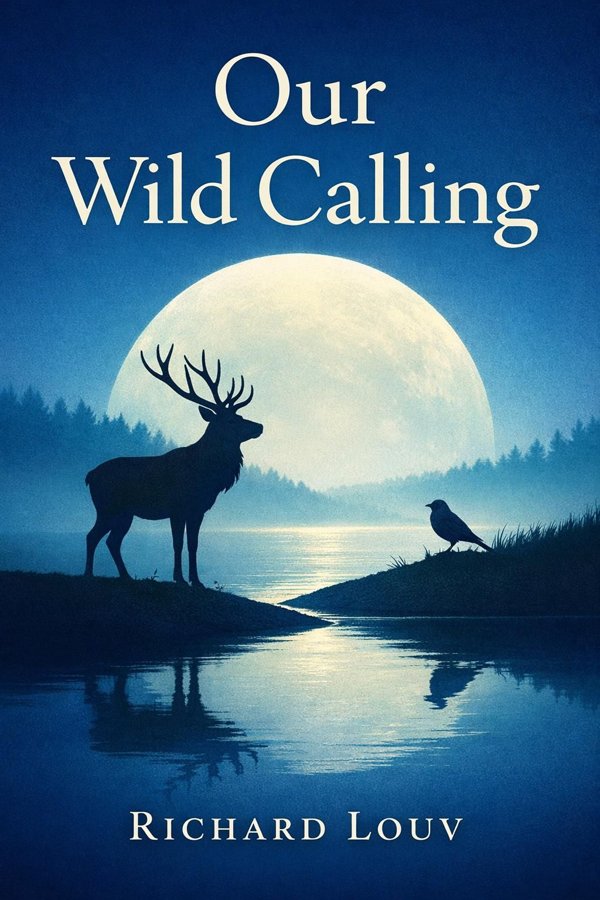
Our Wild Calling: How Connecting with Animals Can Transform Our Lives—and Save Theirs: Summary & Key Insights
by Richard Louv
 10 min11 chaptersAudio available
What Is Our Wild Calling: How Connecting with Animals Can Transform Our Lives—and Save Theirs About?
Our Wild Calling: How Connecting with Animals Can Transform Our Lives—and Save Theirs by Richard Louv is a environment book spanning 11 pages. In this book, Richard Louv explores the profound and often overlooked relationship between humans and animals. He argues that reconnecting with the natural world and its creatures can heal psychological wounds, strengthen empathy, and inspire conservation. Through scientific research, personal stories, and cultural insights, Louv shows how our bond with animals is essential for both human well-being and the survival of other species.
This FizzRead summary covers all 11 key chapters of Our Wild Calling: How Connecting with Animals Can Transform Our Lives—and Save Theirs in approximately 10 minutes, distilling the most important ideas, arguments, and takeaways from Richard Louv's work. Also available as an audio summary and Key Quotes Podcast.
Our Wild Calling: How Connecting with Animals Can Transform Our Lives—and Save Theirs
In this book, Richard Louv explores the profound and often overlooked relationship between humans and animals. He argues that reconnecting with the natural world and its creatures can heal psychological wounds, strengthen empathy, and inspire conservation. Through scientific research, personal stories, and cultural insights, Louv shows how our bond with animals is essential for both human well-being and the survival of other species.
Who Should Read Our Wild Calling: How Connecting with Animals Can Transform Our Lives—and Save Theirs?
This book is perfect for anyone interested in environment and looking to gain actionable insights in a short read. Whether you're a student, professional, or lifelong learner, the key ideas from Our Wild Calling: How Connecting with Animals Can Transform Our Lives—and Save Theirs by Richard Louv will help you think differently.
- ✓Readers who enjoy environment and want practical takeaways
- ✓Professionals looking to apply new ideas to their work and life
- ✓Anyone who wants the core insights of Our Wild Calling: How Connecting with Animals Can Transform Our Lives—and Save Theirs in just 10 minutes
Want the full summary?
Get instant access to this book summary and 100K+ more with Fizz Moment.
Get Free SummaryAvailable on App Store • Free to download
Key Chapters
Over time, our species built walls — invisible to many, yet profound in their effect — between ourselves and other animals. I trace this divide through history, culture, and technology. Once, we lived among creatures whose presence shaped our stories, our fears, our gods. In villages and forests, the animal was both neighbor and teacher. But with urbanization, industrial agriculture, and virtual entertainment, our relationships grew abstract. The cow became a product; the wolf, a myth; the pet, a consumer choice.
The human–animal divide is not only physical but psychological. In children’s lives, real encounters with living animals are replaced by digital images, cartoons, or stuffed toys. Adults often regard wildlife through the lens of management or tourism. We have come to see ourselves as apart, instead of a part, of the living web. This dislocation is deeply tied to what I earlier described as “nature-deficit disorder.” When we lose contact with other species, we narrow our capacity for empathy.
I invite readers here to look closely at the cultural forces that perpetuate separation. The noise of modernity teaches fear — we fear germs, injury, unpredictability. Yet in that fear we lose the wisdom of relationship. Animals teach patience, humility, and the art of coexisting with mystery. By reclaiming everyday contact — walking outside, watching a bird’s flight, acknowledging the intelligence behind a dog’s gaze — we begin to dismantle the divide not through ideology, but through presence.
In this section, I emphasize that nothing restores relationship faster than encounter. Direct, mindful contact with animals has the power to evoke awe, tenderness, and even healing. Scientific studies confirm that interactions with animals reduce anxiety, lower blood pressure, and strengthen the immune system. But beyond these metrics lies something less measurable and more sacred: an emotional resonance that reminds us of our own belonging.
I share narratives from people whose lives changed through moments of meeting — a soldier recovering with the help of a service dog, a child learning courage through a rescued cat, a park ranger who found renewed purpose in watching whales breach against the horizon. Each encounter is unique, yet they reveal a pattern: empathy grows when we feel seen by the nonhuman world. That sense of mutual recognition — the feeling that an animal perceives us, understands us on some primal level — reawakens our sense of wonder.
Here, I discuss that this power of encounter also carries responsibility. It calls us to pay attention. Encounters can be fleeting, but their influence endures. They remind us that we are participants in a much larger, mysterious conversation. As I write, I encourage readers to reclaim such moments — to allow curiosity and gratitude to replace detachment. When you meet an animal’s gaze, you are not observing; you are being observed. And that mutual awareness is the root of transformation.
+ 9 more chapters — available in the FizzRead app
All Chapters in Our Wild Calling: How Connecting with Animals Can Transform Our Lives—and Save Theirs
About the Author
Richard Louv is an American author and journalist best known for his work on nature and human connection. He coined the term 'nature-deficit disorder' and has written several influential books on the importance of reconnecting with the natural world, including 'Last Child in the Woods' and 'The Nature Principle'.
Get This Summary in Your Preferred Format
Read or listen to the Our Wild Calling: How Connecting with Animals Can Transform Our Lives—and Save Theirs summary by Richard Louv anytime, anywhere. FizzRead offers multiple formats so you can learn on your terms — all free.
Available formats: App · Audio · PDF · EPUB — All included free with FizzRead
Download Our Wild Calling: How Connecting with Animals Can Transform Our Lives—and Save Theirs PDF and EPUB Summary
Key Quotes from Our Wild Calling: How Connecting with Animals Can Transform Our Lives—and Save Theirs
“Over time, our species built walls — invisible to many, yet profound in their effect — between ourselves and other animals.”
“In this section, I emphasize that nothing restores relationship faster than encounter.”
Frequently Asked Questions about Our Wild Calling: How Connecting with Animals Can Transform Our Lives—and Save Theirs
Our Wild Calling: How Connecting with Animals Can Transform Our Lives—and Save Theirs by Richard Louv is a environment book that explores key ideas across 11 chapters. In this book, Richard Louv explores the profound and often overlooked relationship between humans and animals. He argues that reconnecting with the natural world and its creatures can heal psychological wounds, strengthen empathy, and inspire conservation. Through scientific research, personal stories, and cultural insights, Louv shows how our bond with animals is essential for both human well-being and the survival of other species.
More by Richard Louv
You Might Also Like

A Life on Our Planet: My Witness Statement and a Vision for the Future
David Attenborough
10 min
A Sky Full Of Birds
Matt Merritt
10 min
Carbon Zero: Imagining Cities That Can Save the Planet
Alex Steffen
10 min
Eaarth: Making a Life on a Tough New Planet
Bill McKibben
10 min
The Social Contract and Environmental Governance
Various Editors
10 min
The Wild Places
Robert Macfarlane
10 minBrowse by Category
Ready to read Our Wild Calling: How Connecting with Animals Can Transform Our Lives—and Save Theirs?
Get the full summary and 100K+ more books with Fizz Moment.