
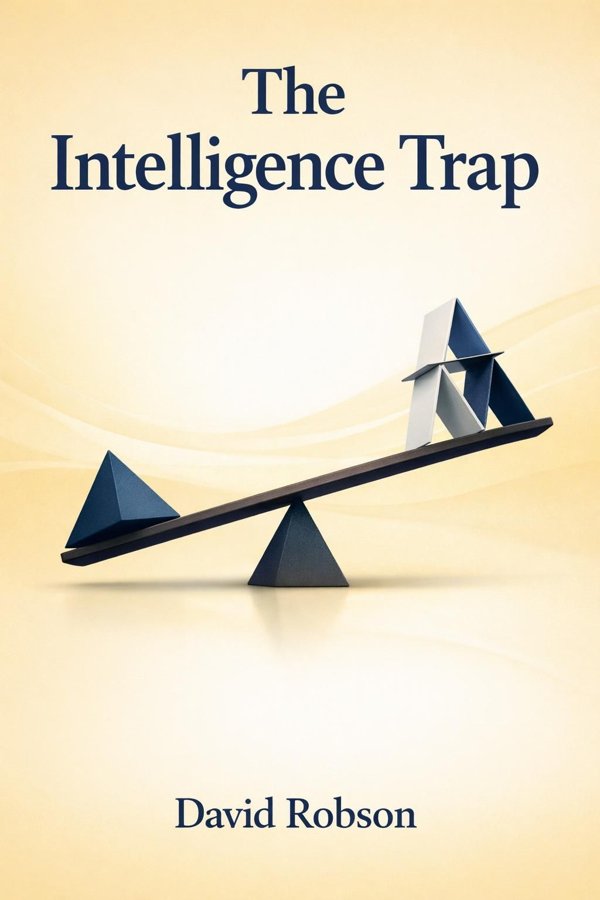
The Intelligence Trap: Why Smart People Do Dumb Things and How to Make Wiser Decisions: Summary & Key Insights
by David Robson
 10 min10 chaptersAudio available
What Is The Intelligence Trap: Why Smart People Do Dumb Things and How to Make Wiser Decisions About?
The Intelligence Trap: Why Smart People Do Dumb Things and How to Make Wiser Decisions by David Robson is a cognition book spanning 10 pages. The Intelligence Trap explores why high intelligence does not always lead to wise decision-making. Drawing on psychology, neuroscience, and behavioral science, David Robson examines how cognitive biases, overconfidence, and flawed reasoning can cause even the smartest individuals to make poor choices. The book offers practical strategies to cultivate wisdom, humility, and better judgment in everyday life.
This FizzRead summary covers all 10 key chapters of The Intelligence Trap: Why Smart People Do Dumb Things and How to Make Wiser Decisions in approximately 10 minutes, distilling the most important ideas, arguments, and takeaways from David Robson's work. Also available as an audio summary and Key Quotes Podcast.
The Intelligence Trap: Why Smart People Do Dumb Things and How to Make Wiser Decisions
The Intelligence Trap explores why high intelligence does not always lead to wise decision-making. Drawing on psychology, neuroscience, and behavioral science, David Robson examines how cognitive biases, overconfidence, and flawed reasoning can cause even the smartest individuals to make poor choices. The book offers practical strategies to cultivate wisdom, humility, and better judgment in everyday life.
Who Should Read The Intelligence Trap: Why Smart People Do Dumb Things and How to Make Wiser Decisions?
This book is perfect for anyone interested in cognition and looking to gain actionable insights in a short read. Whether you're a student, professional, or lifelong learner, the key ideas from The Intelligence Trap: Why Smart People Do Dumb Things and How to Make Wiser Decisions by David Robson will help you think differently.
- ✓Readers who enjoy cognition and want practical takeaways
- ✓Professionals looking to apply new ideas to their work and life
- ✓Anyone who wants the core insights of The Intelligence Trap: Why Smart People Do Dumb Things and How to Make Wiser Decisions in just 10 minutes
Want the full summary?
Get instant access to this book summary and 100K+ more with Fizz Moment.
Get Free SummaryAvailable on App Store • Free to download
Key Chapters
The history of human achievement is laced with both brilliance and blindness. To begin understanding why the intelligence trap occurs, I turn first to some of the great minds whose misjudgments have profoundly shaped our understanding of fallibility. The physicist William Shockley, co-inventor of the transistor, later ruined his reputation by promoting racist pseudo-genetics; the Nobel laureate Linus Pauling, after brilliant contributions to chemistry, pursued misguided beliefs in vitamin megadosing. These figures remind us that intelligence does not inoculate against folly—it may even deepen it. Their tragic errors originated not in a lack of intellect but in an overabundance of confidence.
Scientific studies back this pattern. Across measures, cognitive ability often correlates with better reasoning up to a point—beyond which motivated reasoning takes hold. Highly intelligent individuals tend to construct more elaborate justifications for their preconceived notions. Rather than correcting bias, their intellect refines it. This insight emerged from dual-process theories of psychology: our minds contain both intuitive and analytical systems, but intelligence mainly enhances the analytical one. If the intuitive foundation is emotionally or ideologically skewed, intelligence may simply build a stronger edifice upon a crooked base.
Through this lens, intelligence becomes a double-edged sword—a tool that, depending on one’s mindset, can either cut through error or carve it deeper. The scientific and historical background helps us appreciate the paradox that even the cleverest minds are susceptible to poor judgment when they fail to recognize the limits of their reasoning.
As I examined decades of cognitive research, I found that the roots of the intelligence trap lie in biases that twist our reasoning. Among them, confirmation bias—the tendency to seek only information that reinforces our beliefs—is perhaps the most notorious. But its cousin, motivated reasoning, is subtler and more insidious: our emotions direct our logic, making us defend what we *want* to be true rather than what *is* true. This is why clever people often become formidable defenders of bad ideas. Their minds don’t fail—they rationalize brilliantly.
There is also the illusion of knowledge—the belief that we understand complex systems better than we do. Experiments show that when asked to explain the mechanics of everyday objects, even highly educated people quickly reveal shallow grasp. The problem isn’t ignorance; it’s untested confidence. Intelligence can mask the gaps because it equips us to create coherent narratives that feel persuasive, whether or not they’re accurate.
Our brains evolved for social cohesion, not objective analysis, which means we often prioritize belonging over truth. A highly intelligent individual within a strongly polarized community may deploy their intellect defensively—to justify the tribe’s beliefs and protect identity. In this way, intelligence becomes a servant of bias rather than an antidote. The key, then, isn’t simply to think harder but to think *differently*—to recognize that rational thought is not the natural state of mind but a disciplined, cultivated practice.
+ 8 more chapters — available in the FizzRead app
All Chapters in The Intelligence Trap: Why Smart People Do Dumb Things and How to Make Wiser Decisions
About the Author
David Robson is a British science journalist and author known for his work on psychology and behavioral science. He has written for publications such as New Scientist, BBC Future, and The Guardian, focusing on the intersection of science and human behavior.
Get This Summary in Your Preferred Format
Read or listen to the The Intelligence Trap: Why Smart People Do Dumb Things and How to Make Wiser Decisions summary by David Robson anytime, anywhere. FizzRead offers multiple formats so you can learn on your terms — all free.
Available formats: App · Audio · PDF · EPUB — All included free with FizzRead
Download The Intelligence Trap: Why Smart People Do Dumb Things and How to Make Wiser Decisions PDF and EPUB Summary
Key Quotes from The Intelligence Trap: Why Smart People Do Dumb Things and How to Make Wiser Decisions
“The history of human achievement is laced with both brilliance and blindness.”
“As I examined decades of cognitive research, I found that the roots of the intelligence trap lie in biases that twist our reasoning.”
Frequently Asked Questions about The Intelligence Trap: Why Smart People Do Dumb Things and How to Make Wiser Decisions
The Intelligence Trap: Why Smart People Do Dumb Things and How to Make Wiser Decisions by David Robson is a cognition book that explores key ideas across 10 chapters. The Intelligence Trap explores why high intelligence does not always lead to wise decision-making. Drawing on psychology, neuroscience, and behavioral science, David Robson examines how cognitive biases, overconfidence, and flawed reasoning can cause even the smartest individuals to make poor choices. The book offers practical strategies to cultivate wisdom, humility, and better judgment in everyday life.
More by David Robson
You Might Also Like
A Field Guide to Lies: Critical Thinking in the Information Age
Daniel J. Levitin
10 min
A Theory of Cognitive Dissonance
Leon Festinger
10 min
Black-And-White Thinking: The Burden of a Binary Brain in a Complex World
Kevin Dutton
10 min
Born Liars: Why We Can’t Live Without Deceit
Ian Leslie
10 min
Collective Illusions: Conformity, Complicity, and the Science of Why We Make Bad Decisions
Todd Rose
10 min
Concrete Mathematics: A Foundation for Computer Science
Ronald L. Graham, Donald E. Knuth, Oren Patashnik
10 minBrowse by Category
Ready to read The Intelligence Trap: Why Smart People Do Dumb Things and How to Make Wiser Decisions?
Get the full summary and 100K+ more books with Fizz Moment.