
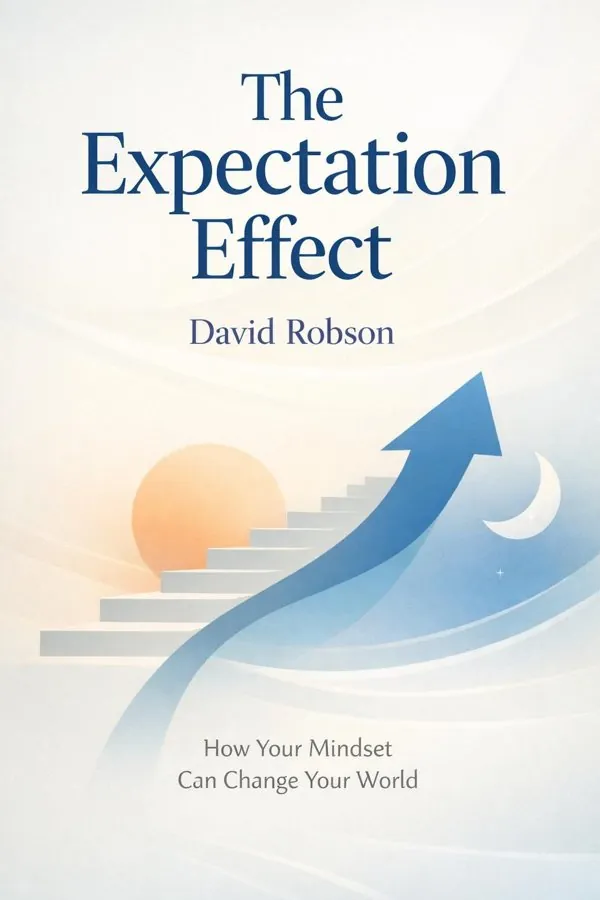
The Expectation Effect: How Your Mindset Can Change Your World: Summary & Key Insights
by David Robson
 10 min9 chaptersAudio available
What Is The Expectation Effect: How Your Mindset Can Change Your World About?
The Expectation Effect: How Your Mindset Can Change Your World by David Robson is a popular_sci book spanning 9 pages. Science journalist David Robson explores how expectations shape our physical and mental reality. Drawing on research in psychology and neuroscience, he shows that beliefs about aging, stress, diet, and intelligence can influence outcomes. Through real-world examples and scientific studies, Robson demonstrates how harnessing the power of expectation can improve health, performance, and well-being.
This FizzRead summary covers all 9 key chapters of The Expectation Effect: How Your Mindset Can Change Your World in approximately 10 minutes, distilling the most important ideas, arguments, and takeaways from David Robson's work. Also available as an audio summary and Key Quotes Podcast.
The Expectation Effect: How Your Mindset Can Change Your World
Science journalist David Robson explores how expectations shape our physical and mental reality. Drawing on research in psychology and neuroscience, he shows that beliefs about aging, stress, diet, and intelligence can influence outcomes. Through real-world examples and scientific studies, Robson demonstrates how harnessing the power of expectation can improve health, performance, and well-being.
Who Should Read The Expectation Effect: How Your Mindset Can Change Your World?
This book is perfect for anyone interested in popular_sci and looking to gain actionable insights in a short read. Whether you're a student, professional, or lifelong learner, the key ideas from The Expectation Effect: How Your Mindset Can Change Your World by David Robson will help you think differently.
- ✓Readers who enjoy popular_sci and want practical takeaways
- ✓Professionals looking to apply new ideas to their work and life
- ✓Anyone who wants the core insights of The Expectation Effect: How Your Mindset Can Change Your World in just 10 minutes
Want the full summary?
Get instant access to this book summary and 100K+ more with Fizz Moment.
Get Free SummaryAvailable on App Store • Free to download
Key Chapters
The roots of the expectation effect stretch back over a century to when medicine first faced its mysterious partner, the placebo effect. For decades, physicians observed baffling recoveries triggered by inert pills, harmless injections, and ritualistic treatments. The insight that expectation alone could modify physiology became both an ethical challenge and a scientific mystery. From Henry Beecher’s revelation during World War II — that many soldiers treated with saline because morphine had run out still felt pain relief — to modern neuroimaging discoveries, the same theme insists itself: belief changes biology.
Just as fascinating, the nocebo effect revealed the dark side of expectation. Patients warned about potential side effects often developed them, even when given placebos. In those cases, anxiety spurred the brain to create real distress through its control over pain perception and hormonal regulation. These dual phenomena form the scientific foundation for understanding expectation’s power: the brain is not simply reacting to stimuli, but predicting and modulating what the body should experience.
When I investigated these histories and the landmark trials that followed, I saw a remarkable transformation. Scientists who once dismissed these responses as nuisances now recognize them as central to the mind-body connection. Functional MRI studies show that placebos activate the same neural circuits as genuine pain-relieving drugs. The introduction of predictive coding — a theory suggesting that perception is shaped by the brain’s best guesses about reality — offered a unifying explanation. We don’t just perceive; we anticipate. And those anticipations sculpt our sensory and bodily responses.
Understanding this background is essential, because it frames everything that follows. The expectation effect is not a modern self-help fantasy. It stands on the shoulders of meticulous clinical observation and rigorous neuroscience.
At the heart of expectation’s power lies the brain’s predictive nature. Every moment, it’s generating models of what will happen next — how your heartbeat should feel, how heavy your limbs should be, how your next sip of coffee will taste. When the brain predicts accurately, experience feels smooth. When it predicts incorrectly, it adjusts perception or physiology to resolve the mismatch.
This predictive coding shapes not only what we see and feel but also how our body acts. When you expect pain relief, the brain releases endorphins and dopamine, easing discomfort and enhancing well-being. When you anticipate reward or improvement, the immune system and metabolic processes follow suit. Conversely, negative expectations raise cortisol levels and inflammatory markers. The biology of belief isn’t metaphorical: it’s a measurable chain of cause and effect, mediated by neurotransmitters, hormones, and immune chemistry.
Once I grasped how expectations are biologically embodied, I began seeing subtle evidence everywhere. Athletes who visualize success activate the same neuromuscular networks as those used in actual performance. Patients expecting faster recovery show more robust immune responses. Even the sensation of fatigue, once considered an unavoidable consequence of muscular depletion, turns out to be partly a perceptual forecast — a signal from the brain that estimates, rather than directly measures, bodily limitation. This realization opens a vast field of opportunity. By revising the predictive models we deploy, we can recalibrate what the body perceives as possible.
+ 7 more chapters — available in the FizzRead app
All Chapters in The Expectation Effect: How Your Mindset Can Change Your World
About the Author
David Robson is a British science writer and journalist who has written for The Guardian, BBC Future, and The Atlantic. His work focuses on psychology, neuroscience, and behavioral science, often exploring how scientific insights can be applied to everyday life.
Get This Summary in Your Preferred Format
Read or listen to the The Expectation Effect: How Your Mindset Can Change Your World summary by David Robson anytime, anywhere. FizzRead offers multiple formats so you can learn on your terms — all free.
Available formats: App · Audio · PDF · EPUB — All included free with FizzRead
Download The Expectation Effect: How Your Mindset Can Change Your World PDF and EPUB Summary
Key Quotes from The Expectation Effect: How Your Mindset Can Change Your World
“The roots of the expectation effect stretch back over a century to when medicine first faced its mysterious partner, the placebo effect.”
“At the heart of expectation’s power lies the brain’s predictive nature.”
Frequently Asked Questions about The Expectation Effect: How Your Mindset Can Change Your World
The Expectation Effect: How Your Mindset Can Change Your World by David Robson is a popular_sci book that explores key ideas across 9 chapters. Science journalist David Robson explores how expectations shape our physical and mental reality. Drawing on research in psychology and neuroscience, he shows that beliefs about aging, stress, diet, and intelligence can influence outcomes. Through real-world examples and scientific studies, Robson demonstrates how harnessing the power of expectation can improve health, performance, and well-being.
More by David Robson

You Might Also Like

Structures: Or Why Things Don"t Fall Down
J.E. Gordon
10 min
The Road to Wigan Pier
George Orwell
10 min
Bonk: The Curious Coupling of Science and Sex
Mary Roach
10 min
First Bite: How We Learn to Eat
Bee Wilson
10 min
In Pursuit Of The Unknown: 17 Equations That Changed The World
Ian Stewart
10 min
Napoleon's Buttons: 17 Molecules That Changed History
Penny Le Couteur and Jay Burreson
10 minBrowse by Category
Ready to read The Expectation Effect: How Your Mindset Can Change Your World?
Get the full summary and 100K+ more books with Fizz Moment.