
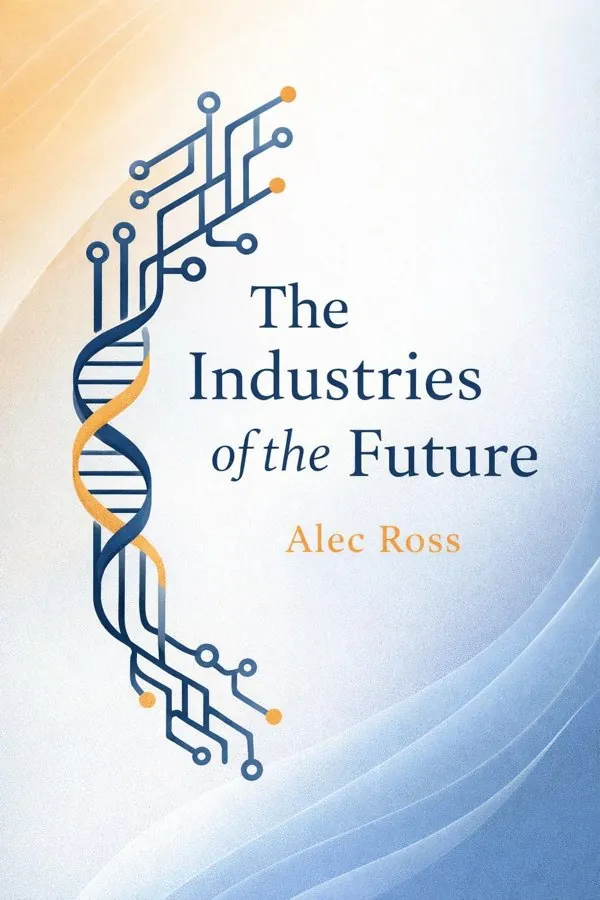
The Industries of the Future: Summary & Key Insights
by Alec Ross
 10 min10 chaptersAudio available
Key Takeaways from The Industries of the Future
The real robotics revolution is not about humanoid machines replacing people overnight; it is about smart, specialized systems quietly changing how work gets done.
One of the most powerful ideas in the book is that biology is becoming a data science.
Data by itself is not power; the ability to interpret it and act on it is.
In the digital age, vulnerability is no longer confined to battlefields or bank vaults.
Money is becoming software, and that changes who gets included in the economy.
What Is The Industries of the Future About?
The Industries of the Future by Alec Ross is a future_trends book spanning 11 pages. The Industries of the Future is Alec Ross’s ambitious guide to the technologies, business models, and geopolitical shifts that will shape the next twenty years. Rather than treating innovation as a vague force, Ross identifies the specific sectors most likely to redefine economies and everyday life: robotics, genomics, cybersecurity, big data, digital finance, artificial intelligence, and the evolving geography of entrepreneurship. His central argument is clear: the future will not arrive evenly, and those who understand where change is heading will be far better prepared to thrive in it. What makes this book especially valuable is Ross’s perspective. As a former Senior Advisor for Innovation to Secretary of State Hillary Clinton, he traveled extensively, met founders and policymakers around the world, and saw firsthand how new industries emerge across borders. He writes not just as a futurist, but as a practitioner who has observed innovation in labs, factories, startups, and governments. The result is a grounded, global, and highly readable analysis of where opportunity will come from, what risks will accompany it, and how individuals, companies, and nations can position themselves wisely in an era of accelerating change.
This FizzRead summary covers all 10 key chapters of The Industries of the Future in approximately 10 minutes, distilling the most important ideas, arguments, and takeaways from Alec Ross's work. Also available as an audio summary and Key Quotes Podcast.
The Industries of the Future
The Industries of the Future is Alec Ross’s ambitious guide to the technologies, business models, and geopolitical shifts that will shape the next twenty years. Rather than treating innovation as a vague force, Ross identifies the specific sectors most likely to redefine economies and everyday life: robotics, genomics, cybersecurity, big data, digital finance, artificial intelligence, and the evolving geography of entrepreneurship. His central argument is clear: the future will not arrive evenly, and those who understand where change is heading will be far better prepared to thrive in it.
What makes this book especially valuable is Ross’s perspective. As a former Senior Advisor for Innovation to Secretary of State Hillary Clinton, he traveled extensively, met founders and policymakers around the world, and saw firsthand how new industries emerge across borders. He writes not just as a futurist, but as a practitioner who has observed innovation in labs, factories, startups, and governments. The result is a grounded, global, and highly readable analysis of where opportunity will come from, what risks will accompany it, and how individuals, companies, and nations can position themselves wisely in an era of accelerating change.
Who Should Read The Industries of the Future?
This book is perfect for anyone interested in future_trends and looking to gain actionable insights in a short read. Whether you're a student, professional, or lifelong learner, the key ideas from The Industries of the Future by Alec Ross will help you think differently.
- ✓Readers who enjoy future_trends and want practical takeaways
- ✓Professionals looking to apply new ideas to their work and life
- ✓Anyone who wants the core insights of The Industries of the Future in just 10 minutes
Want the full summary?
Get instant access to this book summary and 100K+ more with Fizz Moment.
Get Free SummaryAvailable on App Store • Free to download
Key Chapters
The real robotics revolution is not about humanoid machines replacing people overnight; it is about smart, specialized systems quietly changing how work gets done. Ross argues that robots are becoming economically significant because they are moving beyond isolated industrial settings and into logistics, medicine, agriculture, elder care, and service work. As their sensors improve and their costs decline, robots become less like science fiction and more like infrastructure.
This shift matters because robotics changes both productivity and the labor market. In manufacturing, robots can increase precision, reduce waste, and operate continuously. In warehouses, automated systems move goods faster and more accurately than manual processes alone. In medicine, robotic assistance can improve surgical precision. In aging societies such as Japan, robots may help support care work where labor shortages are severe. The key insight is that robotics often complements human work before it replaces it. A nurse using lifting robots, a farmer using autonomous equipment, or a technician overseeing a machine fleet is not eliminated by automation but redefined by it.
Ross also emphasizes that the competitive advantage will go to places and organizations that adapt workflows, not just buy machines. Technology only creates value when institutions redesign training, operations, and incentives around it. Companies that treat robotics as a strategic capability will gain more than those that see it as a flashy purchase.
Actionable takeaway: Focus less on whether robots will replace jobs in the abstract and more on which human skills become more valuable when machines handle repetition, precision, and dangerous tasks.
One of the most powerful ideas in the book is that biology is becoming a data science. Ross shows how the falling cost of sequencing the human genome is transforming medicine, agriculture, pharmaceuticals, and scientific research. When the code of life can be read quickly and affordably, diseases can be understood more precisely, treatments can be tailored to individuals, and entirely new industries can emerge around biological information.
The promise of genomics is practical as well as profound. Doctors can increasingly use genetic information to predict disease risk, select targeted therapies, and avoid medications likely to cause harmful side effects. Researchers can identify patterns across large populations, speeding up drug development and improving diagnosis. Beyond medicine, genomics affects food production through more resilient crops and livestock, potentially helping nations respond to climate pressure and population growth.
Yet Ross does not present this as an uncomplicated triumph. Genomic knowledge raises major ethical and political questions: Who owns genetic data? How should privacy be protected? Could employers or insurers misuse biological information? And how should societies regulate gene editing technologies that can alter future generations? The ability to decode life brings responsibility along with opportunity.
Ross’s broader point is that genomics will reward countries and institutions capable of combining research talent, computational power, ethical governance, and investment capital. This is not just a scientific frontier; it is an industrial one.
Actionable takeaway: Treat advances in life sciences as both a health issue and a strategic economic trend, and pay close attention to the privacy and ethical frameworks surrounding biological data.
Data by itself is not power; the ability to interpret it and act on it is. Ross explains that the explosion of digital information is reshaping business and government because nearly every activity now leaves a measurable trail. Purchases, movements, clicks, medical records, machine outputs, and social interactions all generate data that can reveal patterns invisible to human intuition alone.
This matters because organizations that make better decisions faster tend to outperform those relying on instinct or tradition. Retailers use analytics to refine pricing and inventory. Hospitals identify treatment patterns and early warning signals. Cities use sensor networks to optimize traffic, energy use, and emergency response. Farmers rely on data from soil, weather, and equipment to improve yields. In each case, data converts uncertainty into actionable insight.
But Ross also warns that big data creates asymmetries of power. The institutions collecting and analyzing massive datasets can influence markets, behavior, and even politics. Consumers often enjoy convenience without fully understanding what they surrender in terms of privacy. Governments may use data for public good, surveillance, or both. The same systems that personalize services can also manipulate choices.
The strategic lesson is that data’s value comes from integration: collection, storage, analysis, and execution must work together. Hiring data scientists is not enough if leaders lack the judgment to ask the right questions or the governance to use data responsibly.
Actionable takeaway: Build data literacy as a core skill, whether you are a professional, entrepreneur, or policymaker, and always ask not only what data can do, but who controls it and to whose benefit.
In the digital age, vulnerability is no longer confined to battlefields or bank vaults. Ross argues that cybersecurity has become a foundational condition of economic and national stability because so much of modern life depends on connected systems. Financial networks, power grids, hospitals, transportation systems, communication platforms, and government databases all rely on software that can be breached, disrupted, or manipulated.
This makes cybersecurity more than an IT concern. It is a business continuity issue, a national security issue, and a trust issue. A company can lose intellectual property, customer confidence, and market value through one serious breach. A nation can face cyberattacks that target elections, infrastructure, or military systems without a conventional invasion. Individuals can experience identity theft, fraud, and reputational harm in ways that are difficult to reverse.
Ross highlights the asymmetry of this domain: attackers need only find one weak point, while defenders must protect everything. That is why cybersecurity is not solved by buying software alone. It requires culture, constant updating, talent development, and realistic understanding of human weakness. Employees clicking malicious links, poorly secured devices, and outdated systems often create openings more than dramatic acts of espionage do.
At the same time, this vulnerability creates opportunity. Cybersecurity is itself a major growth industry, with demand for specialists, better authentication systems, secure architecture, and cross-border cooperation. The safer digital systems become, the more society can rely on them.
Actionable takeaway: Treat cybersecurity like hygiene rather than insurance after the fact—embed secure habits, training, and system design before a crisis forces the lesson.
Money is becoming software, and that changes who gets included in the economy. Ross examines how digital finance, mobile payments, cryptocurrencies, and financial technologies are lowering barriers to participation while also challenging traditional institutions. In many regions, especially where banking infrastructure is weak, people can access financial services through a phone before they ever enter a branch.
This is economically transformative. Mobile money systems have allowed individuals in parts of Africa and Asia to send funds, store value, and conduct business without conventional bank accounts. Small entrepreneurs gain faster access to customers and transactions. Migrant workers can send remittances more efficiently. Digital records can help people establish a financial identity, which may later support credit access, savings tools, and insurance.
Ross also explores the disruptive implications for banks, regulators, and governments. If financial services become decentralized or platform-based, old gatekeepers lose control. New questions emerge: How do you regulate digital currencies? How do you prevent fraud and money laundering without excluding the poor? What happens when large technology firms become financial intermediaries? Financial innovation expands freedom, but it can also produce instability if trust mechanisms lag behind.
The deeper message is that financial infrastructure is not neutral. It shapes opportunity, entrepreneurship, and social mobility. Regions that leapfrog legacy systems may gain an advantage because they are not burdened by outdated institutions.
Actionable takeaway: Watch digital finance not only as a consumer convenience but as a structural force that can expand inclusion, shift market power, and create new risks requiring smarter regulation.
The future will reward those who can keep learning faster than industries keep changing. Ross argues that education systems built for the industrial era are poorly matched to a world in which technical knowledge ages quickly and career paths are less predictable. Memorizing information matters less when information is universally accessible; what matters more is the ability to analyze, create, collaborate, and adapt.
This has major implications for schools, universities, employers, and workers. Students need stronger foundations in science, technology, engineering, and math, but Ross does not reduce education to coding alone. He stresses the value of entrepreneurship, communication, ethics, and problem-solving across disciplines. The worker of the future may need to move across several roles and industries, making resilience and curiosity as important as credentials.
Ross also notes that talent is globally distributed while opportunity is not. Countries and regions that develop human capital effectively will attract investment and innovation. Those that neglect education may find themselves unable to benefit from the very technologies reshaping the world. Lifelong learning becomes essential because initial schooling can no longer sustain a 40-year career by itself.
Practical examples include online education platforms, employer-led training, hybrid technical programs, and skills-based hiring models. The institutions that succeed will be those that connect learning directly to evolving market needs without sacrificing civic and humanistic development.
Actionable takeaway: Invest in transferable skills—critical thinking, digital fluency, communication, and continuous learning—because the safest career strategy in a volatile economy is the capacity to evolve.
Innovation does not spread evenly across the map. Ross shows that geography still matters deeply even in a connected world because talent, capital, research institutions, culture, and policy tend to concentrate in specific places. These clusters create reinforcing ecosystems where ideas move quickly, risk is tolerated, and founders can access mentors, investors, and skilled workers.
Silicon Valley is the most famous example, but Ross expands the lens globally. Tel Aviv thrives through military-linked technical expertise and entrepreneurial intensity. Shenzhen rose through manufacturing speed, supply chain density, and aggressive scaling. Nairobi developed digital payment innovation suited to local needs. Each cluster succeeds not by copying another region exactly, but by building on local strengths and solving real problems.
This is a crucial corrective to the myth that the internet makes location irrelevant. Some industries still depend on physical proximity, trust networks, regulatory support, and shared institutional knowledge. Great ideas can originate anywhere, but turning them into globally competitive industries often requires ecosystems, not isolated brilliance.
Ross also points to the policy implications. Governments cannot simply declare themselves innovation hubs. They must build the preconditions: education, infrastructure, rule of law, openness to talent, access to capital, and a culture that tolerates failure. Cities and nations that understand this can create durable advantage.
Actionable takeaway: If you want to participate in future industries, study the ecosystems where innovation compounds, and ask how you can plug into or help build communities where talent, capital, and experimentation reinforce one another.
Artificial intelligence matters most when it changes who or what makes decisions. Ross discusses machine learning as an extension of the data revolution: once enough data is available, algorithms can detect patterns, make predictions, and automate forms of judgment that once required human expertise. This affects sectors as varied as finance, health care, transportation, marketing, security, and logistics.
The significance of AI lies in its reach. Recommendation systems influence what people buy and watch. Fraud detection models monitor transactions in real time. Medical imaging tools assist diagnosis. Predictive maintenance systems reduce industrial downtime. Autonomous systems may eventually transform transport and supply chains. In many cases, AI does not replace human intelligence wholesale; it augments it by handling scale, speed, and probabilistic analysis better than people can.
Ross also recognizes the dangers. Algorithms can reproduce bias when trained on flawed historical data. Opaque systems can centralize authority in institutions that are difficult to scrutinize. Workers may lose bargaining power if firms use AI to monitor productivity or deskill complex tasks. As with other future industries, the question is not simply what the technology can do, but who governs it and how incentives shape its use.
The long-term consequence is that judgment itself becomes an economic asset. Humans will remain essential where context, ethics, empathy, and creativity matter most, but routine decision environments will increasingly be machine-assisted.
Actionable takeaway: Learn to work with AI rather than merely fear it—understand its strengths, question its blind spots, and focus your own value on areas where human judgment remains indispensable.
Technological progress does not automatically produce shared prosperity. Ross is clear that the future of work will create both extraordinary opportunity and painful dislocation, depending on who adapts, who owns productive assets, and how societies respond. Some workers will become more productive and valuable through technology, while others will find their tasks automated, outsourced, or devalued.
This unevenness is one of the book’s most important themes. High-skill workers in design, engineering, entrepreneurship, and advanced services may benefit disproportionately because technology amplifies their output. Meanwhile, middle-skill routine roles are especially vulnerable because software and machines can replicate structured tasks more easily than complex physical or interpersonal work. The result may be labor market polarization: growth in high-wage and low-wage jobs, with pressure on the middle.
Ross does not argue that jobs will simply disappear; rather, their composition will change. New occupations will emerge in areas such as cybersecurity, bioinformatics, robotics maintenance, digital payments, and AI oversight. But transitions are difficult, especially when education systems, social safety nets, and labor policy are outdated. Communities tied to legacy industries may struggle for years if change is ignored rather than managed.
This connects directly to inequality. The benefits of innovation often accrue first to those already connected to networks of capital, skills, and information. Without policy support, the future can become more efficient but less fair.
Actionable takeaway: Prepare for career agility, not career permanence—build skills that travel across industries, keep updating them, and pay attention to how technological shifts affect bargaining power in your field.
Technology does not write the future by itself; policy, governance, and institutions shape who wins, who loses, and what values are protected. Ross repeatedly argues that the most important debates of the coming decades will not be about whether innovation happens, but about how societies govern it. This includes everything from intellectual property and taxation to privacy, immigration, education, antitrust, and international norms.
The need for policy is obvious across the industries Ross explores. Genomics requires ethical boundaries. Cybersecurity demands standards and coordination. Digital finance needs rules that balance inclusion with stability. Innovation clusters depend on research funding, openness, and infrastructure. Labor disruption may require retraining systems, mobility support, or new approaches to social protection. Without effective governance, technological progress can intensify concentration, insecurity, and mistrust.
Ross does not advocate heavy-handed control that smothers entrepreneurship. Instead, he favors smart governance that creates conditions for innovation while defending the public interest. This means governments must become more technologically literate, more flexible, and more globally aware. National policy can no longer ignore cross-border data flows, digital competition, and internationally mobile talent.
The broader message is that political capacity is itself a competitive advantage. Countries with responsive institutions will navigate disruption better than those with rigid bureaucracies or captured systems. In a fast-changing world, good governance becomes part of economic strategy.
Actionable takeaway: Do not treat future industries as purely technical subjects—follow the policy environment around them, because regulation, public investment, and institutional quality will strongly influence where opportunity and power accumulate.
All Chapters in The Industries of the Future
About the Author
Alec Ross is an American author, technology policy expert, and adviser known for analyzing how innovation reshapes economies and societies. He served as Senior Advisor for Innovation to Secretary of State Hillary Clinton, where he worked on issues involving technology, entrepreneurship, education, and global competitiveness. That role took him across many countries, giving him firsthand exposure to emerging startup ecosystems, digital infrastructure, and policy responses to rapid technological change. Ross has also been a teacher, entrepreneur, and public commentator on topics such as the future of work, cybersecurity, and global development. His writing combines policy experience with practical observation, making complex technological shifts accessible to a broad audience. In The Industries of the Future, he draws on that global perspective to map the sectors likely to define the next era of economic transformation.
Get This Summary in Your Preferred Format
Read or listen to the The Industries of the Future summary by Alec Ross anytime, anywhere. FizzRead offers multiple formats so you can learn on your terms — all free.
Available formats: App · Audio · PDF · EPUB — All included free with FizzRead
Download The Industries of the Future PDF and EPUB Summary
Key Quotes from The Industries of the Future
“The real robotics revolution is not about humanoid machines replacing people overnight; it is about smart, specialized systems quietly changing how work gets done.”
“One of the most powerful ideas in the book is that biology is becoming a data science.”
“Data by itself is not power; the ability to interpret it and act on it is.”
“In the digital age, vulnerability is no longer confined to battlefields or bank vaults.”
“Money is becoming software, and that changes who gets included in the economy.”
Frequently Asked Questions about The Industries of the Future
The Industries of the Future by Alec Ross is a future_trends book that explores key ideas across 10 chapters. The Industries of the Future is Alec Ross’s ambitious guide to the technologies, business models, and geopolitical shifts that will shape the next twenty years. Rather than treating innovation as a vague force, Ross identifies the specific sectors most likely to redefine economies and everyday life: robotics, genomics, cybersecurity, big data, digital finance, artificial intelligence, and the evolving geography of entrepreneurship. His central argument is clear: the future will not arrive evenly, and those who understand where change is heading will be far better prepared to thrive in it. What makes this book especially valuable is Ross’s perspective. As a former Senior Advisor for Innovation to Secretary of State Hillary Clinton, he traveled extensively, met founders and policymakers around the world, and saw firsthand how new industries emerge across borders. He writes not just as a futurist, but as a practitioner who has observed innovation in labs, factories, startups, and governments. The result is a grounded, global, and highly readable analysis of where opportunity will come from, what risks will accompany it, and how individuals, companies, and nations can position themselves wisely in an era of accelerating change.
More by Alec Ross
You Might Also Like
Futureproof: 9 Rules for Humans in the Age of Automation
Kevin Roose
10 min
The Third Wave
Alvin Toffler
10 min
2030: How Today's Biggest Trends Will Collide and Reshape the Future of Everything
Mauro F. Guillén
10 min
A Very Human Future: Enriching Humanity in a Digitized World
Rohit Talwar, Steve Wells, Alexandra Whittington
10 min
AI 2041: Ten Visions for Our Future
Kai-Fu Lee, Chen Qiufan
10 min
Abundance: The Future Is Better Than You Think
Peter H. Diamandis, Steven Kotler
10 minBrowse by Category
Ready to read The Industries of the Future?
Get the full summary and 100K+ more books with Fizz Moment.