
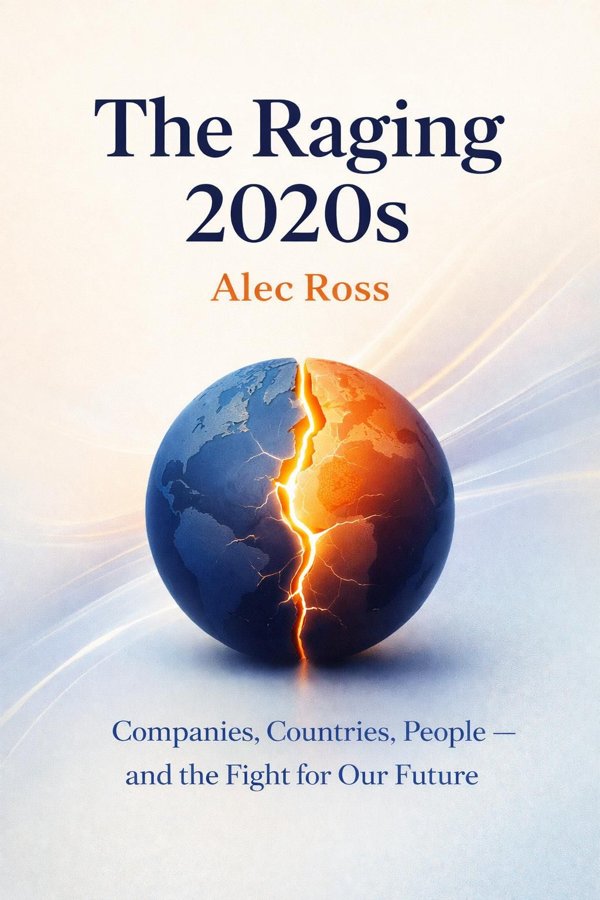
The Raging 2020s: Companies, Countries, People – and the Fight for Our Future: Summary & Key Insights
by Alec Ross
 10 min10 chaptersAudio available
Key Takeaways from The Raging 2020s: Companies, Countries, People – and the Fight for Our Future
A society begins to fracture when its promises no longer match people’s lived reality.
Power no longer resides only in capitals; increasingly, it sits in boardrooms, server farms, and platform ecosystems.
Technological progress can enrich society while simultaneously destabilizing it.
When innovation moves faster than institutions, society lives in a permanent state of catch-up.
Many of the biggest problems of our time ignore borders, yet many of our governing tools still stop at them.
What Is The Raging 2020s: Companies, Countries, People – and the Fight for Our Future About?
The Raging 2020s: Companies, Countries, People – and the Fight for Our Future by Alec Ross is a economics book spanning 10 pages. The 2020s did not begin as an ordinary decade, and Alec Ross argues they will not unfold like one either. In The Raging 2020s, he examines a world in transition, where technological acceleration, political fragility, climate pressure, and widening inequality are redrawing the balance of power between companies, countries, and ordinary people. The old assumptions that once organized modern life—work hard, trust institutions, expect progress—are breaking down, yet no stable replacement has emerged. Ross explores how this rupture is changing labor, democracy, global competition, public trust, and the future of citizenship itself. What makes this book especially valuable is its ability to connect forces that are often discussed separately. Automation is linked to inequality. Corporate concentration is linked to weakened states. Climate change is linked to governance failure and moral responsibility. Ross writes not only as an observer, but as someone with deep experience in technology policy and global affairs. Drawing on his work in government, business, and international innovation, he offers a wide-angle view of the decade’s defining struggles—and a persuasive case for building a new social contract before instability becomes the norm.
This FizzRead summary covers all 10 key chapters of The Raging 2020s: Companies, Countries, People – and the Fight for Our Future in approximately 10 minutes, distilling the most important ideas, arguments, and takeaways from Alec Ross's work. Also available as an audio summary and Key Quotes Podcast.
The Raging 2020s: Companies, Countries, People – and the Fight for Our Future
The 2020s did not begin as an ordinary decade, and Alec Ross argues they will not unfold like one either. In The Raging 2020s, he examines a world in transition, where technological acceleration, political fragility, climate pressure, and widening inequality are redrawing the balance of power between companies, countries, and ordinary people. The old assumptions that once organized modern life—work hard, trust institutions, expect progress—are breaking down, yet no stable replacement has emerged. Ross explores how this rupture is changing labor, democracy, global competition, public trust, and the future of citizenship itself.
What makes this book especially valuable is its ability to connect forces that are often discussed separately. Automation is linked to inequality. Corporate concentration is linked to weakened states. Climate change is linked to governance failure and moral responsibility. Ross writes not only as an observer, but as someone with deep experience in technology policy and global affairs. Drawing on his work in government, business, and international innovation, he offers a wide-angle view of the decade’s defining struggles—and a persuasive case for building a new social contract before instability becomes the norm.
Who Should Read The Raging 2020s: Companies, Countries, People – and the Fight for Our Future?
This book is perfect for anyone interested in economics and looking to gain actionable insights in a short read. Whether you're a student, professional, or lifelong learner, the key ideas from The Raging 2020s: Companies, Countries, People – and the Fight for Our Future by Alec Ross will help you think differently.
- ✓Readers who enjoy economics and want practical takeaways
- ✓Professionals looking to apply new ideas to their work and life
- ✓Anyone who wants the core insights of The Raging 2020s: Companies, Countries, People – and the Fight for Our Future in just 10 minutes
Want the full summary?
Get instant access to this book summary and 100K+ more with Fizz Moment.
Get Free SummaryAvailable on App Store • Free to download
Key Chapters
Power no longer resides only in capitals; increasingly, it sits in boardrooms, server farms, and platform ecosystems. Ross shows how the largest corporations—especially technology firms—have become more influential than many nation-states. They operate across borders, hold immense amounts of data, shape public discourse, and influence everything from labor markets to geopolitics. Unlike traditional industrial giants, digital corporations can scale globally with extraordinary speed while facing relatively limited territorial constraints.
This shift matters because governments are still structured for a slower, more geographically bounded era. A corporation can deploy a new tool worldwide in months; legislation may take years. Platforms can affect elections, media consumption, and social norms in dozens of countries at once. Companies with market capitalizations larger than national GDPs can pressure regulators, route profits across jurisdictions, and negotiate with states from positions of strength.
Ross is not arguing that business success is inherently dangerous. Rather, he warns that when private institutions become more agile and better resourced than public ones, democratic accountability weakens. A social media company can influence speech norms. A cloud provider can become critical infrastructure. A logistics giant can reshape labor standards. These are not simply commercial outcomes; they are quasi-political ones.
Examples are everywhere: app stores controlling market access, tech platforms moderating civic conversation, multinational firms determining where tax burdens fall, and private companies building systems once managed by government. Ross urges readers to recognize that unchecked corporate power creates a governance vacuum.
Actionable takeaway: judge major companies not only by convenience or shareholder returns, but by their impact on competition, privacy, labor, and democracy—and support public rules strong enough to ensure that scale does not outrun accountability.
Technological progress can enrich society while simultaneously destabilizing it. Ross argues that automation and digital transformation are not simply labor-saving tools; they are sorting mechanisms that divide workers, regions, and classes. People with advanced skills, strong networks, and access to capital often benefit disproportionately from new technologies. Those performing routine, repeatable, or location-bound work face wage pressure, job insecurity, or displacement.
The danger is not only that some jobs disappear. It is that opportunity becomes concentrated in a few sectors and metropolitan hubs, while entire communities fall behind. A software engineer in a global city may thrive in a high-growth digital economy, but a warehouse worker, call center employee, or administrative clerk may find that algorithms, robotics, or outsourcing steadily erode bargaining power. Even when jobs remain, they may become more surveilled, more fragmented, and less secure.
Ross pushes back against simplistic narratives. Automation does not automatically produce mass unemployment, nor does innovation guarantee shared prosperity. Outcomes depend on institutions: education systems, labor law, tax policy, healthcare access, retraining programs, and whether workers have a real voice in transitions. A society that treats displaced workers as collateral damage will intensify resentment and instability. A society that supports reskilling, mobility, and income security can turn disruption into renewal.
Practical applications include community college partnerships with employers, portable benefits for gig and contract workers, wage insurance, and lifelong learning systems that help adults adapt more than once across a career. Ross’s deeper point is moral as much as economic: a person’s worth cannot be reduced to their market efficiency.
Actionable takeaway: prepare for technological change by investing continuously in adaptable skills, but also advocate for policies that spread the gains of automation instead of concentrating them at the top.
When innovation moves faster than institutions, society lives in a permanent state of catch-up. Ross argues that one of the defining challenges of the 2020s is the widening gap between technological capability and governmental capacity. Artificial intelligence, biotechnology, digital finance, surveillance tools, and data-driven systems are evolving rapidly, while public institutions often lack the expertise, speed, and flexibility to respond well.
This mismatch creates a dangerous pattern. New technologies are deployed at scale before societies have debated their ethical limits or built appropriate safeguards. By the time regulators act, harmful business models, addictive systems, or discriminatory practices may already be deeply embedded. The result is reactive governance rather than strategic governance.
Ross does not call for governments to smother innovation. He calls for smarter state capacity. Public institutions need technologists, data fluency, and the confidence to set standards early. Consider issues such as facial recognition in policing, algorithmic bias in hiring, misinformation on social platforms, or cryptocurrency risks in financial systems. In each case, the question is not whether the technology exists, but whether democratic institutions can guide how it is used.
Countries that build capable, legitimate institutions will be better positioned to attract investment and protect citizens at the same time. Those that remain paralyzed by polarization, bureaucracy, or ignorance will either overreact clumsily or surrender public decision-making to private actors.
For citizens and leaders alike, Ross’s message is practical: governance must become more anticipatory. That means creating expert public agencies, updating regulatory frameworks, and encouraging collaboration between government, academia, and industry without allowing capture.
Actionable takeaway: support leaders and institutions that treat technological literacy as a core function of modern government, because innovation without competent governance eventually turns from opportunity into disorder.
Many of the biggest problems of our time ignore borders, yet many of our governing tools still stop at them. Ross highlights a profound contradiction at the heart of the 2020s: nation-states remain the primary units of political legitimacy, but they are increasingly unable to manage transnational realities on their own. Climate change, pandemics, cyberattacks, migration, tax avoidance, disinformation, and financial contagion all move across borders more easily than laws do.
This does not mean the state is irrelevant. In moments of crisis, people still look to governments for protection, coordination, and legitimacy. But Ross argues that states are often simultaneously overburdened and underpowered. They are expected to solve global problems with tools designed for national administration. Meanwhile, corporations, criminal networks, and digital communities operate in ways that blur geography.
The weakening of the nation-state is especially visible in the management of global commons—shared systems such as the climate, oceans, cyberspace, and public health. No country can solve these issues alone, but cooperation is often undermined by short-term politics, nationalism, or mistrust. As a result, collective-action problems worsen while institutions of global governance lag behind.
Ross encourages readers to think beyond false choices between national sovereignty and global cooperation. Effective states are still essential, but they must be paired with stronger international coordination and more realistic forms of shared governance. Examples include cross-border tax agreements, cyber norms, pandemic preparedness compacts, and climate frameworks with real enforcement mechanisms.
Actionable takeaway: demand competence at the national level, but also recognize that modern citizenship includes supporting institutions and agreements capable of managing problems no country can contain by itself.
Climate change is not only an environmental issue; it is a test of political seriousness and moral imagination. Ross places climate at the center of the decade because it reveals nearly every structural weakness in modern society at once: short-term thinking, weak international cooperation, unequal vulnerability, corporate irresponsibility, and the inability of institutions to act before catastrophe forces them to. The climate crisis is both a scientific fact and a governance stress test.
Ross emphasizes that the burden of climate disruption is distributed unequally. The people and places least responsible for emissions are often most exposed to floods, droughts, heat waves, displacement, and food insecurity. This makes climate change not just a problem of carbon, but a problem of justice. Wealthier societies and companies have more tools to adapt, insure, relocate, and innovate. Poorer communities endure harsher trade-offs.
At the same time, Ross resists fatalism. He presents climate action as an arena where public policy, market incentives, technological innovation, and civic pressure can align. Renewable energy deployment, resilient infrastructure, carbon pricing, building efficiency, and investment in clean technologies are not abstract ideals; they are practical measures that can reshape incentives and reduce risk. The challenge is political will.
For businesses, climate can no longer be treated as a public relations concern. Supply chains, insurance costs, infrastructure reliability, and investor expectations are all being transformed by environmental realities. For governments, delay is increasingly expensive. For citizens, climate action begins with consumption choices but cannot end there; systemic change matters more.
Actionable takeaway: treat climate responsibility as a civic duty—support policies and organizations that cut emissions, strengthen resilience, and protect vulnerable communities rather than relying on symbolic gestures alone.
Work has always been about more than income. Ross argues that one of the deepest risks of the 2020s is not simply job disruption, but the erosion of work as a source of identity, social connection, and dignity. As labor markets become more automated, fragmented, and platform-mediated, many people experience greater flexibility but less security. The same systems that promise efficiency can also strip workers of predictability, bargaining power, and meaning.
The old model of a long career with one employer was never universal, but it provided a structure around which benefits, retirement, and social status were organized. Today, a growing share of workers move between contracts, gigs, part-time roles, and algorithmically managed tasks. This can create opportunity for some, especially highly skilled professionals. For others, it produces instability, surveillance, and a constant struggle to assemble a decent livelihood.
Ross insists that the future of work should not be measured only by output or innovation. It should also be judged by whether people can build stable lives. That means asking difficult questions: Who receives healthcare when work is fragmented? Who pays into retirement systems? How are workers protected from opaque algorithmic decisions? What happens to communities built around industries that decline?
Practical responses include portable benefits, modernized labor classification rules, stronger support for caregiving, apprenticeships in emerging sectors, and public investment in jobs tied to infrastructure, education, healthcare, and climate adaptation. Ross’s broader point is that a healthy society values people even when markets change faster than their job descriptions.
Actionable takeaway: evaluate work opportunities not only by pay, but by stability, benefits, autonomy, and long-term skill growth—and support policies that make dignity portable across changing forms of employment.
A society can survive disagreement, but it struggles to survive when nobody trusts anyone or anything. Ross sees collapsing trust as one of the hidden accelerants of the decade’s turmoil. Confidence in government, media, corporations, and even fellow citizens has eroded across many democracies. This mistrust is fueled by corruption, inequality, misinformation, institutional failure, and the sense that elites operate by a different set of rules.
Low trust has real consequences. It weakens compliance during crises, undermines democratic compromise, and makes collective action much harder. If people believe every institution is rigged, they become more susceptible to conspiracy theories, demagogues, and cynical withdrawal. Trust, in Ross’s framework, is not a soft cultural issue. It is a form of social infrastructure.
Accountability is the path to restoring it. Ross argues that trust cannot be demanded through slogans; it must be earned through transparency, competence, and consequences. Governments must deliver basic functions effectively. Companies must be honest about data use, labor practices, and social impact. Media institutions must defend standards without becoming disconnected from the public. Citizens, too, have obligations: to participate, verify, vote, and resist the temptation to confuse outrage with engagement.
Examples of civic renewal include participatory budgeting, local journalism support, anti-corruption measures, independent oversight bodies, and digital literacy initiatives that help people assess information critically. These do not solve polarization overnight, but they rebuild habits of democratic life.
Actionable takeaway: strengthen trust locally first—support institutions, leaders, and media sources that demonstrate competence and accountability, because democratic renewal begins where people can still see cause and effect.
The future is not unfolding uniformly; different societies are experimenting in real time. Ross uses international examples to show that the challenges of the 2020s are global, but responses are shaped by national culture, institutional strength, and political choices. Some countries are adapting creatively to disruption through education reform, digital government, industrial policy, and public-private coordination. Others are falling into paralysis, capture, or polarization.
These comparisons matter because they challenge the idea that current dysfunction is inevitable. For example, states that invested early in broadband, digital identity, workforce training, and streamlined public services often respond more effectively to economic and technological change. Societies with stronger civic trust can implement difficult policies with less resistance. Countries that align industrial strategy with clean energy or advanced manufacturing may create resilient growth rather than merely react to global competition.
Ross’s case-study approach also reveals trade-offs. Some highly efficient models come with risks to privacy or centralization. Some market-driven systems generate innovation but neglect social protection. Some strong states coordinate well but leave less room for dissent. The lesson is not to copy any one country wholesale, but to study which institutional habits produce resilience.
For businesses, global comparison helps identify where regulation, infrastructure, and talent ecosystems are moving. For policymakers, it highlights the importance of state capacity. For citizens, it widens the imagination: if another society can build digital public services or worker retraining systems that function, then reform is possible.
Actionable takeaway: look beyond your own country’s political debate and study practical models from elsewhere—comparative learning is one of the fastest ways to challenge complacency and improve institutional design.
All Chapters in The Raging 2020s: Companies, Countries, People – and the Fight for Our Future
About the Author
Alec Ross is an American author, technology policy expert, and strategic advisor whose work focuses on how innovation reshapes economies, politics, and society. He is best known for serving as Senior Advisor for Innovation to U.S. Secretary of State Hillary Clinton, where he helped shape initiatives related to technology, entrepreneurship, and global connectivity. Ross has also worked across academia, public policy, and business, giving him a broad perspective on the interaction between governments, corporations, and citizens. His writing explores the social consequences of technological change, from labor disruption to geopolitical competition. Because he combines policy experience with a global outlook, Ross is particularly effective at translating complex trends into clear arguments about the future of work, democracy, and economic power.
Get This Summary in Your Preferred Format
Read or listen to the The Raging 2020s: Companies, Countries, People – and the Fight for Our Future summary by Alec Ross anytime, anywhere. FizzRead offers multiple formats so you can learn on your terms — all free.
Available formats: App · Audio · PDF · EPUB — All included free with FizzRead
Download The Raging 2020s: Companies, Countries, People – and the Fight for Our Future PDF and EPUB Summary
Key Quotes from The Raging 2020s: Companies, Countries, People – and the Fight for Our Future
“A society begins to fracture when its promises no longer match people’s lived reality.”
“Power no longer resides only in capitals; increasingly, it sits in boardrooms, server farms, and platform ecosystems.”
“Technological progress can enrich society while simultaneously destabilizing it.”
“When innovation moves faster than institutions, society lives in a permanent state of catch-up.”
“Many of the biggest problems of our time ignore borders, yet many of our governing tools still stop at them.”
Frequently Asked Questions about The Raging 2020s: Companies, Countries, People – and the Fight for Our Future
The Raging 2020s: Companies, Countries, People – and the Fight for Our Future by Alec Ross is a economics book that explores key ideas across 10 chapters. The 2020s did not begin as an ordinary decade, and Alec Ross argues they will not unfold like one either. In The Raging 2020s, he examines a world in transition, where technological acceleration, political fragility, climate pressure, and widening inequality are redrawing the balance of power between companies, countries, and ordinary people. The old assumptions that once organized modern life—work hard, trust institutions, expect progress—are breaking down, yet no stable replacement has emerged. Ross explores how this rupture is changing labor, democracy, global competition, public trust, and the future of citizenship itself. What makes this book especially valuable is its ability to connect forces that are often discussed separately. Automation is linked to inequality. Corporate concentration is linked to weakened states. Climate change is linked to governance failure and moral responsibility. Ross writes not only as an observer, but as someone with deep experience in technology policy and global affairs. Drawing on his work in government, business, and international innovation, he offers a wide-angle view of the decade’s defining struggles—and a persuasive case for building a new social contract before instability becomes the norm.
More by Alec Ross
You Might Also Like
Business Adventures
John Brooks
10 min
Nudge
Richard H. Thaler, Cass R. Sunstein
10 min
The Hitchhiker"s Guide to the Galaxy
Douglas Adams
10 minThe Muqaddimah
Ibn Khaldun
10 minThe Outsiders
William N. Thorndike
10 min
A Little History of Economics
Niall Kishtainy
10 minBrowse by Category
Ready to read The Raging 2020s: Companies, Countries, People – and the Fight for Our Future?
Get the full summary and 100K+ more books with Fizz Moment.