
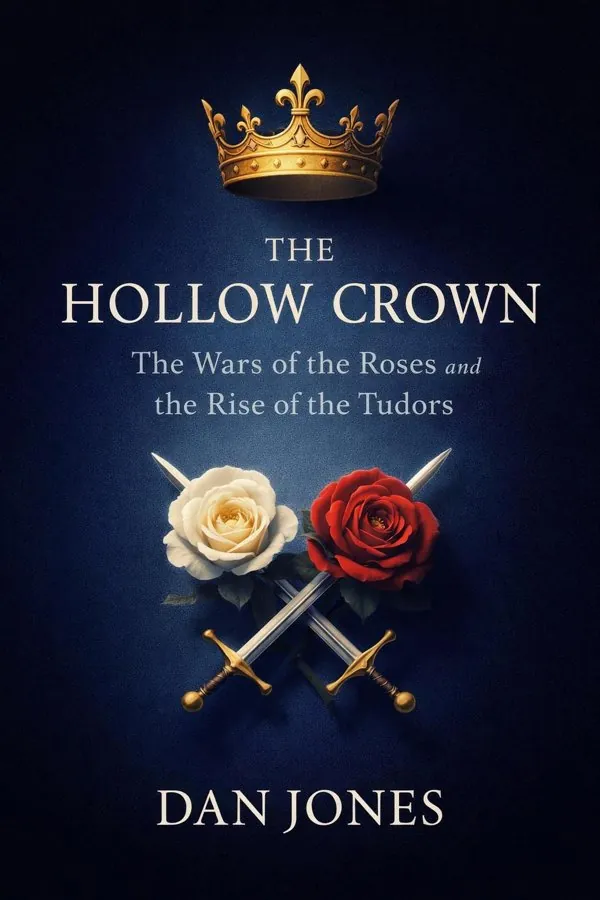
The Hollow Crown: The Wars of the Roses and the Rise of the Tudors: Summary & Key Insights
by Dan Jones
 10 min10 chaptersAudio available
Key Takeaways from The Hollow Crown: The Wars of the Roses and the Rise of the Tudors
One of the book’s central insights is that political collapse often begins not with defeat, but with a dangerous inheritance.
A crown is never just a symbol when bloodlines can be turned into battle plans.
Wars of succession are rarely inevitable at the start; they become inevitable when each side concludes that compromise is now more dangerous than conflict.
Sometimes the most effective rulers are not the most virtuous, but the most adaptable.
History often turns on the unsettling fact that no victory is ever final.
What Is The Hollow Crown: The Wars of the Roses and the Rise of the Tudors About?
The Hollow Crown: The Wars of the Roses and the Rise of the Tudors by Dan Jones is a world_history book spanning 11 pages. Few periods in English history are as dramatic, violent, and consequential as the fifteenth century, when rival dynasties fought to control a kingdom weakened by failed war, factional politics, and a fragile monarchy. In The Hollow Crown, historian Dan Jones turns the Wars of the Roses into a gripping narrative of ambition, legitimacy, betrayal, and survival. Beginning with the troubled reign of Henry VI and ending with the triumph of Henry Tudor at Bosworth, the book traces how England endured decades of instability before a new royal house emerged from the wreckage. What makes this book especially powerful is Jones’s ability to combine scholarly command with the pace of a political thriller. He explains complex family claims, shifting alliances, and battlefield turning points without losing sight of the human beings at the center of events—kings who could not rule, nobles who overreached, queens who fought fiercely for dynastic survival, and opportunists who turned chaos into power. For readers interested in monarchy, state formation, political conflict, or the transition from medieval to early modern England, The Hollow Crown offers both a vivid story and a serious historical argument about how nations are remade through crisis.
This FizzRead summary covers all 10 key chapters of The Hollow Crown: The Wars of the Roses and the Rise of the Tudors in approximately 10 minutes, distilling the most important ideas, arguments, and takeaways from Dan Jones's work. Also available as an audio summary and Key Quotes Podcast.
The Hollow Crown: The Wars of the Roses and the Rise of the Tudors
Few periods in English history are as dramatic, violent, and consequential as the fifteenth century, when rival dynasties fought to control a kingdom weakened by failed war, factional politics, and a fragile monarchy. In The Hollow Crown, historian Dan Jones turns the Wars of the Roses into a gripping narrative of ambition, legitimacy, betrayal, and survival. Beginning with the troubled reign of Henry VI and ending with the triumph of Henry Tudor at Bosworth, the book traces how England endured decades of instability before a new royal house emerged from the wreckage.
What makes this book especially powerful is Jones’s ability to combine scholarly command with the pace of a political thriller. He explains complex family claims, shifting alliances, and battlefield turning points without losing sight of the human beings at the center of events—kings who could not rule, nobles who overreached, queens who fought fiercely for dynastic survival, and opportunists who turned chaos into power. For readers interested in monarchy, state formation, political conflict, or the transition from medieval to early modern England, The Hollow Crown offers both a vivid story and a serious historical argument about how nations are remade through crisis.
Who Should Read The Hollow Crown: The Wars of the Roses and the Rise of the Tudors?
This book is perfect for anyone interested in world_history and looking to gain actionable insights in a short read. Whether you're a student, professional, or lifelong learner, the key ideas from The Hollow Crown: The Wars of the Roses and the Rise of the Tudors by Dan Jones will help you think differently.
- ✓Readers who enjoy world_history and want practical takeaways
- ✓Professionals looking to apply new ideas to their work and life
- ✓Anyone who wants the core insights of The Hollow Crown: The Wars of the Roses and the Rise of the Tudors in just 10 minutes
Want the full summary?
Get instant access to this book summary and 100K+ more with Fizz Moment.
Get Free SummaryAvailable on App Store • Free to download
Key Chapters
One of the book’s central insights is that political collapse often begins not with defeat, but with a dangerous inheritance. Henry VI came to the throne as the son of Henry V, England’s warrior hero, whose victories in France had made the monarchy appear glorious and unstoppable. Yet the dazzling legacy concealed deep structural weakness: crushing war costs, unstable claims in France, faction among the nobility, and a child king unable to command the authority his father had embodied.
Dan Jones shows that Henry VI’s personality mattered enormously. He was pious, gentle, and sincere, but those virtues did not equip him to manage a martial aristocracy, an expensive dual monarchy, and a court full of ambitious magnates. As English fortunes in France collapsed, domestic confidence in the crown weakened. The loss of territory was not only a military setback; it undermined the aura of divine favor and kingly competence that held the regime together. In a political culture built on hierarchy and personal loyalty, weakness at the top rippled outward.
This idea has modern relevance. Institutions often seem strongest just after great success, when leaders assume momentum will continue on its own. But inherited glory can disguise mounting debts, unresolved conflicts, and unrealistic expectations. Whether in politics, business, or family enterprises, successors are judged against legends while managing problems they did not create.
The practical lesson is to examine the hidden liabilities inside any celebrated legacy. Ask not only what has been won, but what it cost, what tensions remain unresolved, and whether current leadership fits present realities. Stability requires more than inheritance; it requires capacity.
A crown is never just a symbol when bloodlines can be turned into battle plans. In The Hollow Crown, Richard, Duke of York, emerges from noble discontent into a figure whose lineage gave him both legitimacy and danger. Descended from branches of the royal family that could rival Lancaster’s claim, York became the focal point for those who believed England needed stronger governance—or simply saw advantage in regime change.
Jones is careful not to reduce York to a cartoon usurper. Richard’s rise was tied to real grievances: military failure in France, corruption at court, the influence of unpopular favorites, and Henry VI’s inability to impose effective order. When the king suffered mental collapse, questions about authority became unavoidable. York’s claim, once theoretical, gained practical force because the existing regime looked incapable of governing. That is one of the book’s smartest points: legitimacy is not static. A claim that seems dormant can become politically explosive when institutions fail.
The Wars of the Roses did not begin simply because one family tree was stronger than another. They began because law, inheritance, patronage, and armed power fused together. Genealogy mattered, but so did timing, coalition-building, and the willingness of nobles to convert argument into force.
In everyday terms, this chapter of history reminds us that formal rules only work when people trust the system applying them. In organizations, competing interpretations of succession or authority can become destructive if leadership vacuums persist.
Actionable takeaway: when leadership is contested, resolve ambiguity early. Clarify succession, define authority, and address grievances before rival claims harden into factions.
Wars of succession are rarely inevitable at the start; they become inevitable when each side concludes that compromise is now more dangerous than conflict. Jones presents the first phase of the Wars of the Roses as a story of mutual fear, failed reconciliation, and repeated political breakdown. Tensions between Lancaster and York did not immediately produce total war. There were moments when settlement seemed possible. But every clash, arrest, and reversal deepened the belief that opponents could not be trusted to spare one another.
The battles of St Albans, Northampton, and Wakefield illustrate this pattern. Initial violence created martyrs, sharpened grievances, and made neutrality harder. Once blood had been spilled among the realm’s leading families, politics changed permanently. Queens, dukes, retainers, and regional affinities were pulled into a cycle in which local interests fused with dynastic ideology. The Act of Accord, which attempted to recognize York as Henry VI’s heir while disinheriting Prince Edward, solved one problem only by creating another: it made compromise intolerable for Margaret of Anjou and those loyal to her son.
Jones’s broader argument is that systems collapse when trust disappears faster than institutions can repair it. Mediation failed because no side believed defeat would be temporary or survivable. That dynamic appears in many settings: workplaces divided by rival camps, political movements split by purges, even families locked in inheritance disputes.
A practical application is to notice the warning signs of escalation—public humiliation, zero-sum rhetoric, and solutions that secure peace for one side while threatening the existence of the other. Those are not settlements; they are delayed detonations.
Takeaway: if a conflict makes opponents feel they cannot safely lose, redesign the terms immediately. Durable peace requires security for both sides, not just victory for one.
Sometimes the most effective rulers are not the most virtuous, but the most adaptable. Edward IV, York’s son, transformed the conflict by pairing military decisiveness with personal charisma and political calculation. Jones portrays him as a king who understood that monarchy was both force and theater. He won the throne through victory, especially at Towton, one of the bloodiest battles fought on English soil, but he kept it through display, patronage, and a talent for projecting confidence after years of uncertainty.
Edward’s reign demonstrates that kingship depended on more than hereditary right. He looked the part of a monarch—physically impressive, socially magnetic, and capable of commanding loyalty. Yet his rule was not simple or secure. His marriage to Elizabeth Woodville alienated powerful allies, especially the Earl of Warwick, who had helped place him on the throne. By elevating the Woodville family and bypassing expected diplomatic arrangements, Edward exposed the perennial tension between private desire and public kingship.
Jones uses Edward’s reign to show how quickly success can generate new enemies. A ruler who centralizes favor inevitably creates resentment among excluded elites. Still, Edward’s recovery from setbacks and his eventual restoration reveal a key pattern: in unstable systems, authority often belongs to the person who can recover fastest from crisis and make rule appear normal again.
The modern application is clear. Leadership requires competence, but also perception management. Teams, citizens, and institutions need to believe that the person in charge can absorb shocks without panic.
Actionable takeaway: in moments of uncertainty, communicate strength through consistency. Build loyalty broadly, avoid concentrating rewards too narrowly, and remember that legitimacy depends as much on confidence inspired as on titles possessed.
History often turns on the unsettling fact that no victory is ever final. The Lancastrian restoration of Henry VI in 1470, after Edward IV had already seemed secure, is one of the clearest examples in The Hollow Crown of how quickly political reality could reverse. Warwick, once Edward’s principal supporter, defected after personal and strategic disagreements, allied with Margaret of Anjou, and helped drive Edward into exile. For a brief moment, the old regime returned.
Jones treats this episode not as an anomaly but as proof of how fragile fifteenth-century kingship remained. The machinery of government could be seized, crowns could be swapped, and loyalty could be renegotiated with startling speed. Yet the restoration also exposed Lancastrian weakness. Henry VI returned as a symbol rather than an effective ruler. The coalition that restored him was held together by shared opposition more than coherent governance. Edward, by contrast, regrouped, returned, and defeated his enemies at Barnet and Tewkesbury, where the Lancastrian cause suffered irreversible damage.
This sequence reveals an enduring political truth: overthrowing a regime is easier than building a durable replacement. Coalitions formed around resentment often fracture once power must be exercised. The episode is useful far beyond medieval history. In organizations, reform efforts can fail when opponents unite to unseat a leader without agreeing on what should come next. In politics, anti-incumbent movements often discover that winning office and governing are profoundly different tasks.
Takeaway: judge any comeback or coalition not by its emotional momentum, but by its governing capacity. Ask who leads, how decisions will be made, and whether the alliance can survive after its common enemy is gone.
Few figures in English history are as disputed as Richard III, and Jones approaches him with narrative energy and historical care. Richard’s rise after Edward IV’s death reveals how succession crises invite ruthless reinterpretation of law, kinship, and necessity. As protector for the young Edward V, Richard was positioned at the center of power during a vulnerable interregnum. Within months, he had declared his nephews illegitimate, claimed the throne, and been crowned king.
Jones shows that Richard did not seize power in a vacuum. There were real fears about Woodville influence, the fragility of a boy king’s government, and factional conflict at court. But those concerns do not lessen the severity of what followed. The disappearance of the Princes in the Tower, whether or not one treats their fate as conclusively solved, permanently poisoned Richard’s reputation. In a world where monarchy rested on hereditary order and public trust, suspicion could be as destructive as guilt.
Richard’s reign demonstrates that legality alone cannot secure legitimacy. He made arguments, staged ceremonies, and used parliament to support his title, yet many remained unconvinced. The problem was not only what he did, but how it looked: a protector had become beneficiary, a guardian had displaced the children he was meant to defend.
This has broad relevance in modern leadership ethics. Even if a technically defensible path to power exists, leaders who appear to profit from opaque procedures or vulnerable stakeholders often trigger lasting distrust.
Actionable takeaway: never rely on procedural justification alone. In any transfer of authority, transparency, impartiality, and public confidence matter as much as formal legality.
The rise of Henry Tudor is one of the book’s most striking examples of how outsiders succeed when established powers destroy one another. Henry’s claim to the throne was thin by traditional standards, derived through the Beaufort line and weakened by earlier exclusions. Yet by the 1480s, England’s political landscape had been so battered by usurpation, faction, and dynastic bloodshed that a candidate offering order could become credible despite genealogical limitations.
Jones presents Henry not as a predestined founder, but as a cautious, persistent challenger who benefited from timing, foreign support, and the unforced errors of Richard III. Exile taught Henry patience. He waited while Yorkist legitimacy eroded, built alliances among disaffected nobles, and linked his cause to marriage with Elizabeth of York, thereby promising dynastic reconciliation. This was politically brilliant: he could present himself not merely as another claimant, but as the means to end the feud.
The lesson is larger than Tudor history. In many competitive environments, the eventual winner is not the strongest original player but the one who recognizes when incumbents have exhausted their credibility. Markets, political systems, and institutions often create openings for disciplined outsiders after insiders spend years fighting one another.
Henry’s example also shows the importance of narrative strategy. He did not need the best claim in abstract terms; he needed a claim people could live with because it promised peace.
Takeaway: when entering a fractured field, do not compete only on pedigree. Offer a stabilizing vision, unite divided interests, and position yourself as the practical solution to collective fatigue.
Battles are remembered as endings, but they usually settle less than later generations imagine. Bosworth Field, where Richard III was killed and Henry Tudor seized the crown, is often treated as the clean conclusion to the Wars of the Roses. Jones makes the event vivid and dramatic, but he also shows that Bosworth was decisive precisely because it fused military victory with symbolic transformation. A king died in battle, a challenger was crowned, and a new dynasty could claim divine favor through success.
Still, Bosworth did not erase decades of instability overnight. Henry VII inherited a suspicious political nation, surviving Yorkist loyalties, and the ever-present possibility of rebellion or pretenders. The battlefield gave him opportunity, not security. He had to convert victory into government through marriage, financial control, legal discipline, and calculated punishment. In this sense, Bosworth was less a final chapter than a hinge between medieval dynastic warfare and a more tightly managed monarchy.
Jones’s treatment of Bosworth is a useful antidote to simplistic ideas about turning points. In history and in life, decisive moments matter most when followed by disciplined consolidation. A promotion, election, lawsuit, or launch can feel like the finish line, yet success depends on what happens next.
The practical application is straightforward. Do not confuse winning a contest with building a durable system. After any major victory, the real work begins: integrating rivals, shoring up weaknesses, and creating legitimacy that does not depend on one dramatic moment.
Actionable takeaway: treat breakthroughs as openings, not conclusions. Plan the consolidation phase before the decisive moment arrives.
The founding of the Tudor dynasty was not just a change of family; it was a change in how monarchy learned from catastrophe. Jones argues that the experience of civil war shaped Tudor statecraft in profound ways. Henry VII understood that noble overmighty subjects, ambiguous succession, and private military followings had helped wreck the fifteenth century. His answer was not idealistic reconciliation alone, but disciplined control.
By marrying Elizabeth of York, Henry symbolically united the warring houses. But symbolism was paired with rigorous policy. He managed noble bonds and recognizances, watched potential threats carefully, and strengthened the crown’s financial base. This was governance born from memory: the Tudors did not simply celebrate peace; they engineered conditions meant to prevent the old chaos from returning. Jones therefore frames the Tudor rise as both a dynastic success and a constitutional consequence of prolonged trauma.
This idea helps explain why periods of instability often produce more centralized systems afterward. Organizations that survive crises tend to impose stricter oversight, clearer accountability, and tighter succession planning. The downside, of course, is that order gained through fear can become rigidity or authoritarian control. The Tudor solution stabilized England, but it also concentrated power in new ways.
For modern readers, the key insight is that crisis leaves institutional scars. The structures built after upheaval tell us what a society fears most repeating.
Takeaway: after any major disruption, identify the vulnerabilities it exposed and redesign systems intentionally. But balance control with legitimacy, or the cure for instability may create a new set of problems.
The deepest achievement of The Hollow Crown is its insistence that the Wars of the Roses were not just a sequence of noble feuds; they were a transformative episode in the making of modern England. Jones’s epilogue draws out the long-term implications of the century’s violence. Ideas of kingship, loyalty, inheritance, and state authority were all altered by repeated depositions, usurpations, and battlefield deaths. The crown had been shown to be both sacred and vulnerable—powerful, yet startlingly fragile.
What emerged from this turmoil was a more cautious and more managed monarchy. The old medieval ideal of the king as warrior-arbiter governing through noble affinity had been exposed as unstable under conditions of weak leadership and dynastic uncertainty. The Tudor state did not abandon medieval forms overnight, but it moved toward tighter administration, stronger fiscal control, and a more defensive understanding of royal security.
Jones also reminds readers that history is shaped by personality as much as structure. Henry VI’s gentleness, Margaret’s ferocity, Warwick’s restlessness, Edward IV’s magnetism, Richard III’s intensity, and Henry VII’s caution all mattered. Structural pressures set the stage, but individuals decided how the drama unfolded. That is why the book remains so compelling: it treats large historical transformation as something lived, improvised, and contested by flawed human beings.
Actionable takeaway: to understand any major institutional change, study both systems and personalities. Structures create possibilities, but character often determines which possibility becomes history.
All Chapters in The Hollow Crown: The Wars of the Roses and the Rise of the Tudors
About the Author
Dan Jones is a bestselling historian, author, journalist, and television presenter known for bringing medieval history to life with energy and clarity. He has written several acclaimed popular histories, including The Plantagenets, The Templars, Powers and Thrones, and Crusaders, earning a wide readership for his ability to combine rigorous research with page-turning narrative. Jones has also presented major historical documentaries and contributed to publications such as The Sunday Times and The Telegraph. His work often focuses on monarchy, warfare, religion, and political upheaval in medieval Europe. In The Hollow Crown, he applies his trademark strengths—clear structure, vivid characterization, and command of complex events—to one of the most dramatic and consequential periods in English history.
Get This Summary in Your Preferred Format
Read or listen to the The Hollow Crown: The Wars of the Roses and the Rise of the Tudors summary by Dan Jones anytime, anywhere. FizzRead offers multiple formats so you can learn on your terms — all free.
Available formats: App · Audio · PDF · EPUB — All included free with FizzRead
Download The Hollow Crown: The Wars of the Roses and the Rise of the Tudors PDF and EPUB Summary
Key Quotes from The Hollow Crown: The Wars of the Roses and the Rise of the Tudors
“One of the book’s central insights is that political collapse often begins not with defeat, but with a dangerous inheritance.”
“A crown is never just a symbol when bloodlines can be turned into battle plans.”
“Wars of succession are rarely inevitable at the start; they become inevitable when each side concludes that compromise is now more dangerous than conflict.”
“Sometimes the most effective rulers are not the most virtuous, but the most adaptable.”
“History often turns on the unsettling fact that no victory is ever final.”
Frequently Asked Questions about The Hollow Crown: The Wars of the Roses and the Rise of the Tudors
The Hollow Crown: The Wars of the Roses and the Rise of the Tudors by Dan Jones is a world_history book that explores key ideas across 10 chapters. Few periods in English history are as dramatic, violent, and consequential as the fifteenth century, when rival dynasties fought to control a kingdom weakened by failed war, factional politics, and a fragile monarchy. In The Hollow Crown, historian Dan Jones turns the Wars of the Roses into a gripping narrative of ambition, legitimacy, betrayal, and survival. Beginning with the troubled reign of Henry VI and ending with the triumph of Henry Tudor at Bosworth, the book traces how England endured decades of instability before a new royal house emerged from the wreckage. What makes this book especially powerful is Jones’s ability to combine scholarly command with the pace of a political thriller. He explains complex family claims, shifting alliances, and battlefield turning points without losing sight of the human beings at the center of events—kings who could not rule, nobles who overreached, queens who fought fiercely for dynastic survival, and opportunists who turned chaos into power. For readers interested in monarchy, state formation, political conflict, or the transition from medieval to early modern England, The Hollow Crown offers both a vivid story and a serious historical argument about how nations are remade through crisis.
More by Dan Jones

You Might Also Like
The Age of Capital
Eric Hobsbawm
10 min
The Gulag Archipelago
Aleksandr Solzhenitsyn
10 min
Jerusalem: The Biography
Simon Sebag Montefiore
10 min
The Anglo-Saxons
James Campbell
10 min
The Boer War
Thomas Pakenham
10 min
The Industrial Revolutionaries: The Making of the Modern World 1776–1914
Gavin Weightman
10 minBrowse by Category
Ready to read The Hollow Crown: The Wars of the Roses and the Rise of the Tudors?
Get the full summary and 100K+ more books with Fizz Moment.