
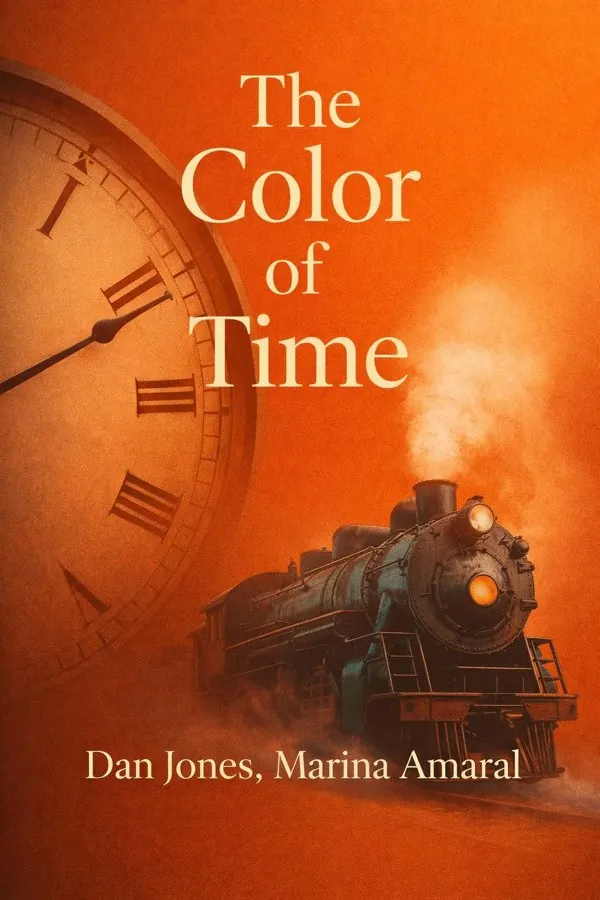
The Color of Time: A New History of the World, 1850–1960: Summary & Key Insights
 10 min9 chaptersAudio available
Key Takeaways from The Color of Time: A New History of the World, 1850–1960
A new way of seeing can change what a civilization remembers.
Civil war does more than split a nation; it forces a society to decide what kind of future it deserves.
Empires often present themselves as orderly, civilizing, and permanent; photographs help reveal the strain beneath that performance.
Modernity is not one event but a rising tempo.
Some eras look peaceful only in hindsight.
What Is The Color of Time: A New History of the World, 1850–1960 About?
The Color of Time: A New History of the World, 1850–1960 by Dan Jones, Marina Amaral is a world_history book spanning 9 pages. The Color of Time: A New History of the World, 1850–1960 is not a conventional history book. Instead of building its argument through long chapters and abstract analysis, it tells the story of the modern world through 200 colorized photographs that span war, empire, invention, migration, inequality, celebrity, labor, and everyday life. Historian Dan Jones supplies the context behind each image, while digital artist Marina Amaral restores them in color with painstaking attention to uniforms, skin tones, landscapes, fabrics, and historical accuracy. The result is striking: people who once looked distant and museum-bound suddenly feel contemporary, vulnerable, and real. What makes the book matter is its ability to collapse the emotional distance between past and present. Color does not merely beautify old photographs; it changes how we perceive them, reminding us that history was lived by human beings with ordinary faces, complicated identities, and immediate concerns. Jones and Amaral are particularly well suited to this project: one brings narrative clarity and global historical range, the other brings technical skill and visual sensitivity. Together, they offer a vivid, accessible, and surprisingly intimate history of a century that shaped the world we now inhabit.
This FizzRead summary covers all 9 key chapters of The Color of Time: A New History of the World, 1850–1960 in approximately 10 minutes, distilling the most important ideas, arguments, and takeaways from Dan Jones, Marina Amaral's work. Also available as an audio summary and Key Quotes Podcast.
The Color of Time: A New History of the World, 1850–1960
The Color of Time: A New History of the World, 1850–1960 is not a conventional history book. Instead of building its argument through long chapters and abstract analysis, it tells the story of the modern world through 200 colorized photographs that span war, empire, invention, migration, inequality, celebrity, labor, and everyday life. Historian Dan Jones supplies the context behind each image, while digital artist Marina Amaral restores them in color with painstaking attention to uniforms, skin tones, landscapes, fabrics, and historical accuracy. The result is striking: people who once looked distant and museum-bound suddenly feel contemporary, vulnerable, and real.
What makes the book matter is its ability to collapse the emotional distance between past and present. Color does not merely beautify old photographs; it changes how we perceive them, reminding us that history was lived by human beings with ordinary faces, complicated identities, and immediate concerns. Jones and Amaral are particularly well suited to this project: one brings narrative clarity and global historical range, the other brings technical skill and visual sensitivity. Together, they offer a vivid, accessible, and surprisingly intimate history of a century that shaped the world we now inhabit.
Who Should Read The Color of Time: A New History of the World, 1850–1960?
This book is perfect for anyone interested in world_history and looking to gain actionable insights in a short read. Whether you're a student, professional, or lifelong learner, the key ideas from The Color of Time: A New History of the World, 1850–1960 by Dan Jones, Marina Amaral will help you think differently.
- ✓Readers who enjoy world_history and want practical takeaways
- ✓Professionals looking to apply new ideas to their work and life
- ✓Anyone who wants the core insights of The Color of Time: A New History of the World, 1850–1960 in just 10 minutes
Want the full summary?
Get instant access to this book summary and 100K+ more with Fizz Moment.
Get Free SummaryAvailable on App Store • Free to download
Key Chapters
A new way of seeing can change what a civilization remembers. That is the central insight behind the opening decade of The Color of Time, which begins in the 1850s, when photography was still a young technology but already transforming how people documented the world. This was the age of steam power, urban expansion, industry, and imperial confidence. Until then, much of history had been mediated through painting, print, and memory. Photography introduced something different: a machine-made record that seemed immediate, democratic, and difficult to ignore.
Jones and Amaral show that early photographs were never just technical curiosities. They were tools of power, identity, and preservation. Images from mid-nineteenth-century Europe reveal crowded streets, formal portraits, industrial workers, and elites whose clothing and posture reflect emerging class divisions. Colorization intensifies this effect. Soot-dark buildings, military fabrics, pale winter skies, and flushed human faces make the era feel less like a fossilized prelude and more like the beginning of our own modern condition.
The chapter also reminds us that cameras do not simply capture reality; they frame it. Early photography often favored the monumental, the official, and the posed. Yet even within those constraints, it preserved details historians treasure: worn boots, rough hands, improvised furniture, and urban grime. Those details reveal how industrial modernity looked and felt on the ground.
A practical lesson follows. Whenever you encounter an image from any era, ask what new technology made it possible, who controlled that technology, and what it excludes as much as what it reveals. Photographs are evidence, but they are also choices.
Actionable takeaway: Use historical images actively, not passively. Train yourself to read them for class, labor, environment, and power, not just for surface beauty.
Civil war does more than split a nation; it forces a society to decide what kind of future it deserves. In the 1860s section, The Color of Time turns to the American Civil War, one of the earliest major conflicts to be extensively photographed. Here the book demonstrates how images can preserve both the scale of historical rupture and the intimate humanity of those caught inside it. Soldiers pose stiffly before battle, commanders cultivate authority, and the dead lie in landscapes made newly shocking by the realism of photography.
Colorization sharpens the moral and emotional stakes. Uniform blues and grays become more than textbook labels. Mud, blood, skin, smoke, and battlefield geography all gain a visceral clarity that reminds readers this was not a symbolic conflict but a brutally physical one. Jones pairs these images with concise historical framing: the war was about union, slavery, citizenship, and the reinvention of the United States. The camera made the conflict legible in a new way, carrying war into homes and public consciousness.
Just as important, the decade captures broader global redefinition. This was an era in which states were consolidating power, abolitionist struggles were reshaping political life, and modern nationalism was becoming increasingly forceful. Photographs from this period often look formal, but beneath the stillness lies upheaval.
For modern readers, the practical application is clear. Images of conflict should not be consumed as spectacle. They should be read alongside political causes, social structures, and the lives of ordinary participants. A photograph of a uniform means little without understanding what that person was fighting for or trapped within.
Actionable takeaway: When viewing images of war, always connect the face to the system behind it—ask what institutions, ideologies, and inequalities made the photograph possible.
Empires often present themselves as orderly, civilizing, and permanent; photographs help reveal the strain beneath that performance. In the 1870–1880 decade, The Color of Time widens its frame beyond the Atlantic world to examine imperial power in a global context. This was a period of expanding colonial rule, military display, diplomatic spectacle, and increasingly racialized hierarchies. Images from imperial settings can at first appear grand and composed, but Jones and Amaral encourage us to look more closely at what is being staged and what is being silenced.
Color matters enormously here. Colonial uniforms, ceremonial garments, desert landscapes, tropical vegetation, and architectural settings all gain specificity. That specificity undermines the flattening effect that black-and-white images often have on vastly different societies. People under empire stop appearing as interchangeable figures in a distant past and become culturally situated individuals. At the same time, the restored images make imperial pageantry more legible as theater: medals glitter, flags stand out, and the machinery of domination becomes visible rather than abstract.
This decade also demonstrates that photography traveled with empire. Cameras were carried by soldiers, explorers, administrators, and entrepreneurs. The resulting archive often reflected unequal power relations: who got documented, who remained anonymous, and who had the authority to label a scene. Yet these same photographs can now be read against the grain, offering evidence of resilience, adaptation, and local identity.
In practical terms, this chapter teaches visual skepticism. Historical images from colonial settings should never be taken at face value. Ask who commissioned the image, who is centered, who is exoticized, and what political purpose the image served.
Actionable takeaway: Treat photographs of empire as contested documents. Read them for domination and resistance at the same time.
Modernity is not one event but a rising tempo. The late nineteenth century, especially the 1880–1900 period, is presented in The Color of Time as an age of acceleration. Railways expanded, cities swelled, consumer culture widened, communication improved, and societies became more interconnected. The book’s images from this era show a world moving faster in body and mind: transportation networks, industrial workers, colonial encounters, public amusements, and emerging mass culture all suggest a planet being reorganized by speed.
What makes this section powerful is its balance between grandeur and ordinary life. It is easy to summarize the period through inventions and economic growth, but photographs remind us that acceleration was experienced unevenly. Some people inhabited electric streets and elegant interiors; others labored in mines, docks, factories, and fields. Colorization restores texture to these differences. Brick, steel, skin, cloth, smoke, and signage all help distinguish privilege from precarity.
Jones also implicitly argues that the roots of the twentieth century lie here. Bureaucracies become stronger, cities become denser, migration becomes more visible, and the contrast between optimism and exploitation becomes sharper. This is the age when modern life begins to feel familiar: crowds, infrastructure, advertisements, uniforms, and global circulation all move closer to our own reality.
A useful application for readers is to think of technological progress as layered rather than universally beneficial. Every leap in communication or transport creates winners, losers, disruptions, and new dependencies. Historical photographs can help us see those layers because they preserve both innovation and the human cost surrounding it.
Actionable takeaway: Whenever you encounter a story of progress, ask who benefited, who paid the price, and what visual evidence supports both sides.
Some eras look peaceful only in hindsight. The years from 1900 to 1914 are often remembered as a glittering prewar age, full of elegance, industry, optimism, and imperial confidence. The Color of Time captures that mood brilliantly, but it also reveals the fragility hiding beneath it. In these images, monarchs and politicians project stability, cities expand with confidence, and social rituals seem orderly. Yet Jones shows that this apparent calm existed alongside arms races, nationalist tensions, labor unrest, suffrage movements, and deep imperial competition.
Colorization gives the period unusual immediacy. Fashion, interiors, military dress, and urban spaces all feel less remote and more psychologically legible. The polished surfaces of the age become easier to read as surfaces. Splendor, in other words, can coexist with anxiety. A parade can signal pride and impending militarism. A grand portrait can suggest both prestige and insecurity. A crowded city scene can imply prosperity and social pressure at once.
This section is especially useful for understanding how historical turning points are rarely obvious to people living through them. Most individuals in 1910 did not know they were standing on the edge of mass industrial war. They went to work, married, campaigned, traveled, and posed for photographs as though the future were manageable.
The practical lesson is deeply relevant today. Periods of technological brilliance and economic integration can still contain hidden instabilities. Visual culture often reflects official confidence more readily than underlying tension, so readers must learn to interpret images contextually, not romantically.
Actionable takeaway: When a period appears prosperous and orderly, look for the unresolved pressures underneath—political, social, military, and economic—before calling it stable.
The First World War is often described in numbers—millions mobilized, millions dead, empires destroyed—but photographs return it to the scale of the human body. In the 1914–1918 section, The Color of Time demonstrates the emotional power of colorized war imagery. Trenches, artillery crews, nurses, refugees, officers, and exhausted infantrymen no longer look like relics from a distant monochrome world. They look frighteningly close to us.
This matters because abstraction can dull moral understanding. When war is remembered only through dates and statistics, it risks becoming impersonal. Jones counters that tendency by grounding each image in brief but forceful historical context. He reminds readers that the Great War was not just a European battlefield conflict. It was global, imperial, industrial, and social. Colonized troops served in imperial armies. Civilians were displaced. Technology amplified killing. Entire political orders began to crack.
Amaral’s colorization heightens the sensory reality of the war without sensationalizing it. Mud has weight, bandages have texture, uniforms have nation-specific identity, and faces reveal fatigue with unsettling clarity. The war ceases to be sepia legend and becomes recognizable suffering. Just as importantly, the images capture resilience: camaraderie, adaptation, care work, and endurance under pressure.
For readers today, this chapter offers a practical framework for approaching all large-scale crises. Never let scale erase people. Whether the subject is war, migration, famine, or pandemic, individual images can recover moral attention that broad narratives often lose.
Actionable takeaway: Pair every big historical statistic with at least one personal image or story. It is one of the most effective ways to keep empathy alive while studying complex events.
Recovery is never a clean reset. The decade from 1918 to 1930, often reduced to the phrase 'the Roaring Twenties,' appears in The Color of Time as a far more uneven and complicated era. Yes, there was innovation, new mass entertainment, cultural experimentation, political reinvention, and a striking appetite for pleasure after the trauma of war. But Jones also emphasizes that recovery unfolded amid grief, revolution, inflation, racial tension, unstable democracies, and unsettled empires.
The photographs in this section bring that contradiction into focus. You may see dancers, celebrities, athletes, political leaders, workers, and street scenes that suggest freshness and movement. Yet colorization complicates any simple story of liberation. It makes visible the material conditions of class, the seriousness behind public performance, and the fragility beneath glamour. The bright surfaces of the age can be read alongside prosthetics, poverty, damaged cities, and the political intensity of the postwar settlement.
One of the book’s strengths here is showing that modern culture became more global in both aspiration and circulation. Trends spread faster, public figures became more recognizable, and visual culture itself acquired new power. But social access to these changes remained deeply unequal. For some, the 1920s meant jazz, cinema, automobiles, and new freedoms. For others, it meant exclusion, repression, or simply trying to survive economic dislocation.
Readers can apply this insight whenever a historical period is packaged as a single mood. Labels like 'roaring' or 'golden' often describe the most visible minority, not the full social reality.
Actionable takeaway: Resist one-word summaries of eras. Ask whose experience defines the label and whose reality is left outside the frame.
Crisis reveals character, but it also reveals systems. The 1930–1945 section of The Color of Time spans depression, dictatorship, war, occupation, genocide, and resistance. It is one of the book’s heaviest portions, and also one of its most illuminating, because it shows how visual history can make both structural violence and individual courage more comprehensible. The images from these years are not merely illustrations of famous events; they are evidence of how ordinary people were drawn into extraordinary danger.
Colorization makes the era disturbingly immediate. Breadlines, uniforms, ruined streets, partisan fighters, civilian evacuees, and concentration camp victims all become harder to hold at a safe emotional distance. Jones’s concise commentary helps anchor each image in broader historical processes: economic collapse radicalized politics; authoritarian regimes mastered mass spectacle; racism and antisemitism were weaponized by the state; and the Second World War expanded into a global confrontation that reached homes, colonies, factories, and front lines alike.
Yet the section is not solely about victimhood. It also highlights resistance in many forms: military opposition, underground networks, cultural defiance, survival, witness, and stubborn dignity. The photographs remind us that courage is not always dramatic. Sometimes it is the act of enduring, documenting, hiding, feeding, or refusing.
A practical lesson emerges for readers navigating modern media. Images of suffering should move us beyond shock toward understanding. They gain meaning when linked to institutions, ideologies, propaganda, and policy. Otherwise, horror can become repetitive and numbing.
Actionable takeaway: When confronting visual evidence of injustice, take a second step: identify the beliefs, laws, and systems that produced what you are seeing.
The postwar world did not simply emerge from rubble; it was consciously built, argued over, and imagined. In the final decade cluster, 1945–1960, The Color of Time traces reconstruction after World War II and the early formation of the contemporary world. The images show bombed cities being restored, political leaders reshaping alliances, families resettling, former colonies pushing toward independence, and consumer modernity expanding across many societies. This is the moment when television, suburban design, Cold War imagery, youth culture, and international institutions begin to define everyday expectations.
Colorization is especially effective here because the period already feels almost familiar. Once restored, the distance between 'history' and 'now' narrows dramatically. Cars, hairstyles, storefronts, household interiors, military technology, and public ceremonies look recognizably modern. That visual closeness reinforces one of the book’s broader arguments: the world after 1945 is not ancient prehistory but the direct foundation of contemporary politics, identity, and culture.
Jones also avoids telling a triumphalist story. Reconstruction brought hope, but it also entrenched new tensions. The Cold War imposed fear and ideological division. Decolonization produced liberation and conflict. Economic growth benefited many while leaving inequalities intact. The photographs invite readers to see the postwar era as both renewal and unfinished business.
This chapter has a practical application for understanding present-day institutions. Many assumptions we consider normal—human rights discourse, superpower rivalry, global media, development policy, and mass consumer aspiration—were shaped decisively in this era.
Actionable takeaway: To understand the present, trace one familiar aspect of your daily life back to 1945–1960 and study the historical choices that made it seem normal.
All Chapters in The Color of Time: A New History of the World, 1850–1960
About the Authors
Dan Jones is a British historian, journalist, broadcaster, and bestselling author known for making complex history engaging for wide audiences. His work spans medieval and modern subjects, and he has built a reputation for combining narrative energy with strong historical grounding. Marina Amaral is a Brazilian digital artist celebrated for her historically researched colorizations of archival photographs. Her process blends artistic skill with careful attention to authentic uniforms, skin tones, landscapes, and material details, allowing viewers to encounter the past with unusual immediacy. In The Color of Time, their talents complement each other perfectly: Jones supplies concise, globally minded historical context, while Amaral transforms monochrome images into vivid visual encounters. Together, they create a work that is both educational and emotionally resonant.
Get This Summary in Your Preferred Format
Read or listen to the The Color of Time: A New History of the World, 1850–1960 summary by Dan Jones, Marina Amaral anytime, anywhere. FizzRead offers multiple formats so you can learn on your terms — all free.
Available formats: App · Audio · PDF · EPUB — All included free with FizzRead
Download The Color of Time: A New History of the World, 1850–1960 PDF and EPUB Summary
Key Quotes from The Color of Time: A New History of the World, 1850–1960
“A new way of seeing can change what a civilization remembers.”
“Civil war does more than split a nation; it forces a society to decide what kind of future it deserves.”
“Empires often present themselves as orderly, civilizing, and permanent; photographs help reveal the strain beneath that performance.”
“Modernity is not one event but a rising tempo.”
“Some eras look peaceful only in hindsight.”
Frequently Asked Questions about The Color of Time: A New History of the World, 1850–1960
The Color of Time: A New History of the World, 1850–1960 by Dan Jones, Marina Amaral is a world_history book that explores key ideas across 9 chapters. The Color of Time: A New History of the World, 1850–1960 is not a conventional history book. Instead of building its argument through long chapters and abstract analysis, it tells the story of the modern world through 200 colorized photographs that span war, empire, invention, migration, inequality, celebrity, labor, and everyday life. Historian Dan Jones supplies the context behind each image, while digital artist Marina Amaral restores them in color with painstaking attention to uniforms, skin tones, landscapes, fabrics, and historical accuracy. The result is striking: people who once looked distant and museum-bound suddenly feel contemporary, vulnerable, and real. What makes the book matter is its ability to collapse the emotional distance between past and present. Color does not merely beautify old photographs; it changes how we perceive them, reminding us that history was lived by human beings with ordinary faces, complicated identities, and immediate concerns. Jones and Amaral are particularly well suited to this project: one brings narrative clarity and global historical range, the other brings technical skill and visual sensitivity. Together, they offer a vivid, accessible, and surprisingly intimate history of a century that shaped the world we now inhabit.
You Might Also Like
The Age of Capital
Eric Hobsbawm
10 min
The Gulag Archipelago
Aleksandr Solzhenitsyn
10 min
Jerusalem: The Biography
Simon Sebag Montefiore
10 min
The Anglo-Saxons
James Campbell
10 min
The Boer War
Thomas Pakenham
10 min
The Industrial Revolutionaries: The Making of the Modern World 1776–1914
Gavin Weightman
10 minBrowse by Category
Ready to read The Color of Time: A New History of the World, 1850–1960?
Get the full summary and 100K+ more books with Fizz Moment.