
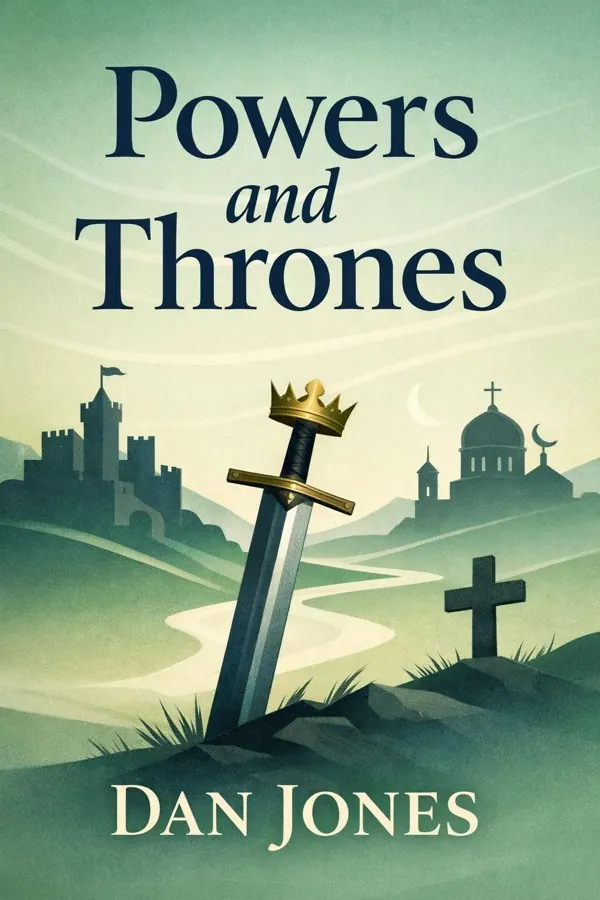
Powers and Thrones: A New History of the Middle Ages: Summary & Key Insights
by Dan Jones
 10 min12 chaptersAudio available
What Is Powers and Thrones: A New History of the Middle Ages About?
Powers and Thrones: A New History of the Middle Ages by Dan Jones is a world_history book spanning 12 pages. Powers and Thrones is a sweeping narrative history of the Middle Ages, spanning from the fall of the Roman Empire to the dawn of the Renaissance. Dan Jones explores how warlords, kings, popes, and ordinary people shaped a thousand years of European history, tracing the rise and fall of empires, the spread of Christianity and Islam, and the birth of modern institutions. The book presents the medieval world as a dynamic and transformative era that laid the foundations for the modern West.
This FizzRead summary covers all 12 key chapters of Powers and Thrones: A New History of the Middle Ages in approximately 10 minutes, distilling the most important ideas, arguments, and takeaways from Dan Jones's work. Also available as an audio summary and Key Quotes Podcast.
Powers and Thrones: A New History of the Middle Ages
Powers and Thrones is a sweeping narrative history of the Middle Ages, spanning from the fall of the Roman Empire to the dawn of the Renaissance. Dan Jones explores how warlords, kings, popes, and ordinary people shaped a thousand years of European history, tracing the rise and fall of empires, the spread of Christianity and Islam, and the birth of modern institutions. The book presents the medieval world as a dynamic and transformative era that laid the foundations for the modern West.
Who Should Read Powers and Thrones: A New History of the Middle Ages?
This book is perfect for anyone interested in world_history and looking to gain actionable insights in a short read. Whether you're a student, professional, or lifelong learner, the key ideas from Powers and Thrones: A New History of the Middle Ages by Dan Jones will help you think differently.
- ✓Readers who enjoy world_history and want practical takeaways
- ✓Professionals looking to apply new ideas to their work and life
- ✓Anyone who wants the core insights of Powers and Thrones: A New History of the Middle Ages in just 10 minutes
Want the full summary?
Get instant access to this book summary and 100K+ more with Fizz Moment.
Get Free SummaryAvailable on App Store • Free to download
Key Chapters
When the Western Roman Empire crumbled in the fifth century, it seemed as though the world itself were falling apart. Cities that had stood for centuries fell silent; roads broke down; aqueducts went dry. From the frontiers, wave after wave of migrants — Goths, Vandals, Huns — pressed into the heart of Europe. Yet to see this merely as collapse is to miss the extraordinary processes of re‑creation that followed. In the ruins of imperial government, local powers emerged. Roman law lingered alongside new tribal codes; Christianity offered unity where politics faltered. Out of that chaos was born the Europe we would come to recognize: fragmented but fertile, unsteady but alive.
As an historian, I wanted to capture this paradox. The imperial world of Rome did not vanish; its bones remained underfoot — in roads, fortresses, language, and law. What changed was who commanded those tools and how they were used. Local lords and bishops became the new keepers of power. The old bureaucracy gave way to personal bonds of loyalty, and Europe shifted from empire to network. The age of universal rule was replaced by one of patchwork sovereignties, each trying to imitate the grandeur Rome had left behind.
Throughout the early Middle Ages, new kingdoms took shape across the former Roman West. The Franks under Clovis, the Ostrogoths in Italy, the Visigoths in Spain, the Anglo‑Saxons in England — each absorbed Roman habits while stamping their own cultural signatures upon them. These were not mere barbarian conquerors but builders of hybrid societies. Latin endured as the language of church and law; Roman Christianity became the common spiritual bond. Yet Germanic traditions of kinship, loyalty, and warrior honor infused political life with a raw vigor that Rome had long since lost.
This fusion produced a Europe distinct from anything before: Christian in faith, Germanic in spirit, and deeply local in its loyalties. Kings ruled not by imperial decree but by mutual obligation. Power was personal and ritualized, displayed in oaths and gifts. I wanted to convey how these early medieval centuries were creative rather than merely destructive. In the modest courts of Merovingian Gaul or Lombard Italy, we see the embers of a new civilization beginning to glow.
+ 10 more chapters — available in the FizzRead app
All Chapters in Powers and Thrones: A New History of the Middle Ages
About the Author
Dan Jones is a British historian, journalist, and television presenter known for his engaging works on medieval and early modern history. He has authored several bestselling books, including The Plantagenets and The Templars, and has presented historical documentaries for major broadcasters such as Channel 5 and Netflix.
Get This Summary in Your Preferred Format
Read or listen to the Powers and Thrones: A New History of the Middle Ages summary by Dan Jones anytime, anywhere. FizzRead offers multiple formats so you can learn on your terms — all free.
Available formats: App · Audio · PDF · EPUB — All included free with FizzRead
Download Powers and Thrones: A New History of the Middle Ages PDF and EPUB Summary
Key Quotes from Powers and Thrones: A New History of the Middle Ages
“When the Western Roman Empire crumbled in the fifth century, it seemed as though the world itself were falling apart.”
“Throughout the early Middle Ages, new kingdoms took shape across the former Roman West.”
Frequently Asked Questions about Powers and Thrones: A New History of the Middle Ages
Powers and Thrones: A New History of the Middle Ages by Dan Jones is a world_history book that explores key ideas across 12 chapters. Powers and Thrones is a sweeping narrative history of the Middle Ages, spanning from the fall of the Roman Empire to the dawn of the Renaissance. Dan Jones explores how warlords, kings, popes, and ordinary people shaped a thousand years of European history, tracing the rise and fall of empires, the spread of Christianity and Islam, and the birth of modern institutions. The book presents the medieval world as a dynamic and transformative era that laid the foundations for the modern West.
More by Dan Jones
You Might Also Like
The Age of Capital
Eric Hobsbawm
10 min
The Gulag Archipelago
Aleksandr Solzhenitsyn
10 min
Jerusalem: The Biography
Simon Sebag Montefiore
10 min
The Anglo-Saxons
James Campbell
10 min
The Boer War
Thomas Pakenham
10 min
The Industrial Revolutionaries: The Making of the Modern World 1776–1914
Gavin Weightman
10 minBrowse by Category
Ready to read Powers and Thrones: A New History of the Middle Ages?
Get the full summary and 100K+ more books with Fizz Moment.