
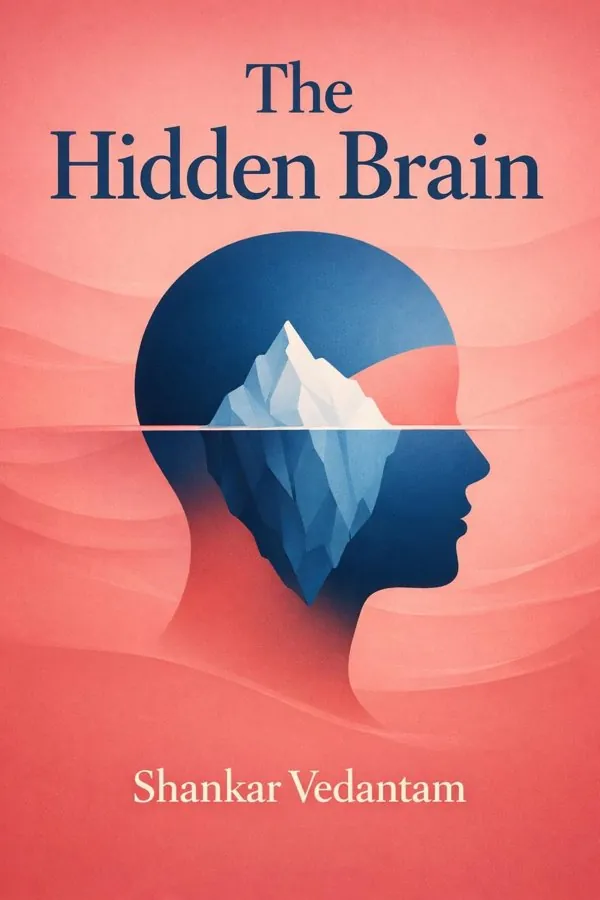
The Hidden Brain: How Our Unconscious Minds Elect Presidents, Control Markets, Wage Wars, and Save Our Lives: Summary & Key Insights
 10 min8 chaptersAudio available
What Is The Hidden Brain: How Our Unconscious Minds Elect Presidents, Control Markets, Wage Wars, and Save Our Lives About?
The Hidden Brain: How Our Unconscious Minds Elect Presidents, Control Markets, Wage Wars, and Save Our Lives by Shankar Vedantam is a cognition book spanning 8 pages. The Hidden Brain explores the powerful influence of unconscious biases and hidden mental processes on human behavior, decision-making, and social interactions. Shankar Vedantam uses research from psychology, neuroscience, and sociology to reveal how unseen mental patterns shape our choices in politics, business, and personal life.
This FizzRead summary covers all 8 key chapters of The Hidden Brain: How Our Unconscious Minds Elect Presidents, Control Markets, Wage Wars, and Save Our Lives in approximately 10 minutes, distilling the most important ideas, arguments, and takeaways from Shankar Vedantam's work. Also available as an audio summary and Key Quotes Podcast.
The Hidden Brain: How Our Unconscious Minds Elect Presidents, Control Markets, Wage Wars, and Save Our Lives
The Hidden Brain explores the powerful influence of unconscious biases and hidden mental processes on human behavior, decision-making, and social interactions. Shankar Vedantam uses research from psychology, neuroscience, and sociology to reveal how unseen mental patterns shape our choices in politics, business, and personal life.
Who Should Read The Hidden Brain: How Our Unconscious Minds Elect Presidents, Control Markets, Wage Wars, and Save Our Lives?
This book is perfect for anyone interested in cognition and looking to gain actionable insights in a short read. Whether you're a student, professional, or lifelong learner, the key ideas from The Hidden Brain: How Our Unconscious Minds Elect Presidents, Control Markets, Wage Wars, and Save Our Lives by Shankar Vedantam will help you think differently.
- ✓Readers who enjoy cognition and want practical takeaways
- ✓Professionals looking to apply new ideas to their work and life
- ✓Anyone who wants the core insights of The Hidden Brain: How Our Unconscious Minds Elect Presidents, Control Markets, Wage Wars, and Save Our Lives in just 10 minutes
Want the full summary?
Get instant access to this book summary and 100K+ more with Fizz Moment.
Get Free SummaryAvailable on App Store • Free to download
Key Chapters
Automatic thinking is the mind’s shorthand system — efficient, adaptive, and, often, dangerously imprecise. In the laboratory, psychologists have demonstrated that we make judgements about people within milliseconds based on features like facial symmetry, skin tone, or resemblance to familiar archetypes. These quick assessments are products of ancient neural circuits that evolved to protect us, yet they often generate bias. Implicit bias operates outside conscious awareness; it does not announce itself as prejudice but hides beneath ordinary perception. In one study, participants who claimed to value equality unconsciously associated whiteness with competence and blackness with threat. They were not lying; their hidden brains were quietly imposing associations learned from culture, media, and past experiences.
When we rely on automatic decision-making, we experience the illusion of neutrality. We imagine we are responding to facts when, in reality, we are responding to patterns the brain constructs without permission. This is why hiring committees, jurors, and even police officers sometimes make choices that contradict their stated values. The unconscious mind interprets data through lenses that have been shaped long before the conscious mind was consulted.
But understanding implicit bias is not about guilt; it is about power. The more we recognize how unexamined assumptions steer our judgments, the better we can correct for them. When I see how physiological arousal or facial cues influence perception, I realize that true fairness begins with self-awareness. Every time we slow down, question our intuitions, or deliberately imagine perspectives beyond our instinctive frame, we loosen the hidden brain’s grip.
Politics, perhaps more than any other human enterprise, reveals how voters respond to symbols rather than substance. The hidden brain prefers simplicity and emotional resonance. When faced with a choice between candidates, people claim to analyze platforms and issues, yet studies of electoral behavior consistently show the power of unconscious processes. In one study, subjects who glanced at photographs of unfamiliar faces for less than a second were able to predict electoral outcomes with surprising accuracy. They didn’t know the candidates or their ideologies; they judged who looked competent or trustworthy — judgments manufactured by the hidden brain.
The emotional shortcuts our minds use were valuable for tribal survival; they told us whom to trust and follow. But in a democratic society, these same shortcuts can distort political outcomes. When imagery, charisma, or even voice tone can outweigh policy knowledge, we must ask whether our political freedom is as rational as we imagine. The unconscious does not merely influence individuals; it scales up to societies. Campaign strategists understand this intuitively — they design messages to trigger fear, belonging, and identity rather than deliberation.
As we become aware of this, we realize that reasoned citizenship requires vigilance against instinct. The best remedy is not cynicism but curiosity: pausing before we react, investigating what emotions underlie our preferences, and learning to distinguish authentic conviction from reflex. By seeing the hidden hand behind political persuasion, we reclaim agency from the automatic brain.
+ 6 more chapters — available in the FizzRead app
All Chapters in The Hidden Brain: How Our Unconscious Minds Elect Presidents, Control Markets, Wage Wars, and Save Our Lives
About the Author
Shankar Vedantam is an American journalist, writer, and science correspondent known for his work on human behavior and social science. He is the host of the popular NPR podcast 'Hidden Brain' and has written extensively about the intersection of psychology and everyday life.
Get This Summary in Your Preferred Format
Read or listen to the The Hidden Brain: How Our Unconscious Minds Elect Presidents, Control Markets, Wage Wars, and Save Our Lives summary by Shankar Vedantam anytime, anywhere. FizzRead offers multiple formats so you can learn on your terms — all free.
Available formats: App · Audio · PDF · EPUB — All included free with FizzRead
Download The Hidden Brain: How Our Unconscious Minds Elect Presidents, Control Markets, Wage Wars, and Save Our Lives PDF and EPUB Summary
Key Quotes from The Hidden Brain: How Our Unconscious Minds Elect Presidents, Control Markets, Wage Wars, and Save Our Lives
“Automatic thinking is the mind’s shorthand system — efficient, adaptive, and, often, dangerously imprecise.”
“Politics, perhaps more than any other human enterprise, reveals how voters respond to symbols rather than substance.”
Frequently Asked Questions about The Hidden Brain: How Our Unconscious Minds Elect Presidents, Control Markets, Wage Wars, and Save Our Lives
The Hidden Brain: How Our Unconscious Minds Elect Presidents, Control Markets, Wage Wars, and Save Our Lives by Shankar Vedantam is a cognition book that explores key ideas across 8 chapters. The Hidden Brain explores the powerful influence of unconscious biases and hidden mental processes on human behavior, decision-making, and social interactions. Shankar Vedantam uses research from psychology, neuroscience, and sociology to reveal how unseen mental patterns shape our choices in politics, business, and personal life.
You Might Also Like
A Field Guide to Lies: Critical Thinking in the Information Age
Daniel J. Levitin
10 min
A Theory of Cognitive Dissonance
Leon Festinger
10 min
Black-And-White Thinking: The Burden of a Binary Brain in a Complex World
Kevin Dutton
10 min
Born Liars: Why We Can’t Live Without Deceit
Ian Leslie
10 min
Collective Illusions: Conformity, Complicity, and the Science of Why We Make Bad Decisions
Todd Rose
10 min
Concrete Mathematics: A Foundation for Computer Science
Ronald L. Graham, Donald E. Knuth, Oren Patashnik
10 minBrowse by Category
Ready to read The Hidden Brain: How Our Unconscious Minds Elect Presidents, Control Markets, Wage Wars, and Save Our Lives?
Get the full summary and 100K+ more books with Fizz Moment.