
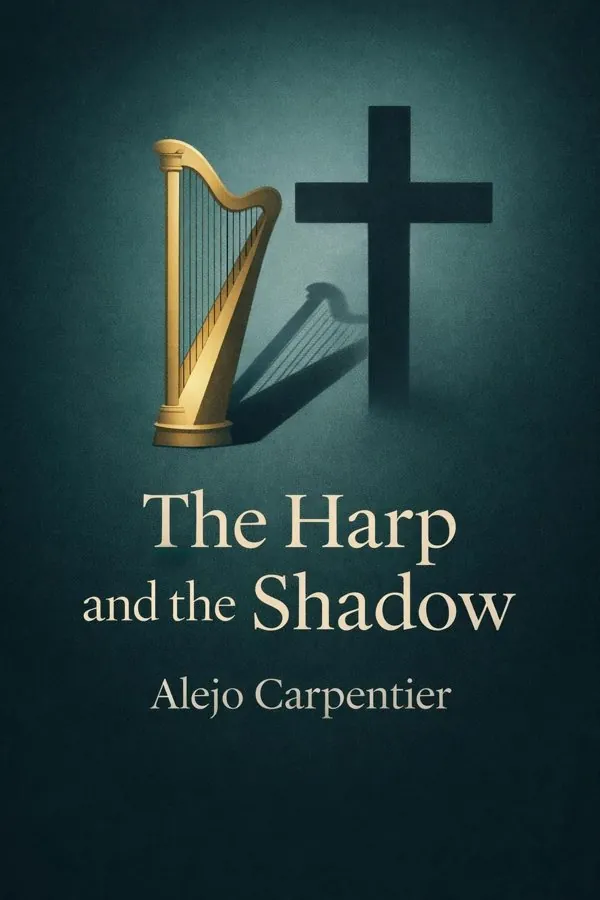
The Harp and the Shadow: Summary & Key Insights
 10 min9 chaptersAudio available
Key Takeaways from The Harp and the Shadow
Holiness can become most suspicious precisely when it is staged with too much grandeur.
A dead man may tell the truth more freely than a monument ever can.
What if the most world-changing journey in history was also a voyage into illusion?
Civilizations rarely preserve the past as it was; they preserve it as they need it to be.
The most enduring empires are often those that convince themselves they are serving heaven.
What Is The Harp and the Shadow About?
The Harp and the Shadow by Alejo Carpentier is a world_history book spanning 3 pages. What happens when one of history’s most celebrated figures is stripped of ceremony, legend, and patriotic reverence? In The Harp and the Shadow, Alejo Carpentier answers that question by revisiting Christopher Columbus not as a heroic icon, but as a contested invention of religion, empire, and memory. First published in 1978, this daring historical novel imagines the Vatican’s attempt to canonize Columbus under Pope Pius IX, then turns to Columbus’s own ghostly confession, and finally reexamines the voyage that transformed the world. The result is not a conventional historical retelling, but a profound meditation on how civilizations create saints, hide violence behind noble language, and confuse myth with truth. The book matters because it challenges one of the foundational narratives of Western history: the idea of “discovery” as a pure, civilizing achievement. Carpentier, one of Latin America’s great literary innovators, brings extraordinary authority to this task through his deep knowledge of history, culture, politics, and baroque narrative form. His novel is both intellectually rich and artistically bold, inviting readers to question official histories and to see how power reshapes the past into something useful, flattering, and sacred.
This FizzRead summary covers all 9 key chapters of The Harp and the Shadow in approximately 10 minutes, distilling the most important ideas, arguments, and takeaways from Alejo Carpentier's work. Also available as an audio summary and Key Quotes Podcast.
The Harp and the Shadow
What happens when one of history’s most celebrated figures is stripped of ceremony, legend, and patriotic reverence? In The Harp and the Shadow, Alejo Carpentier answers that question by revisiting Christopher Columbus not as a heroic icon, but as a contested invention of religion, empire, and memory. First published in 1978, this daring historical novel imagines the Vatican’s attempt to canonize Columbus under Pope Pius IX, then turns to Columbus’s own ghostly confession, and finally reexamines the voyage that transformed the world. The result is not a conventional historical retelling, but a profound meditation on how civilizations create saints, hide violence behind noble language, and confuse myth with truth.
The book matters because it challenges one of the foundational narratives of Western history: the idea of “discovery” as a pure, civilizing achievement. Carpentier, one of Latin America’s great literary innovators, brings extraordinary authority to this task through his deep knowledge of history, culture, politics, and baroque narrative form. His novel is both intellectually rich and artistically bold, inviting readers to question official histories and to see how power reshapes the past into something useful, flattering, and sacred.
Who Should Read The Harp and the Shadow?
This book is perfect for anyone interested in world_history and looking to gain actionable insights in a short read. Whether you're a student, professional, or lifelong learner, the key ideas from The Harp and the Shadow by Alejo Carpentier will help you think differently.
- ✓Readers who enjoy world_history and want practical takeaways
- ✓Professionals looking to apply new ideas to their work and life
- ✓Anyone who wants the core insights of The Harp and the Shadow in just 10 minutes
Want the full summary?
Get instant access to this book summary and 100K+ more with Fizz Moment.
Get Free SummaryAvailable on App Store • Free to download
Key Chapters
Holiness can become most suspicious precisely when it is staged with too much grandeur. In the first part of The Harp and the Shadow, Carpentier places us inside the Vatican, where Pope Pius IX contemplates advancing Christopher Columbus toward sainthood. The setting is solemn, ceremonial, and draped in spiritual authority, yet beneath the sacred language lies something far more earthly: politics. Carpentier shows that canonization is not merely a religious judgment about virtue; it can also be a cultural project, a symbolic act through which institutions shape collective memory.
By focusing on Pope Pius IX, the novel reveals how the Church responds to modern crises by turning to powerful historical symbols. Columbus becomes useful not because his life was unquestionably saintly, but because he represents evangelization, expansion, and a dramatic fusion of faith with world-changing action. In this way, sanctity is shown as something negotiated, narrated, and strategically framed. The Vatican chambers become a theater in which religious authority and historical myth collaborate.
This idea extends well beyond the Church. Modern societies also canonize people through museums, holidays, schoolbooks, films, and monuments. National founders, military leaders, and activists are often simplified until their contradictions disappear. Carpentier invites us to ask: who benefits when complexity is replaced by reverence? Which flaws are ignored so that a usable legend can survive?
A practical way to apply this insight is to examine any celebrated historical figure through multiple lenses: official praise, private motive, historical consequence, and excluded voices. When institutions present a hero as morally pure, that is often the moment to look closer. Actionable takeaway: whenever a society turns a person into a symbol, ask not only whether the story is inspiring, but also what realities that story is designed to conceal.
A dead man may tell the truth more freely than a monument ever can. In the second part, “The Shadow,” Carpentier gives Columbus a voice from beyond the grave. This is one of the novel’s most powerful moves: instead of letting historians, priests, or patriots define him, Carpentier allows Columbus himself to speak in a restless, spectral confession. The result is not vindication, but exposure. The heroic discoverer becomes a conflicted, ambitious, self-justifying, deeply human figure.
Columbus’s ghost recalls his dreams, calculations, deceptions, and desires. He is not a simple villain, nor a noble martyr, but a man consumed by status, recognition, wealth, and divine rhetoric. Carpentier uses this voice to dismantle the polished image of Columbus as a pure instrument of providence. The ghost reveals how self-interest and spiritual language often travel together. He wants glory, titles, legitimacy, and remembrance, even as he cloaks his aims in religious mission.
This section matters because it demonstrates how history often sanitizes interior life. Public narratives celebrate outcomes; confessions reveal motives. In everyday terms, we see similar distortions when leaders present ambitious projects as selfless service, or when organizations describe expansion as moral necessity rather than strategic advantage. A company may call a market takeover “innovation,” just as an empire may call conquest “civilization.”
Carpentier’s technique also reminds us that self-testimony is never neutral. Even a confession can be selective, defensive, and theatrical. Columbus speaks, but he also performs. Readers must therefore listen critically, not submissively.
Actionable takeaway: when evaluating influential figures, distinguish between image, intention, and consequence. Listen for what people say about themselves, but compare it with what they did, whom they harmed, and how others experienced their actions.
What if the most world-changing journey in history was also a voyage into illusion? In the final part, “The Discovery,” Carpentier returns to the crossing itself, but he does not present it as a straightforward adventure story. Instead, the voyage becomes metaphysical: a journey shaped by desire, projection, misunderstanding, and the human urge to name what one cannot truly comprehend. “Discovery” is exposed as less an objective event than an interpretive act, a way of imposing meaning onto unknown worlds.
Carpentier destabilizes the triumphant language usually attached to 1492. Columbus did not simply reveal a blank space on the map. He arrived carrying expectations, religious fantasies, classical references, and imperial ambitions. He saw through inherited ideas before he saw clearly through experience. In that sense, the voyage was not only across the Atlantic, but into the limits of European perception. The New World was filtered through old symbols.
This insight has wide relevance. People still “discover” places, cultures, and communities by interpreting them through preexisting assumptions. Travelers, journalists, diplomats, and even scholars can mistake their own categories for reality. For example, a visitor to another country may describe it only in terms familiar to home, never noticing what resists easy comparison. The same happens in business and politics when leaders enter a new region believing they already understand it.
Carpentier transforms exploration into a philosophical problem: can we ever encounter something new without immediately distorting it? His answer is not optimistic, but it is clarifying. To see the world honestly, one must first recognize the frameworks one brings to it.
Actionable takeaway: before claiming to understand a place, culture, or event, identify the assumptions you are carrying with you. Real discovery begins when interpretation becomes self-aware.
Civilizations rarely preserve the past as it was; they preserve it as they need it to be. One of Carpentier’s central achievements in The Harp and the Shadow is to show how myth transforms history into moral theater. In this theater, characters are assigned simple roles: hero, saint, pioneer, civilizer, martyr. Ambiguity is unwelcome because myth functions best when it offers emotional clarity and political usefulness.
Christopher Columbus becomes the ideal subject for this process. His life sits at the intersection of religion, empire, commerce, and historical rupture. That makes him difficult to explain honestly but very attractive to simplify. Carpentier traces how official culture elevates him into a symbol of destiny and spiritual mission, even though the actual historical figure was entangled in vanity, opportunism, error, and exploitation. Myth does not merely decorate his story; it reorganizes it.
This idea helps readers understand how national memory works. School curricula often highlight grand achievement while minimizing brutality. Public commemorations favor cohesion over truth. Even in contemporary media, major figures are frequently reduced to inspirational shorthand. An entrepreneur becomes a visionary without labor abuses; a political leader becomes a liberator without authoritarian habits. Myth is efficient because it spares us from wrestling with contradiction.
Carpentier does not argue that societies can live without symbols. Rather, he warns that symbols become dangerous when they erase responsibility. A culture that mythologizes its origins often protects itself from moral examination. The result is not pride, but immaturity.
A practical application is to revisit familiar historical narratives and ask what has been edited out. Whose suffering disappears when a founding myth is celebrated? What uncomfortable details have been declared irrelevant? Actionable takeaway: whenever a historical story feels too clean, treat that cleanliness as evidence that myth has replaced honest memory.
The most enduring empires are often those that convince themselves they are serving heaven. Carpentier’s novel explores the intimate alliance between religious language and imperial ambition. Columbus’s voyages are framed not only as geographic expansion, but also as Christian mission. Likewise, the Vatican’s interest in his sanctification reveals how spiritual authority can reinforce political narratives long after the original events have passed.
This does not mean religion is presented as merely cynical propaganda. Carpentier is more subtle than that. He shows that people can sincerely believe they are acting in service of God while participating in systems of domination. That is precisely what makes the fusion of faith and power so potent. Moral certainty allows conquest to appear righteous, and institutional blessing grants worldly ambition a sacred glow.
The pattern is historically familiar. Colonial projects have often marched alongside missionary rhetoric, legal doctrine, and civilizing claims. Even in secular times, the structure persists: governments describe military intervention as liberation, corporations describe extraction as development, and political movements invoke destiny to avoid scrutiny. The language changes, but the mechanism remains the same. A noble cause can provide cover for unequal power.
Carpentier’s insight is useful because it teaches readers not to judge institutions only by ideals, but by the systems those ideals support. Whenever a powerful entity presents expansion as moral duty, skepticism is necessary. Ask who gains authority, who loses autonomy, and who is expected to accept the story as benevolent.
In personal life, the same logic can apply on a smaller scale. Managers, leaders, and public figures may justify self-serving decisions as necessary for a greater good. Intentions matter, but outcomes matter more.
Actionable takeaway: when moral language accompanies the expansion of power, examine the material consequences. The surest test of a “sacred” mission is not its rhetoric, but whom it protects and whom it subordinates.
Sometimes a lavish style is not decorative at all, but diagnostic. Carpentier’s famously baroque prose is essential to understanding The Harp and the Shadow. His long, ornate, layered sentences do more than create atmosphere; they mirror the excess, contradiction, and theatricality of the historical worlds he depicts. In a novel about ceremony, empire, sainthood, and myth, a stripped-down style would miss the point. The language itself must overflow because the culture it describes overflows with symbols, rituals, and self-justifying grandeur.
The baroque mode allows Carpentier to stage history as spectacle while simultaneously critiquing that spectacle. The Vatican’s ritual magnificence, Columbus’s self-dramatization, and the epic aura surrounding discovery are all conveyed through rich verbal architecture. Yet the abundance of language also exposes instability. Beneath splendor lies anxiety; beneath rhetoric lies appetite; beneath ornament lies decay. The style seduces and interrogates at the same time.
For readers, this offers an important lesson in form. How a story is told can be part of what it means. In modern life, presentation often shapes truth claims. Political speeches, brand campaigns, museum exhibits, and documentaries all use aesthetic choices to guide interpretation. A polished presentation can imply legitimacy even when the substance is questionable. Carpentier makes us attentive to this dynamic.
A useful application is to notice when language becomes inflated around power. Excessive formality, grand narratives, moral pageantry, and symbolic abundance may indicate that something is being elevated beyond ordinary scrutiny. This does not mean rejecting beauty or eloquence. It means asking what those qualities are doing.
Actionable takeaway: pay attention not only to content, but to style. When language grows ceremonial or magnificent, ask whether it is illuminating reality or helping to disguise it.
Every celebrated historical narrative carries with it a quieter archive of omissions. In The Harp and the Shadow, Carpentier focuses on Columbus and the institutions that elevate him, but one of the novel’s most important implications concerns those who are pushed to the margins. When history centers the explorer, the pope, and the imperial mission, countless other perspectives fade: Indigenous peoples, the colonized, the enslaved, and those whose worlds were violently transformed by “discovery.”
Carpentier does not solve this silence by pretending fully to restore every missing voice. Instead, he makes readers feel the violence of the official narrative itself. By showing how Columbus is mythologized, he reveals the structure through which alternative experiences are displaced. The book becomes not only a critique of one man, but of historical storytelling as a hierarchy of attention.
This matters deeply in world history. Major events are often remembered from the viewpoint of expansion rather than impact. Textbooks may ask what explorers found rather than what populations lost. Public holidays may honor beginnings that were, for others, catastrophes. Carpentier pushes readers to understand that memory is political because inclusion is political.
This idea remains practical today. In workplaces, families, and institutions, dominant narratives often reflect the perspective of those with authority. A successful merger may be told as innovation by executives and as displacement by employees. A city redevelopment project may be praised as progress by planners and experienced as erasure by residents.
The responsible reader, then, must ask who is absent whenever a story becomes too centered on a single triumphant point of view. Actionable takeaway: after learning the official version of any major event, deliberately seek the accounts of those who bore its costs. History becomes more truthful when the margins are treated as central evidence.
Great historical actors are often great narrators of themselves. Carpentier presents Columbus as a master of self-invention: a man who understands that authority can be created through language, performance, and persistence. He is not merely an explorer crossing oceans; he is also an ambitious strategist crafting an identity worthy of patronage, prestige, and immortality. This makes him modern in a striking way.
Columbus’s achievements cannot be separated from his talent for persuasion. He must convince monarchs, justify setbacks, reinterpret failures, and present uncertain ventures as providential destiny. Carpentier’s portrait emphasizes that history is not made only by action, but by storytelling. Columbus survives, rises, and endures because he knows how to frame himself as necessary.
That insight resonates today in politics, entrepreneurship, media, and personal branding. Public life often rewards those who can package their ambition as mission. Leaders attract support by presenting private desire as collective benefit. Career success may depend not just on competence, but on the ability to narrate one’s work convincingly. Carpentier helps readers see both the power and danger of this skill.
The danger is that self-invention can detach reputation from ethics. A compelling story about one’s purpose can overshadow the real effects of one’s actions. Columbus imagines himself as chosen, visionary, and indispensable. The world-changing consequences of his voyages then get filtered through that self-image, making critique harder.
A practical lesson is to separate charisma from credibility. When someone presents a grand identity—visionary founder, national savior, moral reformer—ask what evidence supports the claim and who benefits from believing it. Personal narrative is powerful, but it is never enough.
Actionable takeaway: admire persuasive vision if you must, but test it against accountability. The more skillfully someone tells their own heroic story, the more carefully you should examine the human cost behind it.
One mark of maturity is the ability to admire human achievement without surrendering to innocence about its costs. The Harp and the Shadow is a profoundly ironic novel, and that irony is not mere wit. It is a method of historical understanding. Carpentier uses irony to puncture inflated narratives, expose contradictions, and remind readers that noble words often coexist with troubling realities.
In the novel, canonization efforts become tinged with absurdity, Columbus’s grandeur becomes haunted by vanity, and the language of discovery is shadowed by violence and misunderstanding. Irony allows Carpentier to hold multiple truths together: Columbus was undeniably consequential, yet morally compromised; the Church speaks of sanctity, yet acts within politics; history produces real transformation, yet explains it through fictions. Without irony, these complexities would collapse into propaganda or denunciation.
This has practical relevance for how we engage with the past. Innocent reading seeks pure heroes and pure villains. Ironic reading accepts that historical actors often believed in ideals while advancing harmful systems. It does not excuse them, but it refuses simplification. This approach is especially useful in public debate, where conversations about history often become polarized between celebration and cancellation.
Carpentier models a third way: critical seriousness without moral naivete. Readers can acknowledge Columbus’s world-historical importance while rejecting his sanctification. They can study institutions respectfully while recognizing their self-interest. They can value heritage without worshipping it.
Actionable takeaway: approach major historical figures with disciplined irony. Resist the urge to either glorify or flatten them. The goal is not comfort, but clearer judgment—an understanding of how greatness, delusion, creativity, and violence can inhabit the same human story.
All Chapters in The Harp and the Shadow
About the Author
Alejo Carpentier (1904–1980) was a Cuban novelist, essayist, journalist, and musicologist whose work transformed Latin American literature. Born in Lausanne and raised in Havana, he developed a deep interest in history, politics, music, and the cultural complexity of the Americas. He became known for his concept of “the marvelous real,” arguing that Latin American reality was inherently extraordinary because of its layered histories and civilizations. His fiction often combines baroque prose with historical reflection, exploring revolution, colonialism, identity, and power. Major works include The Kingdom of This World, The Lost Steps, Explosion in a Cathedral, and The Harp and the Shadow. Carpentier remains one of the most influential literary voices of the twentieth century, admired for his intellectual ambition and his ability to reinterpret history through inventive narrative art.
Get This Summary in Your Preferred Format
Read or listen to the The Harp and the Shadow summary by Alejo Carpentier anytime, anywhere. FizzRead offers multiple formats so you can learn on your terms — all free.
Available formats: App · Audio · PDF · EPUB — All included free with FizzRead
Download The Harp and the Shadow PDF and EPUB Summary
Key Quotes from The Harp and the Shadow
“Holiness can become most suspicious precisely when it is staged with too much grandeur.”
“A dead man may tell the truth more freely than a monument ever can.”
“What if the most world-changing journey in history was also a voyage into illusion?”
“Civilizations rarely preserve the past as it was; they preserve it as they need it to be.”
“The most enduring empires are often those that convince themselves they are serving heaven.”
Frequently Asked Questions about The Harp and the Shadow
The Harp and the Shadow by Alejo Carpentier is a world_history book that explores key ideas across 9 chapters. What happens when one of history’s most celebrated figures is stripped of ceremony, legend, and patriotic reverence? In The Harp and the Shadow, Alejo Carpentier answers that question by revisiting Christopher Columbus not as a heroic icon, but as a contested invention of religion, empire, and memory. First published in 1978, this daring historical novel imagines the Vatican’s attempt to canonize Columbus under Pope Pius IX, then turns to Columbus’s own ghostly confession, and finally reexamines the voyage that transformed the world. The result is not a conventional historical retelling, but a profound meditation on how civilizations create saints, hide violence behind noble language, and confuse myth with truth. The book matters because it challenges one of the foundational narratives of Western history: the idea of “discovery” as a pure, civilizing achievement. Carpentier, one of Latin America’s great literary innovators, brings extraordinary authority to this task through his deep knowledge of history, culture, politics, and baroque narrative form. His novel is both intellectually rich and artistically bold, inviting readers to question official histories and to see how power reshapes the past into something useful, flattering, and sacred.
More by Alejo Carpentier

You Might Also Like
The Age of Capital
Eric Hobsbawm
10 min
The Gulag Archipelago
Aleksandr Solzhenitsyn
10 min
Jerusalem: The Biography
Simon Sebag Montefiore
10 min
The Anglo-Saxons
James Campbell
10 min
The Boer War
Thomas Pakenham
10 min
The Industrial Revolutionaries: The Making of the Modern World 1776–1914
Gavin Weightman
10 minBrowse by Category
Ready to read The Harp and the Shadow?
Get the full summary and 100K+ more books with Fizz Moment.