
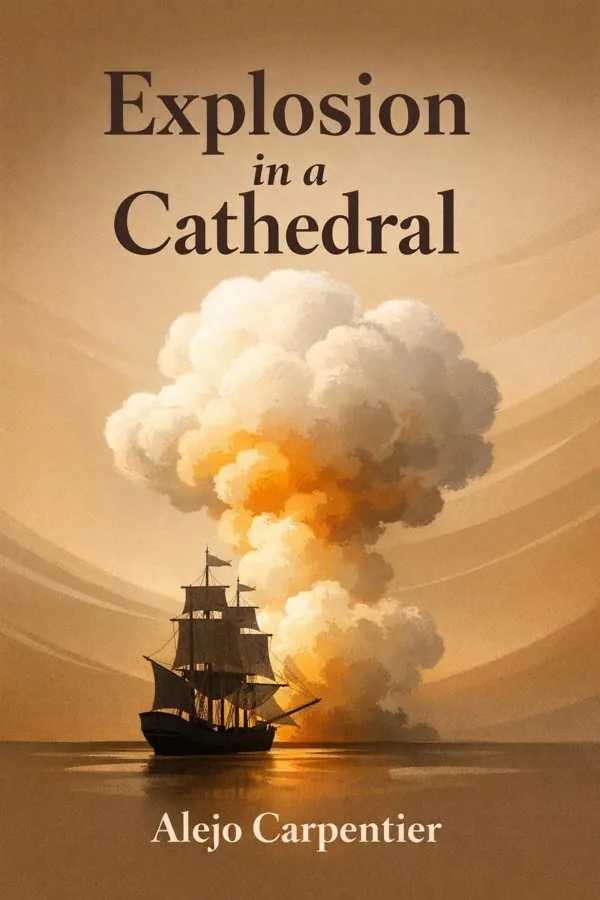
Explosion in a Cathedral: Summary & Key Insights
 10 min9 chapters
Key Takeaways from Explosion in a Cathedral
Revolutions rarely begin with gunfire; they begin with new ways of seeing the world.
History often enters ordinary life through a single magnetic personality.
Ideas become most revealing when they are forced into hostile reality.
Nothing exposes moral contradiction faster than a society praising freedom while profiting from bondage.
The most profound revolutions are sometimes internal rather than public.
What Is Explosion in a Cathedral About?
Explosion in a Cathedral by Alejo Carpentier is a classics book spanning 5 pages. Alejo Carpentier’s Explosion in a Cathedral is one of the great historical novels of the twentieth century: a sweeping, intellectually charged, and deeply unsettling account of how revolutionary ideas travel, seduce, and destroy. First published in 1962, the novel follows Sofia, Esteban, and Carlos, young Cubans whose lives are transformed by the arrival of Victor Hugues, a charismatic agent of the French Revolution. What begins as fascination with Enlightenment ideals gradually becomes a confrontation with terror, empire, slavery, and the brutal machinery of political power. Set across Havana, Guadeloupe, and other Caribbean spaces caught between European ambition and colonial reality, the novel shows that history is never abstract. It enters drawing rooms, ports, plantations, prisons, and private consciences. Carpentier, one of Latin America’s most important novelists, brings unusual authority to this material through his mastery of history, music, politics, and baroque prose. His signature vision of the “marvelous real” turns the Caribbean into more than a setting: it becomes the perfect stage for showing how noble principles can mutate into violence. This is a novel about revolution, but also about innocence lost, moral compromise, and the dangerous distance between ideals and their execution.
This FizzRead summary covers all 9 key chapters of Explosion in a Cathedral in approximately 10 minutes, distilling the most important ideas, arguments, and takeaways from Alejo Carpentier's work.
Explosion in a Cathedral
Alejo Carpentier’s Explosion in a Cathedral is one of the great historical novels of the twentieth century: a sweeping, intellectually charged, and deeply unsettling account of how revolutionary ideas travel, seduce, and destroy. First published in 1962, the novel follows Sofia, Esteban, and Carlos, young Cubans whose lives are transformed by the arrival of Victor Hugues, a charismatic agent of the French Revolution. What begins as fascination with Enlightenment ideals gradually becomes a confrontation with terror, empire, slavery, and the brutal machinery of political power.
Set across Havana, Guadeloupe, and other Caribbean spaces caught between European ambition and colonial reality, the novel shows that history is never abstract. It enters drawing rooms, ports, plantations, prisons, and private consciences. Carpentier, one of Latin America’s most important novelists, brings unusual authority to this material through his mastery of history, music, politics, and baroque prose. His signature vision of the “marvelous real” turns the Caribbean into more than a setting: it becomes the perfect stage for showing how noble principles can mutate into violence. This is a novel about revolution, but also about innocence lost, moral compromise, and the dangerous distance between ideals and their execution.
Who Should Read Explosion in a Cathedral?
This book is perfect for anyone interested in classics and looking to gain actionable insights in a short read. Whether you're a student, professional, or lifelong learner, the key ideas from Explosion in a Cathedral by Alejo Carpentier will help you think differently.
- ✓Readers who enjoy classics and want practical takeaways
- ✓Professionals looking to apply new ideas to their work and life
- ✓Anyone who wants the core insights of Explosion in a Cathedral in just 10 minutes
Want the full summary?
Get instant access to this book summary and 100K+ more with Fizz Moment.
Get Free SummaryAvailable on App Store • Free to download
Key Chapters
Revolutions rarely begin with gunfire; they begin with new ways of seeing the world. At the start of Explosion in a Cathedral, Havana is not yet a battlefield of political upheaval, but it is already a crossroads of trade, ideas, and social contradiction. Within the household of Don Carlos, inherited wealth and colonial order create a fragile sense of stability. Yet beneath that surface lies a restless curiosity, especially in Sofia and Esteban, who are drawn to books, debate, and the promise of a more rational, freer age.
Carpentier uses Havana to show how Enlightenment thought reaches colonial societies indirectly: through ships, imported goods, rumors, pamphlets, and travelers. The Caribbean is not isolated from Europe; it is deeply entangled with it. That entanglement matters because ideas like liberty and equality sound especially powerful in a world structured by slavery, mercantile greed, and rigid hierarchy. For Sofia and Esteban, the new language of reason and emancipation seems to offer escape from both personal confinement and inherited social stagnation.
This opening phase of the novel is important because it captures the seduction of ideology before its consequences are visible. Many readers will recognize the pattern in modern life. Grand political visions often attract followers not because all details are clear, but because they answer a moral hunger. A movement can seem transformative long before anyone tests how it behaves under pressure.
In practical terms, this section invites us to ask how our own beliefs are formed. Do we adopt them because they are just, because they are fashionable, or because they promise meaning? Before embracing any sweeping doctrine, examine the system in which it will operate. Actionable takeaway: when an idea feels intoxicatingly liberating, pause and ask what happens when it meets real institutions, real power, and real human weakness.
History often enters ordinary life through a single magnetic personality. Victor Hugues arrives in Havana not merely as a visitor from abroad but as a force of disruption. He carries the rhetoric, urgency, and theatrical energy of the French Revolution into a colonial world that has known hierarchy for generations. To Sofia and Esteban, he appears as a man of action, conviction, and historical purpose. He does not just describe a new age; he embodies it.
Carpentier makes Hugues compelling because he is not a flat villain or simple hero. He is persuasive, energetic, intellectually confident, and politically useful. He can talk about rights and reason with genuine fervor, yet he also brings with him the seeds of coercion, absolutism, and violence. Through him, the novel explores one of its central truths: charismatic revolutionaries often blur the line between liberation and domination. They inspire others by making history feel immediate, personal, and unavoidable.
Sofia and Esteban respond differently to Hugues, and these differences reveal how political seduction works. One person sees moral destiny; another sees opportunity; another senses danger but lacks the language to resist. This is not confined to the eighteenth century. In workplaces, social movements, and politics, transformative figures can awaken courage while also narrowing critical thought. The more certain a leader seems, the less likely followers are to question methods.
The practical lesson is not to distrust every inspiring person, but to separate moral language from moral conduct. Ask whether a leader welcomes limits, criticism, and accountability, or whether he treats them as obstacles to a higher mission. Actionable takeaway: admire energy and vision, but never outsource your judgment to charisma, no matter how noble the cause appears.
Ideas become most revealing when they are forced into hostile reality. Once the revolutionary tide moves into the Caribbean, Explosion in a Cathedral leaves behind the early fascination of political awakening and enters the harsher territory of implementation. Guadeloupe and the wider colonial world are not blank slates waiting for freedom; they are societies shaped by plantation economies, slavery, war, racial hierarchy, and imperial competition. In that context, slogans imported from France must either transform these structures or become tools within them.
Carpentier shows how the Revolution’s universal claims are tested by local contradictions. Liberty sounds sublime in Parisian declarations, but what does it mean in a slave society? Equality is stirring in theory, but who is included when economic interests are at stake? Fraternity becomes unstable when fear, military necessity, and profit enter the picture. Victor Hugues presents himself as a carrier of emancipation, and in some respects he is. Yet the revolutionary apparatus also depends on force, discipline, and public spectacle. The Caribbean becomes the place where ideals are exposed to their own hypocrisy.
This middle movement of the novel is especially relevant today because it shows how imported frameworks often shift when applied in different cultural and political environments. A policy, ideology, or reform may appear coherent at the center and contradictory at the margins. The issue is not only whether a principle is true, but whether those in power are willing to bear the cost of applying it consistently.
A practical application is to examine any institution by looking at its edge cases, not its mission statement. How does it treat the vulnerable, the inconvenient, the economically dispensable? Actionable takeaway: when evaluating a political ideal, look beyond its language and study how it functions under the hardest conditions and among the least powerful people.
Nothing exposes moral contradiction faster than a society praising freedom while profiting from bondage. One of the most powerful dimensions of Explosion in a Cathedral is its insistence that the French Revolution cannot be understood in the Caribbean without confronting slavery. Carpentier does not allow the reader to linger in abstract admiration for Enlightenment principles. He places those principles in territories where wealth depends on human exploitation, making every proclamation of liberty morally charged and politically unstable.
The novel’s treatment of slavery is crucial because it reveals the gap between revolutionary language and colonial interest. The abolition of slavery can be announced as a triumph of justice, but its enforcement occurs amid resistance, economic anxiety, violence, and opportunism. Freedom itself becomes entangled in administration, war strategy, and social control. Carpentier thereby refuses sentimental simplification. Emancipation is necessary, but its implementation within systems built on domination is chaotic and compromised.
This theme remains deeply modern. Organizations often celebrate values they are structurally unprepared to honor. A company may declare inclusion while rewarding exclusionary behavior. A nation may celebrate equality while tolerating systems that produce predictable injustice. The conflict between stated ideals and material interests is one of the central engines of history.
Readers can apply this insight by examining where value systems meet money, status, and convenience. The truest measure of principle is what people are willing to sacrifice to uphold it. If justice is always postponed when it becomes costly, then it is not truly a governing value.
Actionable takeaway: test every institution, movement, or personal commitment by asking a simple question: what privilege, profit, or comfort would it surrender to make its ideals real?
The most profound revolutions are sometimes internal rather than public. Sofia begins as a young woman shaped by household order, family expectations, and intellectual curiosity, but over the course of the novel she becomes one of Carpentier’s most significant moral centers. Her development is not straightforward empowerment in a modern slogan sense; it is a painful education in history, desire, politics, and the cost of attaching oneself to great causes led by flawed men.
Sofia is drawn to Victor Hugues and to the energy of revolutionary transformation, yet she gradually sees what others either excuse or fail to grasp. Through her, Carpentier explores how private life and public ideology interpenetrate. Political movements do not merely change laws; they reorder intimacy, loyalty, and self-understanding. Sofia’s awakening consists in learning that commitment without scrutiny becomes submission, and that intelligence must eventually detach itself from fascination.
Her importance also lies in the perspective she brings to a world dominated by male ambition and political rhetoric. Sofia sees both the grandeur and the vulgarity of history. She experiences how revolutionary discourse can claim universality while reproducing domination in personal relationships. That dual vision makes her one of the novel’s clearest witnesses to the corruption of ideals.
For readers, Sofia’s arc offers a practical framework for moral independence. Many people outgrow beliefs, relationships, or institutions only after recognizing that admiration has replaced judgment. This can happen in romance, work, activism, or religion. Growth begins when we stop confusing intensity with truth.
Actionable takeaway: if a person or cause once gave your life meaning, revisit it with fresh eyes. Ask not what it promised at the beginning, but what it now requires you to ignore.
To witness history is not the same as to master it; often it leaves a person fragmented. Esteban serves as one of the novel’s most reflective and troubled figures, a man drawn into revolutionary currents yet unable to find lasting certainty within them. Where Victor Hugues acts and Sofia evolves toward sharper judgment, Esteban absorbs, observes, suffers, and doubts. His trajectory reveals the psychological cost of living through an age that demands total commitment while offering little moral clarity.
Carpentier uses Esteban to examine disillusionment not as cowardice but as knowledge. He sees enough to understand that power rarely remains pure, that noble slogans can coexist with cruelty, and that historical necessity is frequently invoked to excuse the inexcusable. Yet understanding does not free him. Instead, it burdens him. He belongs to a generation that cannot return to innocence, but cannot wholeheartedly affirm the world that replaced it.
This makes Esteban strikingly relevant for modern readers who feel politically aware but emotionally exhausted. In times of crisis, many people become witnesses to systems they oppose but feel powerless to change. They read, analyze, and critique, yet action appears compromised and withdrawal feels irresponsible. Carpentier captures that spiritual fatigue with unusual sensitivity.
The practical application is to recognize that perpetual witnessing can become paralyzing if it is not paired with some workable ethic. One does not need perfect certainty before acting, but one does need limits, perspective, and forms of responsibility that do not depend on total ideological faith.
Actionable takeaway: if public events leave you cynical or overwhelmed, define a smaller sphere of honest action. Choose one value you can practice consistently rather than waiting for history to become morally clean.
Every revolution claims to break with the old order, yet many end by rebuilding its habits under new banners. This is among the novel’s central insights. As Victor Hugues gains authority, the language of emancipation becomes increasingly entwined with surveillance, punishment, bureaucracy, and fear. Carpentier shows how revolutionary power often justifies itself by citing emergency, necessity, and the unfinished nature of the struggle. In doing so, it grants itself permission to become what it once condemned.
The brilliance of Explosion in a Cathedral is that it does not present this corruption as a sudden betrayal by one bad individual. Rather, it emerges from structure. Once a movement must govern, defend itself, extract resources, and suppress opposition, the temptation to prioritize control over principle becomes immense. Public virtue turns theatrical. Violence becomes procedural. Moral categories grow elastic in the hands of those who believe history is on their side.
This pattern extends far beyond political revolutions. Startups become bureaucracies. reform movements become gatekeepers. anti-establishment leaders create inner circles and loyalty tests. In each case, the story told about necessity hides a transfer of power. The question is not whether authority is needed, but whether it can be limited before it begins to feed on its own righteousness.
Readers can apply this by paying close attention to how institutions behave after victory. It is easy to judge ideals under oppression; harder and more revealing to judge them in command. Does power become more transparent, or less? Are exceptions temporary, or permanent? Are critics engaged, or purged?
Actionable takeaway: when a cause you support gains influence, become more vigilant, not less. Success is often the moment when principles face their greatest test.
Places on the margins often reveal truths the center cannot see. Carpentier’s Caribbean is not a decorative backdrop to European events; it is the ideal stage for exposing the contradictions of modernity. In ports, plantations, forts, and trading routes, competing empires, races, classes, and legal systems collide. The region condenses the forces of the age: commerce, slavery, war, migration, and ideology. Because of this density, the Caribbean becomes a historical mirror in which the promises of Europe appear magnified and distorted at once.
This setting matters because it overturns a simplistic center-periphery model. The Revolution may originate in France, but its meanings are transformed in the colonies. Colonial societies are not passive recipients of events; they test, reshape, and reveal them. Carpentier demonstrates that to understand universal claims, one must study where they meet difference, violence, and extraction. The so-called margins are often where reality becomes clearest.
In contemporary terms, this insight applies whenever major systems are evaluated only from headquarters, capitals, or elite institutions. A policy may seem coherent in theory, but its effects in border zones, poor communities, or dependent economies tell a truer story. The edges of a system often disclose its hidden assumptions.
Carpentier also gives the Caribbean sensory and symbolic richness. Weather, architecture, sea routes, and tropical abundance heighten the novel’s sense that history is physical, not merely conceptual. Ideas arrive with cargo, decrees, uniforms, and weapons.
Actionable takeaway: to understand any large system, look at its periphery. The places most exposed to its pressures often reveal what the center prefers not to acknowledge.
Human beings are drawn to grand events partly because they feel theatrical. Explosion in a Cathedral repeatedly presents history as spectacle: ceremonies, uniforms, proclamations, public punishments, ships entering harbor, crowds swayed by symbols. Yet Carpentier pairs this theatricality with ruin. The same forces that stage progress also leave behind broken institutions, exhausted souls, and moral wreckage. The cathedral of the title suggests not only sacred grandeur but also violent fragmentation, an explosion within the very structure meant to give order and meaning.
This tension between spectacle and ruin is one reason the novel remains so powerful. Political life often depends on images strong enough to command emotion. Flags, speeches, slogans, and public rituals make individuals feel part of something larger than themselves. But spectacle can conceal cost. It simplifies complexity, glorifies necessity, and aestheticizes violence. Carpentier understands that historical drama is seductive precisely because it gives suffering a script.
Modern readers live in an age saturated with spectacle, from political branding to viral activism to media-driven outrage. The lesson here is not to dismiss symbolism, which matters deeply, but to ask what material realities lie beneath it. What happens after the speech, after the march, after the declaration? Who rebuilds, who grieves, who profits, who disappears from the story?
By linking magnificence with devastation, Carpentier restores gravity to historical imagination. He asks readers to resist being intoxicated by eventfulness alone.
Actionable takeaway: whenever public life becomes highly theatrical, train yourself to look for the hidden ledger of consequences. Spectacle tells you what history wants to look like; aftermath tells you what it actually is.
All Chapters in Explosion in a Cathedral
About the Author
Alejo Carpentier (1904–1980) was a Cuban novelist, essayist, journalist, and musicologist whose work helped redefine modern Latin American literature. Born in Lausanne to a French father and Russian mother and raised in Cuba, he developed a cosmopolitan perspective that deeply informed his writing. Carpentier became known for his richly baroque prose, historical imagination, and influential idea of the “marvelous real,” through which he argued that Latin American reality was itself extraordinary. His fiction often explores revolution, colonialism, music, myth, and the relationship between Europe and the Americas. Among his most celebrated works are The Kingdom of This World, The Lost Steps, and Explosion in a Cathedral. Today, he is regarded as a major twentieth-century writer whose novels combine intellectual ambition with sensory power.
Get This Summary in Your Preferred Format
Read or listen to the Explosion in a Cathedral summary by Alejo Carpentier anytime, anywhere. FizzRead offers multiple formats so you can learn on your terms — all free.
Available formats: App · Audio · PDF · EPUB — All included free with FizzRead
Download Explosion in a Cathedral PDF and EPUB Summary
Key Quotes from Explosion in a Cathedral
“Revolutions rarely begin with gunfire; they begin with new ways of seeing the world.”
“History often enters ordinary life through a single magnetic personality.”
“Ideas become most revealing when they are forced into hostile reality.”
“Nothing exposes moral contradiction faster than a society praising freedom while profiting from bondage.”
“The most profound revolutions are sometimes internal rather than public.”
Frequently Asked Questions about Explosion in a Cathedral
Explosion in a Cathedral by Alejo Carpentier is a classics book that explores key ideas across 9 chapters. Alejo Carpentier’s Explosion in a Cathedral is one of the great historical novels of the twentieth century: a sweeping, intellectually charged, and deeply unsettling account of how revolutionary ideas travel, seduce, and destroy. First published in 1962, the novel follows Sofia, Esteban, and Carlos, young Cubans whose lives are transformed by the arrival of Victor Hugues, a charismatic agent of the French Revolution. What begins as fascination with Enlightenment ideals gradually becomes a confrontation with terror, empire, slavery, and the brutal machinery of political power. Set across Havana, Guadeloupe, and other Caribbean spaces caught between European ambition and colonial reality, the novel shows that history is never abstract. It enters drawing rooms, ports, plantations, prisons, and private consciences. Carpentier, one of Latin America’s most important novelists, brings unusual authority to this material through his mastery of history, music, politics, and baroque prose. His signature vision of the “marvelous real” turns the Caribbean into more than a setting: it becomes the perfect stage for showing how noble principles can mutate into violence. This is a novel about revolution, but also about innocence lost, moral compromise, and the dangerous distance between ideals and their execution.
More by Alejo Carpentier



You Might Also Like






Browse by Category
Ready to read Explosion in a Cathedral?
Get the full summary and 100K+ more books with Fizz Moment.