
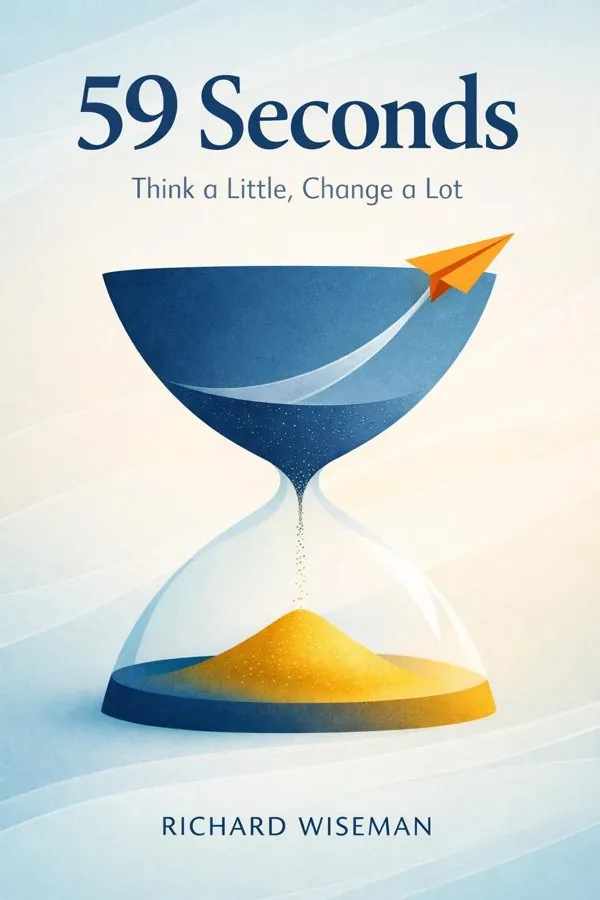
59 Seconds: Think a Little, Change a Lot: Summary & Key Insights
 10 min9 chaptersAudio available
Key Takeaways from 59 Seconds: Think a Little, Change a Lot
One of the book’s most counterintuitive lessons is that happiness is often the result of what we do, not what we wait to feel.
A popular self-help myth says that vividly imagining success will make success more likely.
Influence is often imagined as a dramatic talent: the charismatic speaker, the brilliant negotiator, the born salesperson.
Many people believe creativity is a mysterious gift reserved for artists, inventors, or naturally original thinkers.
We often praise intuition as if gut feelings are inherently wise.
What Is 59 Seconds: Think a Little, Change a Lot About?
59 Seconds: Think a Little, Change a Lot by Richard Wiseman is a positive_psych book spanning 12 pages. What if meaningful personal change did not require months of therapy, endless journaling, or the usual self-help slogans about “believing in yourself”? In 59 Seconds, psychologist Richard Wiseman argues that many popular methods for improving happiness, motivation, relationships, and success are not just ineffective—they are often directly contradicted by research. Instead of offering comforting myths, he turns to decades of psychological science to reveal small, practical interventions that can produce surprisingly fast results. The book matters because it replaces vague inspiration with evidence. Wiseman examines what studies actually show about confidence, creativity, persuasion, romance, stress, and luck, then distills those findings into simple actions readers can try immediately. His approach is refreshingly skeptical, but never cynical: he believes change is possible, just not always in the way conventional wisdom suggests. Richard Wiseman is especially well placed to write this book. As a British psychologist and professor known for his research on luck and everyday behavior, he has built a reputation for translating academic findings into engaging, useful insights. The result is a smart, accessible guide for anyone who wants self-improvement rooted in science rather than wishful thinking.
This FizzRead summary covers all 9 key chapters of 59 Seconds: Think a Little, Change a Lot in approximately 10 minutes, distilling the most important ideas, arguments, and takeaways from Richard Wiseman's work. Also available as an audio summary and Key Quotes Podcast.
59 Seconds: Think a Little, Change a Lot
What if meaningful personal change did not require months of therapy, endless journaling, or the usual self-help slogans about “believing in yourself”? In 59 Seconds, psychologist Richard Wiseman argues that many popular methods for improving happiness, motivation, relationships, and success are not just ineffective—they are often directly contradicted by research. Instead of offering comforting myths, he turns to decades of psychological science to reveal small, practical interventions that can produce surprisingly fast results.
The book matters because it replaces vague inspiration with evidence. Wiseman examines what studies actually show about confidence, creativity, persuasion, romance, stress, and luck, then distills those findings into simple actions readers can try immediately. His approach is refreshingly skeptical, but never cynical: he believes change is possible, just not always in the way conventional wisdom suggests.
Richard Wiseman is especially well placed to write this book. As a British psychologist and professor known for his research on luck and everyday behavior, he has built a reputation for translating academic findings into engaging, useful insights. The result is a smart, accessible guide for anyone who wants self-improvement rooted in science rather than wishful thinking.
Who Should Read 59 Seconds: Think a Little, Change a Lot?
This book is perfect for anyone interested in positive_psych and looking to gain actionable insights in a short read. Whether you're a student, professional, or lifelong learner, the key ideas from 59 Seconds: Think a Little, Change a Lot by Richard Wiseman will help you think differently.
- ✓Readers who enjoy positive_psych and want practical takeaways
- ✓Professionals looking to apply new ideas to their work and life
- ✓Anyone who wants the core insights of 59 Seconds: Think a Little, Change a Lot in just 10 minutes
Want the full summary?
Get instant access to this book summary and 100K+ more with Fizz Moment.
Get Free SummaryAvailable on App Store • Free to download
Key Chapters
One of the book’s most counterintuitive lessons is that happiness is often the result of what we do, not what we wait to feel. Many people treat happiness as a distant emotional reward: once they get the promotion, the relationship, the perfect mindset, then they will finally feel good. Wiseman shows that psychological research points in the opposite direction. Small actions can shift mood first, and emotional change often follows.
Instead of obsessing over “finding” happiness, people benefit from habits that reliably improve well-being. Research highlighted in the book suggests several simple methods: expressing gratitude, performing acts of kindness, nurturing social connections, and even smiling more often. These are not fluffy rituals. They work because they redirect attention, reshape interpretation, and influence how we engage with other people. A gratitude exercise, for example, helps counter the mind’s tendency to fixate on what is missing. Likewise, doing something kind for someone else often boosts the giver’s mood as much as the recipient’s.
Wiseman also challenges the idea that venting negative thoughts endlessly is always healthy. In some cases, repeatedly rehearsing disappointment can deepen it. A more effective strategy is to interrupt rumination by doing something constructive or socially engaging. If someone feels stuck in a low mood, a short gratitude list, a quick call to a friend, or one small helpful act can create momentum.
The broader point is liberating: happiness does not always require a grand life overhaul. It can begin with ordinary, manageable behaviors repeated consistently. Actionable takeaway: for the next week, write down three things that went well each day and perform one deliberate act of kindness daily.
A popular self-help myth says that vividly imagining success will make success more likely. Wiseman argues that this advice often backfires. Research suggests that fantasizing about the perfect outcome can create a premature sense of accomplishment, reducing the effort people actually invest. In other words, dreaming can feel so satisfying that it weakens motivation.
What works better is focusing on the process and identifying the obstacles that stand in the way. This is where goal setting becomes practical rather than performative. Effective goals are concrete, broken into steps, and connected to likely difficulties. Instead of imagining yourself confidently delivering a flawless presentation, imagine the real challenge: you may procrastinate, get distracted, or feel nervous. Then build a response. For example: “If I start scrolling on my phone instead of preparing, I will put it in another room and work for 20 minutes.”
Wiseman draws on research showing that specific planning significantly improves follow-through. This includes writing goals down, making them measurable, and using “if-then” implementation plans. Such plans reduce the need for willpower in the moment because the response is decided in advance. Students, professionals, and anyone trying to build a habit can benefit from this. A vague goal like “get fitter” is weak; a practical one like “walk for 30 minutes after lunch on Monday, Wednesday, and Friday” is far stronger.
The key lesson is that motivation is less about emotional hype and more about structure. Successful people do not merely desire outcomes; they create systems that make action easier and excuses harder. Actionable takeaway: choose one important goal, write it down clearly, and create three if-then plans for the obstacles most likely to derail you.
Influence is often imagined as a dramatic talent: the charismatic speaker, the brilliant negotiator, the born salesperson. Wiseman shows that persuasion is usually built from subtle psychological cues rather than overpowering force. Small changes in wording, context, and behavior can significantly increase the odds of getting a yes.
One important principle is that people like to see themselves as consistent. If someone makes a small commitment, they become more likely to agree to a larger related request later. Another key factor is similarity and connection. We are more receptive to people who seem familiar, friendly, and attentive to our perspective. Compliments, when sincere, can soften resistance. So can asking for advice, which makes the other person feel respected and invested.
Wiseman also highlights the importance of social proof. People take cues from what others are doing, especially in uncertain situations. This helps explain why messages such as “most guests reuse their towels” or “most residents pay their taxes on time” can be more effective than moral appeals alone. The behavior feels normal, not exceptional.
In daily life, these insights apply everywhere: asking a colleague for help, pitching an idea, motivating a team, or encouraging children to cooperate. If you want a proposal accepted, do not launch into demands. Start by finding common ground, asking a question that invites agreement, or gaining a modest first commitment. People resist pressure but respond better when they feel aligned rather than pushed.
Persuasion, then, is not manipulation through tricks. At its best, it is the art of presenting ideas in a way that fits how people actually think and decide. Actionable takeaway: before your next important request, establish one point of agreement first and frame the request in terms of what similar people commonly do.
Many people believe creativity is a mysterious gift reserved for artists, inventors, or naturally original thinkers. Wiseman presents a more encouraging view: creativity can be increased through specific techniques, and some of the most effective are surprisingly simple. Rather than waiting for inspiration, we can create conditions that make insight more likely.
One powerful idea is psychological distance. When people think about a problem as if it belongs to someone else, or imagine it happening far away, they often generate more inventive solutions. Distance reduces the mental clutter and emotional pressure that can trap us in familiar patterns. That is why people are often better at solving a friend’s dilemma than their own. Reframing your challenge as “How would I advise someone else?” can unlock fresh thinking.
Another useful finding is that constraints can stimulate originality. Unlimited freedom sounds ideal, but it often overwhelms the mind. A tighter brief—such as creating a campaign with a tiny budget or planning a meal with only five ingredients—forces the brain to search more creatively. Wiseman also notes that brainstorming improves when people postpone criticism, seek quantity before quality, and expose themselves to unusual combinations of ideas.
These principles have clear applications. A manager stuck on a product issue might ask the team to solve it as if they were consultants hired by another company. A student facing writer’s block might set a challenge to produce ten possible openings in ten minutes, without judging any of them. A couple trying to fix a recurring conflict might imagine how an outsider would interpret the pattern.
Creativity is not magic. It often emerges when we alter perspective and structure the problem differently. Actionable takeaway: when you feel mentally stuck, rewrite the problem as if it belonged to someone else and generate at least ten possible solutions before evaluating any of them.
We often praise intuition as if gut feelings are inherently wise. Wiseman does not dismiss intuition altogether, but he warns that people regularly make poor choices when they rely on impressions without structure. Memory is selective, emotion is noisy, and confidence can easily masquerade as clarity. Good decisions usually come from improving the process rather than glorifying instinct.
One of the simplest and most effective tools in the book is writing things down. When choices stay in our heads, they blur together and become vulnerable to mood and bias. Listing options, pros and cons, likely outcomes, and relevant criteria creates distance from the emotional swirl. This does not guarantee perfect judgment, but it sharply improves clarity. A job choice, for example, becomes easier to evaluate when compared across meaningful factors such as learning potential, income, values, commute, and long-term fit.
Wiseman also highlights the danger of overthinking some decisions while underthinking others. People may agonize over minor purchases and rush major commitments. A better approach is proportionality: devote energy where consequences are significant, and create rules for lower-stakes choices to avoid decision fatigue. He also encourages seeking disconfirming evidence. Instead of asking, “Why is this a good idea?” ask, “What could make this a bad one?” That question often reveals blind spots hidden by enthusiasm.
In relationships, work, and personal life, wiser choices come from slowing down just enough to test assumptions. You do not need to become robotic; you need to become deliberate. The goal is not to eliminate emotion but to prevent emotion from acting alone.
Actionable takeaway: for your next important decision, make a one-page comparison sheet with your top criteria, score each option, and include one column titled “What am I probably overlooking?”
People often assume relationships are shaped mainly by big moments: declarations of love, major arguments, dramatic gestures, or life-changing decisions. Wiseman points instead to the quiet power of everyday interactions. Small habits of attention, wording, and responsiveness often determine whether relationships strengthen or erode over time.
One major insight is that feeling understood matters as much as being agreed with. In conversations, many people prepare rebuttals instead of listening. This creates defensiveness and distance. Simple behaviors such as maintaining eye contact, asking clarifying questions, and reflecting back what the other person said can dramatically improve communication. The other person becomes less likely to escalate because they feel heard rather than dismissed.
Wiseman also discusses how praise and positive reinforcement can be more effective than criticism in changing behavior. In families, workplaces, and friendships, people usually respond better when desired actions are noticed and appreciated. Constant correction tends to generate resentment or withdrawal. This does not mean avoiding difficult conversations; it means not making negativity the default language of connection.
Humor, shared activities, and small rituals also matter. A daily check-in, a weekly walk, a short message of appreciation, or a habit of saying thank you can stabilize relationships in ways that feel almost invisible until they are absent. In romance, attraction may spark connection, but reliable warmth sustains it. In professional settings, trust grows from repeated signals of respect and follow-through.
Healthy relationships are rarely built in single heroic acts. They are built in micro-moments that communicate safety, value, and attention. Actionable takeaway: choose one important relationship and, for the next seven days, practice one deliberate listening behavior and one specific expression of appreciation each day.
Stress is not caused only by pressure; it is amplified by helplessness. Wiseman emphasizes that people cope better when they feel some sense of control, even if the situation itself remains difficult. This insight helps explain why uncertainty and passivity can be so exhausting. When individuals move from vague worry to specific action, stress often becomes more manageable.
One practical method is breaking large concerns into smaller components. “I’m overwhelmed by work” is emotionally true but cognitively unhelpful. It offers no handle. A better question is: what exactly is producing the strain? Is it the unclear priority, the difficult conversation, the looming deadline, or the lack of rest? Once the problem is specified, the mind can shift from rumination to response.
Wiseman also challenges the idea that endlessly analyzing distress is always therapeutic. Sometimes repeated reflection deepens anxiety instead of relieving it. Short, structured techniques often work better: making a plan, changing posture, engaging in brief physical activity, reframing a setback, or talking to someone who can offer perspective rather than just sympathy. Even small interventions matter because they interrupt the feeling of being trapped.
Resilience, in this view, is not stoic suppression. It is the skill of recovering momentum. A person who receives criticism at work, for instance, can either spiral into self-judgment or extract one useful lesson and create one corrective step. The second response protects both confidence and performance. Likewise, during personal stress, routines such as sleep, exercise, and social contact can serve as stabilizers rather than luxuries.
Stress becomes less intimidating when it is translated into action. Actionable takeaway: the next time you feel overwhelmed, write down the problem in one sentence, list the three smallest actions available to you, and do the easiest one immediately.
One of Wiseman’s broader themes is that people are less fixed than they assume. We often talk as if attraction is pure chemistry, parenting is mostly instinct, and personality is a stable essence. The research he discusses suggests something more hopeful: many social outcomes can be influenced by behavior, environment, and expectation.
In attraction, confidence, familiarity, and warmth frequently matter more than people realize. Physical appearance is not irrelevant, but first impressions are shaped heavily by body language, humor, attentiveness, and perceived interest. Someone who asks thoughtful questions, smiles genuinely, and seems comfortable in their own skin often becomes more attractive over time than someone relying on surface appeal alone. This shifts dating advice from performance to connection.
In parenting and influence, Wiseman stresses that labels can become self-fulfilling. Calling a child “shy,” “difficult,” or “lazy” may encourage exactly those patterns. Praising effort, strategy, and progress is more constructive because it points toward growth rather than identity. Similar dynamics apply in schools and workplaces. People often rise or shrink in response to expectations.
Even personality can be nudged through action. A person who sees themselves as unlucky, disorganized, or socially awkward may reinforce that identity by repeating the same behaviors. But when they experiment with different habits—initiating conversations, creating systems, taking more social risks—their self-concept can begin to change. We often become what we repeatedly do.
This is one of the book’s most empowering messages. You do not need to wait for a new personality before behaving differently. Sometimes behaving differently is what creates a new personality. Actionable takeaway: replace one limiting label you use about yourself or someone else with a behavioral goal, such as “start one conversation” or “praise effort twice a day.”
Luck is usually treated as random fate: some people have it, others do not. Wiseman, drawing on his well-known research, makes a more nuanced claim. Chance always plays a role in life, but “lucky” people often behave in ways that increase the number of opportunities they notice, create, and act on. Their good fortune is not entirely accidental.
One pattern is openness. Lucky people tend to talk to more strangers, explore more possibilities, and deviate from rigid routines. Because they encounter more people and situations, they also encounter more chances. An “unlucky” person may miss opportunities simply because they are moving through life on autopilot, focused too narrowly on one expectation. Wiseman gives the impression that luck often begins with attention.
Another pattern is intuition balanced with experimentation. Lucky people may trust their hunches in social situations, but they also test things, follow up, and recover quickly from setbacks. They do not interpret every disappointment as proof that life is against them. Instead, they often reframe bad luck by asking what can still be gained. Missing one opportunity may place them in position for another because they stay engaged rather than retreating.
This insight applies powerfully to work and productivity as well. Networking, trying side projects, learning visible skills, and being willing to ask all expand the surface area of luck. Careers often advance not just through talent, but through timely encounters and noticed initiative. People who seem fortunate are often the ones repeatedly placing themselves where fortunate things can happen.
The practical message is energizing: while you cannot control randomness, you can become the kind of person who collaborates with it. Actionable takeaway: this week, break one routine, start two conversations with new people, and say yes to one opportunity you would normally ignore.
All Chapters in 59 Seconds: Think a Little, Change a Lot
About the Author
Richard Wiseman is a British psychologist, professor, and bestselling author known for bringing psychological science to a wide audience. He has held academic positions in psychology and gained international recognition through his research on luck, belief, self-deception, persuasion, and everyday behavior. Wiseman has a talent for turning complex studies into lively, accessible insights, which has made him a popular speaker, media guest, and writer. His work often explores why common assumptions about human behavior are wrong and what research reveals instead. Across his books and public projects, he combines skepticism, humor, and practicality, helping readers apply psychology to real life. In 59 Seconds, he draws on this expertise to challenge self-help myths and offer evidence-based techniques for rapid, meaningful change.
Get This Summary in Your Preferred Format
Read or listen to the 59 Seconds: Think a Little, Change a Lot summary by Richard Wiseman anytime, anywhere. FizzRead offers multiple formats so you can learn on your terms — all free.
Available formats: App · Audio · PDF · EPUB — All included free with FizzRead
Download 59 Seconds: Think a Little, Change a Lot PDF and EPUB Summary
Key Quotes from 59 Seconds: Think a Little, Change a Lot
“One of the book’s most counterintuitive lessons is that happiness is often the result of what we do, not what we wait to feel.”
“A popular self-help myth says that vividly imagining success will make success more likely.”
“Influence is often imagined as a dramatic talent: the charismatic speaker, the brilliant negotiator, the born salesperson.”
“Many people believe creativity is a mysterious gift reserved for artists, inventors, or naturally original thinkers.”
“We often praise intuition as if gut feelings are inherently wise.”
Frequently Asked Questions about 59 Seconds: Think a Little, Change a Lot
59 Seconds: Think a Little, Change a Lot by Richard Wiseman is a positive_psych book that explores key ideas across 9 chapters. What if meaningful personal change did not require months of therapy, endless journaling, or the usual self-help slogans about “believing in yourself”? In 59 Seconds, psychologist Richard Wiseman argues that many popular methods for improving happiness, motivation, relationships, and success are not just ineffective—they are often directly contradicted by research. Instead of offering comforting myths, he turns to decades of psychological science to reveal small, practical interventions that can produce surprisingly fast results. The book matters because it replaces vague inspiration with evidence. Wiseman examines what studies actually show about confidence, creativity, persuasion, romance, stress, and luck, then distills those findings into simple actions readers can try immediately. His approach is refreshingly skeptical, but never cynical: he believes change is possible, just not always in the way conventional wisdom suggests. Richard Wiseman is especially well placed to write this book. As a British psychologist and professor known for his research on luck and everyday behavior, he has built a reputation for translating academic findings into engaging, useful insights. The result is a smart, accessible guide for anyone who wants self-improvement rooted in science rather than wishful thinking.
More by Richard Wiseman
You Might Also Like
Don't Sweat the Small Stuff... and It's All Small Stuff
Richard Carlson
10 min
Option B
Sheryl Sandberg & Adam Grant
10 min
Hallelujah Anyway: Rediscovering Mercy
Anne Lamott
10 min
I Can Do It: How to Use Affirmations to Change Your Life
Louise Hay
10 min
The Coffee Bean: A Simple Lesson to Create Positive Change
Jon Gordon, Damon West
10 min
The Happiness Hypothesis: Finding Modern Truth in Ancient Wisdom
Jonathan Haidt
10 minFeatured In
Browse by Category
Ready to read 59 Seconds: Think a Little, Change a Lot?
Get the full summary and 100K+ more books with Fizz Moment.