
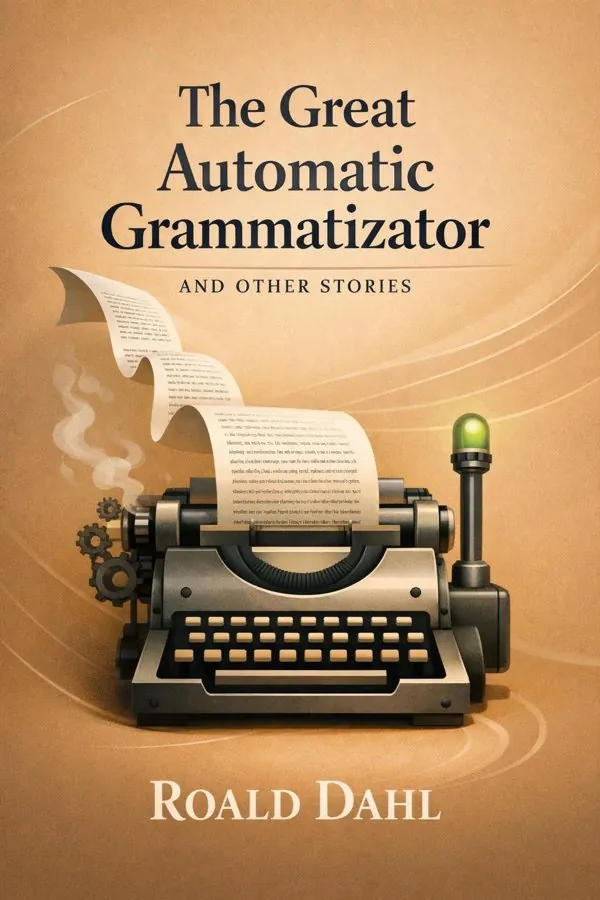
The Great Automatic Grammatizator and Other Stories: Summary & Key Insights
by Roald Dahl
 10 min9 chaptersAudio available
Key Takeaways from The Great Automatic Grammatizator and Other Stories
One of the most unsettling questions in literature is not whether a machine can create art, but what happens to culture when efficiency becomes more valuable than originality.
A clever plan often collapses not because it is poorly designed, but because the person behind it wants too much.
People like to believe they are rational, but vanity regularly overrules intelligence.
Some of the most frightening situations begin not with obvious menace but with exaggerated kindness.
The most disturbing forms of power are not always loud or public; sometimes they emerge through the desire to dominate another person completely.
What Is The Great Automatic Grammatizator and Other Stories About?
The Great Automatic Grammatizator and Other Stories by Roald Dahl is a bestsellers book spanning 13 pages. The Great Automatic Grammatizator and Other Stories is a brilliant showcase of Roald Dahl at his most wickedly inventive. This collection gathers a range of his adult short fiction, where polite society, domestic routine, professional ambition, and private desire are all quietly pushed toward absurdity, cruelty, or catastrophe. Again and again, Dahl begins with something ordinary—a marriage, a dinner party, a business idea, a harmless eccentricity—and then introduces one unsettling twist that exposes vanity, greed, fear, or revenge. The result is fiction that feels entertaining on the surface but deeply sharp underneath. What makes the collection matter is how modern it still feels. The title story, about a machine that can mass-produce fiction, now reads like an eerily early satire of automated creativity, commercialized art, and the uneasy relationship between human talent and technology. Other stories dissect social performance, manipulation, class ambition, and the hidden violence of everyday life. Dahl’s authority comes from his unmatched command of tension, timing, and surprise. He is one of the rare writers who can be funny, sinister, elegant, and brutal within a few pages. This collection is not only memorable storytelling; it is a masterclass in how fiction reveals human weakness.
This FizzRead summary covers all 9 key chapters of The Great Automatic Grammatizator and Other Stories in approximately 10 minutes, distilling the most important ideas, arguments, and takeaways from Roald Dahl's work. Also available as an audio summary and Key Quotes Podcast.
The Great Automatic Grammatizator and Other Stories
The Great Automatic Grammatizator and Other Stories is a brilliant showcase of Roald Dahl at his most wickedly inventive. This collection gathers a range of his adult short fiction, where polite society, domestic routine, professional ambition, and private desire are all quietly pushed toward absurdity, cruelty, or catastrophe. Again and again, Dahl begins with something ordinary—a marriage, a dinner party, a business idea, a harmless eccentricity—and then introduces one unsettling twist that exposes vanity, greed, fear, or revenge. The result is fiction that feels entertaining on the surface but deeply sharp underneath.
What makes the collection matter is how modern it still feels. The title story, about a machine that can mass-produce fiction, now reads like an eerily early satire of automated creativity, commercialized art, and the uneasy relationship between human talent and technology. Other stories dissect social performance, manipulation, class ambition, and the hidden violence of everyday life. Dahl’s authority comes from his unmatched command of tension, timing, and surprise. He is one of the rare writers who can be funny, sinister, elegant, and brutal within a few pages. This collection is not only memorable storytelling; it is a masterclass in how fiction reveals human weakness.
Who Should Read The Great Automatic Grammatizator and Other Stories?
This book is perfect for anyone interested in bestsellers and looking to gain actionable insights in a short read. Whether you're a student, professional, or lifelong learner, the key ideas from The Great Automatic Grammatizator and Other Stories by Roald Dahl will help you think differently.
- ✓Readers who enjoy bestsellers and want practical takeaways
- ✓Professionals looking to apply new ideas to their work and life
- ✓Anyone who wants the core insights of The Great Automatic Grammatizator and Other Stories in just 10 minutes
Want the full summary?
Get instant access to this book summary and 100K+ more with Fizz Moment.
Get Free SummaryAvailable on App Store • Free to download
Key Chapters
One of the most unsettling questions in literature is not whether a machine can create art, but what happens to culture when efficiency becomes more valuable than originality. In “The Great Automatic Grammatizator,” Roald Dahl imagines exactly that problem through Adolph Knipe, an engineer who invents a machine capable of producing marketable fiction at scale. At first, the story is comic and absurd. A device that writes stories sounds like a clever prank. But Dahl quickly reveals a darker point: once art becomes something that can be industrialized, publishers, markets, and even authors may begin to prefer predictable output over unpredictable genius.
Knipe’s machine does not merely write stories; it reorganizes the economics of literature. Writers are pressured into licensing their names, readers unknowingly consume formulaic work, and creativity becomes detached from lived experience. Dahl is not arguing that all systems or tools are bad. He is warning that when art is evaluated primarily through productivity, branding, and profit, its human core gets hollowed out. This idea feels especially relevant today in conversations about algorithmic content, AI-generated writing, and the commodification of personal expression.
The story applies beyond publishing. In business, education, design, and media, systems are useful until they start replacing judgment. A template can help you work faster, but it can also flatten your voice. A tool can amplify talent, but it can also reward sameness. Dahl’s satire encourages readers to ask a practical question: are we using technology to support creativity, or are we redesigning creativity to suit technology?
Actionable takeaway: whenever a tool promises perfect efficiency in a creative task, pause and identify what uniquely human quality—intuition, risk, personality, moral judgment—you must protect from automation.
A clever plan often collapses not because it is poorly designed, but because the person behind it wants too much. That is the engine of “Mrs. Bixby and the Colonel’s Coat,” one of Dahl’s neatest stories of vanity, deception, and poetic justice. Mrs. Bixby, who has been carrying on an affair with a wealthy colonel, receives an extravagant mink coat as a parting gift. The coat represents fantasy, status, and secret desire. But because she cannot openly explain how she acquired it, she must create a scheme to keep it. The more she tries to preserve both her pleasure and her reputation, the more she traps herself.
Dahl’s brilliance lies in his emotional precision. He understands that people rarely ruin themselves through dramatic evil. More often, they are undone by self-serving calculations that seem reasonable in the moment. Mrs. Bixby wants luxury without consequences, excitement without exposure, and admiration without sacrifice. Her husband, meanwhile, proves more perceptive than expected, and the story’s ending lands with a cruelly elegant irony.
The broader lesson is that greed distorts judgment. When people become fixated on preserving image, comfort, or gain, they stop seeing what others can plainly see. This applies in marriages, workplaces, negotiations, and friendships. A person who hides information to maintain advantage usually creates vulnerabilities elsewhere. The scheme becomes larger than the original desire.
In practical life, the story is a reminder to examine the hidden cost of getting what you want. If a reward can only be enjoyed through lies, concealment, or manipulation, it may already own you. Short-term wins often create long-term exposure.
Actionable takeaway: when tempted by a “perfect” gain, ask what story you would need to tell to keep it—and whether that story is more dangerous than the reward is valuable.
People like to believe they are rational, but vanity regularly overrules intelligence. “Parson’s Pleasure” turns that truth into a razor-sharp comedy about expertise, class performance, and fraud. The story follows a smooth antique dealer who disguises himself as a humble clergyman in order to buy valuable furniture cheaply from unsuspecting rural owners. His method depends on a common weakness: many people defer to confident specialists, especially when those specialists seem respectable, educated, and morally harmless.
Dahl’s target is not only the con man. It is also the social world that allows this con to flourish. Authority is often theatrical. The dealer knows that language, clothing, accent, and manner can manufacture trust faster than truth can. He also knows that his victims’ insecurity works in his favor. They do not want to appear ignorant, and that very anxiety makes them manipulable. Yet Dahl, true to form, does not let the fraudster remain superior for long. His elaborate confidence eventually collides with a brutal reversal.
This story offers a practical insight into modern life: expertise should be verified, not merely performed. Today the “parson” may be a consultant, an influencer, a luxury broker, a recruiter, or anyone who packages authority in the right tone. We still confuse polish with credibility. We still assume that fluency equals integrity. And we still underestimate the resentment created when one person quietly exploits another’s lack of knowledge.
The lesson is not to become cynical about all specialists. It is to distinguish between true competence and strategic self-presentation. Ask for evidence. Seek second opinions. Notice whether someone benefits from your insecurity. Dahl shows that people who trade on appearances can be clever—but they are also vulnerable to the chaos they unleash.
Actionable takeaway: before accepting anyone’s expert judgment, identify what independent proof would confirm their claim, and do not let social pressure replace verification.
Some of the most frightening situations begin not with obvious menace but with exaggerated kindness. “The Landlady” is a masterclass in this principle. A young traveler, tired and unfamiliar with his surroundings, finds an unusually welcoming boarding house run by a seemingly gentle woman. Everything appears cozy, affordable, and reassuring. Yet nearly every detail carries a note of wrongness: the unnatural stillness, the landlady’s intense attentiveness, the half-familiar names in the guest book, the odd atmosphere of preservation rather than hospitality.
Dahl understands that terror deepens when it arrives through manners rather than violence. The young man’s vulnerability is not physical weakness but social conditioning. He does not want to seem rude, suspicious, or ungrateful. He keeps accepting the frame the landlady offers because politeness has taught him to suppress instinct. This is what makes the story enduringly relevant. People are often taught to ignore discomfort in order to maintain civility, especially in unfamiliar settings.
The practical application reaches far beyond fiction. In travel, dating, business, and social life, danger is not always loud. Manipulative people often appear helpful, charming, or nurturing at first. Red flags may be subtle: someone moves too quickly, knows too much, asks for trust before earning it, or creates an environment where questioning feels impolite. Dahl shows how a person can walk willingly into danger simply because nothing looks dramatic enough to justify refusal.
The deeper message is that intuition deserves respect. You do not need conclusive proof before setting a boundary. Unease is information. If something feels off, your first responsibility is not to preserve someone else’s comfort. It is to protect your own judgment.
Actionable takeaway: when a situation feels oddly too perfect, too intimate, or too controlled, give yourself permission to leave first and explain later.
The most disturbing forms of power are not always loud or public; sometimes they emerge through the desire to dominate another person completely. “William and Mary” explores this chilling idea through a husband whose controlling personality persists in grotesque form even after his physical life has been radically reduced. What begins as a bizarre medical premise becomes a dark study of marriage, resentment, and the fantasy of retaining authority when all ordinary forms of agency have vanished.
Dahl is interested here in emotional captivity. The husband has spent his life shaping the atmosphere around him through criticism, superiority, and intimidation. The wife has adapted to that control so thoroughly that even when circumstances change, freedom does not arrive cleanly. The story suggests that domination can become psychological architecture: it persists in habits, reflexes, and fears long after its source has weakened. This gives the tale its haunting power. The central question is not merely whether a life can be technologically extended, but whether cruelty can outlast the body.
In a practical sense, the story speaks to relationships where one person monopolizes authority—through intellect, money, status, or emotional pressure. Even after the imbalance shifts, the less powerful person may struggle to act. That is why recovery from controlling dynamics often requires more than changed circumstances. It requires rebuilding independent judgment.
Dahl also satirizes the modern dream of defeating mortality through science. Survival without wisdom, tenderness, or humility may preserve consciousness, but not humanity. A life extended mechanically is not necessarily a life enlarged morally.
Actionable takeaway: if a relationship leaves you second-guessing yourself even in the other person’s absence, start naming the patterns of control explicitly; clarity is the first step toward reclaiming agency.
People often imagine revenge as explosive, but Dahl knew that the most devastating retaliation can be quiet, delayed, and perfectly timed. “The Way Up to Heaven” revolves around a woman whose life has been shaped by a husband who takes pleasure in small cruelties, especially her anxieties about punctuality and travel. He does not abuse through spectacle. He torments through control, teasing, and the precise exploitation of what distresses her most. This makes the story psychologically acute: repeated minor humiliations can produce deeper rage than a single dramatic injury.
What makes the story remarkable is Dahl’s restraint. He allows readers to feel the accumulation of tension until one moment presents the wife with a choice. In that instant, revenge is not a burst of anger but an act of omission. The result is morally unsettling because the reader understands both the cruelty that provoked it and the coldness of the response. Dahl does not ask us to approve. He asks us to confront how ordinary domestic tyranny can deform the soul of the person enduring it.
The wider insight is that unresolved resentment is dangerous because it matures in silence. In marriages, teams, families, and partnerships, one person may believe they are merely being difficult, ironic, or superior, while the other is storing years of injury. People often miss the seriousness of accumulated contempt because each individual act seems small. Dahl reveals that emotional accounts are rarely settled one insult at a time; they compound.
The practical lesson is simple but demanding: take recurring grievances seriously before they harden into irreversible decisions. Repeated disrespect is never trivial just because it is familiar.
Actionable takeaway: if a relationship runs on chronic irritation, stop normalizing it—address the pattern directly before silence turns injury into vengeance.
The family home is supposed to be the safest and most familiar of settings, which is exactly why Dahl loved to corrupt it. In stories such as “Royal Jelly,” “Edward the Conqueror,” and “Lamb to the Slaughter,” he transforms ordinary domestic spaces into sites of dread, absurdity, and hidden power. A husband’s eccentric theory about infant nourishment becomes grotesquely unsettling. A woman’s conviction that a cat contains the spirit of a great musician reveals the thin line between devotion and delusion. A seemingly submissive wife responds to betrayal with shocking decisiveness. In each case, home is not a sanctuary from strangeness; it is where strangeness incubates.
Dahl’s insight is that intimacy magnifies both the comic and the monstrous. In public, people perform stability. In private, obsessions can deepen unchecked. Habits become rituals, resentments become narratives, and affection can coexist with manipulation or violence. The domestic world is ideal terrain for Dahl because readers assume they understand it. Then he reveals how much remains hidden beneath routine.
This idea matters because many of life’s most consequential shifts do happen quietly at home. Relationships change by degrees. Worries become fixations. Imbalances harden. Secrets become normal. The stories teach readers to pay attention to the emotional weather of ordinary life instead of waiting for dramatic signs. If someone becomes consumed by a bizarre idea, if a couple’s dynamic starts revolving around fear, or if a passive person suddenly becomes unnervingly calm, something important may be happening.
Dahl is not telling us to distrust family life entirely. He is showing that familiarity can make us inattentive. The ordinary deserves scrutiny precisely because it is where people feel safest hiding their deepest impulses.
Actionable takeaway: treat repeated odd behavior in close relationships as meaningful data, not harmless background noise; what seems eccentric today may reveal a deeper pattern tomorrow.
Human beings trust their senses, yet some of Dahl’s most intriguing stories suggest that perception is narrow, selective, and dangerously incomplete. “The Sound Machine” explores this literally through an inventor convinced that there are frequencies beyond normal human hearing—sounds made by plants, perhaps even forms of suffering that remain inaccessible to ordinary perception. The premise is fantastical, but the underlying idea is serious: reality may contain signals we are unequipped, unwilling, or too self-important to notice.
Dahl uses the inventor’s obsession to examine the boundary between discovery and delusion. Is he a visionary, or has he fallen into madness? The story refuses easy certainty, and that ambiguity is the point. People who perceive what others do not are often dismissed, but they are not always wrong. At the same time, conviction alone does not guarantee truth. Dahl invites readers into the uncomfortable middle ground where insight and obsession resemble each other.
This theme appears elsewhere in the collection as well. Characters misread motives, underestimate danger, trust appearances, or cling to interpretations that flatter them. Again and again, the gap between what is real and what is assumed creates the conditions for the twist. In practical life, the lesson is invaluable. We rarely operate with complete information. We infer, filter, and project. The result can be innovation—or disaster.
A useful modern application is decision-making under uncertainty. Before concluding that something is impossible, irrelevant, or harmless, ask whether your framework is too limited to register it. Equally, before embracing a dramatic explanation, ask what evidence truly supports it. Dahl’s fiction rewards curiosity, but it punishes certainty built on ego.
Actionable takeaway: when facing an unusual claim or a confusing situation, hold two questions together—“What might I be missing?” and “What would count as real proof?”
All Chapters in The Great Automatic Grammatizator and Other Stories
About the Author
Roald Dahl (1916–1990) was a British novelist, short story writer, poet, and screenwriter whose work spans children’s fantasy, memoir, and dark adult fiction. Born in Wales to Norwegian parents, he first gained literary attention after serving as a Royal Air Force pilot during World War II, experiences that later informed parts of his writing. Dahl became one of the world’s most beloved children’s authors through books such as Charlie and the Chocolate Factory, Matilda, The BFG, and Fantastic Mr. Fox. At the same time, he built a major reputation as a writer of adult short stories known for their wit, menace, and twist endings. His style is marked by clarity, invention, dark comedy, and a keen sense of human weakness. He remains one of the most widely read storytellers of the twentieth century.
Get This Summary in Your Preferred Format
Read or listen to the The Great Automatic Grammatizator and Other Stories summary by Roald Dahl anytime, anywhere. FizzRead offers multiple formats so you can learn on your terms — all free.
Available formats: App · Audio · PDF · EPUB — All included free with FizzRead
Download The Great Automatic Grammatizator and Other Stories PDF and EPUB Summary
Key Quotes from The Great Automatic Grammatizator and Other Stories
“One of the most unsettling questions in literature is not whether a machine can create art, but what happens to culture when efficiency becomes more valuable than originality.”
“A clever plan often collapses not because it is poorly designed, but because the person behind it wants too much.”
“People like to believe they are rational, but vanity regularly overrules intelligence.”
“Some of the most frightening situations begin not with obvious menace but with exaggerated kindness.”
“The most disturbing forms of power are not always loud or public; sometimes they emerge through the desire to dominate another person completely.”
Frequently Asked Questions about The Great Automatic Grammatizator and Other Stories
The Great Automatic Grammatizator and Other Stories by Roald Dahl is a bestsellers book that explores key ideas across 9 chapters. The Great Automatic Grammatizator and Other Stories is a brilliant showcase of Roald Dahl at his most wickedly inventive. This collection gathers a range of his adult short fiction, where polite society, domestic routine, professional ambition, and private desire are all quietly pushed toward absurdity, cruelty, or catastrophe. Again and again, Dahl begins with something ordinary—a marriage, a dinner party, a business idea, a harmless eccentricity—and then introduces one unsettling twist that exposes vanity, greed, fear, or revenge. The result is fiction that feels entertaining on the surface but deeply sharp underneath. What makes the collection matter is how modern it still feels. The title story, about a machine that can mass-produce fiction, now reads like an eerily early satire of automated creativity, commercialized art, and the uneasy relationship between human talent and technology. Other stories dissect social performance, manipulation, class ambition, and the hidden violence of everyday life. Dahl’s authority comes from his unmatched command of tension, timing, and surprise. He is one of the rare writers who can be funny, sinister, elegant, and brutal within a few pages. This collection is not only memorable storytelling; it is a masterclass in how fiction reveals human weakness.
More by Roald Dahl


You Might Also Like
The Godfather
Mario Puzo
10 min
The Handmaid's Tale
Margaret Atwood
10 min
The Hunger Games
Suzanne Collins
10 min
The Nightingale
Kristin Hannah
10 min
The Seven Husbands of Evelyn Hugo
Taylor Jenkins Reid
10 min
Backwater Justice
Fern Michaels
10 minBrowse by Category
Ready to read The Great Automatic Grammatizator and Other Stories?
Get the full summary and 100K+ more books with Fizz Moment.