
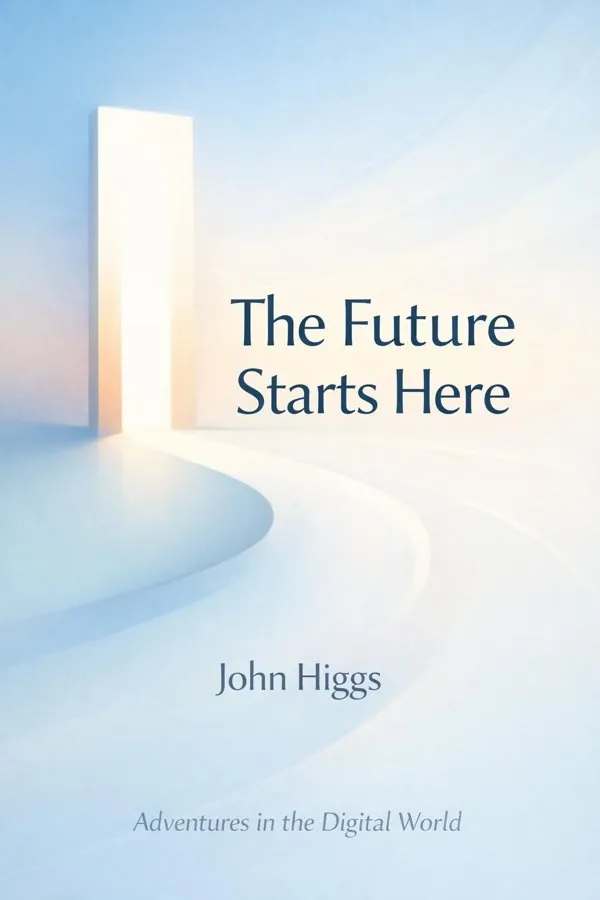
The Future Starts Here: Adventures in the Digital World: Summary & Key Insights
by John Higgs
 10 min9 chaptersAudio available
Key Takeaways from The Future Starts Here: Adventures in the Digital World
One of the strangest features of modern life is that many people feel surrounded by information yet starved of meaning.
We make a serious mistake when we think of the internet as merely a tool, like a hammer or a telephone.
Increasingly, invisible systems decide what we see before we decide what we think.
In the digital world, identity is no longer only something we are; it is something we continuously present, edit, and negotiate.
The future is often described in terms of automation, but Higgs insists that creativity remains one of the most important human powers in a digital age.
What Is The Future Starts Here: Adventures in the Digital World About?
The Future Starts Here: Adventures in the Digital World by John Higgs is a future_trends book spanning 9 pages. The Future Starts Here: Adventures in the Digital World is John Higgs’s lively, wide-ranging attempt to make sense of the strange reality we now inhabit. Rather than treating technology as a niche subject for experts, Higgs argues that the digital revolution has become the atmosphere of modern life. It shapes how we think, work, relate, create, vote, consume, and imagine ourselves. The book explores the collapse of older certainties, the rise of algorithms and networks, and the growing difficulty of maintaining a stable identity in a world saturated with data and constant connection. Yet it is not a gloomy warning about machines taking over. Higgs approaches the future with curiosity, humor, and cultural intelligence, asking how human beings can remain imaginative, ethical, and free in systems increasingly designed for prediction and control. Known for blending history, philosophy, and pop culture, Higgs is an especially compelling guide because he does not reduce the digital age to trends or headlines. He shows how today’s technological shifts are altering the deeper stories we tell about reality itself—and why understanding those shifts matters to anyone trying to live well in the 21st century.
This FizzRead summary covers all 9 key chapters of The Future Starts Here: Adventures in the Digital World in approximately 10 minutes, distilling the most important ideas, arguments, and takeaways from John Higgs's work. Also available as an audio summary and Key Quotes Podcast.
The Future Starts Here: Adventures in the Digital World
The Future Starts Here: Adventures in the Digital World is John Higgs’s lively, wide-ranging attempt to make sense of the strange reality we now inhabit. Rather than treating technology as a niche subject for experts, Higgs argues that the digital revolution has become the atmosphere of modern life. It shapes how we think, work, relate, create, vote, consume, and imagine ourselves. The book explores the collapse of older certainties, the rise of algorithms and networks, and the growing difficulty of maintaining a stable identity in a world saturated with data and constant connection. Yet it is not a gloomy warning about machines taking over. Higgs approaches the future with curiosity, humor, and cultural intelligence, asking how human beings can remain imaginative, ethical, and free in systems increasingly designed for prediction and control. Known for blending history, philosophy, and pop culture, Higgs is an especially compelling guide because he does not reduce the digital age to trends or headlines. He shows how today’s technological shifts are altering the deeper stories we tell about reality itself—and why understanding those shifts matters to anyone trying to live well in the 21st century.
Who Should Read The Future Starts Here: Adventures in the Digital World?
This book is perfect for anyone interested in future_trends and looking to gain actionable insights in a short read. Whether you're a student, professional, or lifelong learner, the key ideas from The Future Starts Here: Adventures in the Digital World by John Higgs will help you think differently.
- ✓Readers who enjoy future_trends and want practical takeaways
- ✓Professionals looking to apply new ideas to their work and life
- ✓Anyone who wants the core insights of The Future Starts Here: Adventures in the Digital World in just 10 minutes
Want the full summary?
Get instant access to this book summary and 100K+ more with Fizz Moment.
Get Free SummaryAvailable on App Store • Free to download
Key Chapters
One of the strangest features of modern life is that many people feel surrounded by information yet starved of meaning. Higgs suggests this is because the grand narratives that once organized society—steady progress, fixed class identities, national myths, religious certainty, and clear ideological camps—have weakened. In the twentieth century, many people could locate themselves inside a stable story about who they were and where history was going. In the digital age, those stories have splintered. The result is not just confusion; it is a new condition in which countless competing narratives coexist, clash, and mutate in real time.
This collapse helps explain why public life can feel fragmented and emotionally intense. Social media rewards personal storytelling, viral outrage, and niche communities. Old gatekeepers such as broadcasters, universities, and newspapers still exist, but they no longer control the flow of meaning. A teenager on TikTok, a conspiracy forum, a meme account, and a global media outlet can all shape cultural reality at once. That creates freedom, but also instability. When everyone can publish, remix, and distribute stories, truth becomes harder to defend and easier to perform.
Higgs does not present this as a simple decline. The breakdown of rigid narratives also opens creative space. People can question inherited assumptions, build new communities, and imagine identities beyond older limits. The challenge is learning to live without the comforting illusion that history follows one obvious path.
In practical terms, this means becoming more conscious of the stories you consume and repeat. Ask what assumptions shape your worldview, where they come from, and who benefits from them. Actionable takeaway: regularly audit the narratives guiding your life—about success, politics, identity, and progress—and choose them deliberately rather than absorbing them by default.
We make a serious mistake when we think of the internet as merely a tool, like a hammer or a telephone. Higgs argues that it is better understood as an environment—a place in which we increasingly live. Tools are things we pick up and put down. Environments, by contrast, shape our behavior continuously, often without our awareness. Just as cities influence movement, architecture affects mood, and weather changes what people do, the internet alters attention, language, relationships, commerce, and politics simply by being the medium through which modern life flows.
Seeing the internet as an environment changes the questions we ask. Instead of only asking whether a platform is useful, we ask what kind of world it creates. Does it reward patience or impulsiveness? Nuance or tribal signaling? Reflection or endless reaction? A messaging app may make communication easier, but it may also train us to expect instant replies. An online marketplace may create convenience, but it also restructures labor, local business, and expectations of speed.
This perspective helps explain why digital life affects even those who try to stay offline. Schools, governments, employers, and social norms are all increasingly built around digital infrastructure. The internet is no longer a separate realm; it is woven into the texture of reality. To navigate it well, we need something like digital ecology: an awareness of how platforms shape habits, emotions, and collective behavior.
A practical example is redesigning your online space with the same care you would your home. Turn off nonessential notifications, curate your feeds, choose slower forms of communication for important topics, and create device-free zones. Actionable takeaway: stop asking only what digital tools help you do, and start asking what kind of person and society they are quietly training you to become.
Increasingly, invisible systems decide what we see before we decide what we think. Higgs explores how algorithms and data have become major forces in shaping contemporary experience. Recommendation engines suggest what to watch, search engines rank what appears true, navigation apps direct traffic, hiring systems filter applicants, and predictive models influence finance, policing, and advertising. These systems do not simply reflect reality; they participate in constructing it.
The power of algorithms lies partly in their opacity. Most users experience them as neutral or inevitable because they operate behind the screen. But every algorithm encodes priorities: efficiency, engagement, profitability, risk reduction, or statistical likelihood. If a platform favors content that generates outrage because outrage drives clicks, it is not passively organizing information; it is rewarding a certain emotional climate. If a credit model denies opportunities to already disadvantaged groups because it relies on historical data, it can reproduce bias while appearing objective.
Higgs pushes readers to see data culture as both impressive and dangerous. Data can improve health care, detect patterns humans miss, and make systems more responsive. At the same time, the belief that everything meaningful can be quantified may flatten human complexity. Not everything that matters can be measured, and not everything measurable should govern decision-making.
In everyday life, this means treating algorithmic outputs as suggestions rather than truth. Compare sources, notice when recommendations narrow your world, and learn the basic incentives behind the platforms you use. For organizations, it means demanding transparency, oversight, and ethical review when automated systems affect real lives. Actionable takeaway: whenever a digital system makes a decision for you, ask what data it uses, what goal it optimizes, and what human realities it might be missing.
In the digital world, identity is no longer only something we are; it is something we continuously present, edit, and negotiate. Higgs examines how online life has transformed the experience of selfhood. Profiles, timelines, avatars, selfies, status updates, and public metrics encourage people to translate themselves into visible, repeatable signals. A person becomes, in part, a feed. This can be liberating because it allows experimentation, self-expression, and connection across geography and social boundaries. But it can also create pressure to perform a coherent, appealing self at all times.
The result is a new tension between authenticity and curation. Social platforms invite intimate disclosure while rewarding branding. People can explore communities that affirm hidden aspects of their identity, yet they can also feel fragmented as they manage different versions of themselves across platforms, workplaces, and private life. Even memory changes: instead of recalling experiences inwardly, we often externalize them as content to be captured, shared, and judged.
Higgs is attentive to the cultural richness of this shift. Digital identity can challenge old categories of class, gender, profession, and belonging. It can empower marginalized voices and create new solidarities. But when identity becomes inseparable from visibility, people may confuse being seen with being known, or popularity with worth. The self risks becoming a project of optimization rather than discovery.
A practical application is to separate spaces for expression from spaces for approval. Journal privately. Maintain relationships that do not depend on performance. Resist measuring your value through followers, likes, or constant feedback. Actionable takeaway: build parts of your life that are intentionally unbranded, unposted, and unmeasured, so your identity remains larger than your digital representation.
The future is often described in terms of automation, but Higgs insists that creativity remains one of the most important human powers in a digital age. As machines become better at calculation, pattern recognition, and repetitive tasks, the distinctly human capacities for imagination, metaphor, play, ambiguity, and unexpected connection become even more valuable. Art matters not because it competes with machines at efficiency, but because it reveals dimensions of life that efficiency cannot capture.
Higgs treats creativity as more than cultural decoration. It is a survival skill for periods of rapid change. When old structures dissolve and new ones emerge, imaginative thinking helps people adapt without becoming passive. Artists, writers, designers, and inventors often detect future possibilities before institutions do. They experiment with forms, remix traditions, and discover meanings that have not yet become obvious. In that sense, creativity is a way of exploring the unknown.
This insight also applies outside the arts. A teacher redesigning a classroom for distracted students, a manager building humane workflows, or a citizen finding new ways to organize community support all rely on creative judgment. These acts resist the idea that the future belongs solely to coders or executives. The digital era needs human interpretation, storytelling, and vision as much as technical expertise.
Practically, this means protecting time for unstructured thought. Read outside your field. Follow curiosity without demanding immediate productivity. Encourage experimentation in teams instead of rewarding only predictable outputs. If you use AI or digital tools, treat them as collaborators or prompts, not replacements for meaning-making. Actionable takeaway: cultivate a regular creative practice—writing, sketching, brainstorming, composing, or building—because originality is one of the strongest ways to stay human in systems designed for repetition.
Technology moves quickly, but moral wisdom usually develops slowly. Higgs highlights a central problem of the digital age: innovation often arrives before society has agreed on the values that should govern it. New tools promise connection, efficiency, convenience, and scale, yet their consequences frequently become visible only after they are deeply embedded. By then, business models, habits, and dependencies can make reform difficult. This is why ethical reflection cannot be an afterthought.
Digital ethics includes obvious concerns such as surveillance, privacy, misinformation, and manipulation. But Higgs points to a broader question: what kinds of human beings are our systems encouraging us to become? A technology may be legal and profitable while still degrading trust, narrowing empathy, or concentrating power in dangerous ways. The issue is not simply whether we can build something, but whether its widespread use creates conditions in which people can flourish.
Consider smart devices that collect intimate behavioral data. They may personalize services and increase convenience, yet they also normalize continuous observation. Or think about social platforms designed around engagement metrics. They can connect communities and amplify underheard voices, but they may also reward outrage, harassment, and addictive use. Ethical design asks not only what users want in the moment, but what protects dignity, agency, and long-term well-being.
For individuals, ethical awareness means reading privacy settings, understanding trade-offs, and supporting companies with better practices. For institutions, it means building interdisciplinary oversight that includes philosophers, sociologists, affected communities, and regulators—not just engineers. Actionable takeaway: before adopting any new technology, ask three questions: what problem does it solve, what harms might it normalize, and who bears those harms if things go wrong?
When technology changes how work is done, it also changes how society defines usefulness, security, and success. Higgs explores how digital systems are transforming labor through automation, platforms, remote collaboration, precarious gig work, and the global circulation of services. Some tasks become faster, cheaper, or fully automated. Others become more fragmented, monitored, and outsourced. The future of work is not one simple story of progress or decline; it is a contested reorganization of value.
A key issue is that digital economies often reward scale and visibility. Platforms can create enormous wealth by connecting users, extracting data, or reducing transaction costs, but they may also shift risks onto workers. A driver, freelancer, content creator, or warehouse employee may be managed by software more than by people. Metrics track performance, ratings shape opportunity, and labor can become both highly flexible and deeply insecure.
Higgs encourages readers to think beyond employment statistics to deeper questions. If machines perform more routine tasks, what should humans be freed to do? How do we value care, education, art, maintenance, and community work that markets often underpay? A society obsessed with optimization can forget that much essential labor is relational rather than mechanical. The digital future demands not only new skills but new moral and economic frameworks.
On a personal level, adaptability matters. Learning continuously, building transferable skills, and developing judgment, communication, and creativity can offer resilience. On a collective level, societies may need stronger safety nets, updated labor laws, and broader definitions of contribution. Actionable takeaway: prepare for the future of work by investing in uniquely human skills—communication, creativity, ethics, adaptability—and by supporting policies that protect dignity as work becomes more digital and less predictable.
It is easy to imagine the digital world as weightless—clouds, streams, networks, virtual spaces. Higgs reminds us that digital life rests on very physical foundations: data centers, rare minerals, undersea cables, power grids, shipping systems, factory labor, and mountains of electronic waste. The future may look sleek on a screen, but it still depends on energy, extraction, and material systems with environmental costs. Any serious discussion of technological progress must therefore include the planet that sustains it.
This insight complicates the popular fantasy that technology alone will save us from every crisis. Innovation can absolutely help: smarter grids, better climate modeling, efficient logistics, and new materials all matter. But if digital systems increase consumption, shorten product life cycles, and normalize constant upgrades, they can intensify the problems they claim to solve. Convenience has an ecological footprint.
Higgs also connects environmental questions to existential ones. A culture fixated on acceleration may lose touch with limits, mortality, and interdependence. The digital mindset often promises frictionless control, but ecological reality insists on complexity and consequence. Human beings are not outside nature, engineering it from above; we remain embedded in living systems we barely understand.
In daily life, this perspective encourages more mindful technology use. Keep devices longer, repair when possible, use energy more consciously, and resist unnecessary upgrades marketed as identity statements. At a policy level, support transparency around supply chains, right-to-repair laws, and cleaner infrastructure. Actionable takeaway: treat every digital convenience as part of a physical chain of resources, labor, and waste, and let that awareness shape more responsible choices.
The most important choice about the future may not be technological but imaginative. Higgs ends on a hopeful note, not because he thinks progress is automatic, but because he believes human beings remain capable of adaptation, reinvention, and wisdom. The digital world is often framed in extreme terms: utopia or collapse, salvation or doom. Higgs rejects both simplifications. The future will be shaped by the values, stories, and institutions we build around our tools.
Hope, in this context, is not passive optimism. It is the discipline of refusing fatalism. If people believe technology is an unstoppable force acting on them from outside, they will surrender agency to corporations, governments, and opaque systems. But if they recognize that digital environments are designed by humans and can be redesigned by humans, then politics, culture, and ethics return to the center. We are not merely users of the future; we are participants in making it.
This perspective restores significance to education, art, civic action, and conversation. A healthier digital society will not emerge from technical fixes alone. It will require citizens capable of critical thought, emotional maturity, historical perspective, and moral courage. It will require communities that prioritize connection over extraction and meaning over endless stimulation.
Practically, hope means engaging rather than withdrawing. Learn how systems work. Support creators and institutions that deepen understanding instead of exploiting attention. Participate in local and digital communities that strengthen trust. Actionable takeaway: replace vague anxiety about the future with one concrete act of agency each week—learn a new digital issue, support an ethical platform, create something meaningful, or help shape healthier norms in your community.
All Chapters in The Future Starts Here: Adventures in the Digital World
About the Author
John Higgs is a British author, cultural historian, and essayist known for exploring the ideas, myths, and social transformations that shape modern life. His work often blends history, philosophy, pop culture, science, and countercultural thought in ways that are both intellectually sharp and highly readable. Higgs has earned a reputation for finding unexpected connections between major cultural shifts and the stories people tell to make sense of them. His notable books include Stranger Than We Can Imagine, which examines the upheavals of the twentieth century, and Watling Street, a reflective journey through British history and identity. In The Future Starts Here, he brings the same wide-angle curiosity to the digital age, showing how technology is reshaping not only institutions and behavior, but also imagination, meaning, and the possibilities of being human.
Get This Summary in Your Preferred Format
Read or listen to the The Future Starts Here: Adventures in the Digital World summary by John Higgs anytime, anywhere. FizzRead offers multiple formats so you can learn on your terms — all free.
Available formats: App · Audio · PDF · EPUB — All included free with FizzRead
Download The Future Starts Here: Adventures in the Digital World PDF and EPUB Summary
Key Quotes from The Future Starts Here: Adventures in the Digital World
“One of the strangest features of modern life is that many people feel surrounded by information yet starved of meaning.”
“We make a serious mistake when we think of the internet as merely a tool, like a hammer or a telephone.”
“Increasingly, invisible systems decide what we see before we decide what we think.”
“In the digital world, identity is no longer only something we are; it is something we continuously present, edit, and negotiate.”
“The future is often described in terms of automation, but Higgs insists that creativity remains one of the most important human powers in a digital age.”
Frequently Asked Questions about The Future Starts Here: Adventures in the Digital World
The Future Starts Here: Adventures in the Digital World by John Higgs is a future_trends book that explores key ideas across 9 chapters. The Future Starts Here: Adventures in the Digital World is John Higgs’s lively, wide-ranging attempt to make sense of the strange reality we now inhabit. Rather than treating technology as a niche subject for experts, Higgs argues that the digital revolution has become the atmosphere of modern life. It shapes how we think, work, relate, create, vote, consume, and imagine ourselves. The book explores the collapse of older certainties, the rise of algorithms and networks, and the growing difficulty of maintaining a stable identity in a world saturated with data and constant connection. Yet it is not a gloomy warning about machines taking over. Higgs approaches the future with curiosity, humor, and cultural intelligence, asking how human beings can remain imaginative, ethical, and free in systems increasingly designed for prediction and control. Known for blending history, philosophy, and pop culture, Higgs is an especially compelling guide because he does not reduce the digital age to trends or headlines. He shows how today’s technological shifts are altering the deeper stories we tell about reality itself—and why understanding those shifts matters to anyone trying to live well in the 21st century.
More by John Higgs
You Might Also Like
Futureproof: 9 Rules for Humans in the Age of Automation
Kevin Roose
10 min
The Third Wave
Alvin Toffler
10 min
2030: How Today's Biggest Trends Will Collide and Reshape the Future of Everything
Mauro F. Guillén
10 min
A Very Human Future: Enriching Humanity in a Digitized World
Rohit Talwar, Steve Wells, Alexandra Whittington
10 min
AI 2041: Ten Visions for Our Future
Kai-Fu Lee, Chen Qiufan
10 min
Abundance: The Future Is Better Than You Think
Peter H. Diamandis, Steven Kotler
10 minBrowse by Category
Ready to read The Future Starts Here: Adventures in the Digital World?
Get the full summary and 100K+ more books with Fizz Moment.