
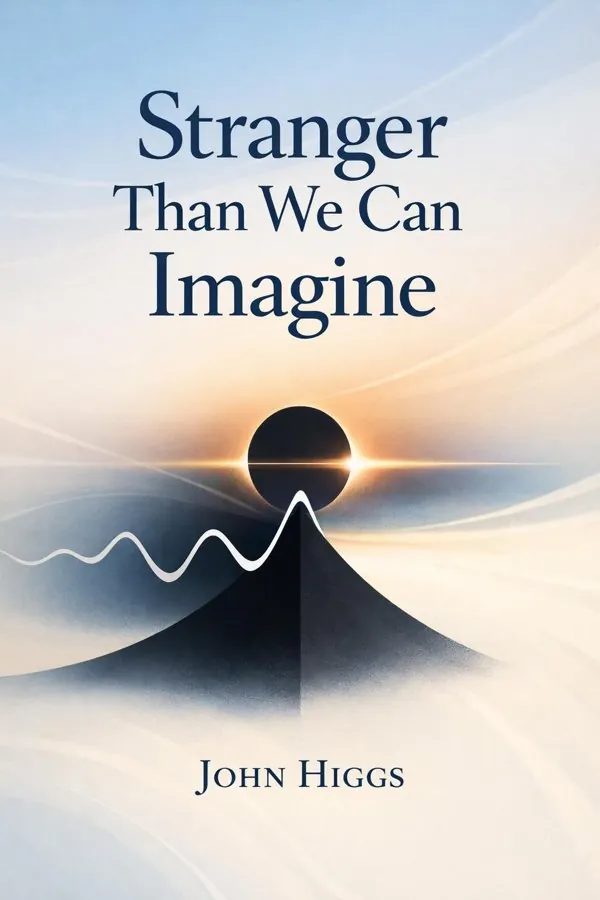
Stranger Than We Can Imagine: Making Sense of the Twentieth Century: Summary & Key Insights
by John Higgs
 10 min9 chaptersAudio available
Key Takeaways from Stranger Than We Can Imagine: Making Sense of the Twentieth Century
One of the strangest ideas of the twentieth century is that time is not the same for everyone.
If relativity weakened certainty, quantum mechanics blew a hole through it.
Modern life became stranger the moment people stopped believing they fully understood themselves.
When reality starts to feel unstable, art changes with it.
The twentieth century’s greatest trauma was not just the scale of its violence, but the fact that advanced civilization produced it.
What Is Stranger Than We Can Imagine: Making Sense of the Twentieth Century About?
Stranger Than We Can Imagine: Making Sense of the Twentieth Century by John Higgs is a civilization book spanning 11 pages. The twentieth century did not merely introduce new inventions or political systems; it changed the very way human beings understood reality. In Stranger Than We Can Imagine, John Higgs offers a lively cultural history of that transformation, tracing how science, art, philosophy, psychology, war, media, and technology combined to make the modern world feel radically unfamiliar. Einstein challenged time and space, quantum mechanics unsettled certainty, Freud redrew the map of the mind, and modern artists abandoned realism for fragmentation and ambiguity. Across these shifts, Higgs argues that the century’s defining experience was not progress alone, but strangeness. What makes this book so compelling is Higgs’s ability to connect ideas that are often studied separately. He shows how breakthroughs in physics echoed in literature, how war altered consciousness, and how the rise of information technology changed identity itself. Rather than presenting a dry chronology, he reveals a pattern: as old certainties collapsed, new ways of thinking emerged. Higgs is especially well suited to this task because he writes with the curiosity of a cultural historian and the storytelling instincts of a journalist, making complex intellectual history accessible, provocative, and deeply relevant.
This FizzRead summary covers all 9 key chapters of Stranger Than We Can Imagine: Making Sense of the Twentieth Century in approximately 10 minutes, distilling the most important ideas, arguments, and takeaways from John Higgs's work. Also available as an audio summary and Key Quotes Podcast.
Stranger Than We Can Imagine: Making Sense of the Twentieth Century
The twentieth century did not merely introduce new inventions or political systems; it changed the very way human beings understood reality. In Stranger Than We Can Imagine, John Higgs offers a lively cultural history of that transformation, tracing how science, art, philosophy, psychology, war, media, and technology combined to make the modern world feel radically unfamiliar. Einstein challenged time and space, quantum mechanics unsettled certainty, Freud redrew the map of the mind, and modern artists abandoned realism for fragmentation and ambiguity. Across these shifts, Higgs argues that the century’s defining experience was not progress alone, but strangeness.
What makes this book so compelling is Higgs’s ability to connect ideas that are often studied separately. He shows how breakthroughs in physics echoed in literature, how war altered consciousness, and how the rise of information technology changed identity itself. Rather than presenting a dry chronology, he reveals a pattern: as old certainties collapsed, new ways of thinking emerged. Higgs is especially well suited to this task because he writes with the curiosity of a cultural historian and the storytelling instincts of a journalist, making complex intellectual history accessible, provocative, and deeply relevant.
Who Should Read Stranger Than We Can Imagine: Making Sense of the Twentieth Century?
This book is perfect for anyone interested in civilization and looking to gain actionable insights in a short read. Whether you're a student, professional, or lifelong learner, the key ideas from Stranger Than We Can Imagine: Making Sense of the Twentieth Century by John Higgs will help you think differently.
- ✓Readers who enjoy civilization and want practical takeaways
- ✓Professionals looking to apply new ideas to their work and life
- ✓Anyone who wants the core insights of Stranger Than We Can Imagine: Making Sense of the Twentieth Century in just 10 minutes
Want the full summary?
Get instant access to this book summary and 100K+ more with Fizz Moment.
Get Free SummaryAvailable on App Store • Free to download
Key Chapters
One of the strangest ideas of the twentieth century is that time is not the same for everyone. Before Einstein, most people lived within a Newtonian picture of the universe: space was fixed, time ticked forward evenly, and reality operated like a giant machine. Einstein’s theory of relativity shattered that confidence. Time could stretch, space could bend, and observation depended on where you stood and how fast you were moving. This was not just a technical change in physics. It altered the cultural imagination.
Higgs shows that relativity mattered because it undermined the assumption that reality was stable and universally shared. If time itself was not absolute, then certainty had lost one of its deepest foundations. The world no longer looked like a clock; it looked like a system dependent on perspective. This intellectual shock rippled beyond science. Artists, writers, and philosophers increasingly embraced multiple viewpoints, fragmented narratives, and subjective truth. The old expectation that there was one correct angle from which to understand life became harder to sustain.
You can still feel this legacy in everyday life. GPS systems work only because they account for relativity. More subtly, modern debates about perspective, context, and lived experience reflect a culture that no longer assumes one fixed frame explains everything. In work, politics, or relationships, we often discover that two people can describe the same event accurately yet differently.
Actionable takeaway: when confronted with disagreement, pause before assuming someone else is simply wrong. Ask what frame of reference they are using, because perspective is often part of reality, not a distortion of it.
If relativity weakened certainty, quantum mechanics blew a hole through it. Early twentieth-century physicists expected matter to become clearer as they looked closer. Instead, they found a realm governed by probability, uncertainty, and paradox. Particles behaved like waves, observation influenced outcomes, and the subatomic world refused to obey common sense. Heisenberg’s uncertainty principle did not merely describe a technical limit in measurement; it revealed that indeterminacy was built into the fabric of reality.
Higgs uses quantum theory as a symbol of a wider cultural shift. The scientific revolution of earlier centuries had encouraged the belief that enough knowledge would eventually explain everything. Quantum mechanics suggested otherwise. The universe was not just complicated; it was fundamentally strange. This had enormous psychological consequences. The modern mind had to accept that not all questions could receive neat, deterministic answers. Ambiguity was no longer a failure of knowledge alone. It was part of the structure of existence.
That mindset spread far beyond laboratories. In economics, psychology, management, and politics, prediction became more probabilistic than absolute. Modern risk analysis, scenario planning, and statistical reasoning all reflect a world in which uncertainty is not an exception but a condition. Individuals also experience this in daily life: no career path, market trend, or social system can be predicted with total confidence.
The practical lesson is not to despair when certainty disappears. Strong decisions can still be made under conditions of incomplete information. Investors diversify, doctors use probabilities, and leaders build contingency plans because certainty is unavailable.
Actionable takeaway: replace the question “How can I be completely sure?” with “What is the best decision given the evidence and uncertainty I have right now?”
Modern life became stranger the moment people stopped believing they fully understood themselves. Sigmund Freud’s central claim was unsettling: consciousness is only a small part of the mind, and our actions are shaped by desires, fears, memories, and conflicts that remain hidden from awareness. Even if later psychologists challenged many details of Freud’s theory, the broader cultural impact was immense. The self was no longer transparent to itself.
Higgs presents Freud as a crucial figure in the twentieth century’s collapse of certainty. If reason had once seemed capable of guiding human behavior, psychoanalysis suggested that irrationality, repression, and symbolism also ruled us. Dreams mattered. Childhood mattered. Slips of the tongue mattered. Human beings were not simply rational individuals making clean decisions; they were layered, conflicted, and often driven by motives they could not easily name.
This insight changed literature, film, therapy, advertising, and politics. Novelists explored interior consciousness. Filmmakers used symbolism and dream logic. Marketers learned to appeal not only to need but to desire, status, and identity. In everyday life, people became more willing to ask why they react strongly to certain situations or repeat harmful patterns.
Freud’s lasting relevance lies less in treating his work as unquestionable science and more in accepting his challenge to self-simplicity. We still underestimate how often emotion shapes supposedly rational choices. A disagreement at work may be about recognition rather than policy. A purchase may satisfy insecurity rather than utility. A relationship conflict may repeat an old script.
Actionable takeaway: when your reaction feels disproportionate, ask not only “What happened?” but “What might this situation be triggering beneath the surface?” That question often reveals more than your first explanation.
When reality starts to feel unstable, art changes with it. Modernism was not simply a new aesthetic style; it was a response to a world that no longer seemed coherent, orderly, or whole. Traditional realism assumed that the world could be represented clearly and consistently. Modernist artists, writers, and musicians increasingly felt that such certainty was false. Cubism showed multiple angles at once. T. S. Eliot and James Joyce broke narrative continuity. Composers moved away from harmony toward dissonance and experimentation.
Higgs argues that modernism mirrored the same intellectual shocks that transformed science and philosophy. If time was relative, the self was divided, and society was unstable, then old artistic forms could not honestly contain modern experience. Fragmentation, abstraction, and ambiguity became not failures of art but truthful ways of depicting reality. Modernism taught people to tolerate difficulty and to see meaning as something constructed rather than simply received.
This matters beyond galleries and classrooms. We still live in a modernist inheritance whenever we accept that identity can be layered, stories can have unreliable narrators, and meaning can emerge from fragments rather than from tidy wholes. In business presentations, media literacy, and design thinking, we increasingly combine disparate pieces into patterns. We are used to nonlinear information and mixed signals because modern culture trained us for it.
The practical use of modernism is its refusal to pretend that simplicity always equals truth. Sometimes a messy representation is more honest than a polished one. A life story, a team problem, or a social crisis may resist neat summaries.
Actionable takeaway: when facing complexity, do not force everything into one elegant explanation. Try mapping the fragments first. Patterns often appear only after you stop demanding artificial coherence.
The twentieth century’s greatest trauma was not just the scale of its violence, but the fact that advanced civilization produced it. The First and Second World Wars exposed a devastating contradiction at the heart of modernity. Industrial progress, scientific expertise, and bureaucratic efficiency had been expected to improve human life. Instead, they enabled mechanized slaughter, propaganda, genocide, and total war. The same civilization that built airplanes, antibiotics, and radio also built trenches, concentration camps, and atomic bombs.
Higgs treats the world wars as central to the century’s psychological break. They shattered the nineteenth-century belief that history naturally moved upward through reason and progress. After the wars, optimism could no longer come easily. Intellectuals, artists, and ordinary citizens had to confront the possibility that human beings were not becoming steadily more enlightened. Civilization itself could become an instrument of destruction.
This shift shaped politics, ethics, and institutions. The United Nations, human rights frameworks, and postwar European cooperation all emerged from the attempt to prevent a recurrence. Culturally, irony deepened, innocence faded, and trust in authority weakened. People became more alert to ideology, mass manipulation, and the danger of dehumanizing language.
These lessons remain urgent. Any society that assumes technology or education automatically guarantees moral progress is vulnerable to repeating old mistakes. Efficient systems are not necessarily humane systems. Smart people are not automatically wise.
Actionable takeaway: judge institutions not only by their sophistication or productivity, but by whether they preserve dignity, restrain power, and protect the vulnerable. Progress without ethics can become catastrophe at scale.
After so many certainties collapsed, postmodernism asked a dangerous but liberating question: what if the big stories we live by are not universal truths, but constructions? Nations, ideologies, religions, scientific objectivity, even personal identity came under renewed scrutiny. Postmodern thinkers did not always claim that nothing was true. More often, they argued that truth is filtered through language, power, culture, and perspective. Grand narratives that claimed to explain history or human nature began to look suspiciously totalizing.
Higgs presents postmodernism as a logical successor to the century’s earlier shocks. Once physics destabilized matter, psychology destabilized the self, and war destabilized faith in progress, it became difficult to trust any single worldview completely. Postmodernism sharpened awareness of how institutions shape what counts as normal, rational, or legitimate. It encouraged people to notice who gets to define reality and whose voices are excluded.
This has practical strengths and real dangers. On the positive side, it helps uncover bias in media, challenge oppressive systems, and make room for plural perspectives. On the negative side, excessive skepticism can weaken shared standards and feed cynicism. If every claim is treated as just another narrative, serious differences between truth, propaganda, and manipulation become harder to defend.
In daily life, postmodern insight is useful when examining branding, political messaging, social media identities, and workplace culture. Every organization tells stories about itself. Those stories may illuminate reality, but they can also hide power.
Actionable takeaway: practice double vision. Ask both “What is being said?” and “Who benefits if I believe this story?” Critical thinking becomes stronger when you examine message and context together.
A defining feature of the late twentieth century is that more and more of reality came to be understood as information. Telegraphy, radio, television, computers, and eventually the internet transformed not just communication speed, but the structure of society. Knowledge could be copied, transmitted, stored, and manipulated at unprecedented scale. Distance mattered less. Attention became a valuable resource. Human beings increasingly interacted through screens, signals, and networks rather than only through place-based communities.
Higgs shows that the information age is not just a technological development; it is a philosophical one. Earlier societies were organized around land, labor, and industry. The modern digital world is organized around data, systems, and connectivity. This changes memory, authority, identity, and power. Search engines alter what it means to know something. Social platforms alter what it means to be seen. Algorithms alter how decisions are made and how culture spreads.
Examples are everywhere. Remote work depends on networked communication. News cycles are accelerated by digital platforms. Personal identity is now partly curated through profiles, posts, and searchable traces. Even friendship and politics are influenced by recommendation systems and viral dynamics.
The opportunity is extraordinary access. The risk is fragmentation, overload, and manipulation. More information does not automatically produce more wisdom. People can become highly connected while feeling mentally scattered and emotionally isolated.
Actionable takeaway: treat attention as a finite resource. Build deliberate habits for what you consume, when you disconnect, and which digital tools genuinely serve your goals. In an information society, managing attention is a form of self-preservation.
Not all twentieth-century change came from laboratories or governments. A great deal came from people who felt mainstream society was spiritually empty, politically dishonest, or psychologically repressive. Countercultural movements questioned accepted norms around work, sex, authority, war, drugs, religion, and personal freedom. From the Beats to the 1960s and beyond, these movements insisted that modern life could not be reduced to productivity, conformity, and rational control.
Higgs is especially strong at showing that counterculture was not a sideshow. It was one of the century’s key engines of change. Alternative spirituality, psychedelic experimentation, communal living, antiwar protest, and new artistic forms all tested the limits of the dominant worldview. These movements often exaggerated, failed, or became commercialized, but they also expanded the space of the possible. Many ideas once seen as fringe later entered the mainstream, including environmental concern, mindfulness, informal dress, sexual openness, and suspicion of centralized authority.
Counterculture matters because it reveals that societies do not evolve only through official institutions. New values often begin at the margins. Today’s workplace flexibility, wellness culture, and skepticism toward rigid hierarchies all carry traces of earlier rebellions against standardization.
Still, rebellion alone is not wisdom. The rejection of one dogma can easily harden into another. The challenge is to preserve openness without drifting into self-indulgence or conspiracy.
Actionable takeaway: periodically review which of your beliefs are truly yours and which you inherited from your environment. Independent thinking does not require rejecting everything mainstream, but it does require examining what you have accepted without reflection.
By the end of the twentieth century, three powerful forces had converged: complexity, individualism, and globalization. Chaos theory and complexity science showed that systems could be deeply ordered yet unpredictable, sensitive to small changes, and shaped by feedback loops rather than linear causes. At the same time, cultures increasingly centered the individual as the primary unit of meaning and choice. Meanwhile, globalization blurred national, cultural, economic, and informational boundaries, making lives more interconnected than ever.
Higgs connects these developments as part of the same historical atmosphere. The old image of a stable society made up of fixed roles and clear borders no longer fit reality. Economies were networked, identities were hybrid, and small events could cascade into global consequences. A currency shock in one country, a software bug, a viral video, or a local protest could reverberate worldwide. Individuals gained more freedom to define themselves, yet they also faced more pressure to construct identity without the guidance of durable collective structures.
This combination explains much about contemporary life: unstable markets, culture wars, online virality, career reinvention, global supply chains, and widespread anxiety. People enjoy more options than before, but they also navigate systems too complex for simple control. Freedom expands while predictability contracts.
The practical lesson is that linear thinking often fails in complex environments. Instead of assuming that one cause produces one effect, it is better to watch for patterns, incentives, unintended consequences, and interdependence. A small habit can alter health; a design choice can reshape behavior; a local event can trigger global reaction.
Actionable takeaway: think in systems. When solving a problem, ask what networks, feedback loops, and second-order effects are involved. In a complex world, better questions matter as much as better answers.
All Chapters in Stranger Than We Can Imagine: Making Sense of the Twentieth Century
About the Author
John Higgs is a British author, cultural historian, and journalist known for exploring the strange meeting point between ideas, history, science, and counterculture. His books often examine how unconventional movements and disruptive concepts reshape mainstream society. Rather than writing narrowly academic history, Higgs blends research with vivid storytelling, making complex intellectual subjects approachable for general readers. He has written on topics ranging from cultural rebellion and belief systems to the hidden patterns behind modern thought. What distinguishes his work is his ability to connect developments that are usually treated separately, revealing larger shifts in consciousness and culture. In Stranger Than We Can Imagine, that talent is on full display as he maps the twentieth century through its scientific revolutions, artistic experiments, psychological discoveries, and technological upheavals.
Get This Summary in Your Preferred Format
Read or listen to the Stranger Than We Can Imagine: Making Sense of the Twentieth Century summary by John Higgs anytime, anywhere. FizzRead offers multiple formats so you can learn on your terms — all free.
Available formats: App · Audio · PDF · EPUB — All included free with FizzRead
Download Stranger Than We Can Imagine: Making Sense of the Twentieth Century PDF and EPUB Summary
Key Quotes from Stranger Than We Can Imagine: Making Sense of the Twentieth Century
“One of the strangest ideas of the twentieth century is that time is not the same for everyone.”
“If relativity weakened certainty, quantum mechanics blew a hole through it.”
“Modern life became stranger the moment people stopped believing they fully understood themselves.”
“When reality starts to feel unstable, art changes with it.”
“The twentieth century’s greatest trauma was not just the scale of its violence, but the fact that advanced civilization produced it.”
Frequently Asked Questions about Stranger Than We Can Imagine: Making Sense of the Twentieth Century
Stranger Than We Can Imagine: Making Sense of the Twentieth Century by John Higgs is a civilization book that explores key ideas across 9 chapters. The twentieth century did not merely introduce new inventions or political systems; it changed the very way human beings understood reality. In Stranger Than We Can Imagine, John Higgs offers a lively cultural history of that transformation, tracing how science, art, philosophy, psychology, war, media, and technology combined to make the modern world feel radically unfamiliar. Einstein challenged time and space, quantum mechanics unsettled certainty, Freud redrew the map of the mind, and modern artists abandoned realism for fragmentation and ambiguity. Across these shifts, Higgs argues that the century’s defining experience was not progress alone, but strangeness. What makes this book so compelling is Higgs’s ability to connect ideas that are often studied separately. He shows how breakthroughs in physics echoed in literature, how war altered consciousness, and how the rise of information technology changed identity itself. Rather than presenting a dry chronology, he reveals a pattern: as old certainties collapsed, new ways of thinking emerged. Higgs is especially well suited to this task because he writes with the curiosity of a cultural historian and the storytelling instincts of a journalist, making complex intellectual history accessible, provocative, and deeply relevant.
More by John Higgs
You Might Also Like
The Structure of Scientific Revolutions
Thomas S. Kuhn
10 min
Genius
Harold Bloom
10 min
A Cultural History of the Medieval Age
Various Editors
10 min
A History of God: The 4,000-Year Quest of Judaism, Christianity and Islam
Karen Armstrong
10 min
A History of the World in 10½ Chapters
Julian Barnes
10 min
A Short History of Progress
Ronald Wright
10 minBrowse by Category
Ready to read Stranger Than We Can Imagine: Making Sense of the Twentieth Century?
Get the full summary and 100K+ more books with Fizz Moment.