
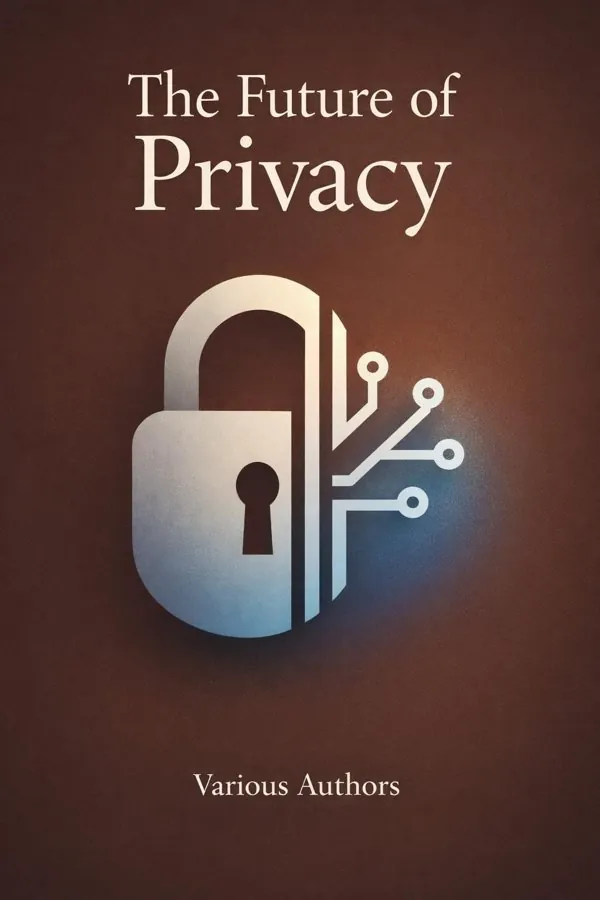
The Future of Privacy: Summary & Key Insights
 10 min8 chaptersAudio available
What Is The Future of Privacy About?
The Future of Privacy by Various Authors is a law_crime book spanning 8 pages. This book is a collection of essays and analyses exploring the evolving concept of privacy in the digital age. It examines legal, technological, and ethical dimensions of data protection, surveillance, and personal autonomy, offering perspectives from scholars, policymakers, and technologists on how privacy norms are being reshaped by emerging technologies.
This FizzRead summary covers all 8 key chapters of The Future of Privacy in approximately 10 minutes, distilling the most important ideas, arguments, and takeaways from Various Authors's work. Also available as an audio summary and Key Quotes Podcast.
The Future of Privacy
This book is a collection of essays and analyses exploring the evolving concept of privacy in the digital age. It examines legal, technological, and ethical dimensions of data protection, surveillance, and personal autonomy, offering perspectives from scholars, policymakers, and technologists on how privacy norms are being reshaped by emerging technologies.
Who Should Read The Future of Privacy?
This book is perfect for anyone interested in law_crime and looking to gain actionable insights in a short read. Whether you're a student, professional, or lifelong learner, the key ideas from The Future of Privacy by Various Authors will help you think differently.
- ✓Readers who enjoy law_crime and want practical takeaways
- ✓Professionals looking to apply new ideas to their work and life
- ✓Anyone who wants the core insights of The Future of Privacy in just 10 minutes
Want the full summary?
Get instant access to this book summary and 100K+ more with Fizz Moment.
Get Free SummaryAvailable on App Store • Free to download
Key Chapters
As we begin with law, we enter the architecture that first gave privacy institutional form. The essays trace the rise of the 'right to privacy' from its embryonic stage in nineteenth-century tort law to its recognition in twentieth-century constitutional doctrines. The authors remind us of Warren and Brandeis’s seminal 1890 essay, where the phrase 'the right to be let alone' captured an emerging cultural anxiety about photography and newspapers. That anxiety became a cornerstone of modern privacy jurisprudence.
In the United States, the book explores how courts struggled to fit privacy within constitutional boundaries. The Fourth Amendment safeguarded against unreasonable searches and seizures; yet it took landmark cases like Katz v. United States to assert that privacy extended beyond property into conversations and personal communications. Scholars unpacked this transformation to show that privacy in law is dynamic: it shifts as society’s technologies of intrusion evolve. Legislatures followed, enacting statutes covering wiretapping, credit reporting, and later, computer databases.
The contributors analyze the delicate balance between societal interests and personal seclusion. They note how privacy decisions often hinge on context — on what society deems reasonable. The law, therefore, does not offer absolute protection but a framework of negotiation. We learn that legal privacy is inherently responsive, tethered to social norms and technological realities, and its strength depends on constant reinterpretation. Through their reflections, we see privacy not merely as protection from exposure but as a foundation for identity, the space in which autonomy can breathe.
The second stage of our inquiry turns to the machine — the computer, the network, and the database that together have made the invisible visible. As contributors from computer science and policy fields explain, the technological revolution of the late twentieth century introduced new dimensions to surveillance. Information systems could now store, search, and cross-reference millions of data points about individual lives. What was once private by obscurity became perilously transparent.
In these pages, we examine how automation and connectivity erode traditional assumptions. The authors discuss the emergence of centralized data banks used by governments and corporations alike. They show how such systems create power asymmetries: those who collect data hold knowledge, while those described by data lose context and control. The consequence is a subtle but profound shift — privacy becomes not about hiding, but about understanding who controls the lens.
Computer scientists contribute detailed technical descriptions of data encryption, access controls, and audit trails. Yet their central insight is that technology alone cannot guarantee privacy. Social will and regulatory principles must shape its use. We see through their analysis that the tension between innovation and privacy is enduring, not oppositional. Technology enables progress, but without ethical and legal boundaries, it risks redefining personhood in terms of data profiles.
The section ultimately asks us to recognize technology as both tool and test. The future of privacy depends on whether we design systems that respect human dignity as much as they respect computational efficiency.
+ 6 more chapters — available in the FizzRead app
All Chapters in The Future of Privacy
About the Author
The contributors include legal scholars, computer scientists, and policy experts who have written extensively on privacy, data protection, and information ethics.
Get This Summary in Your Preferred Format
Read or listen to the The Future of Privacy summary by Various Authors anytime, anywhere. FizzRead offers multiple formats so you can learn on your terms — all free.
Available formats: App · Audio · PDF · EPUB — All included free with FizzRead
Download The Future of Privacy PDF and EPUB Summary
Key Quotes from The Future of Privacy
“As we begin with law, we enter the architecture that first gave privacy institutional form.”
“The second stage of our inquiry turns to the machine — the computer, the network, and the database that together have made the invisible visible.”
Frequently Asked Questions about The Future of Privacy
The Future of Privacy by Various Authors is a law_crime book that explores key ideas across 8 chapters. This book is a collection of essays and analyses exploring the evolving concept of privacy in the digital age. It examines legal, technological, and ethical dimensions of data protection, surveillance, and personal autonomy, offering perspectives from scholars, policymakers, and technologists on how privacy norms are being reshaped by emerging technologies.
More by Various Authors


You Might Also Like

Abortion and the Law in America: Roe v. Wade to the Present
Mary Ziegler
10 min
Black Edge: Inside Information, Dirty Money, and the Quest to Bring Down the Most Wanted Man on Wall Street
Sheelah Kolhatkar
10 min
Blood Feud: The Man Who Blew the Whistle on One of the Deadliest Prescription Drugs Ever
Kathleen Sharp
10 min
Catch and Kill: Lies, Spies, and a Conspiracy to Protect Predators
Ronan Farrow
10 min
Chaos: Charles Manson, the CIA, and the Secret History of the Sixties
Tom O'Neill with Dan Piepenbring
10 min
Code and Other Laws of Cyberspace
Lawrence Lessig
10 minBrowse by Category
Ready to read The Future of Privacy?
Get the full summary and 100K+ more books with Fizz Moment.